
Mad Max: Fury Road (2015)

4/4 stars

The Mad Max series continues to improve with each passing entry. The first film was little more than a bit of roughneck ozploitation and lacked the sense of good fun that characterized the sequels. As the films have come along director George Miller hones his skill framing sustained sequences of nonstop action and in Fury Road he has brought his craft to perfection.

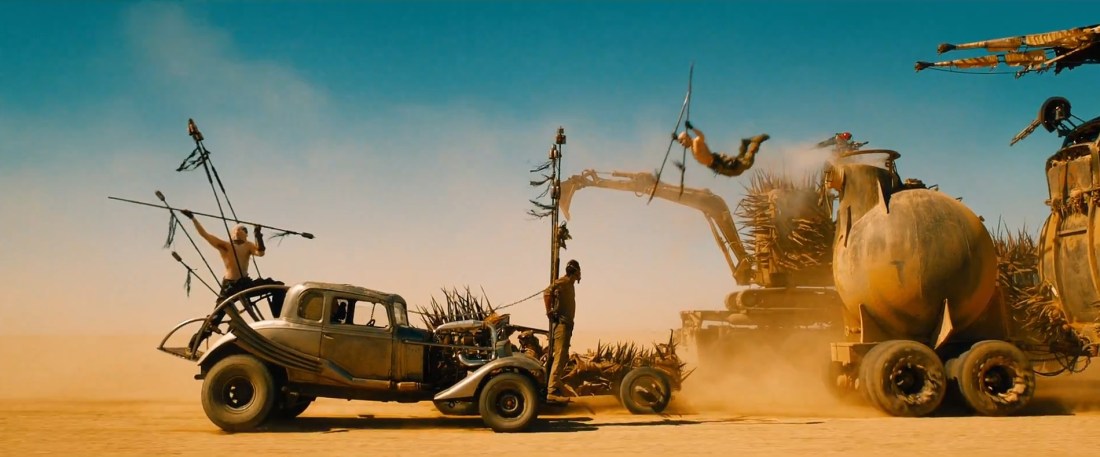
Mad Max: Fury Road is essentially a two hour chase picture; simply plotted and finely choreographed. Nonstop action can be quite dull in a lot of movies, but this movie has such brilliantly tuned pacing that my investment in its story never became fatigued. It takes a fine hand to make movies like this so good and this is one of the best of its kind; proudly standing among Terminator 2 or Aliens as one of the greatest action movies ever made.

The movie sees Mad Max (played by Tom Hardy replacing Mel Gibson) run afoul of a gang of bandits who take him prisoner to their Citadel, a massive canyon fortress ruled by an asthmatic albino warlord named Immortan Joe (Hugh Keays-Byrne). The ruler keeps his minions in religious awe of him and he controls access to a large reservoir of water by which he holds his subjects under his thumb. When his favored Imperator Furiosa (Charlize Theron) defects and smuggles his harem of “breeders” out of the citadel Max is dragged along as Immortan goes after her to get them back. While on the chase Max is handcuffed to one of Immortan’s feral soldiers named Nux (Nicholas Hoult). In the ensuing battle Max escapes his captors along with Nux as an unwanted addition. He makes contact with the fleeing Furiosa and their relationship opens with mistrust and mismatched priorities, but then develops into a friendship and an enjoined quest to bring Immortan’s escaping harem to a place of safety. The girls (Rosie Huntington-Whiteley, Zoe Kravitz, Riley Keough, Abbey Lee, and Courtney Eaton) are a sensual lot of macguffins whose combination of little personality and minimal attire makes them offset whatever feminist and anti-slavery themes the movie is trying to convey. There is something puerile about fantasies of “grateful” rescued women in distress that appeals to the audience, and I feel attempting to find social commentary in how these women are presented here would be dishonest. The girls are eye-candy and little else; and the “people are not property” message is best found elsewhere. If this be a serious flaw, it is a flaw that is participated in by its actresses and its being a testosterone-fueled action romp. And perhaps it can be forgiven. Fury Road makes up for it with a tight camaraderie between its three central heroes and a highly entertaining narrative that marries road pictures (an under-acknowledged genre) with riveting special effects and action. The film is more escapist than philosophical and works perfectly on that level.

The car chase which makes up the majority of the film’s runtime is a spectacle of blood, dust, chrome, booming voices, and good old-fashioned grit. Barely a scene goes by without burning rubber and blowing sand. It’s an aggressive escapade of rust, gasoline, battered metal, and roaring engines. The film is high on bravado and violent energy. It’s post-nuke desert landscape creates a visually arresting palette of reds and yellows while its kinetic pace never stoops to repetition. The use of color in Fury Road is essential to its aesthetic and I can only look at the black-and-white version that was released as a meritless gimmick that fails to understand the proper uses of black-and-white and what it is for. This movie along with Logan (another great picture bastardized with a black-and white version) was made with color in mind and is best seen that way.

Tom Hardy, in a role requiring minimal dialogue, fills Max’s shoes well enough; but he doesn’t quite have the charismatic appeal of Gibson and Miller made the right choice in making Furiosa the film’s main perspective throughout the majority of it. Hardy is left to do the physical gruntwork of the Max character without talking too much to make the recast uncomfortably stand out.
While I would have been happy to see Mel Gibson take on the role again as an older Max, Fury Road still remains, to my mind, the best of the Mad Max series. Miller tried with the first one and succeeded with the next two. With this one, he perfected.

Rogue One: A Star Wars Story (2016)

4/4 stars

“Rebellions are built on hope.” This is said twice in Rogue One: A Star Wars Story and each time it is said it’s to galvanize the cynical to action. The phrase is not wasted on its audience nor used to preach to the choir. It’s directed at those who need it the most: the complacent and the cowardly.
Hope is not a happy subject. It is, in fact, a very sobering and serious one. There is nothing lightweight or naive about it. Hope demands a lot. It often comes attached with sacrifice and tragedy. The fact that Pandora’s Box contained hope should not be surprising to anyone who understands what hope means and what it asks of us.

Rogue One is the second Star Wars film made by Lucasfilm after Disney purchased the company and after the rather tepid and lightly-treading The Force Awakens, it was a step in the right direction. Star Wars is more than childish escapism. It’s also about something. It preaches hope without guarantees, abandoning self for larger causes, and faith while under fire. The series also has a lot to say about hatred, forgiveness, redemption, and what vengefulness does to a soul. In many ways Star Wars provides an accessible extrapolation of the Sermon on the Mount and explicable context to “blessed are the meek.”

Rogue One offers up the same message and theme as the original Star Wars movie, but on the other side of the coin. While Luke, Han, Leia, and company make it out alive, the characters in this film do not. Untouchable main characters are safe and digestible, but leave out something. The most worthwhile endeavors, Rogue One tells us, come at great cost. Like in the original Star Wars, director Gareth Edwards and the Lucasfilm Story Group manage to craft a colorful cast of mismatched and attachable characters; and in doing so they succeed in the film’s final scenes to hammer home the ultimate importance of hope, especially when it is all one has.

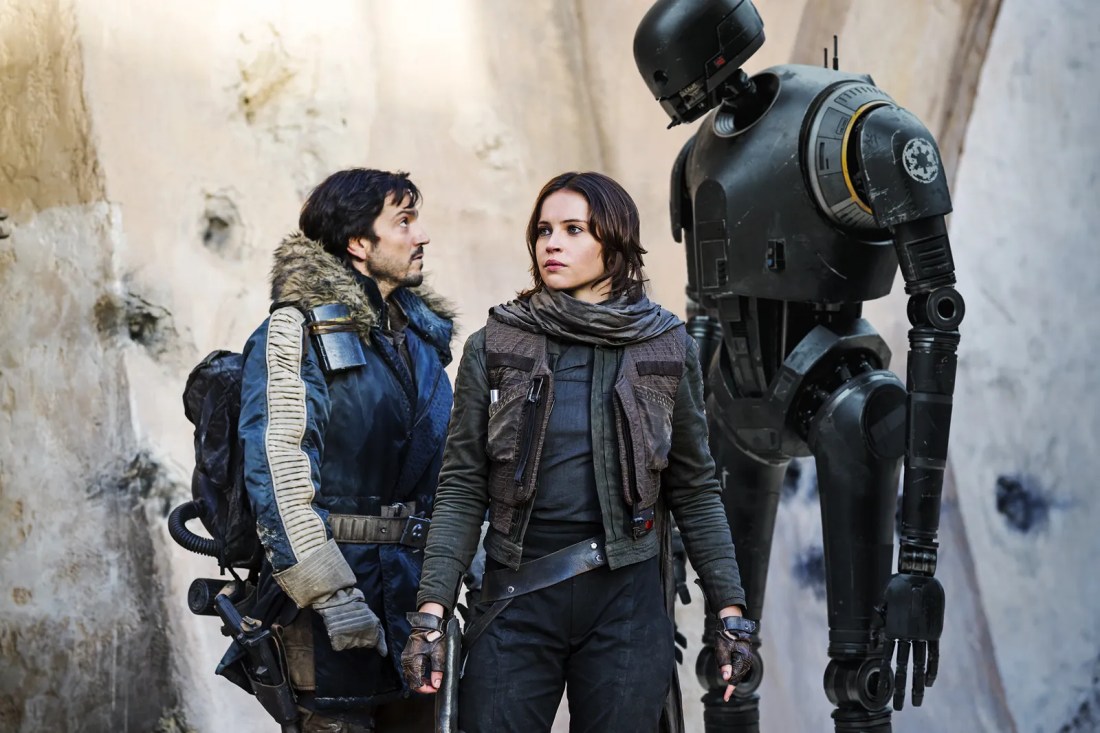
Career criminal Jyn Erso (Felicity Jones) is picked up and recruited into the Rebellion by Cassian Andor (Diego Luna) and a smart-mouthed (-vocalizered?) droid named K-2SO (Alan Tudyk). Turns out her father Galen Erso (Mads Mikkelson) is a top Imperial scientist and a lead designer on the dreaded Death Star whose construction is nearing completion. What begins as a quest to extract (i.e. secretly assassinate) Galen becomes something much bigger when it is revealed that Jyn’s father had purposely planted an exploitable flaw in the Death Star that gives a small chance for destroying it. Unfortunately Galen’s message does not elaborate on the specific nature of the flaw and a race ensues to steal the Death Star plans and deliver them to the Rebellion in order to discover the station’s weakness. Standing in their way are the entirety of the Imperial military and the machinations of Grand Moff Tarkin (impressively recreated by CGI mo-cap) and the ambitious and overcompensating Orson Krennic (Ben Mendelsohn). Along the way our heroes pick up a variety of interesting characters: the blind Force-sensitive monk Chirrut Imwe (Donnie Yen), his more grounded and cynical protector Baze Malbus (Jiang Wen), and an imperial defector named Bodhi Rook (Riz Ahmed).

The characters in Rogue One stand apart from the heroes of the Original Star Wars Trilogy in their lack of perfection and their worldly disregard for moral idealism. Jyn sees the Empire as an unstoppable reality and prefers to keep herself uninvolved with her head down. Cassian makes ethically compromised decisions for what he believes is the greater good. “We’ve all done terrible things on behalf of the Rebellion” he says early in the movie. It is not until Jyn’s father is killed in a botched operation does he begin to see the bigger picture of what it means to be one of the good guys and what is and what is not acceptable for a good man to do no matter what.

What makes Rogue One among the best Star Wars films is its uncynical honesty (a sadly rare combination in film and literature in this day of anti-heroes and angry young men). A lot of snake oil preachers give us an unrealistic view of the world when teaching moral values. They deny the ugliness of the world because it is too hard for them to reconcile their teachings with it. Rogue One denies nothing and tells us to be good anyway. The characters operate on a lot of ifs and long shots. There is no guarantee that they will succeed in getting the Death Star plans or survive the attempt and more difficult still is there is no guarantee that the plans will contain anything useful. And later on as we have seen there is no guarantee that the Rebellion will succeed in destroying the Death Star even if a weakness is found. A lot of people die for these uncertainties. The guarantees are absent. Only hope remains. But rebellions, after all, are built on hope.

Balanced with Rogue One’s themes is a wildly entertaining adventure. The special effects on display are some of Star Wars’s best and the action sequences are well-sustained and paced with plenty of emotional investment to keep the viewer enthralled. The final scenes are full of tragedy and show the grim reality of sacrifice amidst unwelcoming odds. But tragedy is neither the final note nor word of the film. It is hope.

Mad Max Beyond Thunderdome (1985)

3/4 stars

When Max (Mel Gibson) enters the Thunderdome he is introduced to the roaring crowd as “the man with no name.”
It suits.
Like the seminal Man with No Name trilogy that made Clint Eastwood famous the Mad Max series presents a singular hero against a singular backdrop without the need for any ongoing continuity. Their adventures can be viewed in any order with no appreciable loss of comprehension. Like tall tales of gods and folk heroes told around a fire, which story is chosen on any given day does not matter a great deal. By being introduced in this way what director George Miller is trying to tell the audience is that Australia now has its own modern day Eastwood.

A more striking allusion in Mad Max Beyond Thunderdome is made to Peter Pan and his Lost Boys of Neverland. In the film Max encounters a group of feral children who yearn for unclear memories of the past before the apocalyptic wastelands became their home. And like Wendy Darling in Peter Pan, Max must face off against the children’s naivete, delusions, and mistrust before leading them in a fight for freedom against some roguish grownups.

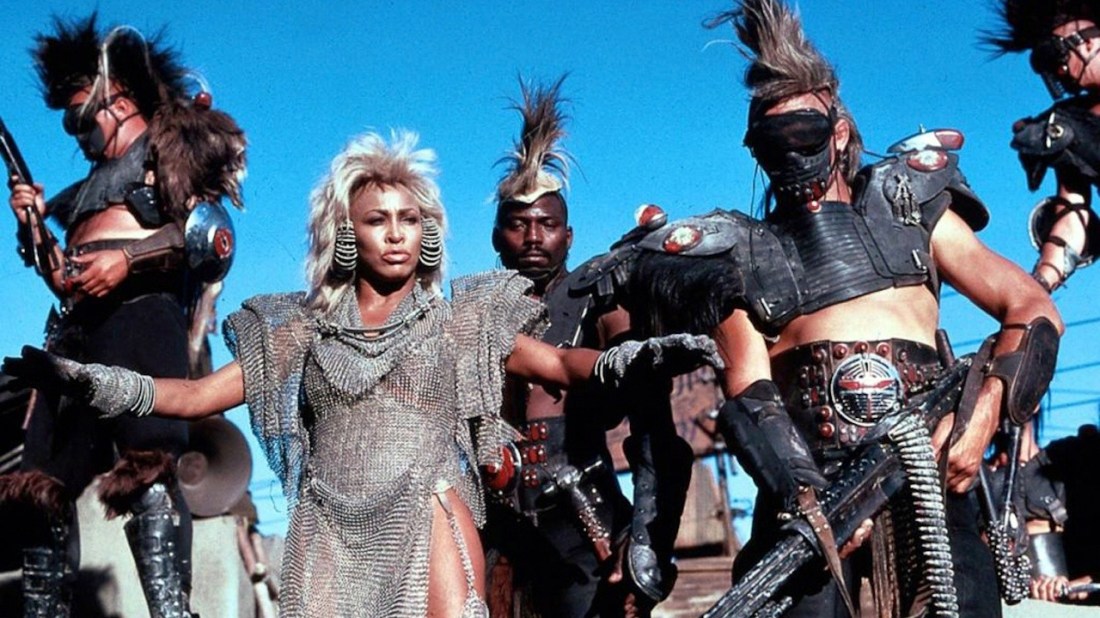
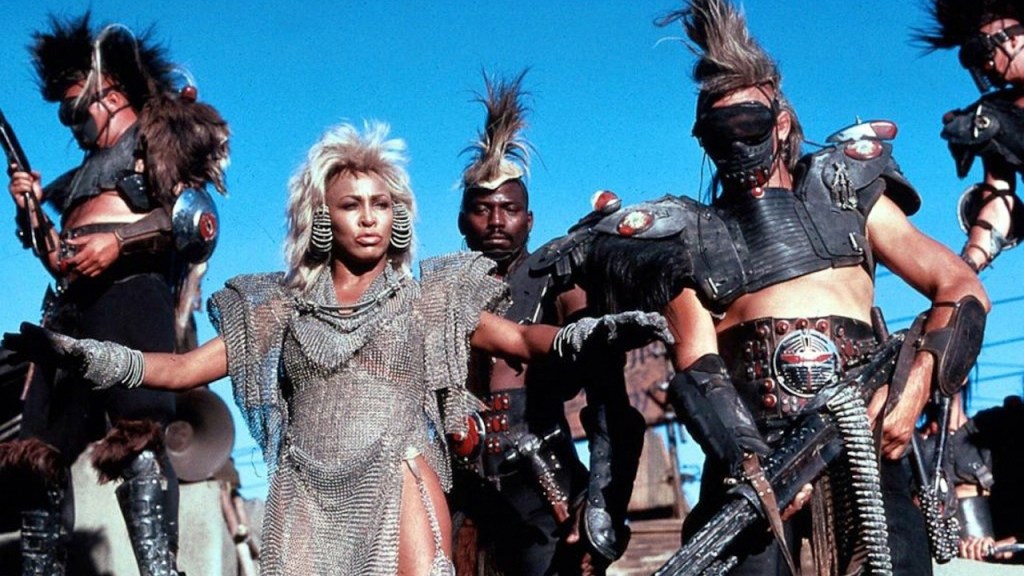
The movie begins with Max coming to a thuggish frontier city called Bartertown where resides the titular Thunderdome, a crude gladiator arena which sits in the center of town. What he finds there is an ongoing power struggle between a charismatic dominatrix named Auntie Entity (played by Tina Turner) and Master Blaster, an odd couple consisting of a child-minded brute (Blaster) and the brains of their unit (Master) who is a dwarf that rides Blaster’s back.
A deal is struck between Auntie and Max that in exchange for resources he must fight and kill Blaster in the Thunderdome. He agrees and what follows is one of the more memorable action set pieces of the film.
The Thunderdome is taller than it is wide and its combatants are attached to suspending harnesses that allow them to bounce around the arena grabbing a variety of weapons attached to the dome. The environment is not flashy, but the fight is exciting.
When Max discovers that Blaster has the mind of a child he refuses to kill him and reveals the deal to Master. Enraged, Auntie has Max sent out into the desert to die. There he is rescued by a clan of young children who mistake him for a legendary captain who featured heavily into their myths. He denies the messianic role and at first wants little to do with the group. But soon he takes on a protective paternal role and leads them to the film’s climax in a faceoff against Auntie Entity and the villains of Bartertown.

Sadly the relationship between Max and the kids makes for one of the weakest points of the film and lacks proper development. Much is rushed and I wanted to see more. Some more time getting acquainted with the group and scenes of Max preparing them for the battle ahead would have gone a long way and the absence of such scenes robbed me of emotional investment. I would have preferred the Lost Boys motif better explored, but pacing and marketable film length are often at odds when crafting an action picture and the movie suffers from prioritizing its action scenes.
The action scenes, however, are quite good if not quite up to the standards of Mad Max 2. The previous film featured a sustained chase scene in the desert that is replicated here, but not as effectively. I felt that I had seen much of this before in the last film; Tina Turner’s gravitas and the good-natured fun of the whole thing being the chief highlight of the final sequence.

I genuinely liked Mad Max Beyond the Thunderdome, but I wanted more of it.

Foreign Correspondent (1940)

Rating 4/4

Foreign Correspondent was an extremely timely film. Released on August 16, 1940, Alfred Hitchcock’s film predicted the German aerial raids of London three days before they happened. When it was released in the UK they had already had.

The film had its beginning as a loose adaptation of journalist Vincent Sheean’s memoirs, but became something much more. After nearly five years of development by producer Walter Wanger and tons of rewrites the project was finally handed over to Hitchcock.

Johnny Jones (Joel McCrea) is a New York crime reporter who is assigned duties as a foreign correspondent to London. He’s to report on the conditions of Europe that will eventually lead up to World War II. His boss, Mr. Powers (Harry Davenport) is disillusioned with the correspondents previously sent over and he figures that perhaps sending a crime reporter would be best. War after all is the worst sort of organized crime. Like mafia men ordering a hit, war is often arranged by cleancut men in suits cheerfully distant from the misery and the mess they create. Much of these sort of men – become old and cynical – show a remarkable ambivalence toward war throughout the film.

His assignment is to interview a Dutch diplomat named Van Meer (Albert Basserman) who is to speak at a luncheon hosted by a Universal Peace Party. The party’s leader is one Stephen Fisher (Herbert Marshall) who has treasonous and very unpeacelike motivations of his own.
After Van Meer is seemingly assassinated Jones soon discovers that the diplomat had been kidnapped in secret by Fisher’s men and the assassination target was a decoy. Van Meer is one of only a few men alive who knows the truth about a secret clause in a treaty that would benefit the Nazi regime should it end up in their hands. The clause is never explicitly revealed in the film because it is not important. It is a macguffin. What is important is that Van Meer is rescued safe and sound at all costs.

Involved in the mess is Mr. Fisher’s daughter Carol (Laraine Day) who has fallen in love with Johnny and agrees to marry him. The complications that arise when she discovers her father is a traitor are obvious.

Before its climax Foreign Correspondent moves along with the same mastery of suspense that would color Hitchcock’s later films in Hollywood. One of its most famous scenes is when Johnny gets his coat caught in the gears of an old windmill and struggles to take it off before the machinery kills him. And in, what I believe, is an even more effective moment of suspense is when Carol unwittingly upsets Johnny and another agent’s plans. Johnny takes her on a trip while his colleague Scott ffolliott (George Sanders) tells Mr. Fisher she had been abducted and he needs to disclose the location of Van Meer to get her back. Carol who had not been made aware of the plan comes home early while ffolliot (the F’s are intentionally lower case) is still there threatening her father. Everything had been going so well up until then and the tension created is immediate. It left me hooked to see the outcome.

Foreign Correspondent ends with Johnny reporting over the radio that the Germans had begun bombing London. The lights and power go out, the explosions can be heard outside shaking the studio; but he goes on for the American listeners to hear. The scene was written by screenwriter Ben Hecht and it was added during post-production when all the other footage had been completed. Reports that the Germans would be bombing London soon convinced the filmmakers to replace the film’s original ending with this one.

The extreme timeliness of Foreign Correspondent’s ending made the film more than just one of the greatest political thrillers of all time. It also crafted an extremely well made and effective propaganda piece for both British and American audiences alike. Even the Nazis’ own chief of propaganda, Joseph Goebbels, recognized it as such calling the movie “a masterpiece of propaganda, a first-class production which no doubt will make a certain impression upon the broad masses of the people in enemy countries.” Goebbels is now deservedly dead and so is his Third Reich. As a classic this movie and the nations that created it outlasted him so I suppose he must have been right.

The movie is also technically ahead of its time with an extremely riveting sequence depicting a plane crash. Using actual footage of a plane descending toward water, Hitchcock had it rear projected onto a screen made of rice paper with large water tanks behind it. With a push of a button the water crashes through the screen filling the cockpit set. Highly convincing and innovative for 1940. It was a technical achievement that Hitchcock remained very proud of for the rest of his life.
He was less proud of the casting, wanting Gary Cooper and Joan Fontaine for the main roles of Johnny and Carol. Producer David O. Selznick refused to loan Fontaine out and he had to settle with Laraine Day who is passable in the role.
Gary Cooper turned down the part of Johnny, but he came to regret it and later admitted he made a mistake. I am not sure he had. I really enjoy Joel McCrea’s performance in this as the good-natured and amiably sardonic Mr. Jones. Cooper is a great actor, but this role wasn’t for him.

La Chienne (1931)

Rating 4/4

When a good man commits a murder and a bad man who is innocent is hanged for it who is going to care and who should? Jean Renoir’s La Chienne may not answer these questions, but it does show us the consequences.

Renoir tells us in the film’s opening that the movie has no moral or message to give. Instead the movie simply shows us people being people. Renoir doesn’t believe in villains. He believes in humans who do bad things.

Maurice Legrand (Michel Simon) is an aspiring painter whose talents are unappreciated by his shrewish wife Adèle. She thinks he is wasting his time and her drawing room space with his hobby. Adèle frequently compares him negatively to her first husband who was killed in action. “A real man! A hero! A brave man who gave his life in 1914 for sluggards like you!,” she declares.
When the dead husband suddenly shows up very much alive Maurice lets him have her.
This leaves Maurice free to continue his love affair with the young Lulu (Janie Marèse) who is being prostituted by her boyfriend Dédé (Georges Flamant) to pay his debts. He’s greedy, abusive, and narcissistic. The very opposite of the kindly, but shy Maurice.
Lulu and Dédé hatch a scheme to sell Maurice’s paintings as her own. Maurice discovers this, but allows it to happen so she can use the money to live comfortably. Maurice’s naivete and Dédé’s greed end in tragedy for both of them.

The title of the film in English is “The Bitch” and Lulu more than earns it. Incapable of love or empathy she puts on a performance to gain Maurice’s affection and financially benefit from it. Lulu scoffs at his feelings, laughs at him, and is proud of her lack of scruples and two-facedness. Maurice kills her in a moment of passion and Dédé is hanged for the crime. The latter’s reputation as a scoundrel is set dead against him and Maurice finds himself able to live with himself afterward. The film ends with him an old man, a poor vagrant; but still as amiable and as kindly as he was before.

La Chienne, true to its promise that the movie contains no moral lesson, expresses no sense of outrage over what happens. The events happen as they do and the characters remain who they were. The audience is left to make their own judgments. The movie makes no comment.
Maurice is a man who got away with murder. He is also sweet-natured and is in no way an active menace to society. Dédé most certainly is. He’s a selfish bastard and perfectly capable of the crime he is accused of. Nevertheless he dies an innocent victim.
And Lulu is La Chienne. The bitch. She is manipulative, devoid of compassion, and embracing and proud of her duplicitousness. It gets her killed in the end, but the movie doesn’t tell us if she deserved it. It doesn’t tell us if the question of innocence or guilt even matters.
What Renoir’s film does tell us is that people do things, good and bad. And the consequences occur as they may, and not always in a way we deem fair.

La Chienne had the potential of making its title actress Janie Marèse a star in French cinema, but was sadly killed at the age of 23 in a car accident shortly after making the picture. Her co-star Georges Flamant was driving the car. After he survived the press vilified him and his career as an actor was almost destroyed. Adding to the tragedy, Michel Simon had fallen in love with her during production and never forgave Flamant or Renoir (whom he deemed partially responsible) for her death.

The aftermath of La Chienne’s production mirrored its theme. People did things as people often do and there were consequences. And as in the film, who was truly at fault remains unanswered.

Gilda (1946)

Rating 3.5/4

“Hate can be a very exciting emotion. There is a heat in it, that one can feel. Didn’t you feel it tonight? It warmed me. Hate is the only thing that has ever warmed me.”
Ballin Mundson (George Macready) is sincere when he says this to his wife and she doesn’t disagree. She repeats it herself to her lover Johnny (Glenn Ford) and he doesn’t disagree either.

Charles Vidor’s 1946 film noir, Gilda, is not a love story. It’s a hate story. It’s a story of people using love to cruelly punish and destroy each other.

Gilda (Rita Hayworth) hates Johnny for walking out on her years ago. Johnny hates her for humiliating him and making him feel less like a man. Her husband Ballin hates everybody and carries it wherever he goes so much that no one notices anymore. What comes of this hatred is one of the most unhealthy love triangles out of classic Hollywood.

Johnny makes a crude living as a cheating gambler in Argentina who believes “a dollar is a dollar in any language.” I looked it up and he’s right. What he’s wrong about, though, is that he can keep getting away with cheating. After he’s caught doing it at a Buenos Aires casino Johnny comes face to face with the understandably offended Ballin Mundson who owns the joint. Ballin takes a liking to the kid and instead of smashing his fingers with a hammer he offers him a job as personal security.

Their partnership is surprisingly a happy one although it is apparent that Ballin is keeping secrets from him. Things become more complicated when Johnny is introduced to Ballin’s new wife, the one and only Gilda, his ex. Ballin who has made hate so much a part of himself that he can recognize it begins to sense something is wrong right away. He doesn’t suspect that the two know each other, but he amazingly recognizes hatred coming from Gilda to Johnny immediately. Johnny and Gilda’s “introduction” is extremely cordial and lacks even the slightest innuendo of hostility. But Ballin picks it up all the same even when he cannot understand it.
The movie provides the viewer none of their backstory up to this point letting us see the scene from Ballin’s eyes. We are as perplexed as he is when he questions Gilda about her hatred and she coyly denies it. Not until she and Johnny meet each other later that the truth comes out. It is almost soap opera-like when she is suddenly introduced in this way. Johnny makes no previous mention of her in the film, not even in the frequent voice-overs that are true to film noir fashion. This way of bringing Gilda into the story is effective in making sense of Ballin’s actions later in the movie. He is an extremely complex character and very little of this film is given from his perspective. By doing so here is masterful screenwriting.

Ballin slowly begins to realize their history and starts becoming more possessive and watchful of her. Johnny does so to, but even more aggressively and he deceives himself by saying it’s for his boss’s sake.

Ballin’s dealings with German mafia adds more tension to the situation as Gilda and Johnny meanwhile begin an affair that is both hateful and passionate. For the both of them it is driven purely by sexual passion and they bitterly try to use it overpower the other.
The various twists and turns of the plot lead them closer and closer to each other and Johnny unleashes cruel emotional abuse to bring her down to the humiliation he once felt and which he believes she deserves. Power obtained, Johnny reveals himself to be an awful and vicious man who has resented this woman’s independence and confidence from the very beginning.

At the end we see them at the absolute lowest they can be and Johnny’s empire comes crumbling down around him. Ultimately the film robs us of any emotionally poignant resolution by providing a tacked-on happy ending that undermines the message. An unbelievable twist ending followed by no tragedy ruins the experience.

Overall Gilda is a great film that could have been better concluded. The movie made Rita Hayworth a Hollywood icon and sex symbol. It also launched a long affair between her – married to Orson Welles at the time – and co-star Glenn Ford.

The cinematography was done by Rudolph Maté also known for his work on Dreyer’s Vampyr. In Gilda he plays with light and shadow with the characters emotional states often masking their faces during moments when they are at their most honest.
Jack Cole’s choreography of Hayworth’s dance numbers are legendary and “Put the Blame on Mame” became a staple reused in other films noir.
The movie was produced by Columbia film producer Virginia van Upp who was only one of three women producing films at the time. She was also an accomplished screenwriter who had helped coach Hayworth for this role who was mostly known for doing musical comedies at the time.
The movie has a keen understanding of male emotional abuse in relationships and I think Virgina’s involvement shows.

Sleeper (1973)

Rating 3/4

Comedy, like science fiction, is ripe for social commentary and Woody Allen’s Sleeper, being both, is as brilliant as any.
Combining the physical antics of Buster Keaton and the wit of Bob Hope, Woody Allen had somehow achieved the impossible. He crafted alongside the comedy a highly intelligent vision of the future where the human race will have morally and intellectually degenerated into puerile sheep without ever challenging or being challenged. It’s as relevant and insightful as other great science fiction films like 2001: A Space Odyssey or The Day the Earth Stood Still.

Miles Monroe (Woody Allen) wakes up 200 years into the future after being involuntarily put in cryosleep after a routine surgery goes wrong. The doctors who wake him are able to cure him of his ailment, but what they can’t fix is a world where everyone is mentally infantile and sexually impotent. I am of course referring to the world of 2173. I can understand, I suppose, if someone became confused and thought I was referring to the present. I don’t think a man like Woody Allen could disagree.

Miles ends up on the run for his life after unwillingly getting involved with Marxist revolutionaries who want to use him to take down the government.

I’ve mentioned this film is a comedy while none of this sounds remotely funny. And yet, it is. With a highly well-thought out premise, Sleeper is a hilarious movie. The science-fiction background provides Allen with a comparative view of futurist mankind with how we are now. What being a comedy adds to it is a sharp take on absurdity and deservedly insults moral and intellectual laziness. The same sort of laziness threatening us now in 2024 just as much it did in 1973.

Miles meets Luna Schlosser (Diane Keaton) who is politically apathetic and lives an affluent life of ease. She writes bad poetry and thinks butterflies turn into caterpillars. She gets high with her friends by passing around and rubbing a ritual orb. She has a cheap understanding of sex and prefers to have pleasure artificially induced. Using a special chamber called an Orgasmatron people can now, not only skip the foreplay, but all physical activity involved altogether.

Throughout this insanity he disguises himself as a butler robot only to have his head nearly removed by a technician. He and Luna go on a quest to destroy the dictator’s severed nose to stop him from being cloned. Doctors tells him fudge bars and cigarettes are healthy now. And my favorite of all, he slips on a giant peel from a banana the size of a canoe. This same banana is owned and aggressively protected by a farmer who walks a six-foot high chicken on a leesh. Just in case the situation was not bizarre enough.

Miles is questioned in one scene about the meaning of a few fragments from his time in history. These include photos of famous political figures and selections from TV news broadcasts. The ironic and factually inaccurate answers he gives are some of the funniest and best-written lines in the movie. He also tells Luna this surreal story about how he asked his mother where babies come from. His mother misheard him and thought he said rabies so she tells him from dog bites. He says, “The next week, a woman on my block gave birth to triplets… I thought she’d been bitten by a great dane.”

Sleeper is also the sort of comedy that is rife with slapstick humor most of which is deliberately shot like old silent shorts from Buster Keaton and Laurel and Hardy. The camera is sped up to feign fast movement, the music – composed by Woody Allen himself – is jazzy, and the physical antics are cartoonishly out of this world.

Sleeper is funny from beginning to end and doesn’t become imbalanced with the social commentary. Both perfectly support the other and the rawer slapstick bits fit the the film’s overall tone. This might be the only sci-fi movie with classic bits like a pie in the face and slipping on a banana peel that doesn’t lose its preoccupation with social commentary in an Orwellian setting.

Sleeper is right up there with THX 1138, Logan’s Run, or Silent Running as a work of cerebral sci-fi. Simply because it swaps drama for comedy doesn’t make it any lesser and believing so would be a mistake.

King Kong (1933)

Rating 4/4

King Kong is the most influential movie monster put on screen save for perhaps Godzilla. Every child knows who Kong is even if they haven’t seen the movie. He’s on lunchboxes, been made into toys, and is even the namesake of a beloved Nintendo video game character. Kong is also one of the earliest icons in the pantheon of Hollywood heroes and villains preceded by only a few like Dracula and Frankenstein. Whole books could be written about his cultural impact and importance without bothering to even discuss the film itself.

The 1933 classic is a technically impressive spectacle achieved in a time when computer visual effects were wholly nonexistent. Despite their outdatedness the effects in this film required more talent and creativity than can be found in the average VFX artist working on movies today. Lacking the tools and software of the modern era the movie-magicians of 1933 pushed stop-motion animation to its limits alongside other techniques such as matte painting, rear screen projection, and composite shots. The images put on screen are truly a marvel for the time and what I find even more impressive than the effects achieved is the restraint put into their use by the filmmakers. What too often was the case for later b-movies produced in the following decades was an exploitative use of special effects that failed to impress their audiences but succeeded in providing insight into the films’ budgets.
Stop-motion pioneers Willis H. O’Brien (Harryhausen’s future mentor) and Buzz Gibson and cinematographer Frank D. Williams had a firm grasp on the limitations of the methods they were using. When the characters are attacked by a brontosaurus it’s introduced in the background rising out of the water under low-key lighting and masked in mist. All of the stop-motion effects in King Kong are shot in varying degrees of distance and never in close-up. For close-up shots of Kong a full-sized mechanical model of his head and shoulders was used.
Williams achieved the composite sequences of the actors seemingly performing in front of the monsters by using an optical printer to combine the animation, matte paintings, and actors in the foreground into a single shot. The result is staggering, and although it looks nothing like we can achieve on computers today; it took more imagination and broke more ground than what’s being done now which is largely safe, patented, and takes no risks. The last time computer effects succeeded in impressing me was back in 2009.

The film was directed by Merian C. Cooper and Ernest B. Shoedsack, who already had experience with monkeys when filming silent documentaries like Chang: A Drama of the Wilderness (1927) and Rango (1930). The trashy bestiality themed film Ingagi (1930) born out of the trends set by these pictures was enough of an exploitative hit that it was largely based on its success that RKO provided financial backing for King Kong.

The film’s lead is a documentarian jungle filmmaker named Carl Denham (Robert Armstrong) who casts Ann Darrow (Fay Wray) to add sex appeal to his next picture; something his critics had found lacking. She is taken to the infamous Skull Island where Denham wants to capture footage of the big ape. She is kidnapped by the natives who want to sacrifice her to Kong. Instead he becomes infatuated with her. Denham makes frequent allusions to Beauty and the Beast interpreting beauty as the beast’s only weakness and cause for eventual downfall. This becomes realized when the woman is rescued and Kong goes apeshit (if you’ll pardon the expression) and attacks the natives’ village. He wrecks their homes, stomps on anyone and everything, and brutally chows down on the locals. Tame by today’s standards, much of the violence in this film is decidedly brutal for 1933 and would not be seen in mainstream cinema again for many years after the Hays Code was adopted by Hollywood a year later. In one earlier scene Kong battles a T-Rex also brought to life by stop-motion. The fight ends with a victorious Kong ripping apart the dinosaur’s jaw with dripping gore and gruesome cracking sounds added for good measure.

After Carl Denham gases Kong what follows is cinema history. He’s showcased at a fair in Manhattan only to break loose and terrorize the city. His climb up the Empire State Building with Ann in tow and being shot by airplanes is an iconic image achieving a fame scarcely less than that that of famous real-world photographs. Denham’s exclamation after Kong’s death, “No, it wasn’t the airplanes. It was Beauty killed the Beast,” is equally iconic.

The film was a massive success and a sequel was rushed into production and released the same year called Son of Kong. He also became the subject of two Japanese kaiju films of the 60s in one of which he fought the legendary Godzilla. King Kong was remade twice in 1976 and then in 2005 and later became a key player in the now ongoing MonsterVerse series of films. None of these later pictures were as innovative as this one. King Kong tried and succeeded in doing things that had never been done before. I don’t think it would hurt much if more blockbusters coming out nowadays tried doing the same.

Now something should be said about the more problematic elements in the film that have aged even worse than the effects. I will not deny that these elements are there and I am not going to defend them. The movie is explicitly sexist and racist in many of its themes and dialogue. Ann Darrow is not a character, but a plot point to simultaneously titillate the camera and provide abysmal commentary on women’s roles. When she is being held terrified by Kong Ann doesn’t hesitate to pose in a way that brings more attention to her legs than a woman in peril actually would. She is also subject to condescension and patronizing from the crew which she takes with only marginal protest and the most sexist character in the film becomes her love interest. The island’s natives are presented as superstitious savages and virtually no anthropological and social interest is taken in them in the film’s script.
I believe the film’s historical context should be explained before being shown to younger views. I don’t think cutting these elements out for later releases is appropriate and is as damaging to it artistically as colorizing it was in 1989. I am quite fond of what Disney Plus has been doing by presenting its older films with these elements unedited with a mere disclaimer that explains that these attitudes are outdated and are as wrong then as they are now. Much of our accomplishments in art and literature is sadly mired by these issues and I think we as a society have matured enough to look at them and accept them for what they are without resorting to censorship and erasure. Looking at it I can praise the film for its accomplishments and condemn it for its flaws.
King Kong like any piece of art is several things. It’s an entertaining adventure story reminiscent of the works of H. Rider Haggard and Burroughs. It’s a special effects pioneer. And it’s a sad document of 1930’s sexual and racial attitudes. It is not an ethical failing to praise a film for its high points while also condemning its low ones.

Heidi (1937)

Rating 2.5/4

Shirley Temple is not everyone’s cup of tea. Many people I know find her work entirely too saccharine and they wince when she appears on screen. They’ve become unused to innocence in movies.
I don’t personally have a problem with Shirley Temple, but I also am able to identify her for what she was and accept it. She’s a heartstring tugger. A patented guaranteed box office draw by simply being cute. She laughs, she cries, she sings, she dances. I think my sister had a toy like her once.

It’s all subjective, but her type of saccharine appeals to some people, myself included. I am a father to two girls of my own and I am not offended by cute.

The 1937 adaptation of Johanna Spyri’s novel – one of dozens – was a later entry in Temple’s child acting career when the studios began wondering if she would soon age out of the sort of roles she was making bank at. However, she continued to be a success with critics and audiences during this period nonetheless.

Heidi is a decent entry in the Shirley Temple canon; not as memorable as Curly Top or as funny as Bright Eyes, but decent.
Temple, playing the titular lead, is sent to live with her grandfather (Jean Hersholt) in the Swiss Alps by her greedy, ill-mannered aunt Dede (Mady Christians) who doesn’t want to care for her after Heidi’s parents pass away. The townsfolk fear the old man who is said to be ill-tempered and isolated himself from society. He is only grumpy for a few minutes of screentime before suddenly growing to love Heidi and show her affection. Many movies from the 30s were edited to favor double-billing in theaters and thus the film is simply too short to portray a change of heart well. Hersholt plays the role less like an angry hermit and more like an old man who has been alone too long and needed someone to give him joy and a reason to live. This he does well and his fear and desperation when he discovers she has been taken away is effectively heartbreaking. Custody battles are painful for everyone.
Heidi is kidnapped from her grandfather’s home by the same aunt from before who was offered cash to deliver a playmate to an invalid girl name Klara (Marcia Mae Jones) in Germany. It makes for a delightful second act in which Heidi is forced to acclimate to snooty high society and forms a friendship with Klara. Sadly these scenes begin to weaken toward the end resorting to tone deaf slapstick involving an escaped monkey which is ignorantly referred to as a gorilla by the butler.
The third act further bastardizes the plot with an over the top chase sequence via sleigh when the grandfather comes to Germany to rescue her from an evil servant (Mary Nash) who tries to sell Heidi to some gypsies. If that sounds stupid to you, that’s only because it is.

All in all Heidi doesn’t work in every aspect, but it is entertaining if you don’t need to be convinced too much by the characters and story.

Breathless (1960)

Rating 3.5/4

“After all I am an asshole,” says Michel introducing himself. He speaks with resignation and without apology. The world has reached its verdict about him and he doesn’t disagree. And why shouldn’t he? Michel Poiccard (Jean-Paul Belmondo) is a thoroughly selfish and unlikable individual and cannot see himself being anything else. He steals cars, objectifies women, robs people in public restrooms, and mistreats everyone.
Michel idolizes Humphrey Bogart and plays it cool: wearing sunglasses indoors and rarely goes without a cigarette in his mouth. In Jean-Luc Godard’s Breathless, Belmondo became an instant icon of the French New Wave bringing classic Hollywood cool to young French audiences of the 60s.
He is in love with Patricia (Jean Seberg) an American girl who is rebelling against the expectations of society in her own way. She is smart and independent, but doesn’t seem to like it much. She confides in a friend that she is uncomfortable with her freedom and we see her become unhealthily drawn to Michel’s rude and narcissistic exterior. He tells her he knows he loves her because he wants to sleep with her. She knows this is nonsense, but lets it slide because she wants to sleep with him too. She quotes Faulkner at him, “between grief and nothing I will take grief.” Michel rejects this calling grief a compromise and says he wants all or nothing. In the end we see which of the two he receives.
In a lengthy bedroom scene Patricia’s every attempt to culture and civilize him is rebuffed by his apathy and he constantly interrupts any serious conversation by asking her to take her clothes off. Eventually she says to him, “We look each other in the eyes and I don’t know why.” Michel provides her excitement and not much else.

In the film’s opening Michel steals a car and goes for a ride. He monologues, occasionally looking at the camera toward the audience; and here we get our first clear look at his character. He expresses a number of harsh opinions about anything that is not remotely on his wavelength, refuses to pick up a pair of female hitchers because he thinks they are not attractive enough, and plays with a gun he finds in the glovebox as if it was a toy.
He is stopped by a policeman but gets away when the officer is killed. We don’t see Michel commit the crime. In a series of jump cuts a gunshot is heard, the policeman collapses, and Michel is then seen running away on foot. In Paris he drags Patricia into the mess as he tries desperately seeking men who owe him money so he can fund passage to Italy for himself and her. He steals a few more cars, beats up man in a restroom for the cash in his pocket, and cheats a taxi driver out of his fare. Patricia protects him by lying to investigators who are looking for him.

I am uncertain that Michel is guilty of the crime he is being accused of. The movie spends plenty of time after the murder showing us that even if he hadn’t he is certainly capable of it. After all, he is an asshole as he said himself. Every heinous and reprehensible act he commits is depicted clearly accept for the murder. For society and even Michel himself it doesn’t really matter. Society made its judgments. He is just as aware of his shortcomings as anyone. He just doesn’t care. It’s all the same when the world already hates him whether he did it or not. What he does after the murder won’t be any different no matter what his guilt. In the end his only feelings are of exhaustion and disgust.

Breathless takes a unique approach to its cinematography using custom film in a handheld camera that presents a distinctly documentarian look. The camera is never still for a moment, subtly moving even during still shots like in many of Scorsese’s films.
The scenes of dialogue are subjected to frequent jump cuts, sometimes between every line. Time lapses happen between the characters’ statements even when the next line directly follows the previous one. This was a last minute editorial decision made in post-production and it has been widely debated by viewers for decades. My own interpretation is that the time in which these conversations take place are being deliberately made unimportant by Godard. Different times, same conversation. Michel has given the same pillow talk and used the same lines to seduce women on multiple occasions. He is after all, an asshole.

Breathless – released in France as À bout de souffle – has become immensely popular among young theater goers since its release in 1960. There is a reason for this. It’s rough, raw, and hideously brazen in its honesty. The universe doesn’t blare trumpets declaring objectively that one person or the next is bad or good. People can only see their behavior whatever it may be and make their own judgments. Michel and Patricia are loathsome to many. Either for being unidentifiable or hitting too close to home. Michel is cool, but also a jerk with deep-seated insecurities and completely devoid of empathy or remorse. Patricia is infuriating. She’s beautiful. She’s clever. And every choice she makes is terrible and costs her more and more of her dignity and self-respect. She’s neither a feminist icon nor a stand-in for misogynistic ideals. She is wholly herself for better or worse.

I don’t like anyone in this movie. I don’t like what happens in this movie. Listening to Michel’s putdowns and enduring his selfish attitude is difficult at times. But people like him do exist. And Godard masterfully gives us a realistic and uncomfortable look at them without awkward moralizing or offensive apathy. I didn’t have fun watching the film. I wasn’t supposed to. And that’s what makes it a masterpiece.