
4/4 stars
“Rebellions are built on hope.” This is said twice in Rogue One: A Star Wars Story and each time it is said it’s to galvanize the cynical to action. The phrase is not wasted on its audience nor used to preach to the choir. It’s directed at those who need it the most: the complacent and the cowardly.
Hope is not a happy subject. It is, in fact, a very sobering and serious one. There is nothing lightweight or naive about it. Hope demands a lot. It often comes attached with sacrifice and tragedy. The fact that Pandora’s Box contained hope should not be surprising to anyone who understands what hope means and what it asks of us.
Rogue One is the second Star Wars film made by Lucasfilm after Disney purchased the company and after the rather tepid and lightly-treading The Force Awakens, it was a step in the right direction. Star Wars is more than childish escapism. It’s also about something. It preaches hope without guarantees, abandoning self for larger causes, and faith while under fire. The series also has a lot to say about hatred, forgiveness, redemption, and what vengefulness does to a soul. In many ways Star Wars provides an accessible extrapolation of the Sermon on the Mount and explicable context to “blessed are the meek.”
Rogue One offers up the same message and theme as the original Star Wars movie, but on the other side of the coin. While Luke, Han, Leia, and company make it out alive, the characters in this film do not. Untouchable main characters are safe and digestible, but leave out something. The most worthwhile endeavors, Rogue One tells us, come at great cost. Like in the original Star Wars, director Gareth Edwards and the Lucasfilm Story Group manage to craft a colorful cast of mismatched and attachable characters; and in doing so they succeed in the film’s final scenes to hammer home the ultimate importance of hope, especially when it is all one has.
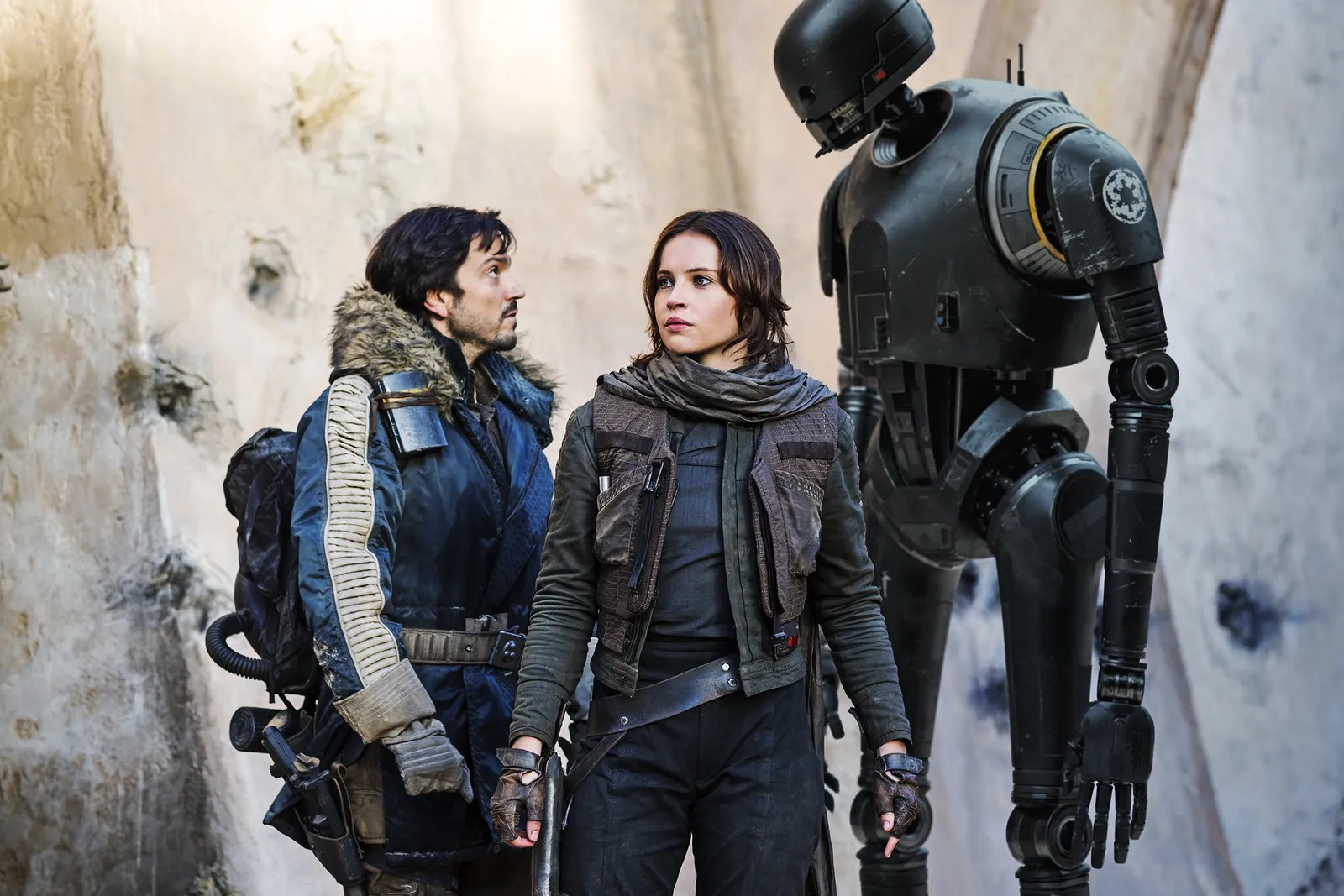
Career criminal Jyn Erso (Felicity Jones) is picked up and recruited into the Rebellion by Cassian Andor (Diego Luna) and a smart-mouthed (-vocalizered?) droid named K-2SO (Alan Tudyk). Turns out her father Galen Erso (Mads Mikkelson) is a top Imperial scientist and a lead designer on the dreaded Death Star whose construction is nearing completion. What begins as a quest to extract (i.e. secretly assassinate) Galen becomes something much bigger when it is revealed that Jyn’s father had purposely planted an exploitable flaw in the Death Star that gives a small chance for destroying it. Unfortunately Galen’s message does not elaborate on the specific nature of the flaw and a race ensues to steal the Death Star plans and deliver them to the Rebellion in order to discover the station’s weakness. Standing in their way are the entirety of the Imperial military and the machinations of Grand Moff Tarkin (impressively recreated by CGI mo-cap) and the ambitious and overcompensating Orson Krennic (Ben Mendelsohn). Along the way our heroes pick up a variety of interesting characters: the blind Force-sensitive monk Chirrut Imwe (Donnie Yen), his more grounded and cynical protector Baze Malbus (Jiang Wen), and an imperial defector named Bodhi Rook (Riz Ahmed).
The characters in Rogue One stand apart from the heroes of the Original Star Wars Trilogy in their lack of perfection and their worldly disregard for moral idealism. Jyn sees the Empire as an unstoppable reality and prefers to keep herself uninvolved with her head down. Cassian makes ethically compromised decisions for what he believes is the greater good. “We’ve all done terrible things on behalf of the Rebellion” he says early in the movie. It is not until Jyn’s father is killed in a botched operation does he begin to see the bigger picture of what it means to be one of the good guys and what is and what is not acceptable for a good man to do no matter what.
What makes Rogue One among the best Star Wars films is its uncynical honesty (a sadly rare combination in film and literature in this day of anti-heroes and angry young men). A lot of snake oil preachers give us an unrealistic view of the world when teaching moral values. They deny the ugliness of the world because it is too hard for them to reconcile their teachings with it. Rogue One denies nothing and tells us to be good anyway. The characters operate on a lot of ifs and long shots. There is no guarantee that they will succeed in getting the Death Star plans or survive the attempt and more difficult still is there is no guarantee that the plans will contain anything useful. And later on as we have seen there is no guarantee that the Rebellion will succeed in destroying the Death Star even if a weakness is found. A lot of people die for these uncertainties. The guarantees are absent. Only hope remains. But rebellions, after all, are built on hope.
Balanced with Rogue One’s themes is a wildly entertaining adventure. The special effects on display are some of Star Wars’s best and the action sequences are well-sustained and paced with plenty of emotional investment to keep the viewer enthralled. The final scenes are full of tragedy and show the grim reality of sacrifice amidst unwelcoming odds. But tragedy is neither the final note nor word of the film. It is hope.

