Rogue One: A Star Wars Story (2016)

4/4 stars

“Rebellions are built on hope.” This is said twice in Rogue One: A Star Wars Story and each time it is said it’s to galvanize the cynical to action. The phrase is not wasted on its audience nor used to preach to the choir. It’s directed at those who need it the most: the complacent and the cowardly.
Hope is not a happy subject. It is, in fact, a very sobering and serious one. There is nothing lightweight or naive about it. Hope demands a lot. It often comes attached with sacrifice and tragedy. The fact that Pandora’s Box contained hope should not be surprising to anyone who understands what hope means and what it asks of us.

Rogue One is the second Star Wars film made by Lucasfilm after Disney purchased the company and after the rather tepid and lightly-treading The Force Awakens, it was a step in the right direction. Star Wars is more than childish escapism. It’s also about something. It preaches hope without guarantees, abandoning self for larger causes, and faith while under fire. The series also has a lot to say about hatred, forgiveness, redemption, and what vengefulness does to a soul. In many ways Star Wars provides an accessible extrapolation of the Sermon on the Mount and explicable context to “blessed are the meek.”

Rogue One offers up the same message and theme as the original Star Wars movie, but on the other side of the coin. While Luke, Han, Leia, and company make it out alive, the characters in this film do not. Untouchable main characters are safe and digestible, but leave out something. The most worthwhile endeavors, Rogue One tells us, come at great cost. Like in the original Star Wars, director Gareth Edwards and the Lucasfilm Story Group manage to craft a colorful cast of mismatched and attachable characters; and in doing so they succeed in the film’s final scenes to hammer home the ultimate importance of hope, especially when it is all one has.

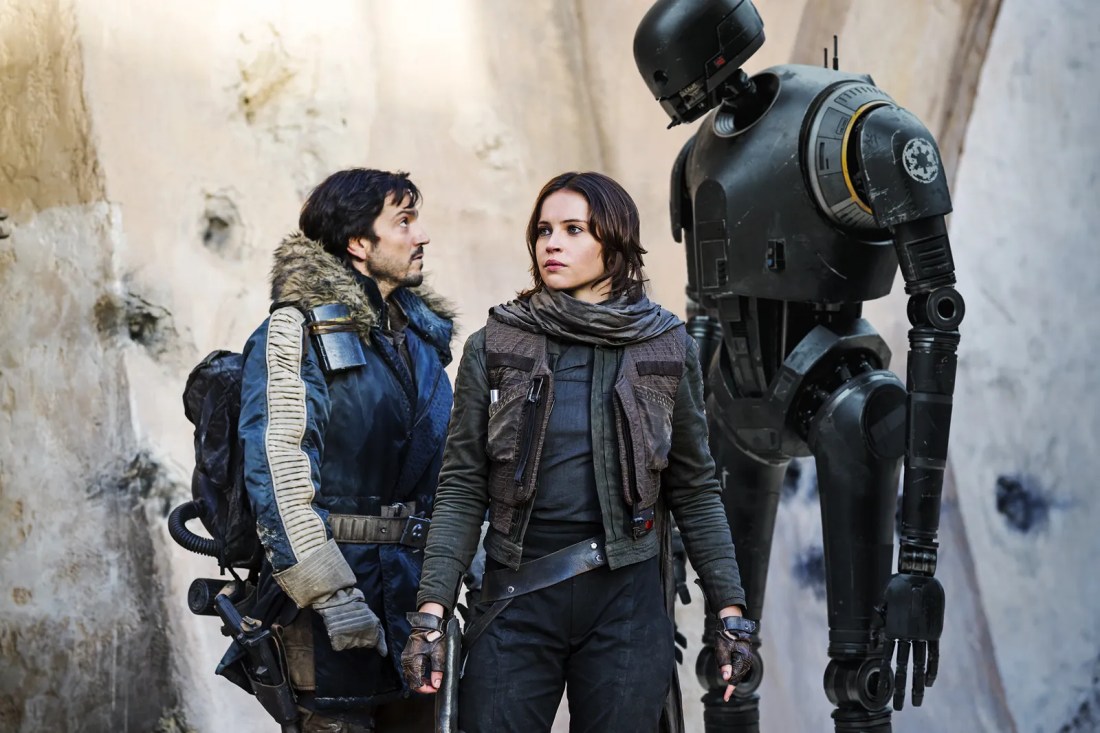
Career criminal Jyn Erso (Felicity Jones) is picked up and recruited into the Rebellion by Cassian Andor (Diego Luna) and a smart-mouthed (-vocalizered?) droid named K-2SO (Alan Tudyk). Turns out her father Galen Erso (Mads Mikkelson) is a top Imperial scientist and a lead designer on the dreaded Death Star whose construction is nearing completion. What begins as a quest to extract (i.e. secretly assassinate) Galen becomes something much bigger when it is revealed that Jyn’s father had purposely planted an exploitable flaw in the Death Star that gives a small chance for destroying it. Unfortunately Galen’s message does not elaborate on the specific nature of the flaw and a race ensues to steal the Death Star plans and deliver them to the Rebellion in order to discover the station’s weakness. Standing in their way are the entirety of the Imperial military and the machinations of Grand Moff Tarkin (impressively recreated by CGI mo-cap) and the ambitious and overcompensating Orson Krennic (Ben Mendelsohn). Along the way our heroes pick up a variety of interesting characters: the blind Force-sensitive monk Chirrut Imwe (Donnie Yen), his more grounded and cynical protector Baze Malbus (Jiang Wen), and an imperial defector named Bodhi Rook (Riz Ahmed).

The characters in Rogue One stand apart from the heroes of the Original Star Wars Trilogy in their lack of perfection and their worldly disregard for moral idealism. Jyn sees the Empire as an unstoppable reality and prefers to keep herself uninvolved with her head down. Cassian makes ethically compromised decisions for what he believes is the greater good. “We’ve all done terrible things on behalf of the Rebellion” he says early in the movie. It is not until Jyn’s father is killed in a botched operation does he begin to see the bigger picture of what it means to be one of the good guys and what is and what is not acceptable for a good man to do no matter what.

What makes Rogue One among the best Star Wars films is its uncynical honesty (a sadly rare combination in film and literature in this day of anti-heroes and angry young men). A lot of snake oil preachers give us an unrealistic view of the world when teaching moral values. They deny the ugliness of the world because it is too hard for them to reconcile their teachings with it. Rogue One denies nothing and tells us to be good anyway. The characters operate on a lot of ifs and long shots. There is no guarantee that they will succeed in getting the Death Star plans or survive the attempt and more difficult still is there is no guarantee that the plans will contain anything useful. And later on as we have seen there is no guarantee that the Rebellion will succeed in destroying the Death Star even if a weakness is found. A lot of people die for these uncertainties. The guarantees are absent. Only hope remains. But rebellions, after all, are built on hope.

Balanced with Rogue One’s themes is a wildly entertaining adventure. The special effects on display are some of Star Wars’s best and the action sequences are well-sustained and paced with plenty of emotional investment to keep the viewer enthralled. The final scenes are full of tragedy and show the grim reality of sacrifice amidst unwelcoming odds. But tragedy is neither the final note nor word of the film. It is hope.

Star Wars: Episode V – The Empire Strikes Back (1980)

4/4

The Empire Strikes Back is flawless. Not many movies are. Only a couple are released per decade really.

After the original Star Wars film released in 1977 it was a massive success with critics and audiences alike, and no film since had such a groundbreaking impact on the future of cinema. Fans, young and old, eagerly waited three years for the next installment in the Saga and what often happens when hype is built up for a sequel is disappointment. Sequels typically never live up to the originals because filmmakers put every bit of their talent into their first pictures and second entries are almost always an afterthought. They become obligatory cashcows bringing back familiar settings and characters with no serious attempt at telling a good story.

And yet, The Empire Strikes Back is flawless. It improves upon the original in every aspect of its production: it’s more tightly edited, employs even better and more groundbreaking special effects, has stronger performances from its cast, and is overall better written. The fans waited patiently (and impatiently) for three years and they got what they expected and more.

In the last film the final shot is of our heroes facing the camera happy and celebrant. This one ends with Luke, Leia, and the droids facing away. Gazing at a distant galaxy, comforting one another; hopeful and fearful. They’ve been separated from their friends, the future is uncertain, and the best they can do is wonder, looking away to their destinies. It ends on a strong note, but not a happy one.

The Empire Strikes Back – directed by Irving Kershner and written by Lawrence Kasdan and Leigh Brackett – is the darkest chapter in the entire 9-film saga. More than a few will argue in favor of Revenge of the Sith, but that movie cannot by its very nature as a prequel ever fill us with the sort of tension and doubt that this one does. At least assuming you are viewing them in the correct order.

The film opens three years after A New Hope and the Rebel Alliance is now on a brand new hidden base on the frozen wasteland world of Hoth. After they are discovered by the evil Empire and viciously attacked the remaining forces scatter.
Their mission is to rendezvous at a distant location in space, but before they do our heroes have unfinished business. Luke Skywalker (Mark Hamill) is sent by the ghost of Obi-Wan Kenobi (Sir Alec Guinness) to find an elusive Jedi Master named Yoda to complete his training as a Jedi Knight. Han Solo (Harrison Ford), Princess Leia (Carrie Fisher), Chewie (Peter Mayhew), and the two droids Artoo (Kenny Baker, Ben Burtt) and Threepio (Anthony Daniels) need to stop for gas.
The evil Dark Lord of the Sith, Darth Vader (James Earl Jones, David Prowse) is obsessed with finding Luke Skywalker in the hopes of turning him to the Dark Side of the Force and make him an evil Sith Lord like himself. Vader can somehow sense Luke’s presence in the Force much like he could with his old master Obi-Wan. Unbeknownst to the protagonists it is this perception which motivated the Imperial attack on Hoth.
Luke begins his training on the boggy world of Dagobah under Yoda who is a two-foot high green little goblin voiced and performed by Muppet-alumnus, Frank Oz. Yoda introduces himself as a playful, mischievous urchin annoying Luke and Artoo both with juvenile pranks and mocking comments. Luke tells him, “I’m looking for a great warrior.” Yoda laughs. “Wars not make one great,” he says. His mirth and behavior exposes Luke’s deep-seated anger issues and lack of patience. It bestows humility on him without which his descent to the Dark Side would be all the easier. I think many Star Wars fans I have seen on the internet could benefit from a weekend on Dagobah with Yoda.
Yoda is a masterful technical achievement. As a mere puppet his texture and look is decidedly realistic and he was designed to feature a whole range of emotions with his eyes and face unseen previously in movie-puppetry.

Han and Leia’s story is further developed in the movie in the meantime. They bicker like an old married couple in a way that is reminiscent of old 1930’s rom-com romances. He’s brash, arrogant, and fatally attracted to the woman who annoys him so much. She’s fierce, independent, unintimidated, and fatally attracted to the man that she imagines to be beneath her.
The hyperdrive on the Millennium Falcon is damaged and they are unable to make it to the rendezvous without making repairs. Han recruits the aid of an old smuggler buddy named Lando Calrissian (Billy Dee Williams) to help them. They go to Cloud City – a veritable castle in the sky floating over a gas giant – where Lando betrays them to the Empire. Vader deliberately tortures them knowing that Luke would sense it in the Force and come rushing to the rescue.
What follows is several grim happenings that are far removed from the heroic devil-may-care adventures of the previous film. Han is left incapacitated and captured by the space mafia and Luke is left physically maimed and devastated by the revelation that Darth Vader is his own true father. His world and pie-eyed optimism were dealt a singular blow and he never recovers or becomes the same person he was again.

What The Empire Strikes Back does is force its characters to grow up. It’s a much more psychological film than the other entries (save for perhaps the much-maligned The Last Jedi). The stakes get raised and there are serious losses. No one walks away unscarred and altered forever. The movie is about trauma and hope without guarantees. Simply being the good guy is not enough anymore.

Irving Kershner is a better director of actors and can get better performances out of his actors than George Lucas can, who takes a backseat from director’s duty and contributes instead to the story and provides creative input on the visuals. We get a much better film as a result with a tight script by Kasdan and Brackett.

Lucasfilm and ILM also had three years to further improve the special effects technology which makes for a spectacle miles ahead of the original film. John Williams also provides us with the best of the nine film scores composed for the Saga with several of them – The Imperial March included – having entered the pantheon of great classical pieces of music. His music is like that of a 19th century ballet and it sets the epic and dramatic tone of the film throughout.

I could keep going, but the fact is there is not a technical or dramatic aspect of The Empire Strikes Back that isn’t done perfectly. Really, after half a dozen or more paragraphs I can still summarize everything into one word. Flawless.

Star Wars (1977)

Rating 4/4

Star Wars since its release in 1977 has become one of those quintessential films like The Wizard of Oz or Snow White which everyone has seen and has entered into the collective consciousness of people all around the world. It’s as recognizable as Hamlet and Tom Sawyer and Hercules and Moses. And being a life-long die hard Star Wars fan and after the brand has expanded upon itself the last 40 years with sequels, prequels, comics, and novels it’s not easy to just review it purely as a movie from 1977. Star Wars is now a phenomenal mythic enterprise and viewing the film simply as a late seventies sci-fi hit created by the director of American Graffiti is not needed anymore.
Which is why I am not going to review it at all. What I would rather do instead is take a few moments of your time and discuss the phenomenon that this movie became and hopefully convey what it means to me personally.
I was 15 years too late to see this movie when it first came out in theaters; seeing it for the first time as a second generation fan in the early 90’s when I was about six years old. I have no recollection of that first viewing experience and as far as I am concerned Star Wars has always been around.
In my earliest memories Star Wars was already a near and dear thing to me. I played with the Kenner and Hasbro action figures, illiterately leafed through my uncle’s collection of comics, and eagerly picked up as much knowledge of the lore as I could. With the amount of affection I had for Star Wars, and how much space it took in my playtime and imagination; first seeing this movie must have been as close to a spiritual experience as I am willing to believe in.
I could drone on some more about how much Star Wars changed everything, but I would be being disingenuous. I never saw it change anything. Things had already been changed by it around the time I was born. The adults and teens who first saw it 47 years ago probably cannot understand how much my generation takes it for granted. It’s like the existence of automobiles, going to church, or just the presence of movies in general. A point in time in which it did not exist is beyond my comprehension.

But Star Wars did change everything. They say hindsight is 20/20 and I don’t disagree. I especially agree when I wasn’t even around back then in the first place. It baffles me how so many people in Hollywood had such little faith in Star Wars’ production. A quick glance at any of the making of features in print or on film will show constant references to risk-taking and predictions of failure. When I look at this movie I wonder how anyone in their right mind could have thought it was going to be a flop. Living in a time when movies like Star Wars are a dime a dozen and oversaturate the box office it’s hard to imagine the late 70’s when more serious pictures were being produced and science fiction/fantasy movies were frequent critical and financial failures. Believe it or not, sci-fi movies used to not be guaranteed blockbusters and many of them were your typical tax-shelter projects similar to what we are seeing being produced for the SyFy channel and Netflix today.

I won’t waste any more words on Star Wars changing cinema since we all know it did. What I find more interesting and less talked about is how much it changed George Lucas himself.
If one were to patiently sit through his early student films from the 60’s followed by his debut, THX 1138, you see the obvious influences and overall tone of his work. Lucas was making films for the anti-war counter-culture youth of America: fed up with Vietnam, fed up with Watergate, fed up with segregation and Jim Crow laws, and just plain fed up with The Man altogether.
He made THX as a Huxley-esque attack on authoritarian government and American Graffiti was a revisit to teenage life in California before Vietnam.
Star Wars was something different. Something special. Yeah, there is an echo of anti-imperialism in it, but much of it was written and produced with a more basic and ergo more important motivation. With his third film, Lucas left counter-culturalism in the background and sought instead to revitalize for younger moviegoers spirituality and myth in a language they could understand. And miraculously its success overshadowed its ambitions. Star Wars has achieved George Lucas’s goal more than he could have anticipated when he first began writing it in 1974. Probably even more than he anticipated when he was actually making the film which was fraught with budget problems, uncooperative cinematographers and crews, cynical execs having no faith in its success, supply problems, and labor difficulties of every kind…
But successful it was. Like the myths Lucas was drawing from, Star Wars became a natural part of our culture. The Force, wookiees, Darth Vader, Luke Skywalker, the Millennium Falcon, and even Jar-Jar Binks are as familiar and recognizable to us as Thor, Zeus, and the Garden of Eden. Many of its characters, creatures, planets, and technology have become proverbial and require no exposition when used to make a point or reference. Many of my generation learned “May the Force be with you” before we learned to say “Amen.” The lightsaber is as iconic as Excalibur or Mjolnir. It would be self-indulgent to go on, but I could for a thousand more paragraphs if I wanted to.

George Lucas would not direct another film again until 1999 with the release of The Phantom Menace. In the meantime he produced and wrote less of the counter-culture material that characterized his earlier work and focused more on writing the remaining movies of the Star Wars trilogy and Indiana Jones as well as championing the progress of special effects in cinema with ILM. In 1997, two years before the release of his first prequel, the Star Wars trilogy was re-released in theaters in the form of Special Editions with the films’ negatives cleaned up and restored, enhanced special effects inserts, and occasionally a few cut scenes put back in. Many of these changes were controversial and ironically helped create some new proverbial myths of their own. “Han Shot First” has become nearly as recognizable as “May the Force be with you.”

You may have begun to notice that I have been so far speaking more about Star Wars as a saga and critically successful franchise than I am about the 1977 picture itself and there is a reason for this. Any review I could write about this movie would add nothing that hasn’t been already said and said better than I can. To be frank, if you haven’t seen Star Wars, nothing in this piece is directed to you. Which is why I must reiterate this is not a review. There are not enough people living under a rock for such a review to be useful and if they emerge I am not so vain as to think they would come flocking to this blog to see if Star Wars is worth watching or not.
It is, and you should go watch it again sometime. Not because I said so, but because you and I already both know that you should.