Suicide Squad (2016)

1/4 stars

Suicide Squad barely qualifies as a movie. It plays more like a feature length trailer for a movie that doesn’t exist. I said as much to my family when the movie was over. When I later looked up some info on the movie and found out that the film’s editing was outsourced to a company whose specialty was, indeed, making film trailers I felt fairly vindicated. Its original editor dropped out midway through post-production and the studio opted not to give director David Ayer final cut. The nicest thing I can say about Suicide Squad is that there is good evidence that Warner Brothers sabotaged it.
The entire movie is nothing but the sort of highlights of action and comedy that one sees in marketing. It never takes a break, but keeps moving from one thing to the next, never stopping to flesh out its characters or settle upon a theme. It’s essentially a heist/task force movie; a genre that has put out more garbage than gold most of the time.

Suicide Squad was an endurance test on my patience the entire time I was watching it. When a film has its characters written this thinly, what you get is a boring movie. It doesn’t matter how many action scenes you cram into it. There is no emotional investment in this movie at all. The motivations and drives of its leads are limply delegated to a few short vignettes which don’t do the job. These scenes are also thinly written, serving only to tell us how the characters feel, but the never showing it convincingly. It misuses its cast unforgivably.

Following the death of Superman in Batman v Superman, the film’s plot – or what passes for one – tells us that the US government is concerned about how to combat evil meta-humans going forward. At the Pentagon, intelligence officer Amanda Waller (Viola Davis) comes up with the brilliant idea (and by brilliant I mean stupid) to create a specialized response unit comprised of some of the worst criminals and super-villains in the world. However, the only thing she accomplishes by doing this is, is to create the very problem that the Pentagon feared. One of them goes rogue almost immediately and poses such a serious threat the remaining members of the team are assigned to take her out. The incompetence on display here is staggering. What makes Waller all the more infuriating is she never takes any ownership of the mess. She remains arrogant and overconfident throughout the film, and worse still, she outright murders Pentagon personnel for overhearing information about the Suicide Squad they weren’t cleared to hear. These individuals probably had families to go home to and they are killed to protect a group of gangbangers and thugs. Waller ought to face court martial and a firing squad for this.

Enchantress (Cara Delevingne) is an ancient witch spirit who possesses the body of a woman named June Moore who just happens to be the lover of one of Waller’s subordinates. Enchantress summons her brother Incubus and creates an army of possessed former soldiers in order to destroy the human race. What else is new?
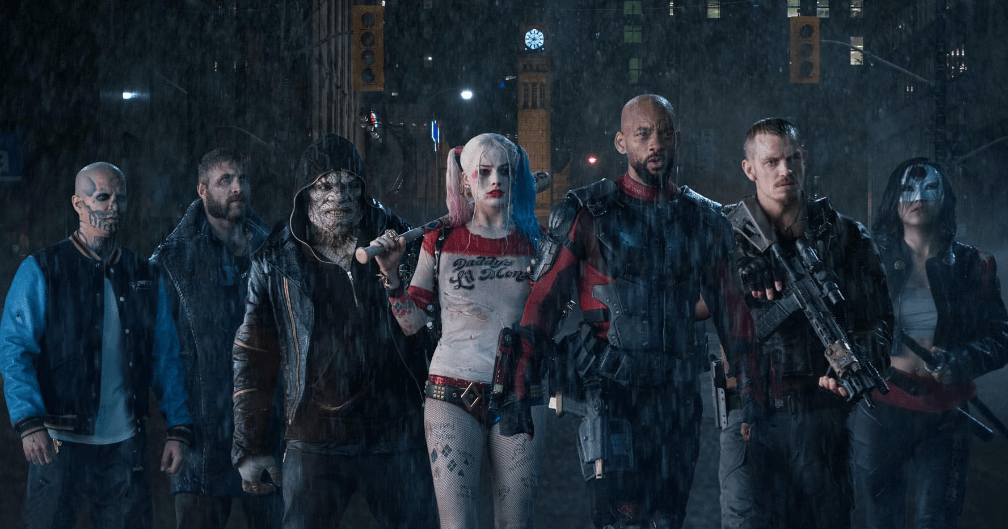
The members of the Suicide Squad are six prison inmates. Deadshot (Will Smith) is a paid assassin and family man who wants to see his daughter again. Killer Croc (Adewale Akinnuoye-Agbaje) is a sewer-dwelling lizard man whose sole reason for joining is because he wants to negotiate getting BET on the TV in his cell. El Diablo (Jay Hernandez) is a fire-wielding gangbanger who accidentally killed his family years ago and is now mildly sad about it. He refuses to use his powers at first, but later comes around. Good for him, I guess.
The most interesting of the bunch – yet still woefully underwritten – is Harley Quinn (Margot Robbie). She’s an exaggerated caricature of Mallory from Natural Born Killers who maintains a cutesy flirtatious lilt to her voice even when murdering people. She’s the Joker’s (Jared Leto) girlfriend and was at one time his therapist until he brainwashed her by forcing her into an electro-shock therapy machine. Her weapon of choice is a baseball bat which she preposterously brings to gun fights. The other two are Slipknot and Captain Boomerang whose contributions to the film leave them not worth talking about. There is also added to the mix a Japanese swordswoman named Katana (Karen Fukuhara) whose dead husband’s soul lives in her sword.
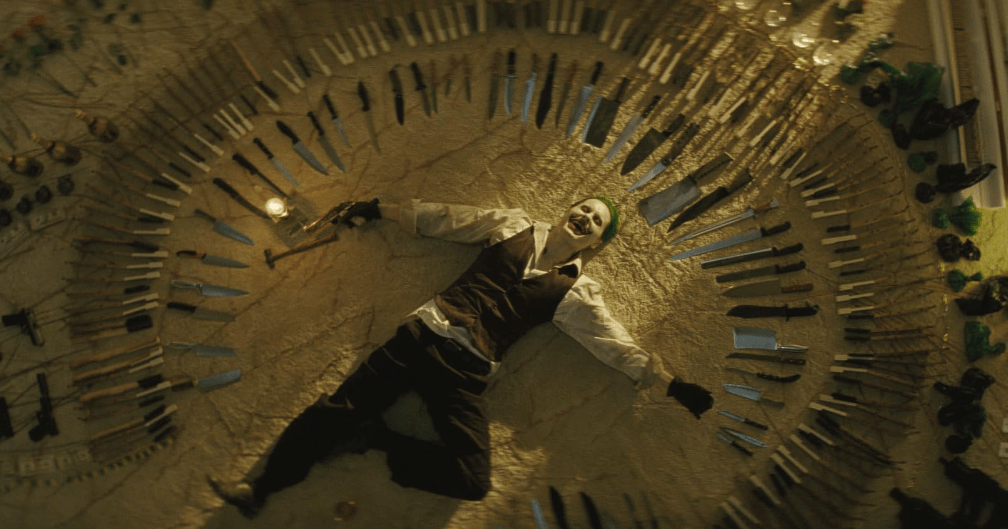
Joker is one of the weakest points of the movie. His screentime is shockingly minimal and Leto plays him more like a flamboyant mob boss than the master of chaos and insanity that we know. His appearance – slick-backed green hair, white makeup, and shirtless tattooed body – reminds me of someone you’d see in an emo band.

These characters are introduced in quick succession with a few sparing minutes given for each to provide them some semblance of backstory. The movie’s plot gets moving and doesn’t stop as soon as its begins. Suicide Squad barely has a first act which is crucial if you want to tell a story and have the audience give a damn about it.
Instead of plot the film is more obsessed with violent imagery, edgelord humor, and squeezing in as many back shots of Margot Robbie in booty shorts during its runtime as it can get away with. The whole thing is a childish mess and doesn’t deserve to be called a movie. It was made with 12 year old boys in mind. The sort who play a lot of GTA, listen to rap and metal, and who just discovered internet pornography for the first time recently. Not only does Suicide Squad have nothing to say about real people, it isn’t even made for real people. Certainly not people I’d leave alone with my kids.

I find it hard to believe that Suicide Squad is supposed to be connected to Man of Steel and Batman v Superman. Those movies, while imperfect, are far more charismatic and wholesome than this piece of juvenile trash. It has all the delicate plotting of a Friday the 13th movie, but even less entertaining. After seeing what Warner Brothers had done to Batgirl I wished they could have shelved this one as well. This is one of the worst superhero movies I have ever seen. I hated every disingenuous moment of it. I hated its thoughtless and pointless approach to violence. I hated the sleaze that went into its writing. Suicide Squad fails on every level, including the simple requirement of being a movie. I would have rather just watched the film’s trailer and pretended it was a short film. The full picture was time wasted that I will never get back. Rarely is a movie so bad that I cannot imagine myself watching it again at some point. But, if I never think about this movie again it won’t be soon enough.

Director: David Ayer
Writers: David Ayer
Producers: Charles Roven, Richard Suckle, Geoff Johns, Steven Mnuchin, Deborah Snyder, Zack Snyder, Colin Wilson, Bruce Franklin, Andy Horwitz, Alex Ott
Cast: Will Smith (Deadshot), Margot Robbie (Harley Quinn), Viola Davis (Amanda Waller), Jared Leto (Joker), Jai Courtney (Boomerang), Jay Hernandez (Diablo), Adewale Akkinuoye-Agbaje (Killer Croc), Cara Delevingne (June Moone/Enchantress), Joel Kinnaman (Rick Flag), Adam Beach (Slipknot), Karen Fukuhara (Katana)
Composer: Steven Price
Cinematographer: Roman Vasyanov
Editor: John Gilroy
Batman v Superman: Dawn of Justice (2016)

3/4 stars

note: This is a review of the Ultimate Edition, an expanded edition of the film not initially shown in theaters

When I first saw Batman v Superman ten years ago I hated it. A lot of people did. Many still do. But, having seen it for a second time a decade later I find myself in the awkward position of being one of its defenders. Bear in mind, the Ultimate Edition is the only cut of the film I have seen, so I can honestly inform the reader that the extra thirty minutes are not what made the difference to me.
No, what I think happened this second time around was a mixture of acceptance and comprehension of what the filmmakers were trying to do. Being dark is not necessarily an issue for me. What made Man of Steel a bad movie was that its darkness extended to its main character as well as the plot. Putting Superman in a dark story is fine. Wholesome, good people live in a dark world and how they adapt to it and learn to live in it is ripe for good storytelling. But, in Man of Steel Superman comes right off the bat as someone angsty and angry which suited him not a bit. The kinder more winsome Superman of old would have made that film more palatable since light versus dark is what he is all about.

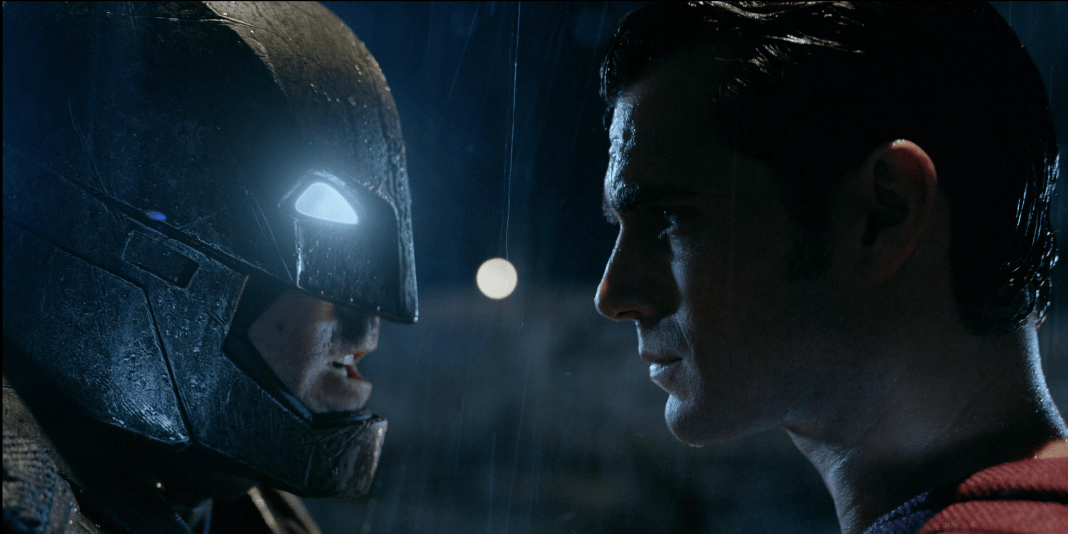
Superman (Henry Cavill) is not much better in this movie either, but, perhaps I have got used to him. He is not as unsure of himself as he was in Man of Steel for one thing. And, also, Batman v Superman is not all about him. It’s not really about Batman (Ben Affleck) that much either. The angsty Superman is here to stay and the movie accepts this and moves on without dwelling on his character as much.
For me, BvS’s saving grace is that the dark tone is not just a gimmick like it was in Man of Steel. This movie has something to say for once. What made many people angry, I suspect, is that they purchased their tickets and expected to see a superhero movie. Can’t really blame them there. But, Batman v Superman: Dawn of Justice – an admittedly awful title – is not a superhero movie. It’s an epic social thriller that takes the subject of Superheroes (or meta-humans as the film calls them) seriously. It’s a commentary on what the ramifications of beings like this would have in a world that is post-9/11. In many ways I view the movie as a companion piece to Zack Snyder’s Watchmen.
Much of the film’s scenes are set in newsrooms, congressional hearings, and foreign lands falling apart under unstable regimes. The frequent cameos of real life figures like Charlie Rose, Nancy Grace, and Neil DeGrasse Tyson commenting on the existence of superheroes is just another way the film tries to posit how a world inhabited by meta-humans would react to them.

The film is set two years after General Zod wrecked devastation on Metropolis and now the world is questioning whether it needs another all-powerful Kryptonian living amongst them. Superman is a good man who is on the side of humanity, but that fact is not unquestionable to the many people who were maimed and lost their loved ones in the fallout. It was Snyder’s conscious decision to spend more time on this subject than on the pure unadulterated superhero flare we have come to expect in these sort of movies. Just before I rewatched it I read this comment from director Zack Snyder that he made about the movie in 2023: “I think that probably is what caused the movie to be so polarizing. I think a lot of people went into the movies for going like, “Oh, it’s the superhero romp, right? Let’s have fun with it.” And we gave them this sort of hardcore deconstructivist, heavily layered, experiential modern mythological superhero movie that … you really need to pay attention to. That was not cool. That’s not something anyone wanted to do.”
At first when I read that comment I got annoyed. I thought it patronizing and a failure to take ownership of the issues that people actually had with the movie. Watching it again, though, I hearken back to that comment and understand somewhat of what he was trying to say. I believe he was mostly right, but a few people did have other reasons for not liking it. The characterizations of Superman, Batman, and Lex Luthor (Jesse Eisenberg) are hardly traditional. The film still languishes under its fast-edited action sequences and unconvincing special effects. And a lot of people bristled at the reason for Batman sparing Superman’s life being that their mothers’ names were both Martha. The latter issue was meme’d and mocked to death back in 2016 and a lot of people still complain about it today. I am not as angry about it as they are. The scene intended to give Batman an understanding of Superman’s humanity that he had not seen before. He had a mother. The scene only failed because of a lack of subtlety and Batman’s animosity died down too quickly to be believable. I thought Batman’s issues with Superman were not wholly addressed here. Having a mom named Martha should not have been enough to convince him that Superman was not a threat and the movie should have resolved this concern a bit more. I also believe the addition of visual flashbacks to Bruce Wayne’s parents being shot was too on the nose and the scene would have been better received without them. But, the fact that Supes also had a mom named Martha being a turning point in Batman’s relationship with Superman didn’t bother me. It’s not as stupid as people say it is. It just needed some adjustments to its execution. But, people like their bandwagons, you know.

Batman is a big point of contention, and I do understand why. He is a bit hard to swallow. He is much more brutal and violent than any previous incarnation of the character we had seen on screen before. He also shows a shocking indifference to human life. Much of his actions are reckless and indirectly cause the deaths of the men he is fighting. The reason I still am able to accept him, however, is that the reinterpretation of the character is not so jarring as it is with Superman. Clark Kent and his alter ego don’t align at all with what he is supposed to represent, whereas Batman has always been a more edgy character. Making Batman this grim was the only logical thing the filmmakers could do if he is to contrast with Superman as he is presented here. It helps that he is not the movie’s main character. Batman serves the majority of the plot as an antagonist who has become misguided by suspicion and paranoia. The movie focuses most on the loneliness and the near sociopathy of the character which, let’s face it, has been with Batman since the beginning. Batman has always been the sort of guy whose trauma and internal rage at injustice had driven him to becoming a violent vigilante who beats the wicked and corrupt to a bloody pulp. Must I also point out that he dresses up in a vampiric bat costume and has the power of fear and the cover of darkness as his primary weapons? I can forgive the movie for knowing what everyone else knows that such a man in real life would likely be mentally ill.

The actual fight between the two is instigated by Lex Luthor. Instead of the usual self-congratulating Bond villain played by Hackman and Spacey, Jesse Eisenberg plays him…well…as Jesse Eisenberg. Eisenberg is not a bad actor, but he is a one-trick pony. He only plays one guy in all of his films and that is Jesse Eisenberg. His Luthor is neurotic, talks fast, and eats up attention like a child eats up sugar. He clearly loves the sound of his own voice and becomes grandiose and prone to demagoguery. He thinks of Superman as a sort of god in the classical sense and wants him dead on that basis alone. Instead of cutting his teeth on Sesame Street and Dr. Seuss like most normal people, he lives by cherrypicking the philosophies of Nietzsche and Ayn Rand. I’ve known people like this and they aren’t much fun at parties.
By staging a number of terroristic plots that are deliberately centered around Superman’s presence he turns him into a controversial figure. A vocal minority of the citizenry are now leery of Superman and Batman is convinced that the world will not be safe and secure until he is dead.

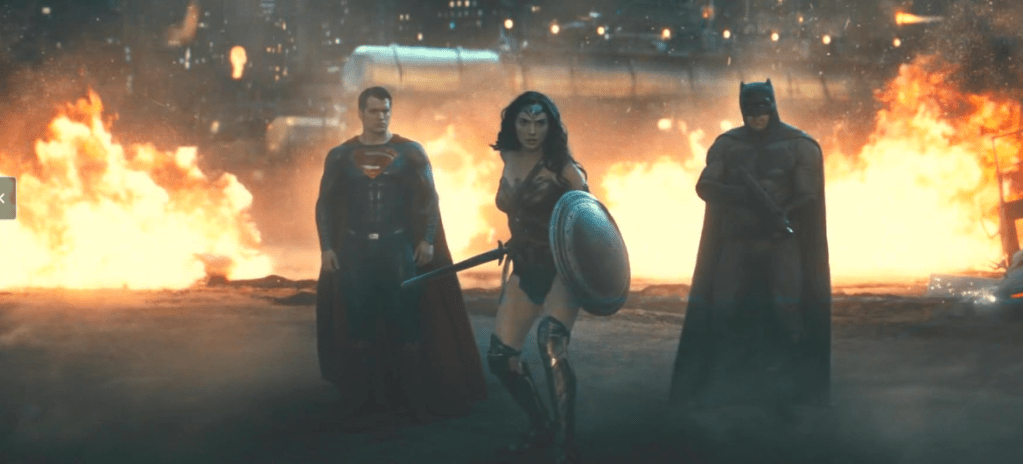
Another newcomer to the franchise is Wonder Woman (Gal Gadot) who spends most of the movie in disguise as Diana Prince. Her purpose in the film is limited and she is there by and large as a justification for the “Dawn of Justice” part of the movie’s title. She is meant to foreshadow the eventual rise of the Justice League. The Flash, Cyborg, and Aquaman also make very brief appearances, but they don’t inundate the movie with too many characters as a lot of superhero movies do with their villains. Secret archived footage is shown of them on computer screens to give us our first look at them before they make it to the main event.
Gadot’s performance is a bit bland, but she is not given a whole lot to do in her defense. As Wonder Woman she doesn’t spring into action until the final climactic battle and when she does she contributes little. Action movie directors must find writing for women hard or something, because I complain about this often.

The final battle is where the movie tends to fall apart. It’s a CGI-laden mess. The three heroes get tossed about frequently, transitioning from CGI models to actors when they land. CGI is supposed to be like a magic trick and when done poorly the trick is revealed to the audience and takes them out of the illusion. Doomsday, a monster made of kryptonite designed by Luthor, looks like a cartoon. It stomps about, roaring its head off and fighting the heroes in front of bluescreen that is so obvious it’s more like watching a video game.
The modern filmmakers have seemed to forget that fight scenes need personality as well as action. There is a lot of emotion involved when fighting someone. There needs to be a personal connection that has to be shown during the fight and not just in the moments leading up to it. This is done through simple emoting, facial expressions, and signs of physical exhaustion as the conflict becomes prolonged. What this movie fails to do is show us any of that. It’s all fast blink-and-you’ll-miss-it kinetics, explosions, loud noises, and whole shots where not a single thing on screen is real. All of which is dimly lit for reasons I suspect have to do with disguising the fakeness of the special effects. It’s more exhausting than entertaining.

Batman v Superman: Dawn of Justice is at its strongest when it is not trying to fulfill its obligations as a superhero movie. The social commentary is brilliant and the pacing of its first act is near perfect. It suffers during its action scenes, but provides a much more profound experience when it is being serious. It’s not perfect, but I rather liked it.

Director: Zack Snyder
Writers: Chris Terrio, David S. Goyer
Producers: Charles Roven, Deborah Snyder, Wesley Coller, David S. Goyer, Geoff Johns, Benjamin Melniker, Steven Mnuchin, Christopher Nolan, Emma Thomas, Michael E. Uslan, Trevor Christie, Curt Kanemoto, Bruce Moriarty, Jim Rowe, Andrea Wertheim, Gregor Wilson
Cast: Ben Affleck (Bruce Wayne/Batman), Henry Cavill (Clark Kent/Superman), Amy Adams (Lois Lane), Jesse Eisenberg (Lex Luthor), Diane Lane (Martha Kent), Laurence Fishburne (Perry White), Jeremy Irons (Alfred), Holly Hunter (Senator Finch), Gal Gadot (Diana Prince/Wonder Woman), Scoot McNairy (Wallace Keefe), Callan Mulvey (Anatoli Knyasev), Tao Okamoto (Mercy Graves)
Composers: Junkie XL, Hans Zimmer
Cinematographer: Larry Fong
Editor: David Brenner

Rogue One: A Star Wars Story (2016)

4/4 stars

“Rebellions are built on hope.” This is said twice in Rogue One: A Star Wars Story and each time it is said it’s to galvanize the cynical to action. The phrase is not wasted on its audience nor used to preach to the choir. It’s directed at those who need it the most: the complacent and the cowardly.
Hope is not a happy subject. It is, in fact, a very sobering and serious one. There is nothing lightweight or naive about it. Hope demands a lot. It often comes attached with sacrifice and tragedy. The fact that Pandora’s Box contained hope should not be surprising to anyone who understands what hope means and what it asks of us.

Rogue One is the second Star Wars film made by Lucasfilm after Disney purchased the company and after the rather tepid and lightly-treading The Force Awakens, it was a step in the right direction. Star Wars is more than childish escapism. It’s also about something. It preaches hope without guarantees, abandoning self for larger causes, and faith while under fire. The series also has a lot to say about hatred, forgiveness, redemption, and what vengefulness does to a soul. In many ways Star Wars provides an accessible extrapolation of the Sermon on the Mount and explicable context to “blessed are the meek.”

Rogue One offers up the same message and theme as the original Star Wars movie, but on the other side of the coin. While Luke, Han, Leia, and company make it out alive, the characters in this film do not. Untouchable main characters are safe and digestible, but leave out something. The most worthwhile endeavors, Rogue One tells us, come at great cost. Like in the original Star Wars, director Gareth Edwards and the Lucasfilm Story Group manage to craft a colorful cast of mismatched and attachable characters; and in doing so they succeed in the film’s final scenes to hammer home the ultimate importance of hope, especially when it is all one has.

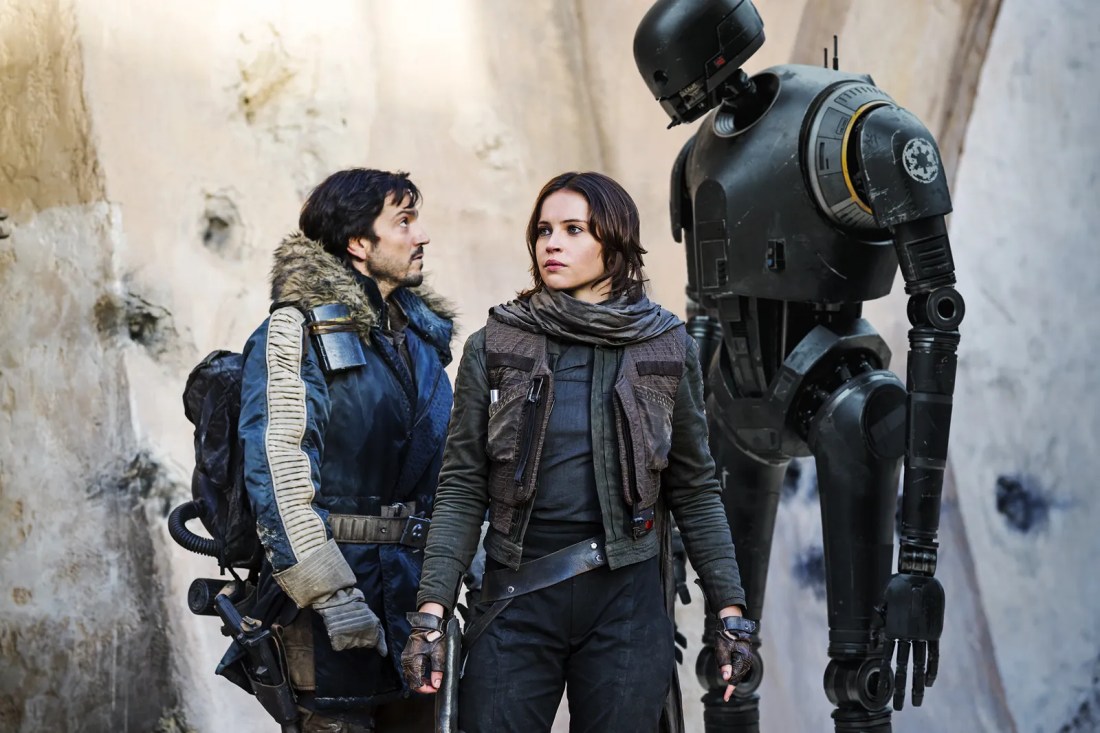
Career criminal Jyn Erso (Felicity Jones) is picked up and recruited into the Rebellion by Cassian Andor (Diego Luna) and a smart-mouthed (-vocalizered?) droid named K-2SO (Alan Tudyk). Turns out her father Galen Erso (Mads Mikkelson) is a top Imperial scientist and a lead designer on the dreaded Death Star whose construction is nearing completion. What begins as a quest to extract (i.e. secretly assassinate) Galen becomes something much bigger when it is revealed that Jyn’s father had purposely planted an exploitable flaw in the Death Star that gives a small chance for destroying it. Unfortunately Galen’s message does not elaborate on the specific nature of the flaw and a race ensues to steal the Death Star plans and deliver them to the Rebellion in order to discover the station’s weakness. Standing in their way are the entirety of the Imperial military and the machinations of Grand Moff Tarkin (impressively recreated by CGI mo-cap) and the ambitious and overcompensating Orson Krennic (Ben Mendelsohn). Along the way our heroes pick up a variety of interesting characters: the blind Force-sensitive monk Chirrut Imwe (Donnie Yen), his more grounded and cynical protector Baze Malbus (Jiang Wen), and an imperial defector named Bodhi Rook (Riz Ahmed).

The characters in Rogue One stand apart from the heroes of the Original Star Wars Trilogy in their lack of perfection and their worldly disregard for moral idealism. Jyn sees the Empire as an unstoppable reality and prefers to keep herself uninvolved with her head down. Cassian makes ethically compromised decisions for what he believes is the greater good. “We’ve all done terrible things on behalf of the Rebellion” he says early in the movie. It is not until Jyn’s father is killed in a botched operation does he begin to see the bigger picture of what it means to be one of the good guys and what is and what is not acceptable for a good man to do no matter what.

What makes Rogue One among the best Star Wars films is its uncynical honesty (a sadly rare combination in film and literature in this day of anti-heroes and angry young men). A lot of snake oil preachers give us an unrealistic view of the world when teaching moral values. They deny the ugliness of the world because it is too hard for them to reconcile their teachings with it. Rogue One denies nothing and tells us to be good anyway. The characters operate on a lot of ifs and long shots. There is no guarantee that they will succeed in getting the Death Star plans or survive the attempt and more difficult still is there is no guarantee that the plans will contain anything useful. And later on as we have seen there is no guarantee that the Rebellion will succeed in destroying the Death Star even if a weakness is found. A lot of people die for these uncertainties. The guarantees are absent. Only hope remains. But rebellions, after all, are built on hope.

Balanced with Rogue One’s themes is a wildly entertaining adventure. The special effects on display are some of Star Wars’s best and the action sequences are well-sustained and paced with plenty of emotional investment to keep the viewer enthralled. The final scenes are full of tragedy and show the grim reality of sacrifice amidst unwelcoming odds. But tragedy is neither the final note nor word of the film. It is hope.