
3/4 stars
Wonder Woman is where the DC Extended Universe (DCEU) finally gets it right. Upon its release it was the best of the series and the best looking. Man of Steel was a turgid misfire and Suicide Squad was an execrable display of incompetence. Batman v Superman had many great qualities, but had flaws that alienated its audience. With Wonder Woman next on the slate, director Patty Jenkins approached the material by making what the audiences had wanted all along: a superhero movie. Instead of following the subversive pattern set by Zack Snyder she tears a page from Phase One of the Marvel Cinematic Universe’s playbook and makes a superhero origin movie that follows the writing philosophy of the first Iron Man and Captain America: The First Avenger.
These types of movies are what they are. They aren’t movies in the usual sense. They are not made to stand on their own, but designed to revolve around a larger cycle of other movies. Modern superhero films are part of an expensive serial that releases two to three 2-hour episodes a year. Even origin stories like this one serve only to introduce its character. What they don’t do is give the characters a solid resolution. Story is an afterthought, the writing being pooled into setting up the ensemble event to come later. A lot of auteurs in the industry resent them for reasons I do not necessarily disagree with, but accepting them as something different I can review them for what they are and not for something they aren’t intended to be. I happen to enjoy serials, after all.
Wonder Woman (Gal Gadot) starts out as a young woman who is trained and honed for combat on an island inhabited by Amazons. Diana – the future Wonder Woman – was made of clay and brought to life by the god Zeus. She is raised by the Amazonian queen Hippolyta (Connie Nielsen) who delays her combat training because she wants to keep her sheltered. But, Hippolyta’s sister, Antiope (Bonnie Wright) trains her in secret. Diana is told that the god of war, Ares, had slain all the other gods except for Zeus who had banished him to who knows where. The Amazons were created to protect the race of humans against Ares who wants to exterminate them and they fear his eventual return. I don’t rightly recall reading this in Bulfinch and Hamilton, but comic book gods are a different ilk from their classical sources and merely share their names. I’ve had similar thoughts about Rick Riordan.
When American fighter pilot, Steve Trevor (Chris Pine) crashes his plane nearby while being pursued by Germans they learn from him that outside of their cozy island the world is currently being embroiled in WWI. When Diana first meets him she asks him if he is a man. She had never seen one before and they are seemingly scarce on the island. This begs a lot of questions since the movie explains – too thoroughly, I thought, for a family movie – that only Diana was made of clay and the others were sexually reproduced. There are so many things I want to ask. Where are the men? Do they keep them sequestered out back? Are they only kept for breeding? Is there a way to sign up for the job? And so on.
Diana believes that the war Steve is describing could only be the work of Ares and she negotiates a deal with him to return him home as long as he takes her with him so she can find and kill Ares. Steven thinks she is being naive, but agrees. The eventual reveal of Ares later on is a serious weak spot in the movie since it undermines a more poignant theme that had been running in the film up to that point. Trevor understands that true evil is not found in a single external force and he tries to tell her this several times. The fact is, wars like WWI are not waged by gods and monsters. They are brutally executed on the battlefield, but they are conducted by bureaucrats and men in suits with trimmed nails. They murder men, women, and children by edict and paperwork, call it a day, and then take their families out for ice cream. Evil is not men twirling their mustaches and cackling. Evil looks scarcely different than you or I. So when after so much is made of her being naive on the nature of human wickedness, the sudden reveal of Ares as an instigator behind the war didn’t sit well with me.
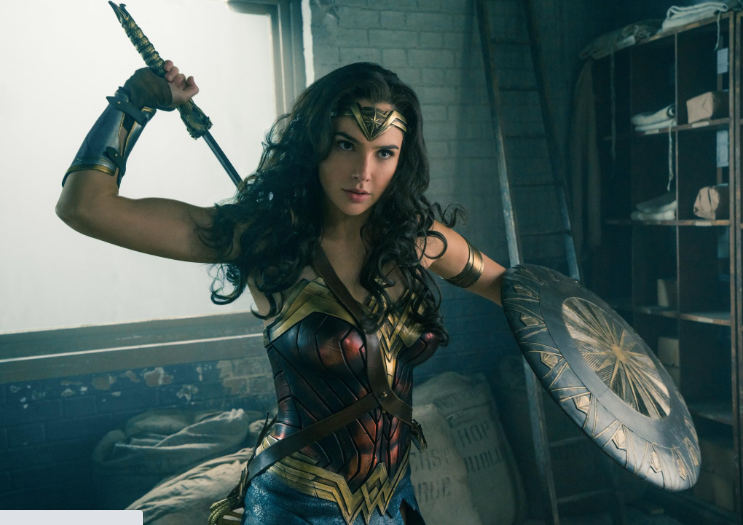
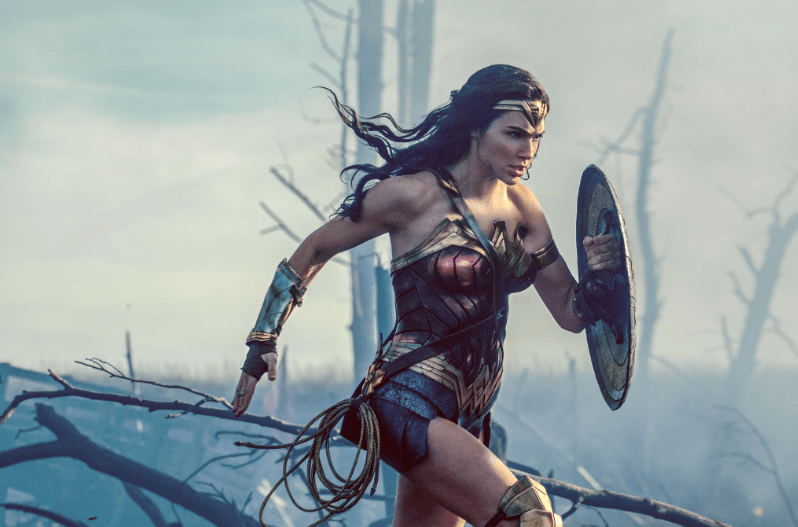
The strongest moments in Wonder Woman are when Diana is slowly adjusting to modern culture and when she is fighting Germans on the front. The action scenes are much better than what the DCEU had done so far. In the earlier films the fights are shot dimly and rely on quick editing to give the viewer a lot of visual noise, but nothing that can be clearly made out. This time, the camera never loses focus on Wonder Woman even when the fighting speeds up and intensifies. Like in the classic Superman movies with Christopher Reeve she charges heroically into action in closeups. We never lose a clear view of Wonder Woman and the side characters which was sadly lacking in the Snyder pictures. Where the action scenes fail is an overuse of slow-mo. Slow-motion photography tends to telegraph events and it steals away their surprise and oomph. When an arrow starts moving in slow-mo around the same moment a character slowly dives into frame you know they are about to get shot. It’s a waste of dramatic tension.
Wonder Woman’s cinematography is otherwise flawless. As I said above it is so far the best looking of the DCEU films up to this point. It drops the drab colors of the previous flicks replacing it with beautiful shots that, for once, contain color and detail. Throughout the late 2000s and most of the 2010s movies started sucking color out of their movies in favor of dim lenses that make everything appear in shades of grey-blue. For reference, see what happened to the Harry Potter movies’ cinematography as the series went on. But around 2016-2017 we started seeing more natural color and lighting in movies again and the trend has mostly stuck around for now. The best shots are when Diana and Trevor are in London. There is a gorgeous attention to detail in the set design and palette. The scenes when Diana is trying on modern clothes in a shop, while deliberately silly, look fantastic.
The music in Wonder Woman, like in Man of Steel and BvS, is largely composed of incidental pieces with nothing in particular that stands out, save for Wonder Woman’s main theme. It was first heard in BvS and it’s a real banger. I’d accept it as the definitive Wonder Woman theme along with John Williams’ Superman and Danny Elfman’s Batman scores. It’s that good, even if they really don’t make great music that much in movies anymore.
I enjoyed Wonder Woman a lot. It showed that the DCEU series was capable of reproducing the sort of content that made the Marvel movies so popular. The mismanagement that caused the series’ demise later was preventable had they made more movies in the same vein as this one.
When Trevor mentions that saving the day would involve finding the man who can, Diana quips back, “I am the man who can.” Looking at the DCEU’s fallen house of cards compared with the success that was this movie, I think she was on to something. Women, especially Wonder Women, often are.
Director: Patty Jenkins
Writers: Allan Heinberg, Zack Snyder, Jason Fuchs
Producers: Charles Roven, Deborah Snyder, Zack Snyder, Richard Suckle, Jon Berg, Wesley Coller, Geoff Johns, Stephen Jones, Steven Mnuchin, Rebecca Steel Roven, John Bernard, Tommy Gormley, Curt Kanemoto, Enzo Sisti
Cast: Gal Gadot (Diana Prince/Wonder Woman), Chris Pine (Steve Trevor), Connie Nielsen (Hippolyta), Robin Wright (Antiope), Danny Huston (Ludendorff), David Thewlis (Sir Patrick), Said Taghmaoui (Sameer), Ewen Bremner (Charlie), Eugene Brave Rock (The Chief), Lucy Davis (Etta), Elena Anaya (Dr. Maru)
Composer: Rupert Gregson-Williams
Cinematographer: Matthew Jensen
Editor: Martin Walsh

