Snow White and the Seven Dwarfs (1937)

4/4 stars

When looking at cinema and its history, you will be hard-pressed to find a film more significant than Disney’s Snow White. Without it, what would we have today? It paved the way for all animated films produced in the future. Without Snow White there would have been no Pixar, Star Wars, Harry Potter, or the popular influx of superhero movies that we have today. Even The Wizard of Oz would not have been made had MGM not been inspired by Snow White’s success. It brought magic back into the movie theater.

The 1930’s was a rough decade for movies. Aside from the early Universal Monsters and an occasional gem from Hitchcock or Renoir, much of what remains of the decade prior to 1937 are any number of poorly preserved “talkies”; most of which were badly performed and awkwardly paced.

Around the time Snow White came out, the need to redefine cinema was at hand. It happens infrequently throughout the evolution of the art form. When safe bets and stagnation set in an auteur always comes along to remind us of the spectacle that movies were originally made for. It happened in the 1970’s with Spielberg and George Lucas’s Star Wars.
In 1937 the career of Melies – one of the best presenters of spectacle – was long over. Animation at the time was reserved for short subjects and the endeavor to produce a full-length theatrical cartoon like Snow White was considered a big gamble. But, it was a gamble that paid off and movies were never the same again.

The story of Snow White and the Seven Dwarfs is a familiar one. It’s been subject to many other adaptations following the Disney cartoon and it was a well known nursery staple before that. The most popular English form of the Grimm version that inspired the movie was released in 1857. This means that the movie is now older to our current time than the fairy tale was to Disney back in 1937. One might argue that the story is timeless, but if I may be indulged one minor digression, it is my opinion that the original Grimm publication in 1812 (Schneewittchen) was an amalgamation of elements from varying bits of folklore that the Grimm version only compounded and finalized. The story is hardly ancient since the Grimms would have had to make a lot of personal creative choices in its formation. It’s a classic story, but not truly proper folklore.

Literary history aside, the film itself is a work of art. These were the happy days of gorgeous painted backgrounds with animated cels adding liveliness and character to the setting. The film makes minimal use of spoken dialogue, preferring songs to carry the story. The movie makes abundant use of sound in every scene. Often, the musical beats match the beats of the action, letting music replace traditional sound effects. This is particularly seen in Heigh Ho and Whistle While You Work which incorporates the songs’ music into the little visual moments that occur. The mining of diamonds is made with triangles and cowbells and the sound of a tortoise’s laughter is produced with a trumpet. Snow White is one of the most musical of Disney’s productions. It’s like musical theater; a ballet set to the art of animation.

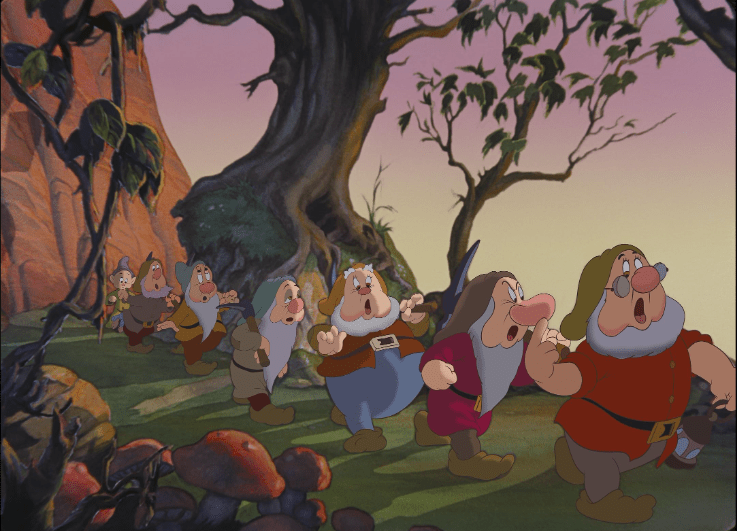
Snow White, the Prince, and the Evil Queen were animated with rotoscoping which was popular at the time. The method had the unfortunate effect of leaving their facial animations ill-defined and it has fallen out of favor long ago. Gratefully the dwarfs and the forest animals are not presented in this way, and they are where the animation truly shines. The saturated color of the animated cels add liveliness and character to the film. They give life and habitation to the beautiful painted backdrops, which unlike rotoscoping, I miss in modern cartoons. The animation gives each of the dwarfs their distinct personalities. They are easily recognized and stand out from each other, which, as fans of The Hobbit will tell you, is a difficult feat.

Disney’s Snow White and the Seven Dwarfs is one of the finest animated fairy tale adaptations ever made. More than that, it is one of the finest films of all time. Unbeknownst to any one at the time, what Walt Disney had accomplished was the future of cinema. It sets the gold standard for how popular films are supposed to be. Its influence cannot be denied. It is as relevant a historical work of art and cultural mainstay as the Sistine Chapel, Wagner’s opera, and the poems of Wordsworth.
In the big picture, film may still be in its adolescence; but Snow White, wherever the arts are respected, will always be among its greatest works.

There has been a lot of talk in recent years of Snow White’s character. Mainly, that she is a misogynistic character type. The general conception is that she lacks personal strength and relies on a male figure to come to her
rescue. In other words, she embodies the damsel in distress motif. However, I disagree with this assessment and I believe the movie deserves a fairer re-analysis. Quite frankly, I think the movie is being grossly misremembered by critics who had not viewed it in a while.
Snow White is shown with a sweet-natured disposition, for sure, and her voice is constantly at a high lilting pitch. She is giggly, bubbly, and extremely positive. But, these are personality traits that some people do have, and per se none of them have anything to do with personal strength. Under her circumstances, though, these traits are more indicative of strength than not. It should be borne in mind that Snow White is living alone with a cruel stepmother after her father had died. Instead of having her spirit broken she remains optimistic and holds onto her ideals of kindness. This is hardly behavior to be expected in the weak.
And the notion that the Prince is some sexist depiction of a male figure coming to her rescue is complete nonsense and not supported by the facts. He only appears in the movie twice, leaving her to spend the majority of the plot doing things for herself. While he does nothing, she survives alone in the woods and takes charge of the dwarfs’ household, becoming their leader. When she sings I’m Wishing, it is not a cry for rescue as modern critics like to claim, but a song of longing. It’s a song about the distance between herself and her lover. It’s a mutually established love and there is nothing sexist about missing the company of one’s partner. His kiss that wakes her from the witch’s curse has been lambasted as an example of non-consent which is just ridiculous when critiquing a fairy tale. In fairy stories we are expected as the audience to suspend our disbelief in love at first sight and we are also expected to accept that they are lovers and that such a kiss was welcome. And I especially don’t want to hear any nonsense about him carrying her in his arms at the end. She was in a coma for a year and her mobility had likely atrophied for awhile. What was the Prince supposed to do? Force her to crawl out of bed Kill Bill-style uphill to his horse?

This may just be my opinion, and others will have their feelings about Snow White, whatever I, or anyone else, might say. What can be agreed on is that movies would not be the same without Snow White. More up-too-date interpretations will continue to come and go and I wish them well. Stories like this were meant to be retold. Even the Grimms were only retelling it. But, better or worse, no retellings of the last hundred years will rival this film in importance. None of them will change the course of the arts like this movie had done. Snow White and the Seven Dwarfs marked the beginning of the modern movie.

Directors: William Cottrell, David Hand, Wilfred Jackson, Larry Morey, Perce Pearce, Ben Sharpsteen
Writers: Ted Sears, Richard Creedon, Otto Englander, Dick Rickard, Earl Hurd, Merrill De Maris, Dorothy Ann Blank, Webb Smith
Producer: Walt Disney
Cast: Roy Atwell (Doc), Adriana Caselotti (Snow White), Eddie Collins (Dopey), Pinto Colvig (Sleepy, Grumpy), Billy Gilbert (Sneezy), Otis Harlan (Happy), Lucille La Verne (Evil Queen), Scotty Mattraw (Bashful), Moroni Olsen (Magic Mirror), Harry Stockwell (The Prince)
Composers: Frank Churchill, Leigh Harline, Paul J. Smith, Bernard B. Brown, Edward H. Plumb, Norman Spencer
Editor: Bill Melendez

Philadelphia (1993)

4/4 stars

About fifteen years ago I had a conversation with a woman who told me she couldn’t understand why I supported gay rights if I was not gay myself. Her ignorance was profoundly telling. About seventy or so Alabaman whites marched at Selma in 1965. Had she been there at the time I knew now where she would have been. She’d have stayed at home. For far too many justice for others is not their problem.

In Jonathan Demme’s Philadelphia, attorney Joe Miller (Denzel Washington) is faced with a similar dilemma. After agreeing to take Andrew Beckett’s (Tom Hanks) case against AIDS discrimination he is propositioned by a homosexual in a drugstore. To this guy it seemed that only another homosexual would take any interest defending a gay man’s rights. But, Miller, an unapologetic homophobe, vehemently and violently denies the assumption. For him the issue is a matter of justice and the law, not social acceptance of the LGBTQ community. Like Oskar Schindler, Miller’s reasons for protecting the disenfranchised are not the same as the disenfranchised’s for seeking his help. When Miller comes around it is not a dramatic scene of recognition of his errors, but a slow process of developing compassion. As their relationship grows Beckett becomes more than just a client. He becomes a fellow human being.

Andrew Beckett is a lawyer working for a prominent law firm who gets fired after receiving an AIDS diagnosis. To him his termination is a cut and dry case of discrimination. But his boss Charles Wheeler (Jason Robards) and his team of lawyers have orchestrated things so that things are not so simple. They sabotage one of his cases by hiding a much needed file so they can accuse him of incompetence. And it is this argument of incompetence they bring to the courtroom, leaving him to have to prove that his homosexuality and illness were the real reasons.
Miller is reluctant, at first, to take Beckett’s case. The fact that he was Beckett’s tenth choice to represent him doesn’t help either. Miller doesn’t think he has a case and he rejects him initially.
The moment of change comes months later when Miller is at the library. As he quietly pores over a stack of books a complete stranger passes him by and stares him down with an angry unprovoked glare. As a 39 year old black man in 1993, Miller remembers a time when racism was legal and institutionalized and the cause of the stranger’s unspoken hostility is obvious. When the moment passes he sees Beckett, his physical deterioration now clearly visible, looking over some law books at another table. The library’s curator and other visitors are uncomfortable with his presence and drop hints that they want him to go study out of sight. The ignorant prejudice that makes them think AIDS is communicable by proximity is fully on display. The scene makes minimal use of dialogue, letting visual language and editing do the talking.

Philadelphia is a film that lets the camera subtly speak for the characters. Emotion is conveyed most strongly in the movie’s shots. Values and thoughts flash by unspoken through glances, gestures, and body language. The film often speaks volumes in scenes where not a word is spoken.

In the court room the defendants exert all their efforts into damaging Beckett’s credibility. They push forward a narrative that Beckett was a mediocre lawyer and the situation with the missing file was the last straw. Their arguments and the facts they present are erudite and convincing enough to leave things seemingly stacked against him. His own defense relies more on circumstantial evidence and it is a very subtle point about his former bosses’ behavior that gives him any chance for success.
Beckett when he is on the stand makes a profound statement about justice. He claims that his favorite part of being a lawyer were those rare moments when he felt he played some role in seeing justice done for other people. It’s a turning point in the proceedings where the looks of shame on the defendants’ faces and the judge’s observation of them silently clarifies everything. They were not the good guys in this story and they knew it.
Being the good guy may seem naive to some, especially to lawyers, but the simple morality of Sesame Street values is where the buck stops at the end of the day. And that is a truth that stands whether we grown-up civilized people want to admit it or not.

Philadelphia is not so much a film about acceptance of the LGBTQ community – despite the subject matter – but rather the universality of human rights and the justice that all people deserve as human beings. What the film states is that we shouldn’t have to approve of someone’s life style and personal identity to afford them rights and give them justice. The fact remains that a man was wrongfully terminated and the act was against the law. A homophobic lawyer’s opinion of his client’s sexuality is irrelevant and Miller understood this when he took Beckett’s case. He finds himself having to remind a journalist in one scene that the Declaration of Independence said that all men are created equal, not all straight men are created equal.

Justice and rights are, as a principle, universal and when we only give them to some we ultimately give them to none. Tides can turn in how the social zeitgeist views certain groups and our salvation and progress lie in the precedent we set today. If we don’t stand up and defend outcasts who are socially safe to discriminate against, who will, when the tides turn again, stand up and defend us?

Director: Jonathan Demme
Writer: Ron Nyswaner
Producers: Jonathan Demme, Edward Saxon, Ron Bozman, Gary Goetzman, Kenneth Utt, Kristi Zea
Cast: Tom Hanks (Andrew Beckett), Denzel Washington (Joe Miller), Joanne Woodward (Sarah Beckett), Jason Robards (Charles Wheeler), Antonio Banderas (Miguel Alvarez), Mary Steenburgen (Belinda Conine), Charles Napier (Judge Garnett)
Composer: Howard Shore
Cinematographer: Tak Fujimoto
Editor: Craig McKay

Doom (2005)

1/4 stars

Doom is a movie that pleases neither fans of the game or fans of action movies in general. Being both I can say this with some authority. ID Software’s 1993 Doom is often heralded as one of the greatest video games ever made and with good reason. It fathered the popularity of the first person shooter genre, was satisfying and cathartic to play, and graphically set the stage for the PC becoming the superior platform for gaming. Alongside BioShock, Donkey Kong Country, and Final Fantasy VI it is one of my favorite video games of all time. It’s simple on story (forgivable in a video game), but it plays like a game of chess. More than just “guns blazing” action it is a game of resource management and split-second decisions on choice of weapon and the player’s movements.

But enough about the video game. I am here to review the movie.

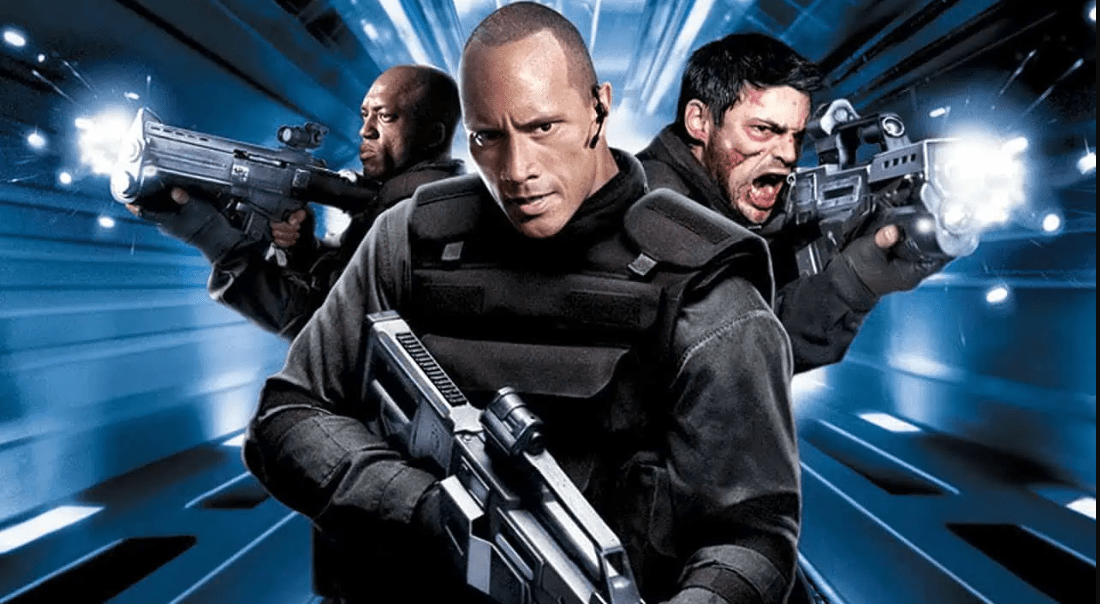
The movie adaptation is a chaotic mess of noise and bad lighting that does no justice to video games or to science fiction movies. Instead of the satanic, heavy-metal inspired inferno of Gothic imagery that made the game so memorable – and so controversial – we get instead a close quarters action thriller that tries to imitate Aliens, but in the end barely reaches the quality of Jason X. At least that movie, awful as it was, had some personality to it. This film has none.
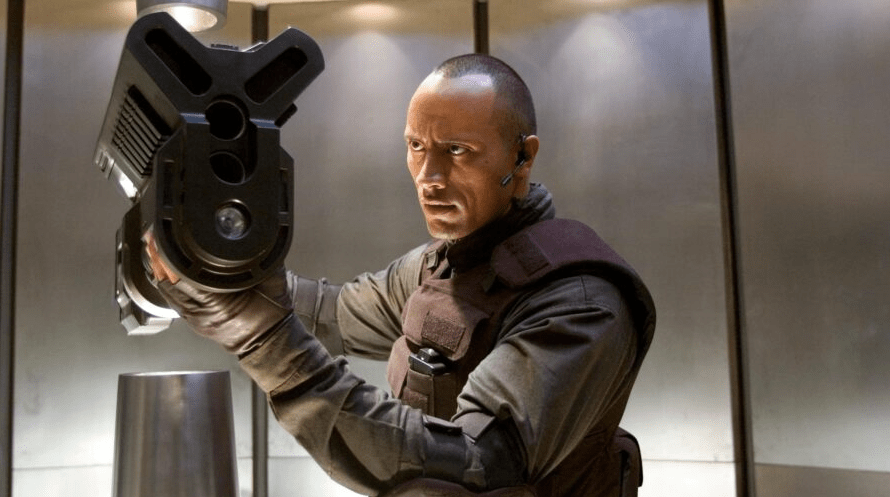
The characters are not characters at all. They exist only because somebody has to shoot the guns, wear the costumes, and get eviscerated every once and awhile. Being written the way they are, the casting can only be an expensive waste of time. Rosamund Pike, The Rock, Karl Urban, and the talented and too often underrated Richard Brake should have fired their agents after starring in this non-spectacle. There is no chemistry to any of their performances. They grunt, scream, and utter some false-ringing phrases of machismo. What the writers don’t seem to understand is that without character investment and plot development, action scenes are going to be boring.
Even had the visuals not been drab and unappealing, the persistent action sequences lack interest. Everything is dimly lit to disguise the paltry special effects budget; the sequences mostly shot in close-up of grimacing faces of space marines space marining their way through dark hallways, strobe lights, and a lot of muzzle flashes and shattering glass.
There is one mildly impressive scene where Karl Urban’s “character” goes into first-person mode (like in the video game) as he fires through a gauntlet of monsters and demons. But the sequence is out of place and pointless. The rest of the film is not shot this way and it doesn’t serve the plot at all. Although admittedly I thought the hell knight wielding a chainsaw was kinda nifty.

My use of the word demon might be a bit premature. In the games they were demons because they were accidentally summoned from Hell by experimental portal tech. But, here they are said to be ancient natives of Mars’s moons that were dug up by an archaeological team. They are explicitly claimed to have one extra chromosome compared to humans and this apparently gives them super-strength and high intelligence. They were products of an ancient eugenic program that turned them into murderous monsters. I won’t comment on the feasibility of all that because I am not a geneticist, but I suspect the science behind this lore is fairly dubious at best.
At any rate the monsters can barely be seen throughout most of the movie. I would expect theater goers expecting some sort of spectacle in 2005 felt ripped off. None of these people spending their cash on a Doom movie were asking for badly lit shadows scurrying past the camera from a distance. But that is what they got, and when we finally get any decent look at the monsters in the film’s last 30 minutes it is too little too late.

This movie really has nothing to do with Hell or even monsters. It doesn’t even have much to do with space marines. There would have to be more genuine camaraderie for that. It doesn’t even have a story worthy of attention. The plot never thickens, it merely simmers. It sticks on one point and doesn’t develop. The space marines go to mars, growl, shoot at things. and die on senseless repeat until the movie is over. Doom was a cheap and tawdry experience to sit through.
If you really want to watch a good adaptation of a video game go watch the Fallout TV series on Amazon. But this movie can stay in Hell where it belongs. It’s the same Circle where they keep the Uwe Boll films.

Director: Andrzej Bartkowiak
Writers: Dave Callaham, Wesley Strick
Producers: Lorenzo di Bonaventura, John Wells, John D. Schofield, Laura Holstein, David Minkowski, Henning Molfenter, Thierry Potok, Jeremy Steckler, Matthew Stillman
Cast: The Rock (Sarge), Karl Urban (John Grimm), Rosamund Pike (Samantha Grimm), Deobia Oparei (Destroyer), Ben Daniels (Goat), Razaaq Adoti (Duke), Richard Brake (Portman), Al Weaver (The Kid), Dexter Fletcher (Pinky), Brian Steele (Hell Knight), Yao Chin (Mac), Robert Russell (Dr. Carmack), Daniel York (Lt. Hunegs), Ian Hughes (Sanford Crosby)
Composer: Clint Mansell
Cinematographer: Tony Pierce-Roberts
Editor: Derek Brechin

Fantastic Planet (1973)

4/4 stars

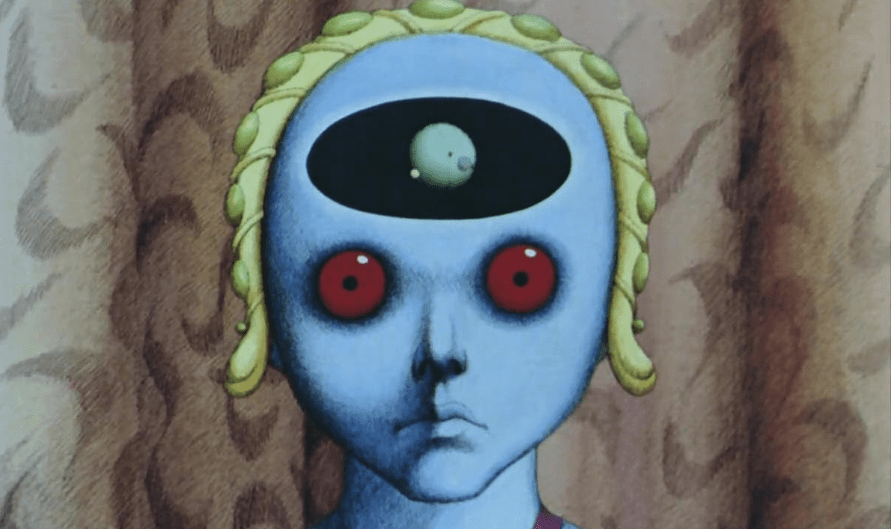
Fantastic Planet is a beautiful and visually arresting piece of counter-culture art. Roland Topor’s animation is like the illustrations of a storybook. Not a single shot is wasted and every frame is a work of beauty on its own. The images have a grim Dr. Seussian quality and are illustrated like a darker version of the works of Maurice Sendak.

The film presents a challenge to our notions of nature and humanity’s relationship with it. The natives of the planet Ygram are gigantic blue-skinned beings called Draags. Theirs is a sophisticated, proud culture where knowledge is highly sought after and meditation is a regular ritual in every household. Humans are also present, but they are the size of insects in comparison and are viewed as little more than dumb animals to the Draags. The humans are called Oms (evidently derived from “homme” the French word for Man), and when they are not being kept as pets they are treated as vermin.
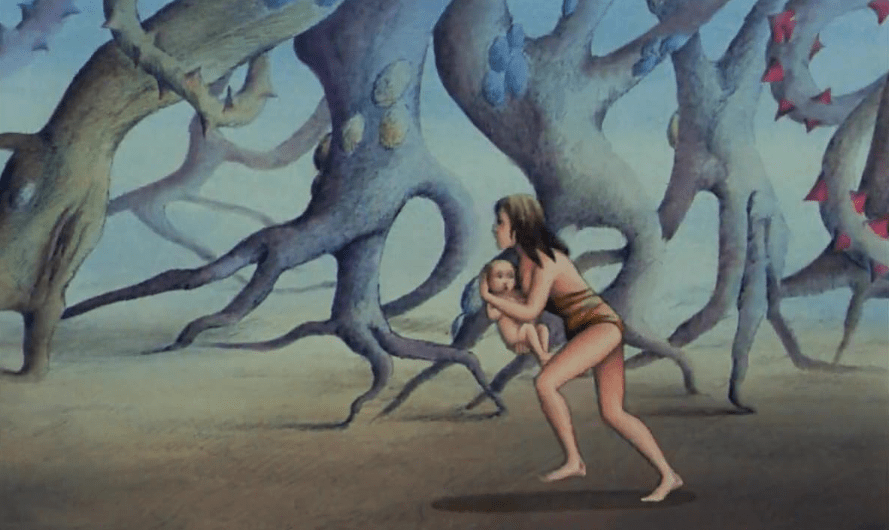
The movie opens with an Om mother carrying an infant in her arms. When she runs into a large blue hand, it’s finger flicks her around like one would an annoying bug. The casual cruelty brings about her death, but a young Draag child finds the Om baby and adopts it as a pet. Their relationship is a playful one, but I would not call it loving. The young Om is prodded and teased like he’s a toy and when the Draag grows into adolescence she becomes bored with him and neglects him. The Om (whose name is Terr) runs away and finds more of his kind in the wilds. These Oms are considered pests by the Draags and are routinely exterminated in a process called de-Ominization.
The Draag attitude toward Oms is not entirely hostile, but it is highly patronizing. Oms make decent pets they claim, but they breed too rapidly in the wild. As sub-Draag animals in their eyes, the Oms have no rights and kindness is afforded them only when it is convenient. In our own culture dogs and cats are loved and treated with familial affection, but little thought is given to killing them should they bite another human being or if they contract a disease. We distinguish them from humans where individual rights come into play. The Draag opinion of Oms is not dissimilar. What is most alarming about the Draag’s ideas about Oms is how sensible they are from their point of view. Why shouldn’t they flick an annoying Om away like a bug if a bug is all they are? Why shouldn’t their nests be subject to extermination if animals is all they are? As long as the Oms are equated with animals the Draags’ behavior toward them is justified. It’s as justified as how we treat animals on our own planet. No crime is committed when we squash a bug. Even when we take satisfaction and enjoyment from the experience. Think on the last time you squashed an annoying beetle. Did it make a popping crunch when it died? Have you ever sucked terrified pests with a vacuum and watched them go? Was it oddly fun and satisfying? In its own way The Fantastic Planet asks these questions. And it adds one more. Could there be something wrong with being so casual about it, let alone enjoying it? The reason we reject these questions is because we accept that they are sub-human species and the act of killing them and even enjoying it doesn’t carry the same moral weight as doing the same to another human being. As long as the Draag maintain this same view of the Oms they are cushioned against any guilt from causing them harm. When we are convinced of our definitions there is moral justification in committing these acts without moral censure. Roland Topor, who also co-wrote the film, knows this better than most. His father was a Polish-Jew who had been one of a small group of survivors of a Nazi death camp. And like the Draags, the Nazis freed themselves of guilt by their definitions. Jews were not human beings to them. Ergo their brutal treatment was justified. Evil doesn’t cackle and twirl its mustache like in cartoons. It moralizes and debates with cold reason.

Fantastic Planet is the sort of film that is only one of a handful of films that comes along in my lifetime. They are the films that challenge me by asking questions that are uncomfortable and difficult to answer. Like most of my species, I was raised to find the question of animal rights laughable at best. Fantastic Planet asks the question and it is not funny at all. It forces the viewer to face the issue even if the answer is not clear. I appreciate art that challenges. I personally think we need more of it. Even were we to fall back onto the opinions we held before, it is no bad thing to reevaluate them once in awhile.

Director: Rene Laloux
Writers: Roland Topor, Rene Laloux
Producers: Anatole Dauman, Simon Damiani, Andre Valio-Cavaglione
Cast: Jennifer Drake (Tiwa), Eric Baugin (Young Terr), Jean Topart (Master Sinh), Jean Valmont (Adult Terr)
Composer: Alain Goraguer
Cinematographers: Boris Baromykin, Lubomir Rejthar
Editors: Helene Arnal, Marta Latalova

The Plague Dogs (1982)

3.5/4 stars

Hope is a powerful thing. It can push a man (or a dog) to achieve more than he otherwise could without it. But hope doesn’t ensure victory and The Plague Dogs is tragically aware of this. By the close of the first act it is clear that nothing that happens in the movie is going to end well.

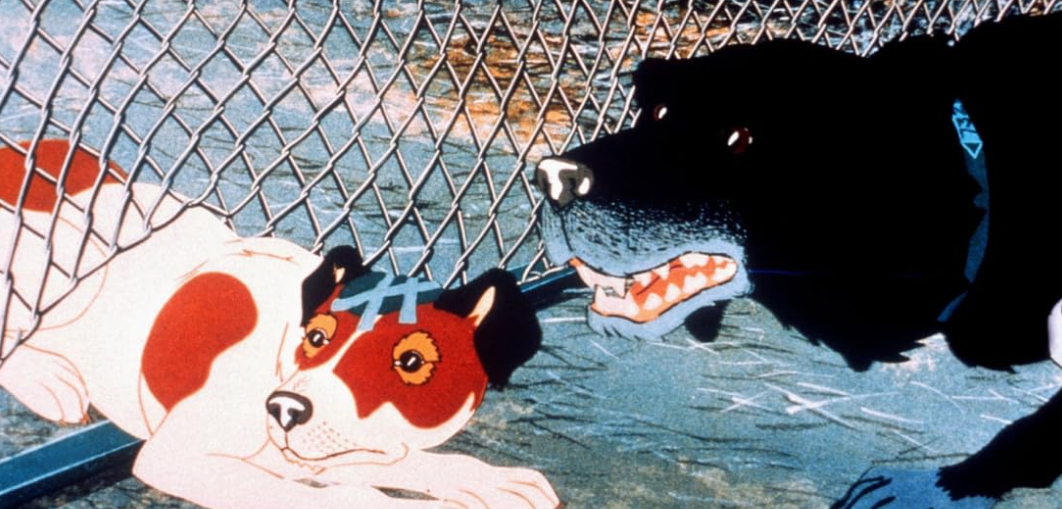
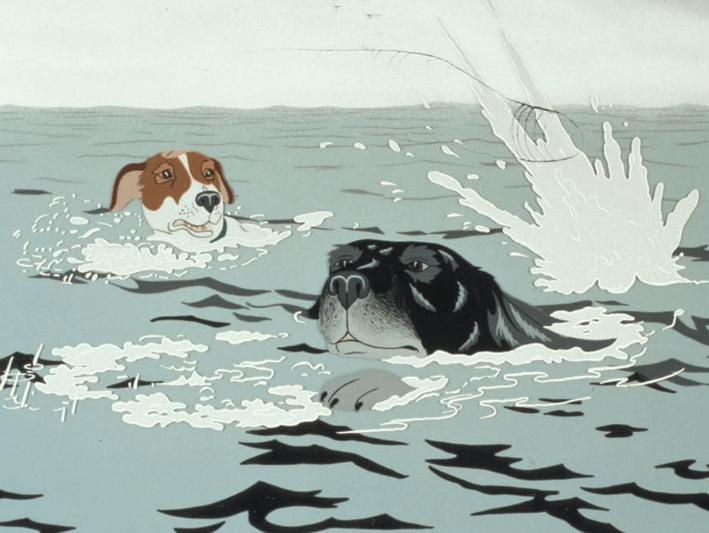
The film (by the creators of Watership Down and based on a novel by the same author) opens with a dog being cruelly drowned by lab scientists. They retrieve and resuscitate him; and it is explained that they have been doing this routinely. What is involved is an endurance test in which the scientists time how long the poor dog can be kept underwater before being saved. It’s stated that psychology is a factor. The dog, named Rowf (Christopher Benjamin), begins to anticipate the rescues which gives him the endurance to survive the longer and longer periods of simulated drowning. Simpler put, hope is trained into him as a Pavlovian response.
Rowf doesn’t understand why this is being done to him and wonders aloud if he has been a bad dog somehow. His friend, Snitter (John Hurt), has more reason to think so. Unlike Rowf, Snitter was not raised in captivity and once had a kind, loving master. But his old owner was killed by an oncoming truck after he had tried to coax Snitter off the road. Snitter still suffers from bad dreams over the incident and he views the lab and the harsh world they escape into as a sort of purgatory to atone for his past sins. Snitter is not being drowned routinely like Rowf is, but the scientists conducted an experimental brain surgery on him that causes him difficulty in distinguishing reality from his imagination. This causes him to relive his past traumas vividly and he sometimes dives into his own memories of happier days because he thinks he is physically safer there.

Their escape from the lab presents them with freedom, but not much happiness. The English countryside they wander in is to them a stark wild place. The painted backgrounds present wide open fields and stony ground in late Autumn. It’s a cold unfriendly place that requires cold and unfriendly acts to survive. They begin slaughtering sheep for food which gets a lot of angry attention from local herders. It’s not long before the two escaped dogs are on the news and the lab scientists are working hard to find the dogs and kill them. Turns out there is more to the dogs’ escape than killing sheep and inconveniencing farmers. The dogs are revealed to be carriers of the bubonic plague and the scientists have an invested interest in seeing them neutralized.

Rowf and Snitter don’t understand any of this, of course, and they press on trying to find a safe place away from the harsh environment. At first, Snitter holds out in the hopes of finding new masters to care for them, but the harsh reception from the locals dashes these dreams. In the end their only goal is safety. What they find in the end is a world that has rejected them and won’t allow them peace or security.

The driving force throughout the events of The Plague Dogs is hope. But the situation Snitter and Rowf are in is a hopeless one. The film delves into the psychology of hope honestly. Hope does not always bring about victory, but it can lengthen the duration of survival and add endurance. The dogs’ ignorance and their hope gets them as far as it does. But the film’s final note is one of uncertainty and nothing works out for them as they had wished.

The fact that The Plague Dogs is a cartoon can be misleading to the unwary. The painted backdrops give still life realism to the Fall-to-Winter world they dwell in, and the animated cells are not gaudy and colorful like in a Disney picture. The animals and people are drawn with the same realism in mind and they are photographed as if they were live action and not cute cartoon characters. This is also a very violent film that gives tangible reality to the messiness of death. The Plague Dogs, like Watership Down which preceded it, is not a movie for young children. If anything, this film is more traumatizing and dark than Watership Down ever was. That film was about the harshness and sacrificial requirements needed to achieve victory. The Plague Dogs is not about victory at all. Rather, it is about hope in the midst of hopelessness. Their hope carries them far, but never far enough; and there is a stark sort of truth to how this movie handles hope and its value. Most movies cop out with promises of salvation and victory, even if bittersweet and costly. The Plague Dogs is a movie that has the guts to tell us that sometimes things just don’t work out. That is not to say that hope is a dangerous lie. The film doesn’t indict hope at all. But it does say something about being prepared for failure. It’s a rough truth, but a valuable one.

Director: Martin Rosen
Writer: Martin Rosen
Producers: Martin Rosen, Jake Eberts
Cast: John Hurt (Snitter), Christopher Benjamin (Rowf), James Bolam (The Tod), Nigel Hawthorne (Dr. Boycott), Warren Mitchell (Tyson/Wag), Bernard Hepton (Stephen Powell), Penelope Lee (Lynn Driver)
Composer: Patrick Gleeson
Editor: Richard Harkness

Wonder Woman (2017)

3/4 stars

Wonder Woman is where the DC Extended Universe (DCEU) finally gets it right. Upon its release it was the best of the series and the best looking. Man of Steel was a turgid misfire and Suicide Squad was an execrable display of incompetence. Batman v Superman had many great qualities, but had flaws that alienated its audience. With Wonder Woman next on the slate, director Patty Jenkins approached the material by making what the audiences had wanted all along: a superhero movie. Instead of following the subversive pattern set by Zack Snyder she tears a page from Phase One of the Marvel Cinematic Universe’s playbook and makes a superhero origin movie that follows the writing philosophy of the first Iron Man and Captain America: The First Avenger.

These types of movies are what they are. They aren’t movies in the usual sense. They are not made to stand on their own, but designed to revolve around a larger cycle of other movies. Modern superhero films are part of an expensive serial that releases two to three 2-hour episodes a year. Even origin stories like this one serve only to introduce its character. What they don’t do is give the characters a solid resolution. Story is an afterthought, the writing being pooled into setting up the ensemble event to come later. A lot of auteurs in the industry resent them for reasons I do not necessarily disagree with, but accepting them as something different I can review them for what they are and not for something they aren’t intended to be. I happen to enjoy serials, after all.

Wonder Woman (Gal Gadot) starts out as a young woman who is trained and honed for combat on an island inhabited by Amazons. Diana – the future Wonder Woman – was made of clay and brought to life by the god Zeus. She is raised by the Amazonian queen Hippolyta (Connie Nielsen) who delays her combat training because she wants to keep her sheltered. But, Hippolyta’s sister, Antiope (Bonnie Wright) trains her in secret. Diana is told that the god of war, Ares, had slain all the other gods except for Zeus who had banished him to who knows where. The Amazons were created to protect the race of humans against Ares who wants to exterminate them and they fear his eventual return. I don’t rightly recall reading this in Bulfinch and Hamilton, but comic book gods are a different ilk from their classical sources and merely share their names. I’ve had similar thoughts about Rick Riordan.
When American fighter pilot, Steve Trevor (Chris Pine) crashes his plane nearby while being pursued by Germans they learn from him that outside of their cozy island the world is currently being embroiled in WWI. When Diana first meets him she asks him if he is a man. She had never seen one before and they are seemingly scarce on the island. This begs a lot of questions since the movie explains – too thoroughly, I thought, for a family movie – that only Diana was made of clay and the others were sexually reproduced. There are so many things I want to ask. Where are the men? Do they keep them sequestered out back? Are they only kept for breeding? Is there a way to sign up for the job? And so on.

Diana believes that the war Steve is describing could only be the work of Ares and she negotiates a deal with him to return him home as long as he takes her with him so she can find and kill Ares. Steven thinks she is being naive, but agrees. The eventual reveal of Ares later on is a serious weak spot in the movie since it undermines a more poignant theme that had been running in the film up to that point. Trevor understands that true evil is not found in a single external force and he tries to tell her this several times. The fact is, wars like WWI are not waged by gods and monsters. They are brutally executed on the battlefield, but they are conducted by bureaucrats and men in suits with trimmed nails. They murder men, women, and children by edict and paperwork, call it a day, and then take their families out for ice cream. Evil is not men twirling their mustaches and cackling. Evil looks scarcely different than you or I. So when after so much is made of her being naive on the nature of human wickedness, the sudden reveal of Ares as an instigator behind the war didn’t sit well with me.

The strongest moments in Wonder Woman are when Diana is slowly adjusting to modern culture and when she is fighting Germans on the front. The action scenes are much better than what the DCEU had done so far. In the earlier films the fights are shot dimly and rely on quick editing to give the viewer a lot of visual noise, but nothing that can be clearly made out. This time, the camera never loses focus on Wonder Woman even when the fighting speeds up and intensifies. Like in the classic Superman movies with Christopher Reeve she charges heroically into action in closeups. We never lose a clear view of Wonder Woman and the side characters which was sadly lacking in the Snyder pictures. Where the action scenes fail is an overuse of slow-mo. Slow-motion photography tends to telegraph events and it steals away their surprise and oomph. When an arrow starts moving in slow-mo around the same moment a character slowly dives into frame you know they are about to get shot. It’s a waste of dramatic tension.

Wonder Woman’s cinematography is otherwise flawless. As I said above it is so far the best looking of the DCEU films up to this point. It drops the drab colors of the previous flicks replacing it with beautiful shots that, for once, contain color and detail. Throughout the late 2000s and most of the 2010s movies started sucking color out of their movies in favor of dim lenses that make everything appear in shades of grey-blue. For reference, see what happened to the Harry Potter movies’ cinematography as the series went on. But around 2016-2017 we started seeing more natural color and lighting in movies again and the trend has mostly stuck around for now. The best shots are when Diana and Trevor are in London. There is a gorgeous attention to detail in the set design and palette. The scenes when Diana is trying on modern clothes in a shop, while deliberately silly, look fantastic.

The music in Wonder Woman, like in Man of Steel and BvS, is largely composed of incidental pieces with nothing in particular that stands out, save for Wonder Woman’s main theme. It was first heard in BvS and it’s a real banger. I’d accept it as the definitive Wonder Woman theme along with John Williams’ Superman and Danny Elfman’s Batman scores. It’s that good, even if they really don’t make great music that much in movies anymore.

I enjoyed Wonder Woman a lot. It showed that the DCEU series was capable of reproducing the sort of content that made the Marvel movies so popular. The mismanagement that caused the series’ demise later was preventable had they made more movies in the same vein as this one.
When Trevor mentions that saving the day would involve finding the man who can, Diana quips back, “I am the man who can.” Looking at the DCEU’s fallen house of cards compared with the success that was this movie, I think she was on to something. Women, especially Wonder Women, often are.

Director: Patty Jenkins
Writers: Allan Heinberg, Zack Snyder, Jason Fuchs
Producers: Charles Roven, Deborah Snyder, Zack Snyder, Richard Suckle, Jon Berg, Wesley Coller, Geoff Johns, Stephen Jones, Steven Mnuchin, Rebecca Steel Roven, John Bernard, Tommy Gormley, Curt Kanemoto, Enzo Sisti
Cast: Gal Gadot (Diana Prince/Wonder Woman), Chris Pine (Steve Trevor), Connie Nielsen (Hippolyta), Robin Wright (Antiope), Danny Huston (Ludendorff), David Thewlis (Sir Patrick), Said Taghmaoui (Sameer), Ewen Bremner (Charlie), Eugene Brave Rock (The Chief), Lucy Davis (Etta), Elena Anaya (Dr. Maru)
Composer: Rupert Gregson-Williams
Cinematographer: Matthew Jensen
Editor: Martin Walsh

Suicide Squad (2016)

1/4 stars

Suicide Squad barely qualifies as a movie. It plays more like a feature length trailer for a movie that doesn’t exist. I said as much to my family when the movie was over. When I later looked up some info on the movie and found out that the film’s editing was outsourced to a company whose specialty was, indeed, making film trailers I felt fairly vindicated. Its original editor dropped out midway through post-production and the studio opted not to give director David Ayer final cut. The nicest thing I can say about Suicide Squad is that there is good evidence that Warner Brothers sabotaged it.
The entire movie is nothing but the sort of highlights of action and comedy that one sees in marketing. It never takes a break, but keeps moving from one thing to the next, never stopping to flesh out its characters or settle upon a theme. It’s essentially a heist/task force movie; a genre that has put out more garbage than gold most of the time.

Suicide Squad was an endurance test on my patience the entire time I was watching it. When a film has its characters written this thinly, what you get is a boring movie. It doesn’t matter how many action scenes you cram into it. There is no emotional investment in this movie at all. The motivations and drives of its leads are limply delegated to a few short vignettes which don’t do the job. These scenes are also thinly written, serving only to tell us how the characters feel, but the never showing it convincingly. It misuses its cast unforgivably.

Following the death of Superman in Batman v Superman, the film’s plot – or what passes for one – tells us that the US government is concerned about how to combat evil meta-humans going forward. At the Pentagon, intelligence officer Amanda Waller (Viola Davis) comes up with the brilliant idea (and by brilliant I mean stupid) to create a specialized response unit comprised of some of the worst criminals and super-villains in the world. However, the only thing she accomplishes by doing this is, is to create the very problem that the Pentagon feared. One of them goes rogue almost immediately and poses such a serious threat the remaining members of the team are assigned to take her out. The incompetence on display here is staggering. What makes Waller all the more infuriating is she never takes any ownership of the mess. She remains arrogant and overconfident throughout the film, and worse still, she outright murders Pentagon personnel for overhearing information about the Suicide Squad they weren’t cleared to hear. These individuals probably had families to go home to and they are killed to protect a group of gangbangers and thugs. Waller ought to face court martial and a firing squad for this.

Enchantress (Cara Delevingne) is an ancient witch spirit who possesses the body of a woman named June Moore who just happens to be the lover of one of Waller’s subordinates. Enchantress summons her brother Incubus and creates an army of possessed former soldiers in order to destroy the human race. What else is new?
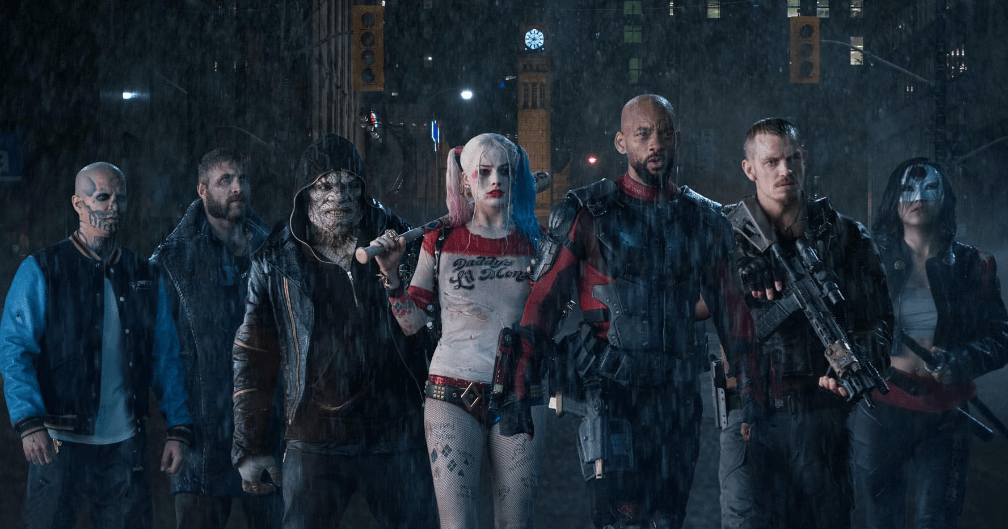
The members of the Suicide Squad are six prison inmates. Deadshot (Will Smith) is a paid assassin and family man who wants to see his daughter again. Killer Croc (Adewale Akinnuoye-Agbaje) is a sewer-dwelling lizard man whose sole reason for joining is because he wants to negotiate getting BET on the TV in his cell. El Diablo (Jay Hernandez) is a fire-wielding gangbanger who accidentally killed his family years ago and is now mildly sad about it. He refuses to use his powers at first, but later comes around. Good for him, I guess.
The most interesting of the bunch – yet still woefully underwritten – is Harley Quinn (Margot Robbie). She’s an exaggerated caricature of Mallory from Natural Born Killers who maintains a cutesy flirtatious lilt to her voice even when murdering people. She’s the Joker’s (Jared Leto) girlfriend and was at one time his therapist until he brainwashed her by forcing her into an electro-shock therapy machine. Her weapon of choice is a baseball bat which she preposterously brings to gun fights. The other two are Slipknot and Captain Boomerang whose contributions to the film leave them not worth talking about. There is also added to the mix a Japanese swordswoman named Katana (Karen Fukuhara) whose dead husband’s soul lives in her sword.
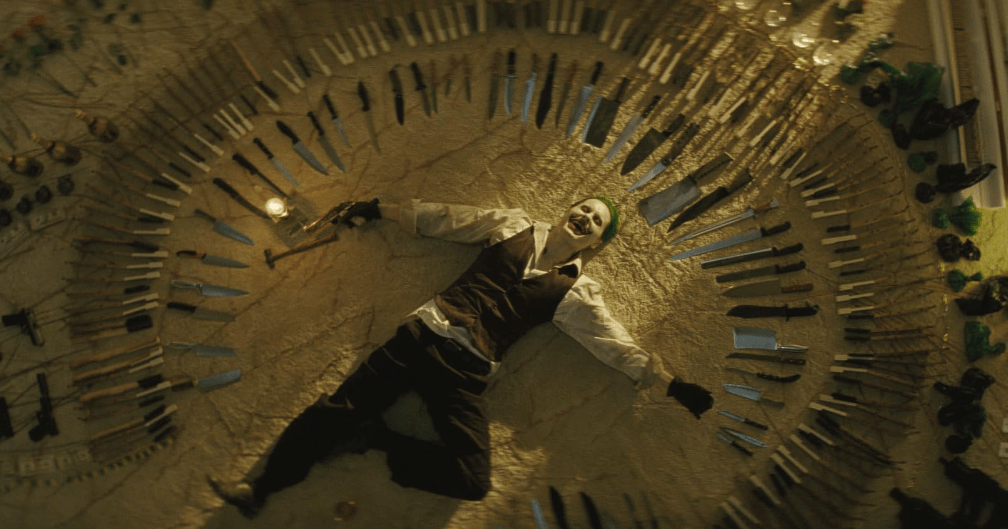
Joker is one of the weakest points of the movie. His screentime is shockingly minimal and Leto plays him more like a flamboyant mob boss than the master of chaos and insanity that we know. His appearance – slick-backed green hair, white makeup, and shirtless tattooed body – reminds me of someone you’d see in an emo band.

These characters are introduced in quick succession with a few sparing minutes given for each to provide them some semblance of backstory. The movie’s plot gets moving and doesn’t stop as soon as its begins. Suicide Squad barely has a first act which is crucial if you want to tell a story and have the audience give a damn about it.
Instead of plot the film is more obsessed with violent imagery, edgelord humor, and squeezing in as many back shots of Margot Robbie in booty shorts during its runtime as it can get away with. The whole thing is a childish mess and doesn’t deserve to be called a movie. It was made with 12 year old boys in mind. The sort who play a lot of GTA, listen to rap and metal, and who just discovered internet pornography for the first time recently. Not only does Suicide Squad have nothing to say about real people, it isn’t even made for real people. Certainly not people I’d leave alone with my kids.

I find it hard to believe that Suicide Squad is supposed to be connected to Man of Steel and Batman v Superman. Those movies, while imperfect, are far more charismatic and wholesome than this piece of juvenile trash. It has all the delicate plotting of a Friday the 13th movie, but even less entertaining. After seeing what Warner Brothers had done to Batgirl I wished they could have shelved this one as well. This is one of the worst superhero movies I have ever seen. I hated every disingenuous moment of it. I hated its thoughtless and pointless approach to violence. I hated the sleaze that went into its writing. Suicide Squad fails on every level, including the simple requirement of being a movie. I would have rather just watched the film’s trailer and pretended it was a short film. The full picture was time wasted that I will never get back. Rarely is a movie so bad that I cannot imagine myself watching it again at some point. But, if I never think about this movie again it won’t be soon enough.

Director: David Ayer
Writers: David Ayer
Producers: Charles Roven, Richard Suckle, Geoff Johns, Steven Mnuchin, Deborah Snyder, Zack Snyder, Colin Wilson, Bruce Franklin, Andy Horwitz, Alex Ott
Cast: Will Smith (Deadshot), Margot Robbie (Harley Quinn), Viola Davis (Amanda Waller), Jared Leto (Joker), Jai Courtney (Boomerang), Jay Hernandez (Diablo), Adewale Akkinuoye-Agbaje (Killer Croc), Cara Delevingne (June Moone/Enchantress), Joel Kinnaman (Rick Flag), Adam Beach (Slipknot), Karen Fukuhara (Katana)
Composer: Steven Price
Cinematographer: Roman Vasyanov
Editor: John Gilroy

The Straight Story (1999)

3.5/4 stars

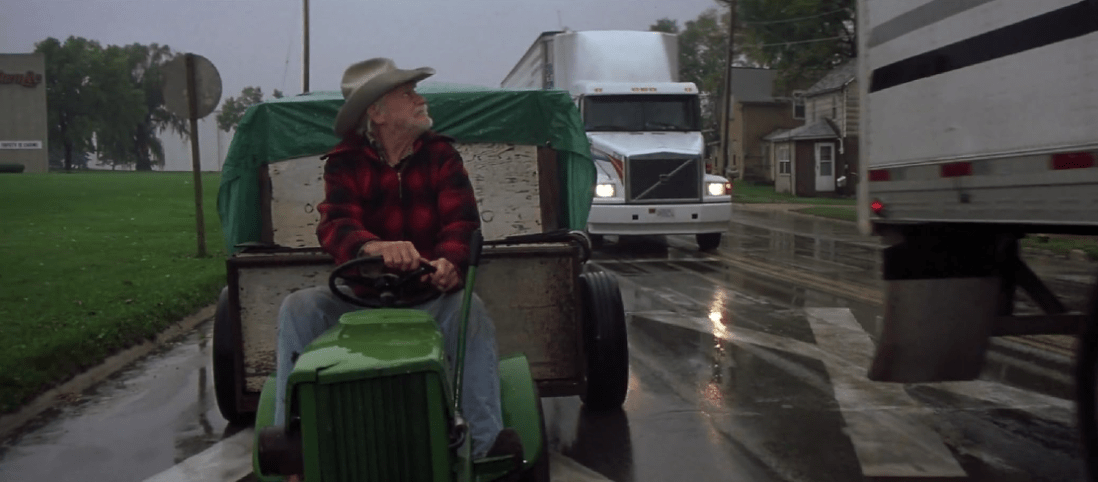
In the Summer of 1994 74 year-old Alvin Straight drove 240 miles from Laurens, Iowa to Blue River, Wisconsin on a riding mower. His older brother Henry had suffered a stroke and Alvin, too old to hold a driver’s license, decided to make the trip to see him on his John Deere. At 5 miles an hour the trip took six weeks. To sustain himself he packed the mower’s trailer with food, camping gear, clothes, and other amenities; while camping out in corn fields and woods at night.
Why an ailing, elderly man with diabetes and emphysema would do this is not a mystery to me as a native of the Midwest. The old timers in my neck of the woods are notoriously stubborn when it comes to self-preservation, but to them family is everything. They are also always working. After retirement they often take a new lease on life, buying farms, renting properties, or pouring their remaining time onto their vehicles. I’ve met a lot of men like Alvin. None of them did what he did, but they are all quite capable of it and they most certainly would do it if a similar situation arose.

David Lynch’s The Straight Story perfectly captures the rural Midwestern spirit. As a Michigan native much of the imagery and personalities that the film portrays are familiar to me. People in the Midwest, especially among the quiet life of retirees, are very much like the people in this movie. Shot on location, The Straight Story accurately presents in its road movie format the long stretches of road along cornfields that sit between towns. Not on a lawn mower, of course, but I have been on many such trips.

I am uncertain what drew David Lynch, a filmmaker known for his surrealism and fascination with body horror, to this story. But, by taking on the project the film’s title takes on a double meaning. The Straight Story naturally refers to the story of Alvin Straight, but it is also out of all of Lynch’s films the most straight story of his career. What typically characterizes his work are unreliable narrators, non-sequential narratives, and bizarre imagery. None of these elements, however, are here and, what’s more, it is the only Lynch film to be rated G and to be distributed by the Walt Disney Company. To the more adolescent David Lynch fans the film might come across as saccharine and hokey. But, to me, the film is just another example of Lynch’s fascination with human behavior and how it connects to the mystery of what life is about and what it means. Unlike his other films it asks no questions. Instead its characters have either since come up with answers of their own or have given up bothering with the questions at all. Their lives have been lived already. Alvin and the other characters in the movie are not seeking anymore, but only doing. Art is often about making sense out of the human experience. But, it is nice to have a change of pace with a movie that is about simple, plain old-fashioned living and carrying the values we learn without constantly questioning them. Questioning values is a young man’s game. The Straight Story, I suspect, speaks most to those who have gone on long enough to have their lives and values figured out. The Straight Story speaks to young and old alike, but it is to the old that it is chiefly directed.

After Alvin Straight (Richard Farnsworth) suffers a fall in his home, his doctor tells him he has to make serious life-style changes if he is to regain control of his health. Like any rural Midwesterner of his generation he decides to ignore the advice. The sole compromise he makes for the doctor is agreeing to equip a second cane.
Alvin lives with his daughter, Rose (Sissy Spacek) who is understandably concerned about her father’s well-being. She has a severe learning disability that leaves her with the mentality of a ten year-old. To Alvin, calling her slow is far from the mark and he insists that she has shown a capacity for self-sufficiency that others do not understand. Due to her issues the State had taken her children away from her after one of them was injured in a house fire while being babysat. The incident was not her fault and she had nothing to do with it. But, the malicious disregard for the mentally ill and the itchy trigger finger people have for calling Child Protective Services is unfortunately systemic in this country and her voice was never heard. Alvin says not a day goes by when she is not pining for her children. Rose, like Alvin, has past trauma that they bear quietly in the present. It makes them who they are, but the trauma is long in the past and what is left are the lasting effects. Past trauma is often dealt with dramatically in movies. A lot of screaming, crying, slamming of fists, heart-wrenching dialogue, and other bits of Oscar bait. But, in reality people, like the people in this movie, cope with their past trauma quietly and it shapes their character. Neither Rose nor Alvin would be the people they are today without it, but the trauma is not the crux of the film’s story.

Alvin gets more bad news when he finds out that his brother (Harry Dean Stanton) has had a stroke. They had not spoken in years after they had had a spat, but the combination of his health problems and those of his brother gives Alvin a sense of borrowed time. Without being able to drive a car, he hooks a trailer to his John Deere mower and begins a six-week journey to meet his brother and hopefully make amends.

The journey is a celebration of rural and small town Americana. The odyssey is a visual feast of stretches of road, country fields, abandoned barns, and bonfires in woody glades. He passes through a modest number of small Midwestern towns where people gather and stare. The people he meets along the way amount to small episodes where his values and eccentric actions touch them in some significant way. Family is a big part of his value system and many of the folks he encounters aren’t quite there yet, but their meetings with him leave them a lot to think about. In Alvin is found something sweet and wholesome that to some may come across as trite. The triteness is an illusion, though, because for Alvin what he says is very much real and true to life. These encounters frequently put the film at risk of uttering a false note, but I detect nothing disingenuous in the movie’s messages. Even when he encourages a teen runaway to go back home or lectures a couple of bickering brothers about loving one’s family, The Straight Story, never rings false like a Hallmark TV movie. The film proves that jadedness is not a necessary quality of being real, and that wholesome values do not have to be faked in drama.

The real life Alvin Straight never did what he did to garner praise or fame. In fact, he never was much comfortable with the media attention and he had declined offers to appear on Leno and Letterman. I doubt he gave it much thought that driving 240 miles on a lawn mower was unusual. He was just a man like anybody else. A man with an ailing brother he wanted to see and the mower was the only means to get there. He was tenacious, but not special; and that is apparently how he wanted to be remembered.
His story could easily have been the subject of a TV movie – come and gone, and then forgotten. I am glad it was not. By giving it a theatrical release and under the guidance of a talented filmmaker it’s inspiring message is more broadly accessible than something aired on a Friday night. The Straight Story’s radical idea that wholesome values and being real do not have to be exclusive is a message people need to hear more and more.

Director: David Lynch
Writers: John Roach, Mary Sweeney
Cast: Richard Farnsworth (Alvin Straight), Sissy Spacek (Rose Straight), Everitt McGill (Tom), Harry Dean Stanton (Lyle Straight)
Producers: Pierre Edelman, Neal Edelstein, Michael Polaire, Mary Sweeney
Composer: Angelo Badalamenti
Cinematographer: Freddie Francis
Editor: Mary Sweeney

Joker (2019)

3.5/4 stars

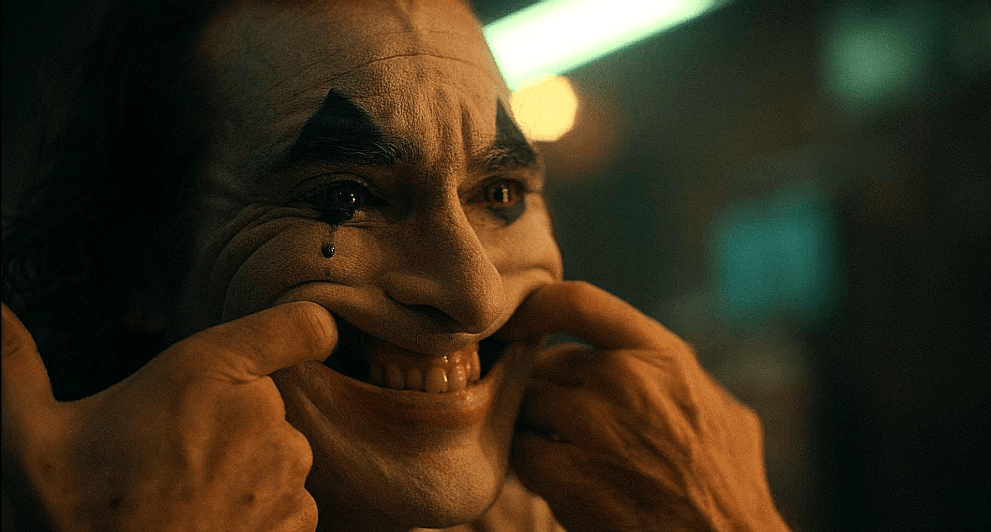
Joker is a movie that rarely shows a moment of compassion or kindness. And, yet, compassion is what the film is about. The absence of it creates a vacuum that emphasizes why kindness and warmth are so important. The pervasive images of cruelty and humiliation on display express the film’s ideals by negative example. The lasting impression when the movie is over is powerful.

When I first saw Todd Phillips’ Joker in theaters back in 2019 I had a strong negative reaction to it. I had felt at the time that the film was being disingenuous and that it was catering to the depressive instincts of angry young men. I’m sure you know the type. They quote Nietzsche, wear black, listen to Nine Inch Nails, and casually say life is terrible on principle. But, seven years later, viewing the film a second time, I think I understand the movie a little more. Like Spike Lee’s Do the Right Thing it shows a series of conditions that escalate to terrible acts of violence. It grates against black and white thinking that patently condemns these events without considering the importance of recognizing their causes.

Arthur Fleck (Joaquin Phoenix) is a severely mentally ill man who has unrealistic dreams of becoming a famous comedian. He lives a lonely existence where the only figure in his life sympathetic toward him is his ailing mother Penny (Frances Conroy), But, she is oblivious to the severity of his problems, suffering from debilitating mental issues and delusions herself. She frequently says he was always such a happy boy even though he is far from happy and likely never was. He is on seven different medications and tells his social worker “You just ask the same questions every week. How’s your job? Are you having any negative thoughts? All I have are negative thoughts.”
Depression is a real bitch and combining it in a cocktail of emotional immaturity, cognitive difficulties, and social isolation is a recipe for disaster. He and his mother live well below the fringes of poverty which forces him to eke out a living in his condition. His job outsources him as a party clown, but his social awkwardness and odd behavior elicits scorn from his boss and coworkers. A part of his condition is a nervous tick where he flies into fits of uncontrollable laughter regardless of what he is feeling at the time. Despite his attempts to explain the condition he only gets mocked and he is frequently asked what he finds so funny. He is unable to connect or bond with anyone. Arthur looks wishfully on as others socialize and engage with one another, but only becomes off putting when he tries to do the same. He comforts himself with childish fantasies of positive social interactions among people he likes and admires. But, in his real life the only time people give him a second look is usually to say something mean.
The isolation he endures is the key to his slow descent into madness. Mental illness and isolation go hand in hand and it gives the sufferer a unique perspective on people. For most of us we can generally separate the mean people from the kind ones; the good from the bad. But, for people with severe mental illness this is harder to do since neither the good people nor the bad people seem capable of treating them very well. The rotten eggs, of course, take every opportunity to heap cruelty and bullying on mentally ill victims. But, there is also a profound failing among more upright people that cuts even deeper. Sidelong glances of irritation, limited empathy, refusing to listen or understand, and social ostracizing are inflicted on the mentally ill by the upright and wicked alike. An impression is given to men like Arthur Fleck that there is a free pass for otherwise nice people to be dismissive and unkind to them because no one really likes them anyway. It’s a road to resentment and painful consequences that often could have been evaded by one encouraging word at the right time that never came.
I think it is these themes that created the polarizing reactions the film got when it came out. The films plays like a dirge for all the school shooters and impassioned murderers who have plagued our recent history. In the wake of a terrible crime it is easy to justify hatred for the perpetrator given the severity of what they had done. And offering them any sympathy or understanding is a big no-no. But, no one wants to acknowledge the onus that is on people who don’t do those things to prevent them. I do try to avoid commenting on specific current social and political issues on this blog so without naming any names I am going to say that I have heard interviews with school shooting survivors who practically boast of the bullying they inflicted on the shooter prior to the event and justify it by what the killer had done. It is hard to blame them after what they had been through, though. There is no denying that what was done is terrible and there is especially no denying that the actions were morally egregious and unjustifiable. But, there is something ugly about normalizing ostracizing the mentally ill on this basis. The disproportion of their crimes too often leaves us unable to recognize that something morally wrong was being done to them regularly before they snapped. And it is these points that made a lot of people angry when they saw the movie. The filmmakers had something to say that many of us don’t want to hear or deal with. There is a reason that the now infamous Aurora, Illinois theater refused to show the film at all after the murders that occurred there during a showing of The Dark Knight Rises in 2012.

The film starts with Arthur working as a street clown twirling a sign to advertise a small business. A group of teenaged thugs steal the sign and beat him up when he tries to chase them down. What follows is one emotional betrayal after another. His boss is angry over the loss of the sign and doesn’t care that he was injured. The social worker he talks to spends their hour staring at him not listening to a word he says. She asks the minimal textbook questions she is required to ask and does little more. Any attempt he makes to express his emotional state usually ends up getting talked over by others who get angry and annoyed with him. They don’t hide their scorn and Arthur is not capable of understanding why he is being treated this way all the time. When pushed to frustration people scream at him for acting out. He writes in his diary, “The worst thing about mental illness is people expect you to behave as if you don’t.” In reality what they expect is for him to not defend himself. And he is swiftly villainised when he does. On a subway a group of three college aged youths begin to harass him and they physically abuse him when he tries to get away. He ends up murdering all three and flees the scene. Gotham City’s reaction is split. The privileged and powers that be condemn the shooting and characterize the dead students as innocent victims whose lives and potential were taken away by a maniac. Among the lower echelons there is a different sentiment. There is widespread sympathy given to Arthur, still currently unidentified as the killer, that galvanizes mass protests against the city government. The murders become a controversial talking point and the scenes eerily seem to anticipate the actions of Luigi Mangione a few years later.

Shortly after the killings Arthur goes to a local comedy club in the hopes of making it big with his act. His performance, however, is a colossal bomb. His laughing condition comes out in full force and he is unable to make any of the jokes land. The footage of his performance becomes viral after clips of it is shown on a talk show hosted by Murray Franklin (Robert DeNiro). Prior to this both Arthur and his mother were fans of Murray and Arthur fantasizes of impressing him someday. But seeing Murray Franklin publicly mock him and his comedy act on live television sends him spiraling deeper into depression and anger. Arthur’s issues escalate continually and he becomes a ticking timebomb. While he is subjected to abuse every day he is met with new tragedies that leaves his ability to cope any further untenable. His mother suffers a stroke and is hospitalized. It is, in fact, in his mother’s hospital room that he sees the episode of Murray mocking him. City budget cuts the funding to social programs leaving him no longer with a social worker and without any further access to his medication. The final nail in the coffin for his mental health is when he discovers revelations about his childhood and identity that steals away any last vestige of the things he values and cares about. Now the only thing that seems to matter are the ongoing riots that he inadvertently started. Outside there are rioters in clown masks who view his actions as that of some unknown local hero. He becomes a perverse symbol for the downtrodden and with that he and society part company for good. The result is violent tragedy and leaving Arthur behind to become the Joker is the only thing that makes sense to him anymore.

Joaquin Phoenix’s performance is spellbinding. His portrayal of a sociopath spiraling out of control is played without gusto and hamfistedness. He is far removed from the wide eyed silliness of Norma Desmond in Sunset Boulevard or the madcap wild insanity of characters like Renfield in Dracula or even the Joker in other media. He is more reminiscent of Travis Bickle from Taxi Driver who happens to be a primary inspiration for the film. He captures the vulnerability and loneliness of real life sociopaths so well to the point that watching him becomes uncomfortable. His physical posture and movements are nervous and uncertain and he emotes through affectation rather than responding naturally which is not uncommon to people with his conditions. What Phoenix accomplished and what earned him his Academy Award for the performance is a perfect character study of a person with mental problems slowly losing his grip on living normally. The systemic problems that wind him up end in events that, while violent and tragic, are not unexpected.

This movie sees the second acting win at the Oscars for an actor playing the Joker (first was Heath Ledger in The Dark Knight) and it is clear to me that the role of Joker has become something coveted. It’s a role like those of characters from Dickens or Shakespeare that gives an actor an opportunity to interpret a literary character who is challenging and complicated to pull off. After films like Logan and The Dark Knight trilogy somewhat of a trend of treating comic books as serious subjects has come about and it is no wonder we are seeing more serious actors pursue these sorts of roles.

Some critics of the film have gone so far as to label the movie dangerous. There was a genuine impression among a lot of people that the movie would incite a riot. To many it seems that Joker is a message to others who see themselves in Arthur Fleck that their anger and hatred for society is permissible. But the movie isn’t talking to them. It is speaking to those who are more like the people around him. It speaks to churchgoers who after Sunday services cuss out teenagers in drive-thrus. It speaks to decent folk who snub and dismiss weirdos in elevators trying to talk to them who smell bad. It speaks to family men who regale their loved ones with funny anecdotes of some crazy person they met at the bus stop. it speaks to honor roll students who make sure undesirables don’t eat with them. The film tells us that evil doesn’t have to be violent. Sometimes evil is just failing to see another human being when they sit right next to us.

Director: Todd Phillips
Writers: Todd Philips, Scott Silver
Cast: Joaquin Phoenix (Arthur Fleck), Robert DeNiro (Murray Franklin), Zazie Beetz (Sophie Dumond), Frances Conroy (Penny Fleck), Brett Cullen (Thomas Wayne)
Producers: Richard Baratta, Bruce Berman, Jason Cloth, Bradley Cooper, Joseph Garner, Aaron L. Gilbert, Walter Hamada, Anjay Nagpal, Todd Phillips, Emma Tillinger Koskoff, Michael E. Uslan, David Webb)
Composer: Hildur Guðnadóttir
Cinematographer: Lawrence Sher
Editor: Jeff Groth

Batman Forever (1995)

2/4 stars

There are three kinds of Batman. Gothic Batman is the subject of the classic comic books and we see him stoically doing what he does best in the Tim Burton movies and the animated TV series from the 90s. The more introspective Edgelord Batman made popular in Christopher Nolan’s Dark Knight trilogy has been a favorite of comic writer Frank Miller, but largely exists elsewhere in memes. Campy Batman is best represented by Adam West back in the 1960s. Campy Batman’s Gotham City is a colorful world of colorful people where villains prance in clownish costumes and laugh maniacally. They are the sort of baddies who twirl their mustaches, tie damsels to railroad tracks, and scheme to poison the city’s water supply.
Director Joel Schumacher’s Batman Forever is a return to the old tradition of campy Batman, slanted camera angles and all. When Schumacher, taking over for Tim Burton, approached the material he aimed to make a live-action cartoon. For better or worse, he succeeded. As stupid and ridiculous as the movie is, it is everything it intended to be; its flaws by design and really a matter of taste.

A common complaint leveled at it is that it is too campy and too cartoonish. I hold to the opposite view. I believe it isn’t campy and cartoonish enough, and therein lies Batman Forever’s downfall. The heroes, given what they are up against, are too sullen for their own good. Val Kilmer, replacing Michael Keaton, in the role of Bruce Wayne commands no presence, adding nothing interesting to the part. As Batman he is stale, watering the character down to a fighting costume.
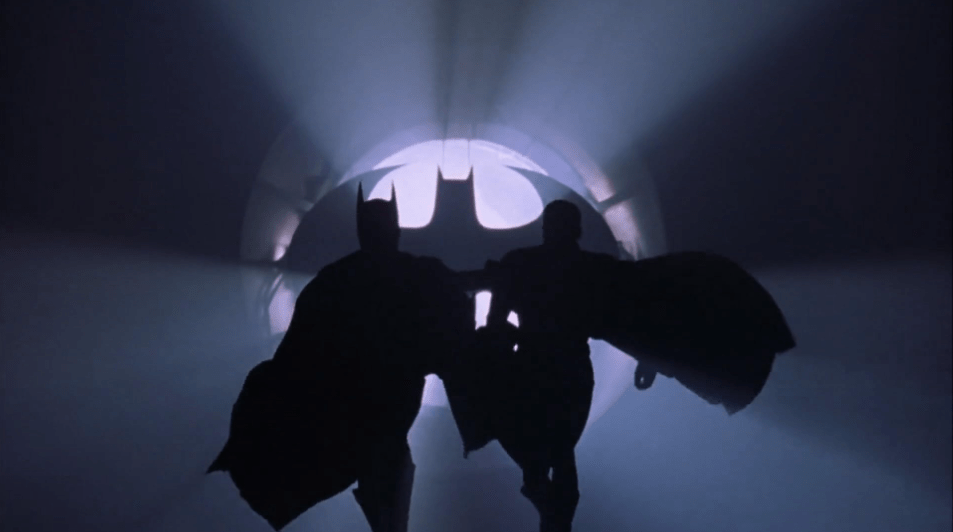
Robin, the Boy Wonder is brought in this time around, and if the fans had been waiting patiently through two movies for Batman’s trusted sidekick to finally appear they must have been sadly disappointed. Chris O’Donnell as Dick Grayson (Robin’s alter ego) has none of Burt Ward’s original energy and passion. O’Donnell plays the role as standoffish and angry. His character development is nothing more than a skin-deep paint-by-numbers expression of the old saw “revenge won’t make the pain go away” and “taking a life leads to a dark path.” There is nothing wrong with such messages of course, but no sincere effort is made to convince the audience of their truthfulness. It’s merely said and Robin comes to these conclusions only when the script finally says so.
Batman and Robin generate no charisma whatsoever, all of their energy being sucked into the two lead villains.

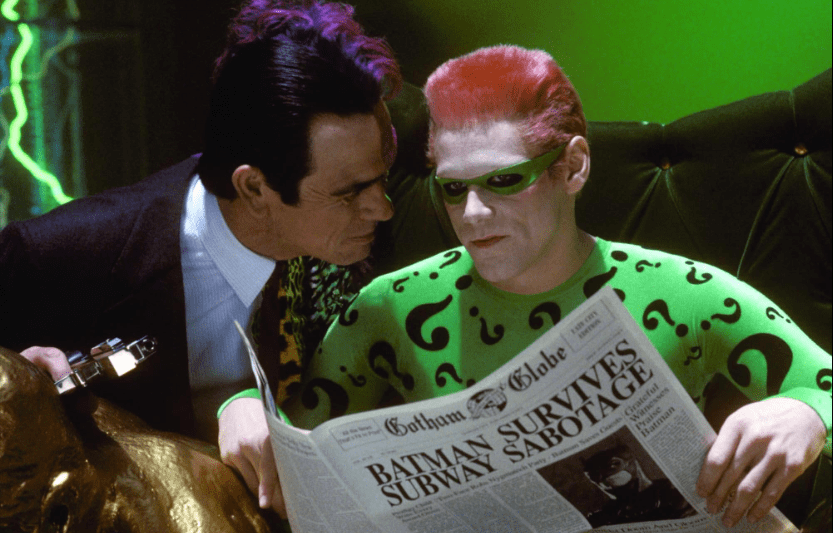
The movie opens with the dastardly Two-Face (Tommy Lee Jones) robbing a bank to lure Batman into a trap. He giggles and jumps up and down like a clown, firing machine guns at nothing in particular as police helicopters swarm above. The burnt side of his face is improbably symmetrical in relation to the other side: a purple bit of prosthetic rubber that appears more like a cartoon’s idea of a deformity than anything seen on a real burn victim. His suit is split in a similar fashion; formal and proper on one side and gaudy and colorful on the other. When we see his evil lair later in the film the interior decoration keeps to this pattern. One side looks like the very throne room of hell and the other is pure white and fit for a fairy tea party. His two sexy girlfriends, Sugar and Spice (Drew Barrymore and Debi Mazar) are bedecked to match.
When Batman arrives at the bank robbery, he is joined by Commissioner Gordon (Pat Hingle) and Dr. Chase Meridian (Nicole Kidman). Meridian is a professional parapsychologist who specializes in super-criminals and caped crusaders alike. She doesn’t look much like a psychologist. She stands next to Batman looking like a blonde bombshell, speaking in silky tones and saying nothing more insightful than what can be gleaned from a copy of Psychology Today. She is about as convincing a psychologist as Denise Richards was as a physicist in The World Is Not Enough. Kidman plays the role like a Bond girl. She feigns a professional interest in Batman that masks something more fetishistic.
We later see a love triangle develop between her, Batman, and his secret identity Bruce Wayne. The movie posits a theme where Dr. Meridian’s infatuation with Batman is something girlish and rebellious; her eventual favoring of Wayne being a moment of maturity. She directs her husky-toned flirtations toward both equally, however, and the point is not hammered home that deeply.

After Two-Face escapes he joins forces with The Riddler (Jim Carrey) whose wild performance is the front and center of the whole show. Carrey plays Riddler with no restraint at all. His acting reaches over the top and then goes only higher. He moves like he is cursed to dance forever and he never stops talking. The performance is loud and obnoxious; Carrey mugs the camera, making bizarre faces and dropping pop culture references and bizarre jokes whenever he is on screen, which ends up being a great deal. Jim Carrey has this way of punctuating his words with sharp turns of his head. He does it so much you could make a drinking game out of it. After Batman Forever I’d be fairly plastered. Try doing it while watching The Mask and you would need a new liver.
When we first meet him he is an excitable and neurotic employee of Wayne Enterprises named Edward Nygma who idolizes Bruce Wayne and wants to impress him with a new mind-control device he invented. Wayne’s predictable rejection crushes the already unhinged Nygma’s spirit and he becomes enraged and bitter. It’s probably the lamest super-villain origin story to date, but it fits the material Schumacher presents.
As Riddler he uses his mind control device to read the minds of everyone in Gotham so he can steal their credit card numbers and financial records. It’s a shockingly short-sighted plot. One man having access to everyone’s money would only crash the economy and more than likely the existence of his machine would force the world to adapt its methods of bookkeeping to counter-act it. But maybe I am overthinking the logistics of a villain scheme obviously reminiscent of a Saturday morning cartoon.

When the movie sticks to Joel Schumacher’s vision it works remarkably well even if Carrey could afford to tone it down a little. Gotham looks better than ever keeping the same Gothic Dr. Seussian aesthetic from before, but more lively and animated. The camera rides through the city like a roller-coaster, allowing the viewer to soak in the details. It reminds me of a professional haunted house made with money as no object.
Tommy Lee Jones and Jim Carrey’s antics are constantly energetic and off the wall. Reminding myself that this is supposed to be a live-action cartoon I can accept them, if not love them overmuch.
Where it fails is with its hero characters. Pat Hingle phones in his performance as Gordon, seeming to be painfully aware of what had become of the series. Kilmer is dry as a bone and O’Donnell is over-serious and undercooked as a character. Nicole Kidman brings to the movie the sort of character we should have had in Catwoman back in Batman Returns. Bond girls and Batman vixens alike are supposed to be somewhat innocent and prepubescent in their sensuality. They entice the man hidden behind the mask, but the boy that the mask represents ultimately wins out and keeps them untouchable. Kidman brings this to Chase Meridian well enough, but still never quite reaches the comic tone that the movie needs more of.

In Batman Forever Schumacher tries too hard to meld the 1960s era camp with the more mature themes of the Burton movies, and the result is an inconsistent mess. In the end I appreciated what the director has tried to do more than what he has done.

Director: Joel Schumacher
Writers: Bob Kane, Lee Batchler, Janet Scott Batchler, Akiva Goldsman
Cast: Val Kilmer (Bruce Wayne/Batman), Tommy Lee Jones (Two-Face/Harvey Dent), Jim Carret (Edward Nygma/Riddler), Nicole Kidman (Dr. Chase Meridian), Chris O’Donnell (Dick Grayson/Robin), Michael Gough (Alfred Pennyworth), Pat Hingle (Commissioner Gordon), Drew Barrymore (Sugar) Debi Mazar (Spice)
Producers: Tim Burton, Mitchell E. Dauterive, Peter Macgregor-Scott, Benjamin Melniker, Kevin J. Messick, Michael E. Uslan
Composer: Elliot Goldenthal
Cinematographer: Stephen Goldblatt
Editors: Mark Stevens, Dennis Virkler