Scott Pilgrim vs. the World (2010)

3.5/4 stars

Scott Pilgrim vs. the World is a movie that defies analysis. As a teenage male power fantasy it lacks serious commentary on power fantasies and, indeed, gives them full expression as something real and legitimate. The world Scott Pilgrim inhabits doesn’t separate adolescent wish fulfillment from reality. Instead, for two hours we are treated to the notion that they are reality. Like True Romance (an admittedly more subtle film) Scott Pilgrim is a boy’s daydream.

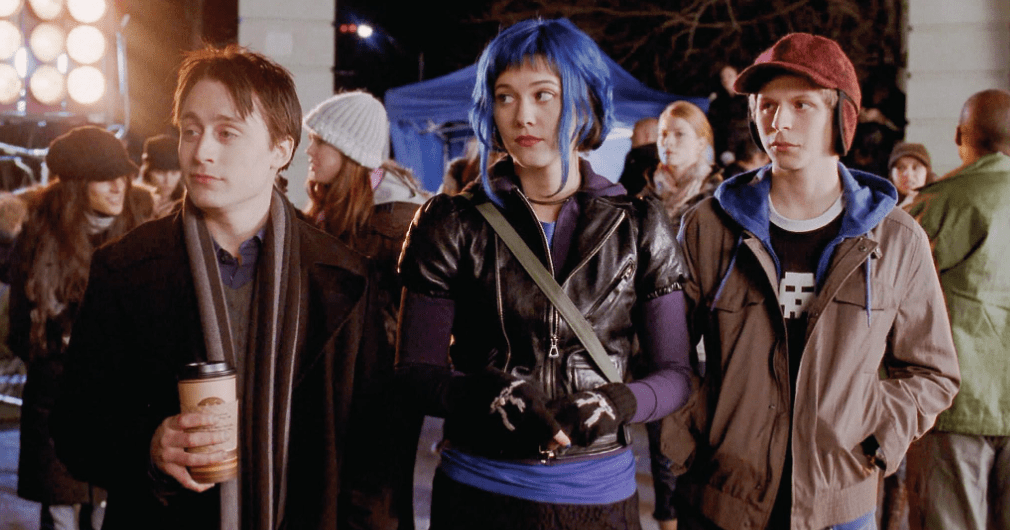
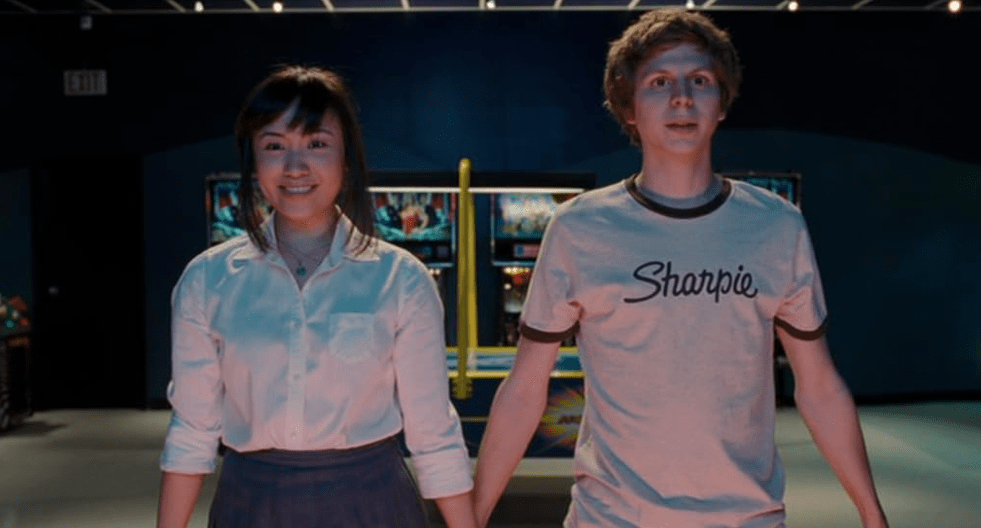
When we first meet Scott Pilgrim (Michael Cera) he is an unemployed 22 year old guitar player who announces to his bandmates that he has a new girlfriend. Her name is Knives Chau (Ellen Wong) and she is a 17 year old high schooler who worships the ground he walks on. His friends make a bit of a fuss over the age gap, suggesting there is something immature in his choices. This is certainly true enough, but more than being immature the relationship touches on a number of ethical grey areas that apparently in 2010 were less scandalous than they are now. Moving on from that, the girl is supportive and enthusiastic for Scott’s musical career. She treats him with complete deference, despite his unobtrusive personality and shy geekiness.
Scott lives in an old bunker-turned-apartment and shares his bed with his gay roommate, Wallace (Kieran Culkin) who disapproves of the relationship. Neither does Scott’s sister Stacey (Anna Kendrick) who pops in and out of the film to give him grief over his life choices. To Scott’s chagrin Wallace always tells her everything about his activities, letting her know as soon as he does. In one surreal and very funny scene Wallace manages somehow to give her the latest dirt even though he is fast asleep at the time. Moments like this are common throughout the movie. It reminds me a bit of a Family Guy episode where the surreal moments pass by with no comment or lasting consequences.

Scott later meets an older girl named Ramona Flowers (Mary Elizabeth Winstead), an offbeat, pink-haired alt girl whom he swears he saw in a dream before. He becomes infatuated with her and pesters her to go out with him, even though he is already in a relationship with Knives. Scott has all the cowardly insecurities of a teenager with low self-esteem and the self-destructive behaviors to match. Like a lot of young men in his predicament Ramona’s complicated sexual history intimidates him. He feels uncertain that he can measure up to her previous partners, all of them jerks of course, while he lives out the common incel myth of being a “nice guy.”
Ramona’s exes have formed a League of Evil Exes whom, according to Ramona, Scott needs to fight if he wants to date her. They are seven in total, all larger than life and highly ridiculous. They range from a boorish action movie star (Chris Evans) to a vegan with super powers (Brandon Routh). The fights are fanciful, super-heroical epic battles heavily annotated with CGI, arcade score counters, and video game prompts a la Mortal Kombat. At first, one could be forgiven for assuming these fights are all in Scott’s head. His scrawny frame implausibly comes out on top every time while his defeated foes disintegrate into coin tokens. And let’s not forget to mention the mass amount of property damage incurred by people being thrown through brick walls and ceilings being ripped off with super strength. But, the results appear to last and his onlooking friends accept the events as if they are really happening.
The “final boss” of the whole affair, Gideon Graves (Jason Schwartzman), who bears a striking resemblance to Marge’s ex-boyfriend from The Simpsons, manages to steal Ramona away from him. This final fight brings Scott face to face with the facts of his infidelity, but not the harsh realities or consequences of it.

The entire film dwells squarely within the realm of teenage male fantasy. Never does Scott Pilgrim find himself forced to wake from it or deal with how life truly is. There are only a few things that clue us in that there is a harsh reality beneath the surface glitter at all. For one, Scott never succeeds in having sex with Ramona and there’s an arm’s length’s distance between the two of them at all times that the fact that they are dating desperately tries to deny. If there is anything to be picked out of the film thematically it is the psychological inner workings of a young virgin male trying to cope with his girlfriend’s sexual experience. What Scott Pilgrim vs. the World is, is a cinematic recreation of what such a young man imagines he wants. It’s juvenile romantic fantasy on full unadulterated display. It never breaks from character by pulling back the curtain and exposing Scott’s insecurities and incel-like mentality. That is the real Scott behind the fantasy. But we are not shown what is behind the fantasy. We are just shown the fantasy itself.

In the end, how Scott Pilgrim is analysed as a character depends upon the maturity of the viewer. The vision of his daydreams are artfully created by cinematography built upon the backs of video games, arcade machines, and comic books. These things are what are at the forefront of his childish mind. What we get out of the mix is a clever, self-aware comedy that is visually appealing and entertaining. The lack of consequences for Scott’s bad behavior may grate against some viewers, and I can understand perfectly if they should feel that way. But, for myself, the movie is not a condoning of his behavior. What Scott Pilgrim vs. the World aims to do is give his fantasies a breath of fresh air. If the exposure is distasteful, perhaps that is what the film is supposed to convey. The movie is ridiculous and unglued from reality. And maybe that is how these sorts of fantasies are supposed to look.

Director: Edgar Wright
Writers: Michael Bacall, Edgar Wright
Producers: Eric Gitter, Nira Park, Marc Platt, Edgar Wright, J. Miles Dale, Jared LeBoff, Adam Siegel, Ronaldo Vasconcellos, Lisa Gitter, Joe Nozemack, Steven V. Scavelli
Cast: Michael Cera (Scott Pilgrim), Kieran Culkin (Wallace Wells), Anna Kendrick (Stacey Pilgrim), Alison Pill (Kim Pine), Aubrey Plaza (Julie Powers), Mary Elizabeth Winstead (Ramona Flowers), Jason Schwartzman (Gideon Graves), Johnny Simmons (Young Neil), Mark Webber (Stephen Stills), Ellen Wong (Knives Chau), Satya Bhabha (Matthew Patel), Keita Saito (Kyle Katayanagi), Kjartan Hewitt (Jimmy), Nelson Franklin (Comeau), Kristina Pesic (Sandra), Ingrid Haas (Monique), Chris Evans (Lucas Lee), Chantelle Chung (Tamara Chen), Brie Larson (Envy Larson), Mae Whitman (Roxy Richter), Brandon Routh (Todd Ingram), Shota Saito (Ken Katayanagi), Bill Hader (The Voice)
Composer: Nigel Godrich
Cinematographer: Bill Pope
Editors: Jonathan Amos, Paul Machliss
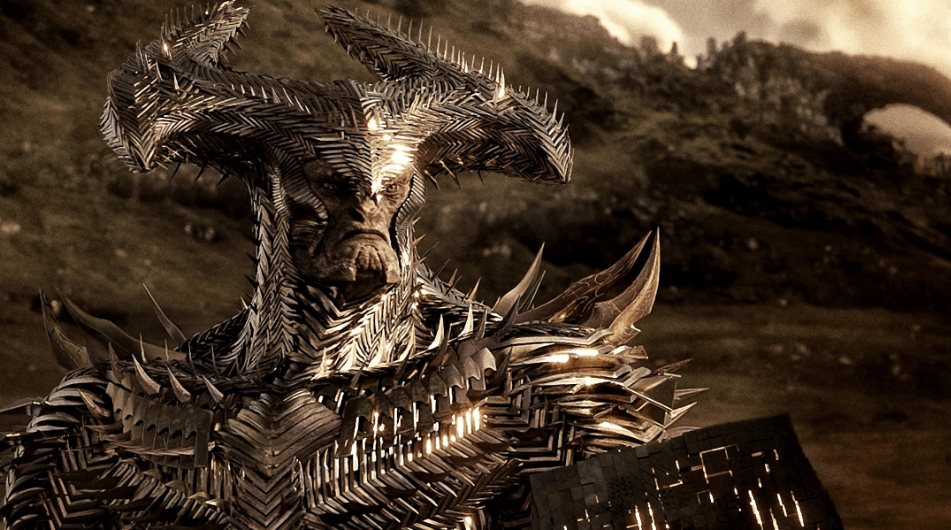
Zack Snyder’s Justice League (2021)

2/4

The Zack Snyder cut of Justice League – something the fans clamored for after the original’s lukewarm reception – is overpadded and badly paced. Nearly two and a half hours go by before the story emerges from its first act and when it finally does it turns into a meandering exercise in repetition. The final climactic battle between the heroes and Steppenwolf (Ciaran Hinds) doesn’t feel like a climax at all as it is barely distinguishable between any of the other fights in the movie. They fight him again and again and again and then the film just kinda stops suddenly. While I didn’t particularly like the original theatrical version when I saw it in theaters I like it better than this one. The original’s final act was poorly written and made too many awkward unfunny attempts at humor, but what it had going for it was a real sense of being climactic. Pacing is more important than length in any movie, and at 4 hours and 3 minutes Zack Snyder’s Justice League is just plain boring.
An issue I had was its use of intertitles that divide the film in a series of parts. It comes across as pretentious and the fades to black to show us these only drag the movie’s pacing even more. I was taken out of the movie each time they appeared and they seemed to serve only as a reminder that the movie was still going.

The plot revolves around a new villain named Steppenwolf – an armored CGI giant straight out of Diablo – who has fallen out of favor with his nephew, Darkseid, and now wants to redeem himself. Steppenwolf is seeking three macguffins called Mother Boxes with which Darkseid wants to gain ultimate control of all life in the universe or something. I mean, look, macguffins and villain plots are not that important in most superhero movies because the resolution is always the same. The heroes win some, lose some, and then ultimately win some again and then the movie is over. We know who the bad guy is and we know who the good guys are and we want to see them fight each other. It’s like PPV wrestling or a video game without interactivity or an ability to skip the cutscenes. The Roger Moore Bond era had the same problem. No one cares what the bad guy is doing, just grab a pair of skis and stop him like always.

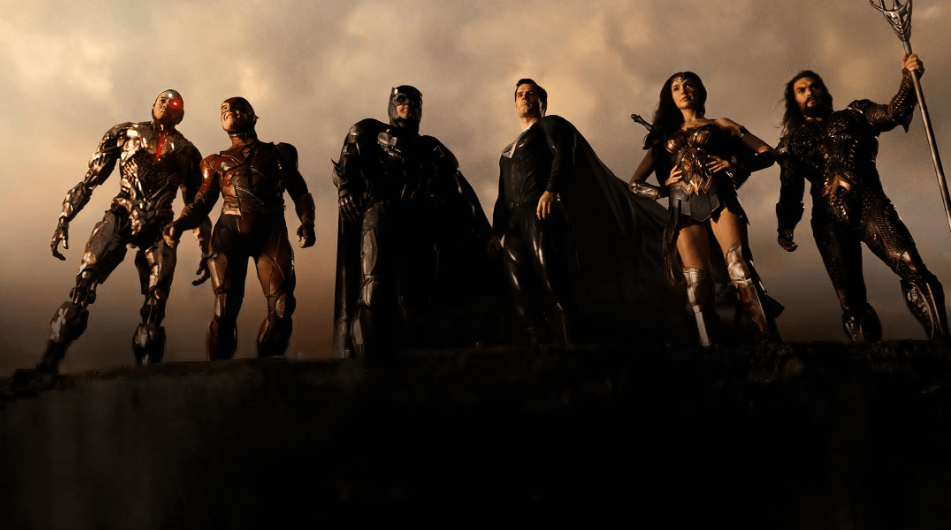
One of the Mother Boxes is in the possession of new JLA member, Cyborg (Ray Fisher), who was created with it after suffering injuries from a car accident. This same Mother Box is used to revive Superman (Henry Cavill) who now dons a black suit with a silver S.
Superman’s revival makes for the best and most interesting part of the movie. He awakens with no memories of who he is at first and starts attacking the Justice League before being snapped out of it by Lois Lane (Amy Adams). My favorite shot during the attack is when the Flash (Ezra Miller) tries to get around Superman at high speeds. Whenever he does this he disappears and the rest of the world goes into slo-mo similar to what happens to Quicksilver in the X-Men movies. As he passes, Superman’s eye slowly shifts in his direction revealing that he is able to keep up with the Flash at all times.

The majority of the movie’s first few hours is Bruce Wayne (Ben Affleck) meeting with the future Justice League members and trying to recruit them. He meets with Aquaman (Jason Momoa) in Iceland who makes it clear that he wants nothing to do with whatever Batman and co. are planning. Obviously he comes around later.
The writing and casting of Aquaman in the DCEU is a conscious effort to distance the character from the memes and jokes that have been made at his expense on the internet. Shows like Big Bang Theory and Family Guy are largely to blame. There is now a consensus among non-comic readers that a man from Atlantis with a three-pronged spear, who can control the power of the seas, and talk to sharks is somehow lame. Here, Aquaman is a rough brawler who drinks heavily and tries to intimidate everyone with his surliness and physique. Momoa’s performance is good enough, but this choice is definitely an odd one.
Batman’s first success is with Wonder Woman (Gal Gadot) who is first introduced in the film stopping terrorists from blowing up a building full of schoolchildren. It’s the usual plot armor gimmick with a bomb with a timer that goes down at a varying rate. If you actually try to count the remaining seconds you realize everyone should have been blown up a minute ago.
Gadot’s Wonder Woman is not strong on personality. She gives dull pep talks and plays at being serious. She is not convincing as a character and her action scenes continue to suffer from special effects tricks that don’t look real.
Cyborg is more reluctant to join than perhaps even Aquaman. He doesn’t relish being in the suit he is in and his prolonged isolation from society has left him bitter and angry. What makes him more interesting than the other characters is that his origin story is ripe for a villain. The circumstances of his condition and his anger says a lot about free will when he ultimately joins the good guys anyway. He has the ability to tap into any network, computer, and camera feed making him an asset that rivals the resources of the Batcave. Before joining JLA he tries to find purpose in life helping poverty-stricken single mothers by hacking their bank accounts and making them millionaires overnight. Even when he is being bad he does it kindly and with pure motivations. Bruce Wayne tells Flash in the movie that his superpower is being rich. But all we have seen him do with that is pay for Clark Kent’s funeral. What does he have to say for himself?
Lastly is the Flash played by Ezra Miller. In the established lore he is prone to causing crisis events, coming in and out of reality, and being an overall nuisance to the space-time continuum. But enough about Ezra Miller.
The Flash character in Justice League is written as comic relief. He is eager for friends and to be liked, but is socially awkward and tends to say the wrong thing or too much at the wrong time. Occasionally he can be funny, but often his bits don’t land and his utterances make me wince. The funniest moment is when he tries to say goodbye to a Russian family, but says Dostoevsky instead of do svidanya. Sadly that moment was cut in this version. Miller puts in the best performance of any of the other actors in Justice League, but he could have been given better lines.

As far as the action set pieces, special effects, and cinematography go, the film has the same problems I had with Batman v Superman. They’re dimly shot, over-reliant on cartoonish CGI, and use so much fast-cuts and quick editing that I doubt even Flash could understand what he was seeing without pausing it off and on again. With the far superior Wonder Woman (2017) released between this movie and BvS it is clear that this is just Zack Snyder’s style. I’m not a fan. His films tend to look drab and ugly and they’re soullessly written.

This movie certainly didn’t anger me the way Suicide Squad did. But it is not exciting like Wonder Woman or as interesting as Batman v Superman. The theatrical version is slightly less good than Man of Steel (another film I disliked), but the Snyder Cut fatigued me. What made movies like Lawrence of Arabia and Gone with the Wind justify their run-times was that there are no wasted shots and the writing is engaging throughout. With Justice League the reincorporated footage and added pickup shots are just mere padding. Stuffing everything back into a movie for a vanity project doesn’t make it good. It just makes it long.

Director: Zack Snyder
Writers: Chris Terrio, Zack Snyder, Will Beall
Producers: Charles Roven, Deborah Snyder, Ben Affleck, Wesley Coller, Curt Kanemoto, Benjamin Melniker, Christopher Nolan, Jim Rowe, Chris Terrio, Emma Thomas, Michael E. Uslan, Madison Ainley, Marianne Jenkins, Tamara Watts Kent, Madison Weireter, Andrea Wertheim, Gregor Wilson
Cast: Ben Afflect (Bruce Wayne/Batman), Henry Cavill (Superman/Clark Kent), Amy Adams (Lois Lane), Gal Gadot (Diana Prince/Wonder Woman), Ray Fisher (Cyborg/Victor Stone), Jason Momoa (Aquaman/Arthur Curry), Ezra Miller (The Flash/Barry Allen), Willem Dafoe (Vulko), Jesse Eisenberg (Lex Luthor), Jeremy Irons (Alfred), Diane Lane (Martha Kent), Connie Nielsen (Hippolyta), J. K. Simmons (Commissioner Gordon), Ciaran Hinds (Steppenwolf)
Composer: Tom Holkenborg
Cinematographer: Fabian Wagner
Editors: David Brenner, Carlos M. Castillon, Dody Dorn)

Wonder Woman (2017)

3/4 stars

Wonder Woman is where the DC Extended Universe (DCEU) finally gets it right. Upon its release it was the best of the series and the best looking. Man of Steel was a turgid misfire and Suicide Squad was an execrable display of incompetence. Batman v Superman had many great qualities, but had flaws that alienated its audience. With Wonder Woman next on the slate, director Patty Jenkins approached the material by making what the audiences had wanted all along: a superhero movie. Instead of following the subversive pattern set by Zack Snyder she tears a page from Phase One of the Marvel Cinematic Universe’s playbook and makes a superhero origin movie that follows the writing philosophy of the first Iron Man and Captain America: The First Avenger.

These types of movies are what they are. They aren’t movies in the usual sense. They are not made to stand on their own, but designed to revolve around a larger cycle of other movies. Modern superhero films are part of an expensive serial that releases two to three 2-hour episodes a year. Even origin stories like this one serve only to introduce its character. What they don’t do is give the characters a solid resolution. Story is an afterthought, the writing being pooled into setting up the ensemble event to come later. A lot of auteurs in the industry resent them for reasons I do not necessarily disagree with, but accepting them as something different I can review them for what they are and not for something they aren’t intended to be. I happen to enjoy serials, after all.

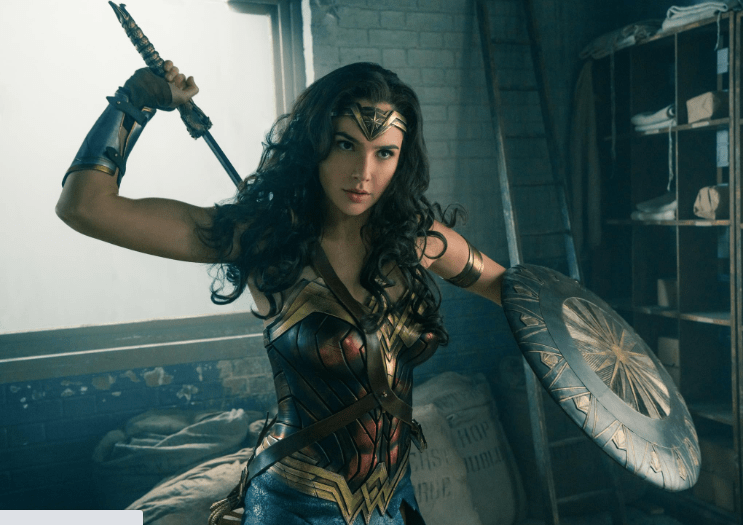
Wonder Woman (Gal Gadot) starts out as a young woman who is trained and honed for combat on an island inhabited by Amazons. Diana – the future Wonder Woman – was made of clay and brought to life by the god Zeus. She is raised by the Amazonian queen Hippolyta (Connie Nielsen) who delays her combat training because she wants to keep her sheltered. But, Hippolyta’s sister, Antiope (Bonnie Wright) trains her in secret. Diana is told that the god of war, Ares, had slain all the other gods except for Zeus who had banished him to who knows where. The Amazons were created to protect the race of humans against Ares who wants to exterminate them and they fear his eventual return. I don’t rightly recall reading this in Bulfinch and Hamilton, but comic book gods are a different ilk from their classical sources and merely share their names. I’ve had similar thoughts about Rick Riordan.
When American fighter pilot, Steve Trevor (Chris Pine) crashes his plane nearby while being pursued by Germans they learn from him that outside of their cozy island the world is currently being embroiled in WWI. When Diana first meets him she asks him if he is a man. She had never seen one before and they are seemingly scarce on the island. This begs a lot of questions since the movie explains – too thoroughly, I thought, for a family movie – that only Diana was made of clay and the others were sexually reproduced. There are so many things I want to ask. Where are the men? Do they keep them sequestered out back? Are they only kept for breeding? Is there a way to sign up for the job? And so on.

Diana believes that the war Steve is describing could only be the work of Ares and she negotiates a deal with him to return him home as long as he takes her with him so she can find and kill Ares. Steven thinks she is being naive, but agrees. The eventual reveal of Ares later on is a serious weak spot in the movie since it undermines a more poignant theme that had been running in the film up to that point. Trevor understands that true evil is not found in a single external force and he tries to tell her this several times. The fact is, wars like WWI are not waged by gods and monsters. They are brutally executed on the battlefield, but they are conducted by bureaucrats and men in suits with trimmed nails. They murder men, women, and children by edict and paperwork, call it a day, and then take their families out for ice cream. Evil is not men twirling their mustaches and cackling. Evil looks scarcely different than you or I. So when after so much is made of her being naive on the nature of human wickedness, the sudden reveal of Ares as an instigator behind the war didn’t sit well with me.

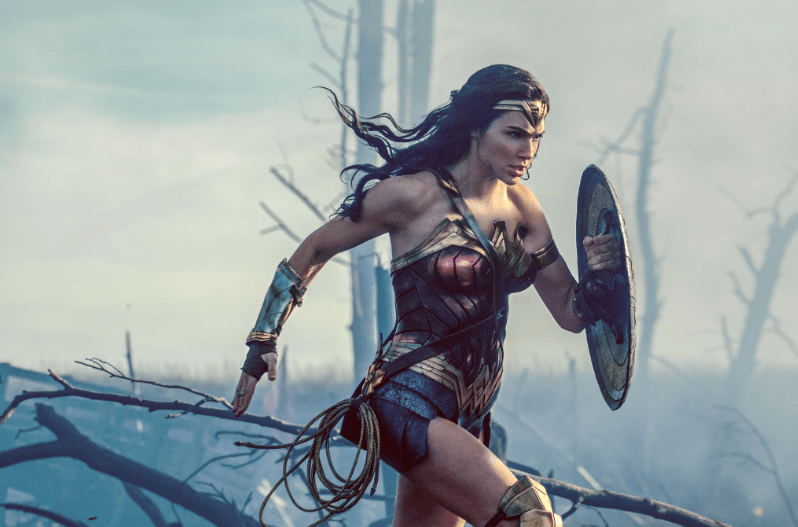
The strongest moments in Wonder Woman are when Diana is slowly adjusting to modern culture and when she is fighting Germans on the front. The action scenes are much better than what the DCEU had done so far. In the earlier films the fights are shot dimly and rely on quick editing to give the viewer a lot of visual noise, but nothing that can be clearly made out. This time, the camera never loses focus on Wonder Woman even when the fighting speeds up and intensifies. Like in the classic Superman movies with Christopher Reeve she charges heroically into action in closeups. We never lose a clear view of Wonder Woman and the side characters which was sadly lacking in the Snyder pictures. Where the action scenes fail is an overuse of slow-mo. Slow-motion photography tends to telegraph events and it steals away their surprise and oomph. When an arrow starts moving in slow-mo around the same moment a character slowly dives into frame you know they are about to get shot. It’s a waste of dramatic tension.

Wonder Woman’s cinematography is otherwise flawless. As I said above it is so far the best looking of the DCEU films up to this point. It drops the drab colors of the previous flicks replacing it with beautiful shots that, for once, contain color and detail. Throughout the late 2000s and most of the 2010s movies started sucking color out of their movies in favor of dim lenses that make everything appear in shades of grey-blue. For reference, see what happened to the Harry Potter movies’ cinematography as the series went on. But around 2016-2017 we started seeing more natural color and lighting in movies again and the trend has mostly stuck around for now. The best shots are when Diana and Trevor are in London. There is a gorgeous attention to detail in the set design and palette. The scenes when Diana is trying on modern clothes in a shop, while deliberately silly, look fantastic.

The music in Wonder Woman, like in Man of Steel and BvS, is largely composed of incidental pieces with nothing in particular that stands out, save for Wonder Woman’s main theme. It was first heard in BvS and it’s a real banger. I’d accept it as the definitive Wonder Woman theme along with John Williams’ Superman and Danny Elfman’s Batman scores. It’s that good, even if they really don’t make great music that much in movies anymore.

I enjoyed Wonder Woman a lot. It showed that the DCEU series was capable of reproducing the sort of content that made the Marvel movies so popular. The mismanagement that caused the series’ demise later was preventable had they made more movies in the same vein as this one.
When Trevor mentions that saving the day would involve finding the man who can, Diana quips back, “I am the man who can.” Looking at the DCEU’s fallen house of cards compared with the success that was this movie, I think she was on to something. Women, especially Wonder Women, often are.

Director: Patty Jenkins
Writers: Allan Heinberg, Zack Snyder, Jason Fuchs
Producers: Charles Roven, Deborah Snyder, Zack Snyder, Richard Suckle, Jon Berg, Wesley Coller, Geoff Johns, Stephen Jones, Steven Mnuchin, Rebecca Steel Roven, John Bernard, Tommy Gormley, Curt Kanemoto, Enzo Sisti
Cast: Gal Gadot (Diana Prince/Wonder Woman), Chris Pine (Steve Trevor), Connie Nielsen (Hippolyta), Robin Wright (Antiope), Danny Huston (Ludendorff), David Thewlis (Sir Patrick), Said Taghmaoui (Sameer), Ewen Bremner (Charlie), Eugene Brave Rock (The Chief), Lucy Davis (Etta), Elena Anaya (Dr. Maru)
Composer: Rupert Gregson-Williams
Cinematographer: Matthew Jensen
Editor: Martin Walsh

Suicide Squad (2016)

1/4 stars

Suicide Squad barely qualifies as a movie. It plays more like a feature length trailer for a movie that doesn’t exist. I said as much to my family when the movie was over. When I later looked up some info on the movie and found out that the film’s editing was outsourced to a company whose specialty was, indeed, making film trailers I felt fairly vindicated. Its original editor dropped out midway through post-production and the studio opted not to give director David Ayer final cut. The nicest thing I can say about Suicide Squad is that there is good evidence that Warner Brothers sabotaged it.
The entire movie is nothing but the sort of highlights of action and comedy that one sees in marketing. It never takes a break, but keeps moving from one thing to the next, never stopping to flesh out its characters or settle upon a theme. It’s essentially a heist/task force movie; a genre that has put out more garbage than gold most of the time.

Suicide Squad was an endurance test on my patience the entire time I was watching it. When a film has its characters written this thinly, what you get is a boring movie. It doesn’t matter how many action scenes you cram into it. There is no emotional investment in this movie at all. The motivations and drives of its leads are limply delegated to a few short vignettes which don’t do the job. These scenes are also thinly written, serving only to tell us how the characters feel, but the never showing it convincingly. It misuses its cast unforgivably.

Following the death of Superman in Batman v Superman, the film’s plot – or what passes for one – tells us that the US government is concerned about how to combat evil meta-humans going forward. At the Pentagon, intelligence officer Amanda Waller (Viola Davis) comes up with the brilliant idea (and by brilliant I mean stupid) to create a specialized response unit comprised of some of the worst criminals and super-villains in the world. However, the only thing she accomplishes by doing this is, is to create the very problem that the Pentagon feared. One of them goes rogue almost immediately and poses such a serious threat the remaining members of the team are assigned to take her out. The incompetence on display here is staggering. What makes Waller all the more infuriating is she never takes any ownership of the mess. She remains arrogant and overconfident throughout the film, and worse still, she outright murders Pentagon personnel for overhearing information about the Suicide Squad they weren’t cleared to hear. These individuals probably had families to go home to and they are killed to protect a group of gangbangers and thugs. Waller ought to face court martial and a firing squad for this.

Enchantress (Cara Delevingne) is an ancient witch spirit who possesses the body of a woman named June Moore who just happens to be the lover of one of Waller’s subordinates. Enchantress summons her brother Incubus and creates an army of possessed former soldiers in order to destroy the human race. What else is new?
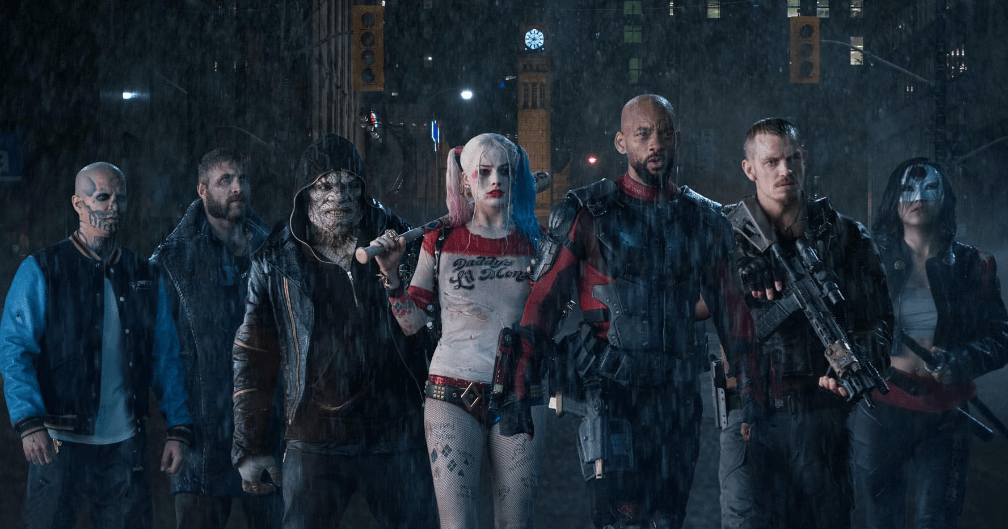
The members of the Suicide Squad are six prison inmates. Deadshot (Will Smith) is a paid assassin and family man who wants to see his daughter again. Killer Croc (Adewale Akinnuoye-Agbaje) is a sewer-dwelling lizard man whose sole reason for joining is because he wants to negotiate getting BET on the TV in his cell. El Diablo (Jay Hernandez) is a fire-wielding gangbanger who accidentally killed his family years ago and is now mildly sad about it. He refuses to use his powers at first, but later comes around. Good for him, I guess.
The most interesting of the bunch – yet still woefully underwritten – is Harley Quinn (Margot Robbie). She’s an exaggerated caricature of Mallory from Natural Born Killers who maintains a cutesy flirtatious lilt to her voice even when murdering people. She’s the Joker’s (Jared Leto) girlfriend and was at one time his therapist until he brainwashed her by forcing her into an electro-shock therapy machine. Her weapon of choice is a baseball bat which she preposterously brings to gun fights. The other two are Slipknot and Captain Boomerang whose contributions to the film leave them not worth talking about. There is also added to the mix a Japanese swordswoman named Katana (Karen Fukuhara) whose dead husband’s soul lives in her sword.
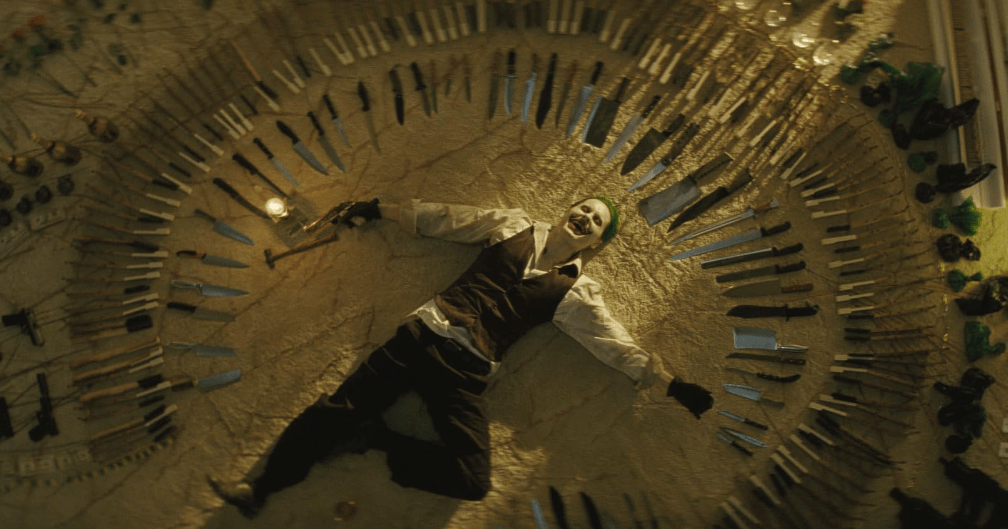
Joker is one of the weakest points of the movie. His screentime is shockingly minimal and Leto plays him more like a flamboyant mob boss than the master of chaos and insanity that we know. His appearance – slick-backed green hair, white makeup, and shirtless tattooed body – reminds me of someone you’d see in an emo band.

These characters are introduced in quick succession with a few sparing minutes given for each to provide them some semblance of backstory. The movie’s plot gets moving and doesn’t stop as soon as its begins. Suicide Squad barely has a first act which is crucial if you want to tell a story and have the audience give a damn about it.
Instead of plot the film is more obsessed with violent imagery, edgelord humor, and squeezing in as many back shots of Margot Robbie in booty shorts during its runtime as it can get away with. The whole thing is a childish mess and doesn’t deserve to be called a movie. It was made with 12 year old boys in mind. The sort who play a lot of GTA, listen to rap and metal, and who just discovered internet pornography for the first time recently. Not only does Suicide Squad have nothing to say about real people, it isn’t even made for real people. Certainly not people I’d leave alone with my kids.

I find it hard to believe that Suicide Squad is supposed to be connected to Man of Steel and Batman v Superman. Those movies, while imperfect, are far more charismatic and wholesome than this piece of juvenile trash. It has all the delicate plotting of a Friday the 13th movie, but even less entertaining. After seeing what Warner Brothers had done to Batgirl I wished they could have shelved this one as well. This is one of the worst superhero movies I have ever seen. I hated every disingenuous moment of it. I hated its thoughtless and pointless approach to violence. I hated the sleaze that went into its writing. Suicide Squad fails on every level, including the simple requirement of being a movie. I would have rather just watched the film’s trailer and pretended it was a short film. The full picture was time wasted that I will never get back. Rarely is a movie so bad that I cannot imagine myself watching it again at some point. But, if I never think about this movie again it won’t be soon enough.

Director: David Ayer
Writers: David Ayer
Producers: Charles Roven, Richard Suckle, Geoff Johns, Steven Mnuchin, Deborah Snyder, Zack Snyder, Colin Wilson, Bruce Franklin, Andy Horwitz, Alex Ott
Cast: Will Smith (Deadshot), Margot Robbie (Harley Quinn), Viola Davis (Amanda Waller), Jared Leto (Joker), Jai Courtney (Boomerang), Jay Hernandez (Diablo), Adewale Akkinuoye-Agbaje (Killer Croc), Cara Delevingne (June Moone/Enchantress), Joel Kinnaman (Rick Flag), Adam Beach (Slipknot), Karen Fukuhara (Katana)
Composer: Steven Price
Cinematographer: Roman Vasyanov
Editor: John Gilroy

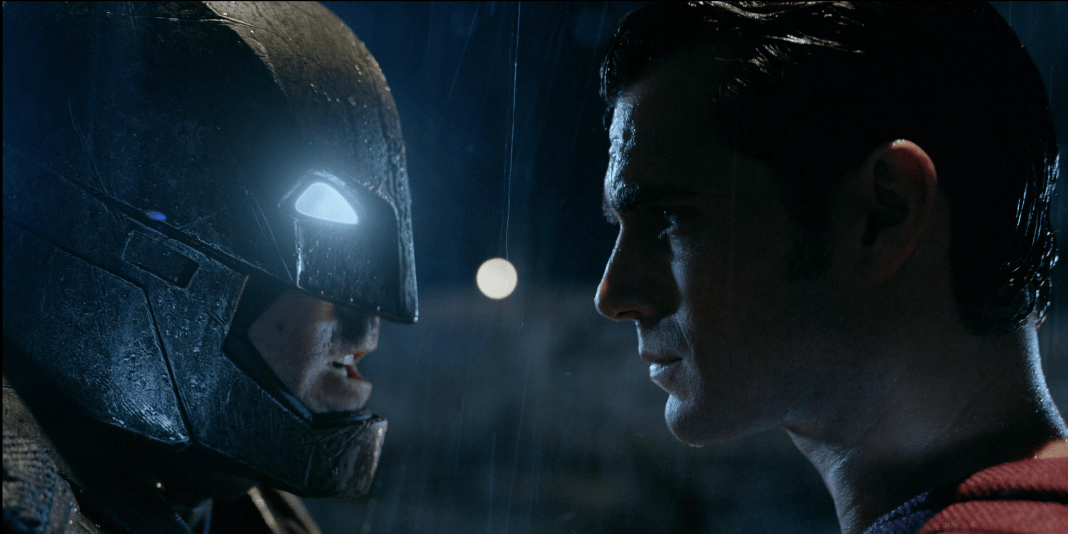
Batman v Superman: Dawn of Justice (2016)

3/4 stars

note: This is a review of the Ultimate Edition, an expanded edition of the film not initially shown in theaters

When I first saw Batman v Superman ten years ago I hated it. A lot of people did. Many still do. But, having seen it for a second time a decade later I find myself in the awkward position of being one of its defenders. Bear in mind, the Ultimate Edition is the only cut of the film I have seen, so I can honestly inform the reader that the extra thirty minutes are not what made the difference to me.
No, what I think happened this second time around was a mixture of acceptance and comprehension of what the filmmakers were trying to do. Being dark is not necessarily an issue for me. What made Man of Steel a bad movie was that its darkness extended to its main character as well as the plot. Putting Superman in a dark story is fine. Wholesome, good people live in a dark world and how they adapt to it and learn to live in it is ripe for good storytelling. But, in Man of Steel Superman comes right off the bat as someone angsty and angry which suited him not a bit. The kinder more winsome Superman of old would have made that film more palatable since light versus dark is what he is all about.

Superman (Henry Cavill) is not much better in this movie either, but, perhaps I have got used to him. He is not as unsure of himself as he was in Man of Steel for one thing. And, also, Batman v Superman is not all about him. It’s not really about Batman (Ben Affleck) that much either. The angsty Superman is here to stay and the movie accepts this and moves on without dwelling on his character as much.
For me, BvS’s saving grace is that the dark tone is not just a gimmick like it was in Man of Steel. This movie has something to say for once. What made many people angry, I suspect, is that they purchased their tickets and expected to see a superhero movie. Can’t really blame them there. But, Batman v Superman: Dawn of Justice – an admittedly awful title – is not a superhero movie. It’s an epic social thriller that takes the subject of Superheroes (or meta-humans as the film calls them) seriously. It’s a commentary on what the ramifications of beings like this would have in a world that is post-9/11. In many ways I view the movie as a companion piece to Zack Snyder’s Watchmen.
Much of the film’s scenes are set in newsrooms, congressional hearings, and foreign lands falling apart under unstable regimes. The frequent cameos of real life figures like Charlie Rose, Nancy Grace, and Neil DeGrasse Tyson commenting on the existence of superheroes is just another way the film tries to posit how a world inhabited by meta-humans would react to them.

The film is set two years after General Zod wrecked devastation on Metropolis and now the world is questioning whether it needs another all-powerful Kryptonian living amongst them. Superman is a good man who is on the side of humanity, but that fact is not unquestionable to the many people who were maimed and lost their loved ones in the fallout. It was Snyder’s conscious decision to spend more time on this subject than on the pure unadulterated superhero flare we have come to expect in these sort of movies. Just before I rewatched it I read this comment from director Zack Snyder that he made about the movie in 2023: “I think that probably is what caused the movie to be so polarizing. I think a lot of people went into the movies for going like, “Oh, it’s the superhero romp, right? Let’s have fun with it.” And we gave them this sort of hardcore deconstructivist, heavily layered, experiential modern mythological superhero movie that … you really need to pay attention to. That was not cool. That’s not something anyone wanted to do.”
At first when I read that comment I got annoyed. I thought it patronizing and a failure to take ownership of the issues that people actually had with the movie. Watching it again, though, I hearken back to that comment and understand somewhat of what he was trying to say. I believe he was mostly right, but a few people did have other reasons for not liking it. The characterizations of Superman, Batman, and Lex Luthor (Jesse Eisenberg) are hardly traditional. The film still languishes under its fast-edited action sequences and unconvincing special effects. And a lot of people bristled at the reason for Batman sparing Superman’s life being that their mothers’ names were both Martha. The latter issue was meme’d and mocked to death back in 2016 and a lot of people still complain about it today. I am not as angry about it as they are. The scene intended to give Batman an understanding of Superman’s humanity that he had not seen before. He had a mother. The scene only failed because of a lack of subtlety and Batman’s animosity died down too quickly to be believable. I thought Batman’s issues with Superman were not wholly addressed here. Having a mom named Martha should not have been enough to convince him that Superman was not a threat and the movie should have resolved this concern a bit more. I also believe the addition of visual flashbacks to Bruce Wayne’s parents being shot was too on the nose and the scene would have been better received without them. But, the fact that Supes also had a mom named Martha being a turning point in Batman’s relationship with Superman didn’t bother me. It’s not as stupid as people say it is. It just needed some adjustments to its execution. But, people like their bandwagons, you know.

Batman is a big point of contention, and I do understand why. He is a bit hard to swallow. He is much more brutal and violent than any previous incarnation of the character we had seen on screen before. He also shows a shocking indifference to human life. Much of his actions are reckless and indirectly cause the deaths of the men he is fighting. The reason I still am able to accept him, however, is that the reinterpretation of the character is not so jarring as it is with Superman. Clark Kent and his alter ego don’t align at all with what he is supposed to represent, whereas Batman has always been a more edgy character. Making Batman this grim was the only logical thing the filmmakers could do if he is to contrast with Superman as he is presented here. It helps that he is not the movie’s main character. Batman serves the majority of the plot as an antagonist who has become misguided by suspicion and paranoia. The movie focuses most on the loneliness and the near sociopathy of the character which, let’s face it, has been with Batman since the beginning. Batman has always been the sort of guy whose trauma and internal rage at injustice had driven him to becoming a violent vigilante who beats the wicked and corrupt to a bloody pulp. Must I also point out that he dresses up in a vampiric bat costume and has the power of fear and the cover of darkness as his primary weapons? I can forgive the movie for knowing what everyone else knows that such a man in real life would likely be mentally ill.

The actual fight between the two is instigated by Lex Luthor. Instead of the usual self-congratulating Bond villain played by Hackman and Spacey, Jesse Eisenberg plays him…well…as Jesse Eisenberg. Eisenberg is not a bad actor, but he is a one-trick pony. He only plays one guy in all of his films and that is Jesse Eisenberg. His Luthor is neurotic, talks fast, and eats up attention like a child eats up sugar. He clearly loves the sound of his own voice and becomes grandiose and prone to demagoguery. He thinks of Superman as a sort of god in the classical sense and wants him dead on that basis alone. Instead of cutting his teeth on Sesame Street and Dr. Seuss like most normal people, he lives by cherrypicking the philosophies of Nietzsche and Ayn Rand. I’ve known people like this and they aren’t much fun at parties.
By staging a number of terroristic plots that are deliberately centered around Superman’s presence he turns him into a controversial figure. A vocal minority of the citizenry are now leery of Superman and Batman is convinced that the world will not be safe and secure until he is dead.

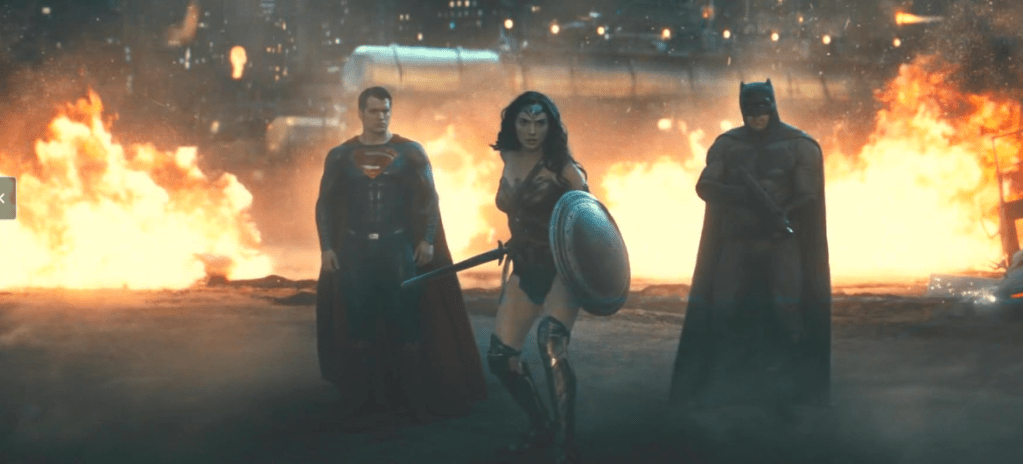
Another newcomer to the franchise is Wonder Woman (Gal Gadot) who spends most of the movie in disguise as Diana Prince. Her purpose in the film is limited and she is there by and large as a justification for the “Dawn of Justice” part of the movie’s title. She is meant to foreshadow the eventual rise of the Justice League. The Flash, Cyborg, and Aquaman also make very brief appearances, but they don’t inundate the movie with too many characters as a lot of superhero movies do with their villains. Secret archived footage is shown of them on computer screens to give us our first look at them before they make it to the main event.
Gadot’s performance is a bit bland, but she is not given a whole lot to do in her defense. As Wonder Woman she doesn’t spring into action until the final climactic battle and when she does she contributes little. Action movie directors must find writing for women hard or something, because I complain about this often.

The final battle is where the movie tends to fall apart. It’s a CGI-laden mess. The three heroes get tossed about frequently, transitioning from CGI models to actors when they land. CGI is supposed to be like a magic trick and when done poorly the trick is revealed to the audience and takes them out of the illusion. Doomsday, a monster made of kryptonite designed by Luthor, looks like a cartoon. It stomps about, roaring its head off and fighting the heroes in front of bluescreen that is so obvious it’s more like watching a video game.
The modern filmmakers have seemed to forget that fight scenes need personality as well as action. There is a lot of emotion involved when fighting someone. There needs to be a personal connection that has to be shown during the fight and not just in the moments leading up to it. This is done through simple emoting, facial expressions, and signs of physical exhaustion as the conflict becomes prolonged. What this movie fails to do is show us any of that. It’s all fast blink-and-you’ll-miss-it kinetics, explosions, loud noises, and whole shots where not a single thing on screen is real. All of which is dimly lit for reasons I suspect have to do with disguising the fakeness of the special effects. It’s more exhausting than entertaining.

Batman v Superman: Dawn of Justice is at its strongest when it is not trying to fulfill its obligations as a superhero movie. The social commentary is brilliant and the pacing of its first act is near perfect. It suffers during its action scenes, but provides a much more profound experience when it is being serious. It’s not perfect, but I rather liked it.

Director: Zack Snyder
Writers: Chris Terrio, David S. Goyer
Producers: Charles Roven, Deborah Snyder, Wesley Coller, David S. Goyer, Geoff Johns, Benjamin Melniker, Steven Mnuchin, Christopher Nolan, Emma Thomas, Michael E. Uslan, Trevor Christie, Curt Kanemoto, Bruce Moriarty, Jim Rowe, Andrea Wertheim, Gregor Wilson
Cast: Ben Affleck (Bruce Wayne/Batman), Henry Cavill (Clark Kent/Superman), Amy Adams (Lois Lane), Jesse Eisenberg (Lex Luthor), Diane Lane (Martha Kent), Laurence Fishburne (Perry White), Jeremy Irons (Alfred), Holly Hunter (Senator Finch), Gal Gadot (Diana Prince/Wonder Woman), Scoot McNairy (Wallace Keefe), Callan Mulvey (Anatoli Knyasev), Tao Okamoto (Mercy Graves)
Composers: Junkie XL, Hans Zimmer
Cinematographer: Larry Fong
Editor: David Brenner

Joker (2019)

3.5/4 stars

Joker is a movie that rarely shows a moment of compassion or kindness. And, yet, compassion is what the film is about. The absence of it creates a vacuum that emphasizes why kindness and warmth are so important. The pervasive images of cruelty and humiliation on display express the film’s ideals by negative example. The lasting impression when the movie is over is powerful.

When I first saw Todd Phillips’ Joker in theaters back in 2019 I had a strong negative reaction to it. I had felt at the time that the film was being disingenuous and that it was catering to the depressive instincts of angry young men. I’m sure you know the type. They quote Nietzsche, wear black, listen to Nine Inch Nails, and casually say life is terrible on principle. But, seven years later, viewing the film a second time, I think I understand the movie a little more. Like Spike Lee’s Do the Right Thing it shows a series of conditions that escalate to terrible acts of violence. It grates against black and white thinking that patently condemns these events without considering the importance of recognizing their causes.

Arthur Fleck (Joaquin Phoenix) is a severely mentally ill man who has unrealistic dreams of becoming a famous comedian. He lives a lonely existence where the only figure in his life sympathetic toward him is his ailing mother Penny (Frances Conroy), But, she is oblivious to the severity of his problems, suffering from debilitating mental issues and delusions herself. She frequently says he was always such a happy boy even though he is far from happy and likely never was. He is on seven different medications and tells his social worker “You just ask the same questions every week. How’s your job? Are you having any negative thoughts? All I have are negative thoughts.”
Depression is a real bitch and combining it in a cocktail of emotional immaturity, cognitive difficulties, and social isolation is a recipe for disaster. He and his mother live well below the fringes of poverty which forces him to eke out a living in his condition. His job outsources him as a party clown, but his social awkwardness and odd behavior elicits scorn from his boss and coworkers. A part of his condition is a nervous tick where he flies into fits of uncontrollable laughter regardless of what he is feeling at the time. Despite his attempts to explain the condition he only gets mocked and he is frequently asked what he finds so funny. He is unable to connect or bond with anyone. Arthur looks wishfully on as others socialize and engage with one another, but only becomes off putting when he tries to do the same. He comforts himself with childish fantasies of positive social interactions among people he likes and admires. But, in his real life the only time people give him a second look is usually to say something mean.
The isolation he endures is the key to his slow descent into madness. Mental illness and isolation go hand in hand and it gives the sufferer a unique perspective on people. For most of us we can generally separate the mean people from the kind ones; the good from the bad. But, for people with severe mental illness this is harder to do since neither the good people nor the bad people seem capable of treating them very well. The rotten eggs, of course, take every opportunity to heap cruelty and bullying on mentally ill victims. But, there is also a profound failing among more upright people that cuts even deeper. Sidelong glances of irritation, limited empathy, refusing to listen or understand, and social ostracizing are inflicted on the mentally ill by the upright and wicked alike. An impression is given to men like Arthur Fleck that there is a free pass for otherwise nice people to be dismissive and unkind to them because no one really likes them anyway. It’s a road to resentment and painful consequences that often could have been evaded by one encouraging word at the right time that never came.
I think it is these themes that created the polarizing reactions the film got when it came out. The films plays like a dirge for all the school shooters and impassioned murderers who have plagued our recent history. In the wake of a terrible crime it is easy to justify hatred for the perpetrator given the severity of what they had done. And offering them any sympathy or understanding is a big no-no. But, no one wants to acknowledge the onus that is on people who don’t do those things to prevent them. I do try to avoid commenting on specific current social and political issues on this blog so without naming any names I am going to say that I have heard interviews with school shooting survivors who practically boast of the bullying they inflicted on the shooter prior to the event and justify it by what the killer had done. It is hard to blame them after what they had been through, though. There is no denying that what was done is terrible and there is especially no denying that the actions were morally egregious and unjustifiable. But, there is something ugly about normalizing ostracizing the mentally ill on this basis. The disproportion of their crimes too often leaves us unable to recognize that something morally wrong was being done to them regularly before they snapped. And it is these points that made a lot of people angry when they saw the movie. The filmmakers had something to say that many of us don’t want to hear or deal with. There is a reason that the now infamous Aurora, Illinois theater refused to show the film at all after the murders that occurred there during a showing of The Dark Knight Rises in 2012.

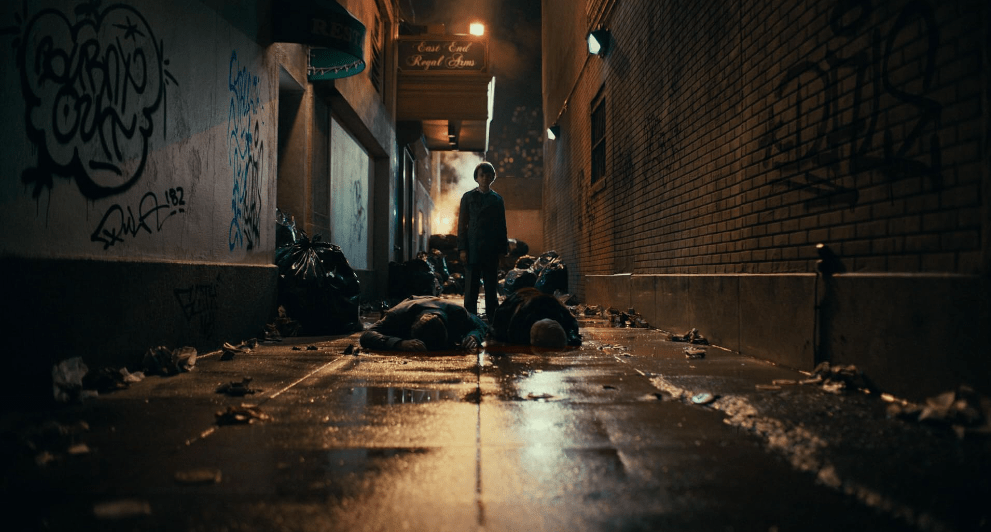
The film starts with Arthur working as a street clown twirling a sign to advertise a small business. A group of teenaged thugs steal the sign and beat him up when he tries to chase them down. What follows is one emotional betrayal after another. His boss is angry over the loss of the sign and doesn’t care that he was injured. The social worker he talks to spends their hour staring at him not listening to a word he says. She asks the minimal textbook questions she is required to ask and does little more. Any attempt he makes to express his emotional state usually ends up getting talked over by others who get angry and annoyed with him. They don’t hide their scorn and Arthur is not capable of understanding why he is being treated this way all the time. When pushed to frustration people scream at him for acting out. He writes in his diary, “The worst thing about mental illness is people expect you to behave as if you don’t.” In reality what they expect is for him to not defend himself. And he is swiftly villainised when he does. On a subway a group of three college aged youths begin to harass him and they physically abuse him when he tries to get away. He ends up murdering all three and flees the scene. Gotham City’s reaction is split. The privileged and powers that be condemn the shooting and characterize the dead students as innocent victims whose lives and potential were taken away by a maniac. Among the lower echelons there is a different sentiment. There is widespread sympathy given to Arthur, still currently unidentified as the killer, that galvanizes mass protests against the city government. The murders become a controversial talking point and the scenes eerily seem to anticipate the actions of Luigi Mangione a few years later.

Shortly after the killings Arthur goes to a local comedy club in the hopes of making it big with his act. His performance, however, is a colossal bomb. His laughing condition comes out in full force and he is unable to make any of the jokes land. The footage of his performance becomes viral after clips of it is shown on a talk show hosted by Murray Franklin (Robert DeNiro). Prior to this both Arthur and his mother were fans of Murray and Arthur fantasizes of impressing him someday. But seeing Murray Franklin publicly mock him and his comedy act on live television sends him spiraling deeper into depression and anger. Arthur’s issues escalate continually and he becomes a ticking timebomb. While he is subjected to abuse every day he is met with new tragedies that leaves his ability to cope any further untenable. His mother suffers a stroke and is hospitalized. It is, in fact, in his mother’s hospital room that he sees the episode of Murray mocking him. City budget cuts the funding to social programs leaving him no longer with a social worker and without any further access to his medication. The final nail in the coffin for his mental health is when he discovers revelations about his childhood and identity that steals away any last vestige of the things he values and cares about. Now the only thing that seems to matter are the ongoing riots that he inadvertently started. Outside there are rioters in clown masks who view his actions as that of some unknown local hero. He becomes a perverse symbol for the downtrodden and with that he and society part company for good. The result is violent tragedy and leaving Arthur behind to become the Joker is the only thing that makes sense to him anymore.

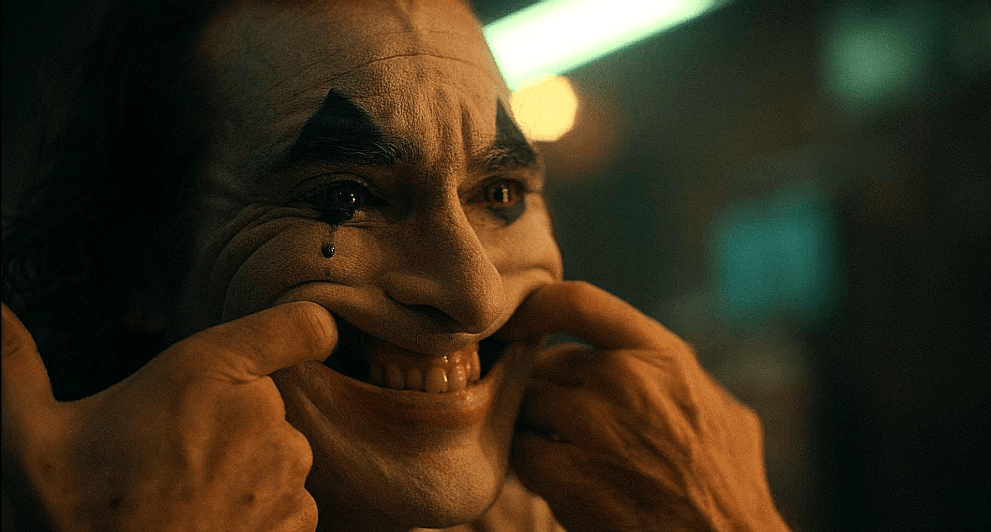
Joaquin Phoenix’s performance is spellbinding. His portrayal of a sociopath spiraling out of control is played without gusto and hamfistedness. He is far removed from the wide eyed silliness of Norma Desmond in Sunset Boulevard or the madcap wild insanity of characters like Renfield in Dracula or even the Joker in other media. He is more reminiscent of Travis Bickle from Taxi Driver who happens to be a primary inspiration for the film. He captures the vulnerability and loneliness of real life sociopaths so well to the point that watching him becomes uncomfortable. His physical posture and movements are nervous and uncertain and he emotes through affectation rather than responding naturally which is not uncommon to people with his conditions. What Phoenix accomplished and what earned him his Academy Award for the performance is a perfect character study of a person with mental problems slowly losing his grip on living normally. The systemic problems that wind him up end in events that, while violent and tragic, are not unexpected.

This movie sees the second acting win at the Oscars for an actor playing the Joker (first was Heath Ledger in The Dark Knight) and it is clear to me that the role of Joker has become something coveted. It’s a role like those of characters from Dickens or Shakespeare that gives an actor an opportunity to interpret a literary character who is challenging and complicated to pull off. After films like Logan and The Dark Knight trilogy somewhat of a trend of treating comic books as serious subjects has come about and it is no wonder we are seeing more serious actors pursue these sorts of roles.

Some critics of the film have gone so far as to label the movie dangerous. There was a genuine impression among a lot of people that the movie would incite a riot. To many it seems that Joker is a message to others who see themselves in Arthur Fleck that their anger and hatred for society is permissible. But the movie isn’t talking to them. It is speaking to those who are more like the people around him. It speaks to churchgoers who after Sunday services cuss out teenagers in drive-thrus. It speaks to decent folk who snub and dismiss weirdos in elevators trying to talk to them who smell bad. It speaks to family men who regale their loved ones with funny anecdotes of some crazy person they met at the bus stop. it speaks to honor roll students who make sure undesirables don’t eat with them. The film tells us that evil doesn’t have to be violent. Sometimes evil is just failing to see another human being when they sit right next to us.

Director: Todd Phillips
Writers: Todd Philips, Scott Silver
Cast: Joaquin Phoenix (Arthur Fleck), Robert DeNiro (Murray Franklin), Zazie Beetz (Sophie Dumond), Frances Conroy (Penny Fleck), Brett Cullen (Thomas Wayne)
Producers: Richard Baratta, Bruce Berman, Jason Cloth, Bradley Cooper, Joseph Garner, Aaron L. Gilbert, Walter Hamada, Anjay Nagpal, Todd Phillips, Emma Tillinger Koskoff, Michael E. Uslan, David Webb)
Composer: Hildur Guðnadóttir
Cinematographer: Lawrence Sher
Editor: Jeff Groth