
3.5/4 stars
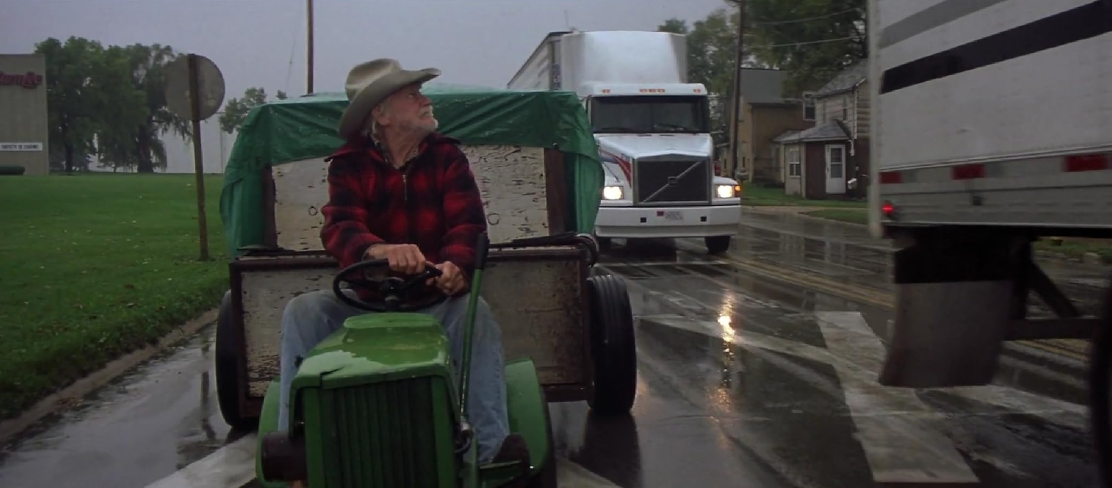
In the Summer of 1994 74 year-old Alvin Straight drove 240 miles from Laurens, Iowa to Blue River, Wisconsin on a riding mower. His older brother Henry had suffered a stroke and Alvin, too old to hold a driver’s license, decided to make the trip to see him on his John Deere. At 5 miles an hour the trip took six weeks. To sustain himself he packed the mower’s trailer with food, camping gear, clothes, and other amenities; while camping out in corn fields and woods at night.
Why an ailing, elderly man with diabetes and emphysema would do this is not a mystery to me as a native of the Midwest. The old timers in my neck of the woods are notoriously stubborn when it comes to self-preservation, but to them family is everything. They are also always working. After retirement they often take a new lease on life, buying farms, renting properties, or pouring their remaining time onto their vehicles. I’ve met a lot of men like Alvin. None of them did what he did, but they are all quite capable of it and they most certainly would do it if a similar situation arose.
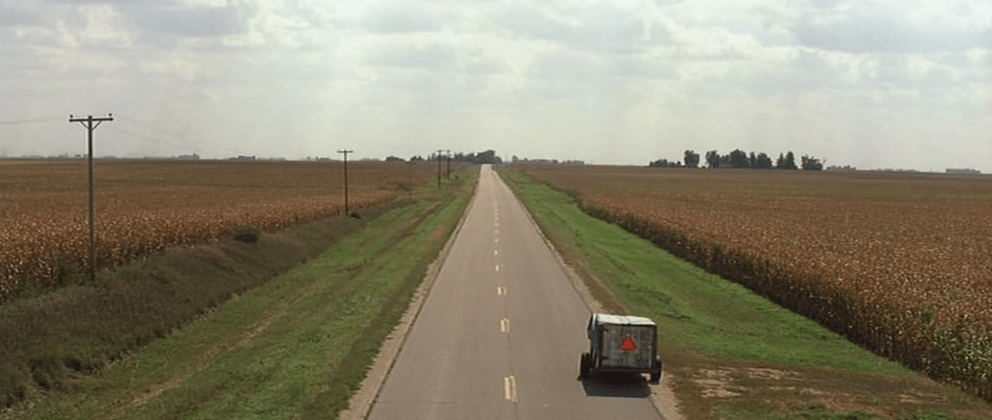
David Lynch’s The Straight Story perfectly captures the rural Midwestern spirit. As a Michigan native much of the imagery and personalities that the film portrays are familiar to me. People in the Midwest, especially among the quiet life of retirees, are very much like the people in this movie. Shot on location, The Straight Story accurately presents in its road movie format the long stretches of road along cornfields that sit between towns. Not on a lawn mower, of course, but I have been on many such trips.
I am uncertain what drew David Lynch, a filmmaker known for his surrealism and fascination with body horror, to this story. But, by taking on the project the film’s title takes on a double meaning. The Straight Story naturally refers to the story of Alvin Straight, but it is also out of all of Lynch’s films the most straight story of his career. What typically characterizes his work are unreliable narrators, non-sequential narratives, and bizarre imagery. None of these elements, however, are here and, what’s more, it is the only Lynch film to be rated G and to be distributed by the Walt Disney Company. To the more adolescent David Lynch fans the film might come across as saccharine and hokey. But, to me, the film is just another example of Lynch’s fascination with human behavior and how it connects to the mystery of what life is about and what it means. Unlike his other films it asks no questions. Instead its characters have either since come up with answers of their own or have given up bothering with the questions at all. Their lives have been lived already. Alvin and the other characters in the movie are not seeking anymore, but only doing. Art is often about making sense out of the human experience. But, it is nice to have a change of pace with a movie that is about simple, plain old-fashioned living and carrying the values we learn without constantly questioning them. Questioning values is a young man’s game. The Straight Story, I suspect, speaks most to those who have gone on long enough to have their lives and values figured out. The Straight Story speaks to young and old alike, but it is to the old that it is chiefly directed.
After Alvin Straight (Richard Farnsworth) suffers a fall in his home, his doctor tells him he has to make serious life-style changes if he is to regain control of his health. Like any rural Midwesterner of his generation he decides to ignore the advice. The sole compromise he makes for the doctor is agreeing to equip a second cane.
Alvin lives with his daughter, Rose (Sissy Spacek) who is understandably concerned about her father’s well-being. She has a severe learning disability that leaves her with the mentality of a ten year-old. To Alvin, calling her slow is far from the mark and he insists that she has shown a capacity for self-sufficiency that others do not understand. Due to her issues the State had taken her children away from her after one of them was injured in a house fire while being babysat. The incident was not her fault and she had nothing to do with it. But, the malicious disregard for the mentally ill and the itchy trigger finger people have for calling Child Protective Services is unfortunately systemic in this country and her voice was never heard. Alvin says not a day goes by when she is not pining for her children. Rose, like Alvin, has past trauma that they bear quietly in the present. It makes them who they are, but the trauma is long in the past and what is left are the lasting effects. Past trauma is often dealt with dramatically in movies. A lot of screaming, crying, slamming of fists, heart-wrenching dialogue, and other bits of Oscar bait. But, in reality people, like the people in this movie, cope with their past trauma quietly and it shapes their character. Neither Rose nor Alvin would be the people they are today without it, but the trauma is not the crux of the film’s story.
Alvin gets more bad news when he finds out that his brother (Harry Dean Stanton) has had a stroke. They had not spoken in years after they had had a spat, but the combination of his health problems and those of his brother gives Alvin a sense of borrowed time. Without being able to drive a car, he hooks a trailer to his John Deere mower and begins a six-week journey to meet his brother and hopefully make amends.
The journey is a celebration of rural and small town Americana. The odyssey is a visual feast of stretches of road, country fields, abandoned barns, and bonfires in woody glades. He passes through a modest number of small Midwestern towns where people gather and stare. The people he meets along the way amount to small episodes where his values and eccentric actions touch them in some significant way. Family is a big part of his value system and many of the folks he encounters aren’t quite there yet, but their meetings with him leave them a lot to think about. In Alvin is found something sweet and wholesome that to some may come across as trite. The triteness is an illusion, though, because for Alvin what he says is very much real and true to life. These encounters frequently put the film at risk of uttering a false note, but I detect nothing disingenuous in the movie’s messages. Even when he encourages a teen runaway to go back home or lectures a couple of bickering brothers about loving one’s family, The Straight Story, never rings false like a Hallmark TV movie. The film proves that jadedness is not a necessary quality of being real, and that wholesome values do not have to be faked in drama.
The real life Alvin Straight never did what he did to garner praise or fame. In fact, he never was much comfortable with the media attention and he had declined offers to appear on Leno and Letterman. I doubt he gave it much thought that driving 240 miles on a lawn mower was unusual. He was just a man like anybody else. A man with an ailing brother he wanted to see and the mower was the only means to get there. He was tenacious, but not special; and that is apparently how he wanted to be remembered.
His story could easily have been the subject of a TV movie – come and gone, and then forgotten. I am glad it was not. By giving it a theatrical release and under the guidance of a talented filmmaker it’s inspiring message is more broadly accessible than something aired on a Friday night. The Straight Story’s radical idea that wholesome values and being real do not have to be exclusive is a message people need to hear more and more.
Director: David Lynch
Writers: John Roach, Mary Sweeney
Cast: Richard Farnsworth (Alvin Straight), Sissy Spacek (Rose Straight), Everitt McGill (Tom), Harry Dean Stanton (Lyle Straight)
Producers: Pierre Edelman, Neal Edelstein, Michael Polaire, Mary Sweeney
Composer: Angelo Badalamenti
Cinematographer: Freddie Francis
Editor: Mary Sweeney

