
3.5/4
Jack Weinberg once told us “Don’t trust anyone over 30”; and watching the majority of high school coming-of-age comedies that have been released over the years I believe he was right. Most of these types of films are made by men well over thirty who have forgotten what it was like to be truly young. For them youth means the sort of lechery, booze, and boorishness that made Bob Clark’s pictures so popular.
George Lucas was 29 when American Graffiti, his second film, was released to American cinemas. It counts. And if there is anyone who can recapture in a bottle what it was like to be a teenager on the cusp of the adult world it is the man who would later give us Star Wars.
American Graffiti is not a film with a plot that can be adequately described and explained without losing some of its heart and appeal. The movie is a slice of life kinda picture showing the last night of freedom for a group of high school graduates about to go out and get jobs and go to college.
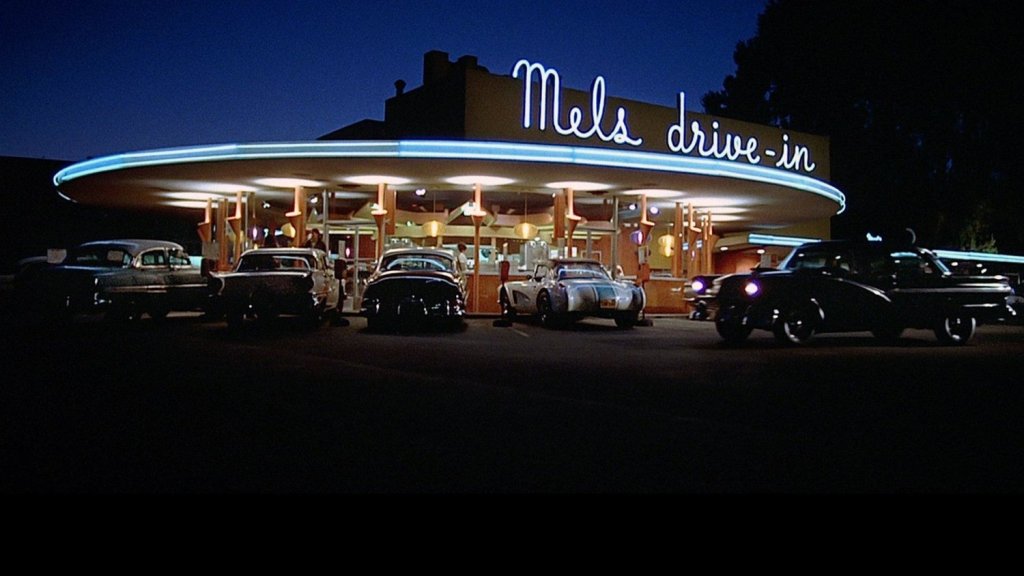
Set in the summer of 1962 with an atmosphere of 50’s diners, music, and cars American Graffiti perfectly and often hilariously portrays its characters living their best lives before the ravages of adulthood begin to take over.
Curt (Richard Dreyfuss) wonders if he really wants to go to college after all and goes on a wild excursion searching for a beautiful girl he saw passing by only to get entangled with a group of greasers whom he helps commit a few petty crimes to avoid getting beaten up by them.
His friend Steve (Ron Howard) is hormonal and immature; pressuring his girlfriend into sex just hours after telling her he wants to be free to see other people while he is away at school. As someone who actually is over 30 I know this is a really bad move.
Steve loans his car to the geeky bespectacled Terry (Charles Martin Smith) who uses it to impress Debbie (Candy Clark), a pretty blonde miles out of his league only to have everything fall apart when Steve later takes the car back. The romance between Terry and Debbie is absurd, charming, and comedically unrealistic in how much she puts up and puts out for him.
Milner (Paul Le Mat) is tricked into taking out a friend’s 12 year old relative, Carol (Mackenzie Phillips) out on a date and their petty bickering and her wit while he tries to pass himself as her babysitter make for some of the funniest moments in the movie. They both know she is too young for him and she takes every opportunity to embarrass and annoy him while she enjoys a night on the town. At the end they part ways with a reluctant mutual respect.
Milner’s rival, Bob Falfa (Harrison Ford) is a brash and immature tool who never quite grew up and has a hankering for street racing high schoolers. He is all ego and bravado who has no qualms over stealing Steve’s girlfriend, Laurie (Cindy Williams). When I was younger I may have felt something for Steve about this, but once again as a man who is over 30 I sympathize more with Laurie’s decision to leave and I was less than satisfied with her resolution with Steve; not being convinced that he really took responsibility for his actions that drove her away in the first place. This, and an unnecessarily tacked-on postscript which tells us what happened to a few of the other characters are the only weak points I found in the movie.
American Graffiti makes for a highly entertaining look at adolescent life in pre-counter culture America. The atmosphere of 50s rock tunes and classic cars doesn’t lose itself in nostalgia and shoe-horned references. It’s more about the characters and their misadventures than it is about the setting. It’s kids being kids without resorting to crude jokes, keg parties, and togas. It’s a sugary slice of young American life and it earns its place as a classic piece of New Hollywood cinema.
 Perspectives on Film