Fantastic Planet (1973)

4/4 stars

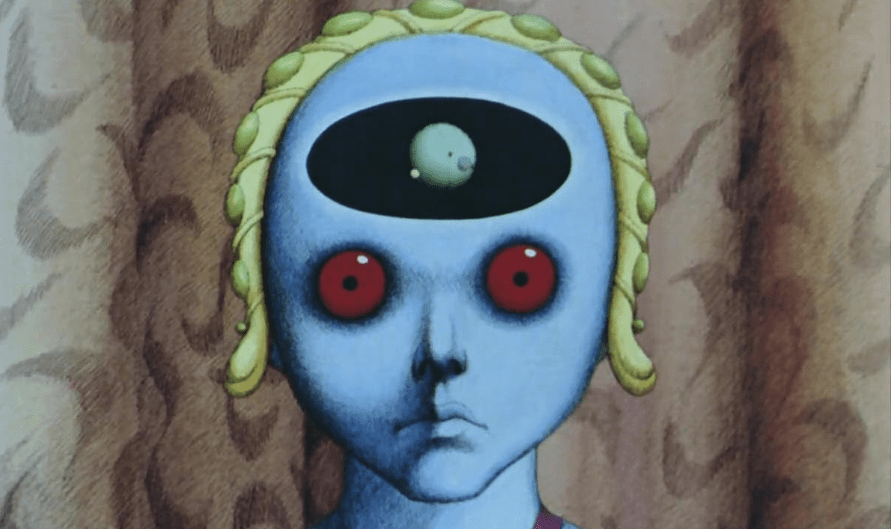
Fantastic Planet is a beautiful and visually arresting piece of counter-culture art. Roland Topor’s animation is like the illustrations of a storybook. Not a single shot is wasted and every frame is a work of beauty on its own. The images have a grim Dr. Seussian quality and are illustrated like a darker version of the works of Maurice Sendak.

The film presents a challenge to our notions of nature and humanity’s relationship with it. The natives of the planet Ygram are gigantic blue-skinned beings called Draags. Theirs is a sophisticated, proud culture where knowledge is highly sought after and meditation is a regular ritual in every household. Humans are also present, but they are the size of insects in comparison and are viewed as little more than dumb animals to the Draags. The humans are called Oms (evidently derived from “homme” the French word for Man), and when they are not being kept as pets they are treated as vermin.
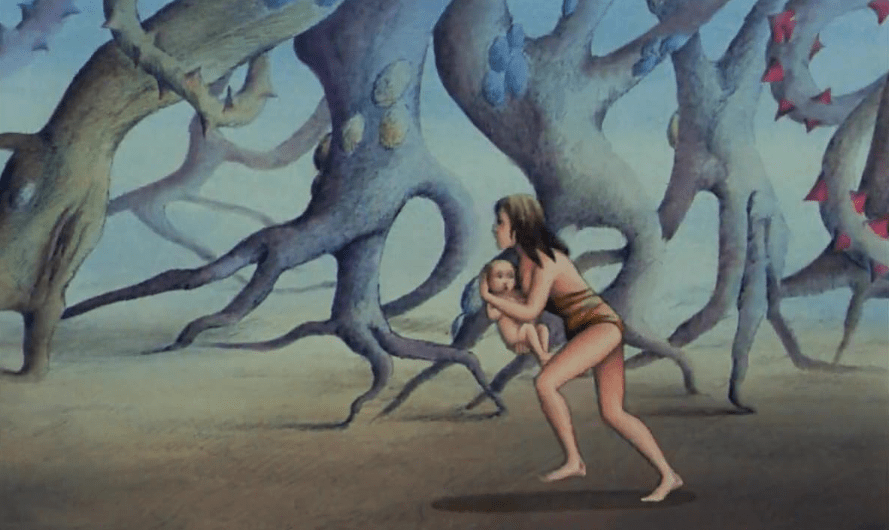
The movie opens with an Om mother carrying an infant in her arms. When she runs into a large blue hand, it’s finger flicks her around like one would an annoying bug. The casual cruelty brings about her death, but a young Draag child finds the Om baby and adopts it as a pet. Their relationship is a playful one, but I would not call it loving. The young Om is prodded and teased like he’s a toy and when the Draag grows into adolescence she becomes bored with him and neglects him. The Om (whose name is Terr) runs away and finds more of his kind in the wilds. These Oms are considered pests by the Draags and are routinely exterminated in a process called de-Ominization.
The Draag attitude toward Oms is not entirely hostile, but it is highly patronizing. Oms make decent pets they claim, but they breed too rapidly in the wild. As sub-Draag animals in their eyes, the Oms have no rights and kindness is afforded them only when it is convenient. In our own culture dogs and cats are loved and treated with familial affection, but little thought is given to killing them should they bite another human being or if they contract a disease. We distinguish them from humans where individual rights come into play. The Draag opinion of Oms is not dissimilar. What is most alarming about the Draag’s ideas about Oms is how sensible they are from their point of view. Why shouldn’t they flick an annoying Om away like a bug if a bug is all they are? Why shouldn’t their nests be subject to extermination if animals is all they are? As long as the Oms are equated with animals the Draags’ behavior toward them is justified. It’s as justified as how we treat animals on our own planet. No crime is committed when we squash a bug. Even when we take satisfaction and enjoyment from the experience. Think on the last time you squashed an annoying beetle. Did it make a popping crunch when it died? Have you ever sucked terrified pests with a vacuum and watched them go? Was it oddly fun and satisfying? In its own way The Fantastic Planet asks these questions. And it adds one more. Could there be something wrong with being so casual about it, let alone enjoying it? The reason we reject these questions is because we accept that they are sub-human species and the act of killing them and even enjoying it doesn’t carry the same moral weight as doing the same to another human being. As long as the Draag maintain this same view of the Oms they are cushioned against any guilt from causing them harm. When we are convinced of our definitions there is moral justification in committing these acts without moral censure. Roland Topor, who also co-wrote the film, knows this better than most. His father was a Polish-Jew who had been one of a small group of survivors of a Nazi death camp. And like the Draags, the Nazis freed themselves of guilt by their definitions. Jews were not human beings to them. Ergo their brutal treatment was justified. Evil doesn’t cackle and twirl its mustache like in cartoons. It moralizes and debates with cold reason.

Fantastic Planet is the sort of film that is only one of a handful of films that comes along in my lifetime. They are the films that challenge me by asking questions that are uncomfortable and difficult to answer. Like most of my species, I was raised to find the question of animal rights laughable at best. Fantastic Planet asks the question and it is not funny at all. It forces the viewer to face the issue even if the answer is not clear. I appreciate art that challenges. I personally think we need more of it. Even were we to fall back onto the opinions we held before, it is no bad thing to reevaluate them once in awhile.

Director: Rene Laloux
Writers: Roland Topor, Rene Laloux
Producers: Anatole Dauman, Simon Damiani, Andre Valio-Cavaglione
Cast: Jennifer Drake (Tiwa), Eric Baugin (Young Terr), Jean Topart (Master Sinh), Jean Valmont (Adult Terr)
Composer: Alain Goraguer
Cinematographers: Boris Baromykin, Lubomir Rejthar
Editors: Helene Arnal, Marta Latalova

Sleeper (1973)

Rating 3/4

Comedy, like science fiction, is ripe for social commentary and Woody Allen’s Sleeper, being both, is as brilliant as any.
Combining the physical antics of Buster Keaton and the wit of Bob Hope, Woody Allen had somehow achieved the impossible. He crafted alongside the comedy a highly intelligent vision of the future where the human race will have morally and intellectually degenerated into puerile sheep without ever challenging or being challenged. It’s as relevant and insightful as other great science fiction films like 2001: A Space Odyssey or The Day the Earth Stood Still.

Miles Monroe (Woody Allen) wakes up 200 years into the future after being involuntarily put in cryosleep after a routine surgery goes wrong. The doctors who wake him are able to cure him of his ailment, but what they can’t fix is a world where everyone is mentally infantile and sexually impotent. I am of course referring to the world of 2173. I can understand, I suppose, if someone became confused and thought I was referring to the present. I don’t think a man like Woody Allen could disagree.

Miles ends up on the run for his life after unwillingly getting involved with Marxist revolutionaries who want to use him to take down the government.

I’ve mentioned this film is a comedy while none of this sounds remotely funny. And yet, it is. With a highly well-thought out premise, Sleeper is a hilarious movie. The science-fiction background provides Allen with a comparative view of futurist mankind with how we are now. What being a comedy adds to it is a sharp take on absurdity and deservedly insults moral and intellectual laziness. The same sort of laziness threatening us now in 2024 just as much it did in 1973.

Miles meets Luna Schlosser (Diane Keaton) who is politically apathetic and lives an affluent life of ease. She writes bad poetry and thinks butterflies turn into caterpillars. She gets high with her friends by passing around and rubbing a ritual orb. She has a cheap understanding of sex and prefers to have pleasure artificially induced. Using a special chamber called an Orgasmatron people can now, not only skip the foreplay, but all physical activity involved altogether.

Throughout this insanity he disguises himself as a butler robot only to have his head nearly removed by a technician. He and Luna go on a quest to destroy the dictator’s severed nose to stop him from being cloned. Doctors tells him fudge bars and cigarettes are healthy now. And my favorite of all, he slips on a giant peel from a banana the size of a canoe. This same banana is owned and aggressively protected by a farmer who walks a six-foot high chicken on a leesh. Just in case the situation was not bizarre enough.

Miles is questioned in one scene about the meaning of a few fragments from his time in history. These include photos of famous political figures and selections from TV news broadcasts. The ironic and factually inaccurate answers he gives are some of the funniest and best-written lines in the movie. He also tells Luna this surreal story about how he asked his mother where babies come from. His mother misheard him and thought he said rabies so she tells him from dog bites. He says, “The next week, a woman on my block gave birth to triplets… I thought she’d been bitten by a great dane.”

Sleeper is also the sort of comedy that is rife with slapstick humor most of which is deliberately shot like old silent shorts from Buster Keaton and Laurel and Hardy. The camera is sped up to feign fast movement, the music – composed by Woody Allen himself – is jazzy, and the physical antics are cartoonishly out of this world.

Sleeper is funny from beginning to end and doesn’t become imbalanced with the social commentary. Both perfectly support the other and the rawer slapstick bits fit the the film’s overall tone. This might be the only sci-fi movie with classic bits like a pie in the face and slipping on a banana peel that doesn’t lose its preoccupation with social commentary in an Orwellian setting.

Sleeper is right up there with THX 1138, Logan’s Run, or Silent Running as a work of cerebral sci-fi. Simply because it swaps drama for comedy doesn’t make it any lesser and believing so would be a mistake.

American Graffiti (1973)

3.5/4

Jack Weinberg once told us “Don’t trust anyone over 30”; and watching the majority of high school coming-of-age comedies that have been released over the years I believe he was right. Most of these types of films are made by men well over thirty who have forgotten what it was like to be truly young. For them youth means the sort of lechery, booze, and boorishness that made Bob Clark’s pictures so popular.
George Lucas was 29 when American Graffiti, his second film, was released to American cinemas. It counts. And if there is anyone who can recapture in a bottle what it was like to be a teenager on the cusp of the adult world it is the man who would later give us Star Wars.

American Graffiti is not a film with a plot that can be adequately described and explained without losing some of its heart and appeal. The movie is a slice of life kinda picture showing the last night of freedom for a group of high school graduates about to go out and get jobs and go to college.
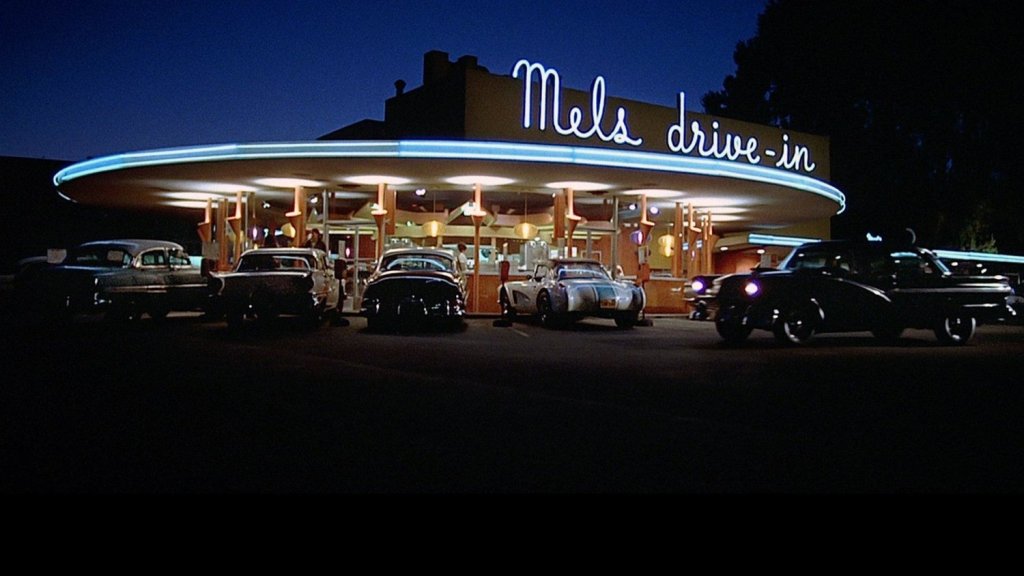
Set in the summer of 1962 with an atmosphere of 50’s diners, music, and cars American Graffiti perfectly and often hilariously portrays its characters living their best lives before the ravages of adulthood begin to take over.

Curt (Richard Dreyfuss) wonders if he really wants to go to college after all and goes on a wild excursion searching for a beautiful girl he saw passing by only to get entangled with a group of greasers whom he helps commit a few petty crimes to avoid getting beaten up by them.
His friend Steve (Ron Howard) is hormonal and immature; pressuring his girlfriend into sex just hours after telling her he wants to be free to see other people while he is away at school. As someone who actually is over 30 I know this is a really bad move.
Steve loans his car to the geeky bespectacled Terry (Charles Martin Smith) who uses it to impress Debbie (Candy Clark), a pretty blonde miles out of his league only to have everything fall apart when Steve later takes the car back. The romance between Terry and Debbie is absurd, charming, and comedically unrealistic in how much she puts up and puts out for him.
Milner (Paul Le Mat) is tricked into taking out a friend’s 12 year old relative, Carol (Mackenzie Phillips) out on a date and their petty bickering and her wit while he tries to pass himself as her babysitter make for some of the funniest moments in the movie. They both know she is too young for him and she takes every opportunity to embarrass and annoy him while she enjoys a night on the town. At the end they part ways with a reluctant mutual respect.
Milner’s rival, Bob Falfa (Harrison Ford) is a brash and immature tool who never quite grew up and has a hankering for street racing high schoolers. He is all ego and bravado who has no qualms over stealing Steve’s girlfriend, Laurie (Cindy Williams). When I was younger I may have felt something for Steve about this, but once again as a man who is over 30 I sympathize more with Laurie’s decision to leave and I was less than satisfied with her resolution with Steve; not being convinced that he really took responsibility for his actions that drove her away in the first place. This, and an unnecessarily tacked-on postscript which tells us what happened to a few of the other characters are the only weak points I found in the movie.

American Graffiti makes for a highly entertaining look at adolescent life in pre-counter culture America. The atmosphere of 50s rock tunes and classic cars doesn’t lose itself in nostalgia and shoe-horned references. It’s more about the characters and their misadventures than it is about the setting. It’s kids being kids without resorting to crude jokes, keg parties, and togas. It’s a sugary slice of young American life and it earns its place as a classic piece of New Hollywood cinema.