Robin Hood: Men in Tights (1993)

2/4 stars

Mel Brooks’ Robin Hood: Men in Tights is a movie that is good, but not good enough. It’s the sort of movie that a master comedian of Mel Brooks’ caliber cannot get away with. Not in the same way that the creators of Scary Movie or The Starving Games could have.
Against his previous offerings such as Blazing Saddles or Young Frankenstein, Men in Tights seems desperate in comparison. Comedy requires a skilled command of tight pacing or else the jokes start to live in a vacuum, like isolated entries in a joke book or a collection of comic strips. My experience of watching Robin Hood: Men in Tights was much like this. It opens at a breakneck rush before suddenly meandering into a collection of poorly interconnected gags that do nothing to serve the backdrop of the story or the characters. When the movie succeeded in getting a laugh out of me it’s always with a joke that could be placed in any other scene of the film, or even in another film altogether. Nothing funny in this movie comments on the story’s events or the characters’ flaws in any clever or meaningful way. The jokes are pure stitchwork. A collage of unrelated gags, arbitrarily placed and only occasionally funny. I feel that the humor in Men in Tights would have served better a more anthological piece like Brooks’ earlier History of the World, Part I.
Perhaps the most desperate of the jokes involves a mole on Prince John (Richard Lewis) that changes position in each of his scenes. The gag is a mild diversion that feels more like padding than anything clever.
Some of the jokes are overwrought. When we first meet Blinkin (Mark Blankfield) he is a blind man reading a medieval issue of “Ye Olde Playboy” in braille, the centerfold rendered embossed to aid his disability. There is simply too much going on here for the joke to work. A blind man reading Playboy in braille in a modern setting would have been funny. A man reading a copy of “Ye Olde Playboy” in medieval England would have been funny. A blind man reading “Ye Olde Playboy” in braille in medieval England is not funny at all.
There are comedic bits in the movie that did generate a chuckle out of me, but they suffer from the same desperate shoehorning that plagues the film. I especially appreciated a delightfully dumb bit where a formation of knights in armor are knocked over like dominoes in a highly contrived and circumstantial way that boggles respectable logic. I genuinely laughed at it. I was also tickled by a smaller scene where Blinkin somehow mistakenly thinks he can see again. It’s the sort of profound idiocy that made the Three Stooges and Beavis & Butthead so popular.
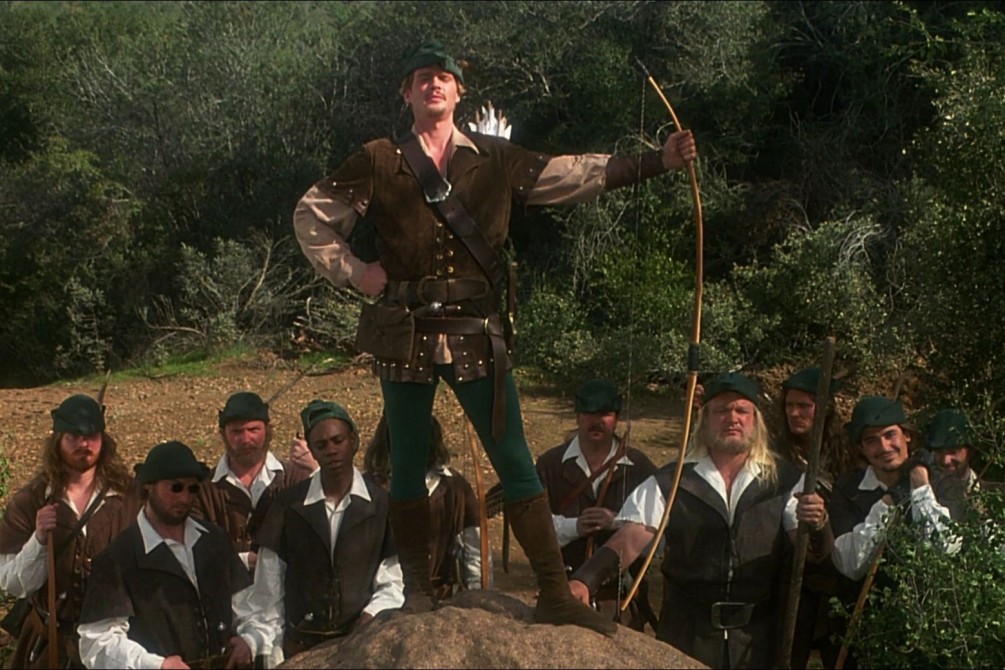
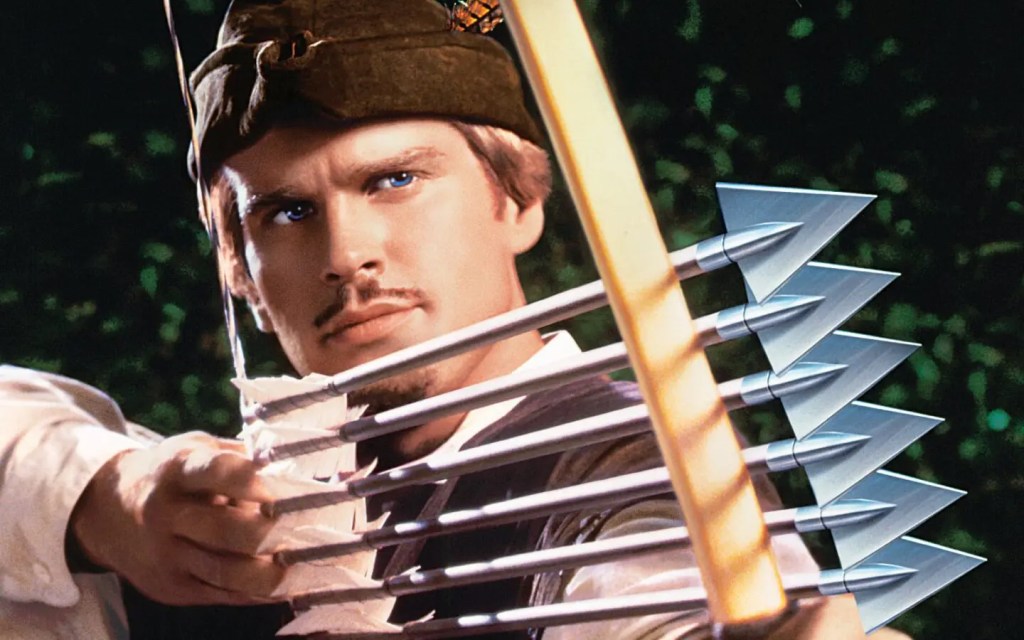
One of its best jokes involves a duel with staves between Little John (Eric Allan Kramer) and Robin Hood (Cary Elwes in a performance too imitative of Westley in the vastly superior The Princess Bride). Their incompetent attempts to adapt to the rods constantly splitting into smaller and smaller pieces is a riot and there is some mild amusement when Little John shows that he is unaware that the bridge he is guarding is over a shallow brook that a Lilliputian could cross with no effort.

But enough about the jokes. What about the story? Robin Hood is a folk hero ripe for parody. He was the subject of numerous renaissance ballads, popularized by novelists like Howard Pyle and Sir Walter Scott, and brought to life on the silver screen by the likes of Erroll Flynn and Walt Disney Studios. There is a wealth of material there to work with.
Unfortunately, Mel Brooks appears to solely target the Kevin Costner take (Robin Hood: Prince of Thieves) which the gap of a few years was enough to make this spoof untimely. Had Brooks set his sights more broadly perhaps he would have had more to joke about.
The movie opens with Robin Hood in prison in Jerusalem after helping King Richard fight in the crusades. There is a quick and shoddily paced build-up to a clandestine escape and afterward his rescuer, Asneeze (Isaac Hayes) sends Robin to find his son Ahchoo (Dave Chappelle, whose comedic talent is criminally underused in the movie) who is living as an exchange student (don’t ask) from Africa to England.
This turns out to not be much of a quest because Robin Hood encounters him almost immediately when reaching England. Ahchoo becomes the first of Robin Hood’s merry men and an adventure follows where the two of them recruit more members. None of these additions are particularly funny. There is Little John as mentioned above, but there is also Will Scarlett OHara (Matthew Porretta), whose only quality is an unfunny name and an apparent skill with throwing knives that is barely used in a movie overcrowded with other underused competing characters. There is also Rabbi Tuckman (Mel Brooks) filling in for Friar Tuck (haha, I guess) and, of course, Maid Marian (Amy Yasbeck) who is presented as an easy woman frustrated by virginity, vigorously enforced by a chastity belt.
The chastity belt is the subject of an absurd prophecy that the bearer of its key will be the man who shall marry her. Vying for her affections is the unimpressive Sheriff of Rottenham (no, that’s not a typo) played by Roger Rees as a foppish and vaguely effeminate coward.
The plot continues to meander with jointless plots and counterplots supplemented by random gags and groan-inducing puns. The archery tournament, winning of Maid Marian, and ousting of Prince John come late in the final act after the movie’s pace has already been firmly eviscerated.

Perhaps I may seem too harsh on Robin Hood: Men in Tights. The movie altogether is passably entertaining and watchable and its mood is amiable enough, I suppose. There is a sense of fun to it and it is clear that no one involved in it took the source material seriously. That is acceptable after all, but I was hoping that the comedy would have been taken seriously at least. Much of the jokes fall flat and do not carry the story along an inch. The desperation and randomness of its jokes left me wishing for more. Coming from Mel Brooks, Robin Hood: Men in Tights is disappointing. It doesn’t live up to the standards of his earlier work and the dearth of clever, memorable dialogue is hard to forgive.
It’s a movie that is just okay. I’ve seen better.

Sleeper (1973)

Rating 3/4

Comedy, like science fiction, is ripe for social commentary and Woody Allen’s Sleeper, being both, is as brilliant as any.
Combining the physical antics of Buster Keaton and the wit of Bob Hope, Woody Allen had somehow achieved the impossible. He crafted alongside the comedy a highly intelligent vision of the future where the human race will have morally and intellectually degenerated into puerile sheep without ever challenging or being challenged. It’s as relevant and insightful as other great science fiction films like 2001: A Space Odyssey or The Day the Earth Stood Still.

Miles Monroe (Woody Allen) wakes up 200 years into the future after being involuntarily put in cryosleep after a routine surgery goes wrong. The doctors who wake him are able to cure him of his ailment, but what they can’t fix is a world where everyone is mentally infantile and sexually impotent. I am of course referring to the world of 2173. I can understand, I suppose, if someone became confused and thought I was referring to the present. I don’t think a man like Woody Allen could disagree.

Miles ends up on the run for his life after unwillingly getting involved with Marxist revolutionaries who want to use him to take down the government.

I’ve mentioned this film is a comedy while none of this sounds remotely funny. And yet, it is. With a highly well-thought out premise, Sleeper is a hilarious movie. The science-fiction background provides Allen with a comparative view of futurist mankind with how we are now. What being a comedy adds to it is a sharp take on absurdity and deservedly insults moral and intellectual laziness. The same sort of laziness threatening us now in 2024 just as much it did in 1973.

Miles meets Luna Schlosser (Diane Keaton) who is politically apathetic and lives an affluent life of ease. She writes bad poetry and thinks butterflies turn into caterpillars. She gets high with her friends by passing around and rubbing a ritual orb. She has a cheap understanding of sex and prefers to have pleasure artificially induced. Using a special chamber called an Orgasmatron people can now, not only skip the foreplay, but all physical activity involved altogether.

Throughout this insanity he disguises himself as a butler robot only to have his head nearly removed by a technician. He and Luna go on a quest to destroy the dictator’s severed nose to stop him from being cloned. Doctors tells him fudge bars and cigarettes are healthy now. And my favorite of all, he slips on a giant peel from a banana the size of a canoe. This same banana is owned and aggressively protected by a farmer who walks a six-foot high chicken on a leesh. Just in case the situation was not bizarre enough.

Miles is questioned in one scene about the meaning of a few fragments from his time in history. These include photos of famous political figures and selections from TV news broadcasts. The ironic and factually inaccurate answers he gives are some of the funniest and best-written lines in the movie. He also tells Luna this surreal story about how he asked his mother where babies come from. His mother misheard him and thought he said rabies so she tells him from dog bites. He says, “The next week, a woman on my block gave birth to triplets… I thought she’d been bitten by a great dane.”

Sleeper is also the sort of comedy that is rife with slapstick humor most of which is deliberately shot like old silent shorts from Buster Keaton and Laurel and Hardy. The camera is sped up to feign fast movement, the music – composed by Woody Allen himself – is jazzy, and the physical antics are cartoonishly out of this world.

Sleeper is funny from beginning to end and doesn’t become imbalanced with the social commentary. Both perfectly support the other and the rawer slapstick bits fit the the film’s overall tone. This might be the only sci-fi movie with classic bits like a pie in the face and slipping on a banana peel that doesn’t lose its preoccupation with social commentary in an Orwellian setting.

Sleeper is right up there with THX 1138, Logan’s Run, or Silent Running as a work of cerebral sci-fi. Simply because it swaps drama for comedy doesn’t make it any lesser and believing so would be a mistake.

American Graffiti (1973)

3.5/4

Jack Weinberg once told us “Don’t trust anyone over 30”; and watching the majority of high school coming-of-age comedies that have been released over the years I believe he was right. Most of these types of films are made by men well over thirty who have forgotten what it was like to be truly young. For them youth means the sort of lechery, booze, and boorishness that made Bob Clark’s pictures so popular.
George Lucas was 29 when American Graffiti, his second film, was released to American cinemas. It counts. And if there is anyone who can recapture in a bottle what it was like to be a teenager on the cusp of the adult world it is the man who would later give us Star Wars.

American Graffiti is not a film with a plot that can be adequately described and explained without losing some of its heart and appeal. The movie is a slice of life kinda picture showing the last night of freedom for a group of high school graduates about to go out and get jobs and go to college.
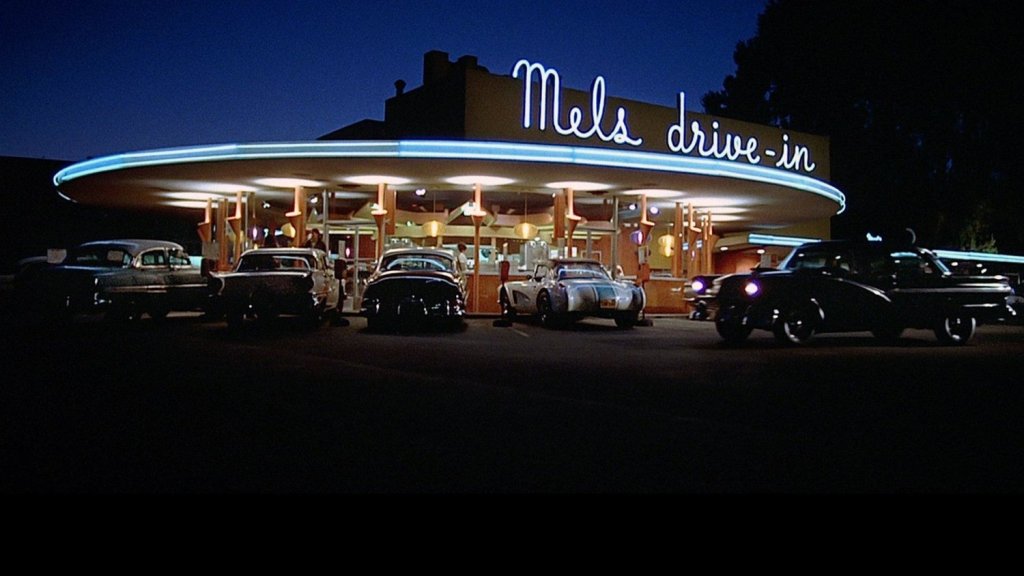
Set in the summer of 1962 with an atmosphere of 50’s diners, music, and cars American Graffiti perfectly and often hilariously portrays its characters living their best lives before the ravages of adulthood begin to take over.

Curt (Richard Dreyfuss) wonders if he really wants to go to college after all and goes on a wild excursion searching for a beautiful girl he saw passing by only to get entangled with a group of greasers whom he helps commit a few petty crimes to avoid getting beaten up by them.
His friend Steve (Ron Howard) is hormonal and immature; pressuring his girlfriend into sex just hours after telling her he wants to be free to see other people while he is away at school. As someone who actually is over 30 I know this is a really bad move.
Steve loans his car to the geeky bespectacled Terry (Charles Martin Smith) who uses it to impress Debbie (Candy Clark), a pretty blonde miles out of his league only to have everything fall apart when Steve later takes the car back. The romance between Terry and Debbie is absurd, charming, and comedically unrealistic in how much she puts up and puts out for him.
Milner (Paul Le Mat) is tricked into taking out a friend’s 12 year old relative, Carol (Mackenzie Phillips) out on a date and their petty bickering and her wit while he tries to pass himself as her babysitter make for some of the funniest moments in the movie. They both know she is too young for him and she takes every opportunity to embarrass and annoy him while she enjoys a night on the town. At the end they part ways with a reluctant mutual respect.
Milner’s rival, Bob Falfa (Harrison Ford) is a brash and immature tool who never quite grew up and has a hankering for street racing high schoolers. He is all ego and bravado who has no qualms over stealing Steve’s girlfriend, Laurie (Cindy Williams). When I was younger I may have felt something for Steve about this, but once again as a man who is over 30 I sympathize more with Laurie’s decision to leave and I was less than satisfied with her resolution with Steve; not being convinced that he really took responsibility for his actions that drove her away in the first place. This, and an unnecessarily tacked-on postscript which tells us what happened to a few of the other characters are the only weak points I found in the movie.

American Graffiti makes for a highly entertaining look at adolescent life in pre-counter culture America. The atmosphere of 50s rock tunes and classic cars doesn’t lose itself in nostalgia and shoe-horned references. It’s more about the characters and their misadventures than it is about the setting. It’s kids being kids without resorting to crude jokes, keg parties, and togas. It’s a sugary slice of young American life and it earns its place as a classic piece of New Hollywood cinema.