
4/4 stars
Christopher Nolan is one of the 21st century’s greatest filmmakers. If Oppenheimer and Interstellar hadn’t made this clear, The Odyssey most certainly will. As Homer’s great epic was a masterclass of world literature, Nolan’s definitive adaptation of the work is a masterclass in cinematic art. It is one of the most ambitious movies ever made and the final product is worthy of the effort.
The homecoming of Odysseus is among the oldest and most well-known stories of the western world. It’s themes and motifs, not to mention its venturesome qualities, continue to shape the arts today; with only The Bible and, perhaps, Shakespeare quite reaching its level of influence.
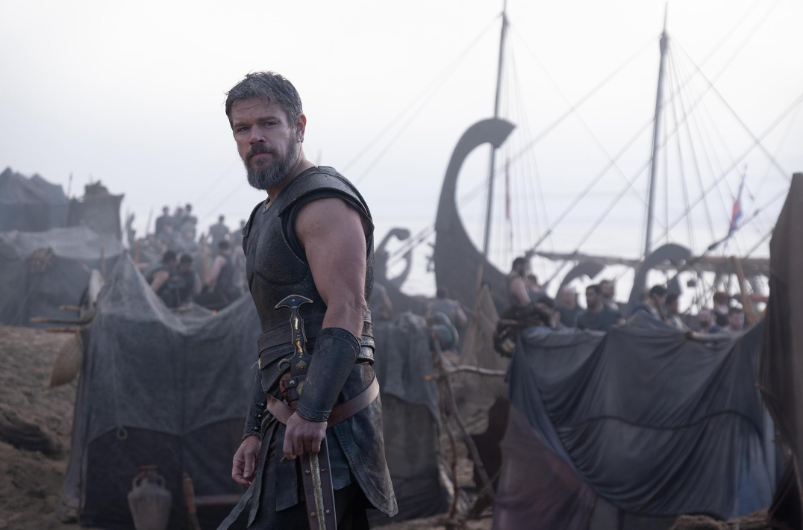
Christopher Nolan’s film is a faithful adaptation of the original poem, but he also achieves with it a transformative meditation on the aftermath of war and the cynicism that comes with it. The Achaean Greeks had approached the Trojan War with a sense of glorious cause. Homer’s Iliad meditates on this aspect quite thoroughly, in fact. But, tragedy and loss followed in its wake. Odysseus (Matt Damon) is presented in the film as a man haunted by his past and what he has to live with in the present. He and the other veterans of the war are left with only tatters of their former lives and the glorious cause they had once thought so noble and important seems little more than a lie that stole their lives away. The survivors are now old men with wives and children they have not seen in years. For some, their homecomings are a bitter welcome. Agamemnon – whose story was made famous in Aeschylus’ Oresteia – returns home to a wife who had taken a lover while he was gone and she murders him in his bed. Many do not return at all.
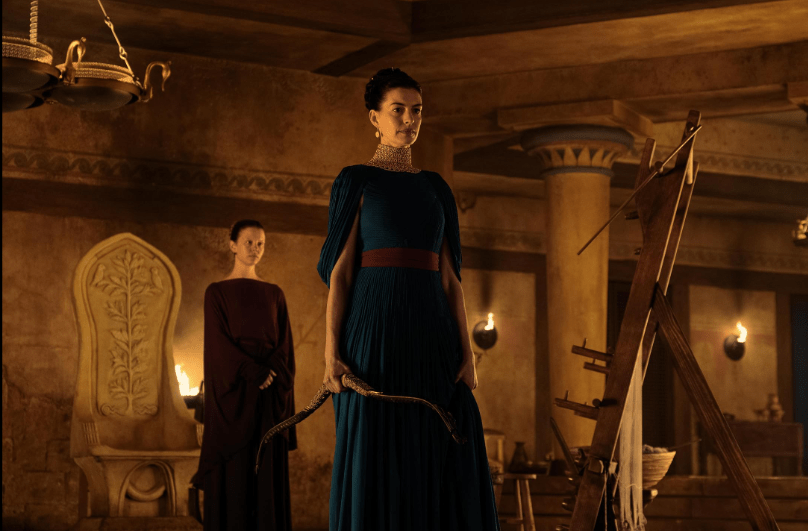
For Odysseus, his return holds more promise, but he is delayed. The tale of his wanderings is told in flashbacks as he dwells on an island inhabited by Calypso (Charlize Theron) who is all too happy to let him stay there and find forgetfulness eating lotus flowers. But, at home he has a wife and a son who have been waiting for him for years. Telemachus (Tom Holland) is due to take his father’s place as ruler of their household, but the parasitic presence of suitors trying to win his mother Penelope’s (Anne Hathaway) hand puts their family under threat and she holds out on them in hopes for Odysseus’s return. The leader of the gang of suitors, Antinous (Robert Pattinson), is a particularly slimy individual. He regularly tries to goad Telemachus into anger so as to provide an excuse to kill him. They view the Greek rules of hospitality as something to take advantage of, while much of the world is said to be abandoning it altogether.
A primary driving force for Odysseus to leave his complacency on Calypso’s island is his own guilt which is personified in visions of Athena (Zendaya) that only he can see. Like in the original Homer epic the gods are feared, but they are largely unseen. Homer’s Iliad made more use of them in its narrative, but The Odyssey gives Man more space to work things out on his own. Instead, the supernatural elements at play are the subjects of fantasy such as monsters and witches. Nolan blends these brilliantly with the overall realism of the film. Here they are shown as naturally occurring phenomena that are as much a part of the world as the men and women and their polities. This is made most apparent in Odysseus’s journey to Hades which is not shown as a descent into some fantastical realm, but rather a grim calling of the souls of the dead to a lonesome fog-laden island.
The two highlights of Odysseus’s adventures are with the Cyclops and the witch Circe. The classic episode where his men are turned into pigs by Circe is horrifying to watch. It’s a slow Cronenbergian process where the twisting of their forms into the shapes of beasts is fuel for nightmares.
The Cyclops is equally visually impressive. Nolan understands special effects better than most filmmakers working today and his use of it is always appropriate and never forceful. He lights and shoots his scenes using CGI in such a way that the viewer needs little demand to suspend their disbelief. As with the transformation of Odysseus’s men into pigs, the Cyclops appears like a real tangible thing that was photographed along with the human actors. The sound design (which will shock me if it doesn’t earn an Oscar next year) is impressive throughout the film, and the Cyclops scene is one of its best examples. He lets out a roar that is unlike anything that I have ever heard in a movie before and I dare a horror film to produce a sound as monstrous and terror-inducing as this.
My favorite scene, however, is when they encounter the Sirens. It is not sexualized as some may expect, but presents one of the deepest moments in the film and some of the finest acting of Matt Damon’s career. Like the sailors with wax in their ears, we do not hear their song, but the effect it has on Odysseus and what he has to say about the experience afterward is a moment where we see the movie at its most poignant.
The Odyssey is the first movie in cinematic history to be filmed entirely on 70mm IMAX cameras and the end result is sweeping and beautiful. While keeping to a natural and realistic approach to the mythological elements of the story, the cinematography remains epic and massive in scope. Looking at the images, especially the ones set at sea, I was overwhelmed with the sense that this is a film that had been on Nolan’s mind for some time. This was a passion project that he was determined to give justice to and to get right. He has most certainly done so. I have called his treatment of the story as definitive and I stand by it. No adaptations of Homer’s work on film have ever achieved this level of excellence. The Odyssey along with Dune: Part Two, Guillermo del Toro’s Frankenstein, and Nolan’s own Oppenheimer will be remembered as among the greatest films of the past decade. This nostalgia-obsessed internet age culture that lurks among YouTube essayists and basement dwelling review-bombers would have you believe that great cinema is dead. Don’t believe them.
Director: Christopher Nolan
Writer: Christopher Nolan
Producers: Christopher Nolan, Emma Thomas, Thomas Hayslip, Zakaria Alaoui, Leifur B. Dagfinnsson, Hjortur Gretarsson, Helen Medrano, Erik Paoletti, Kostas Raftopoulos, Andy Thompson
Cast: Matt Damon (Odysseus), Robert Pattinson (Antinous), Corey Hawkins (Polybus), Jarreth J. Merz (Leodes), Niko Nicotera (Peisander), Tom Holland (Telemachus), Elliott Page (Sinon), Anne Hathaway (Penelope), Elyes Gabel (Elatus), Iddo Goldberg (Amphimedon), Jamie Harris (Agelus), John Leguizamo (Eumaeus), Mia Goth (Melanthus), Ryan Hurst (Mentor), Kate Fuglei (Eurycleia), Benny Safdie (Agamemnon), Himesh Patel (Eurylochus), Jovan Adepo (Elpenor), Andrew Howard (Polites), Josh Stewart (Antiphates), Logan Marshall-Green (Melanthius), Charlize Theron (Calypso), Zendaya (Athena), Jon Bernthal (Menelaus), Jimmy Gonzales (Cepheus), Jesse Garcia (Menetus), Ryan de Quintal (Ilus), Will Yun Lee (Anchialus), Anthony Molinari (Perimedes), Stephen Murphy (Phemius), Matt Lasky (Peisenor), Ian Casselberry (Dolios), Sean Avery (Laodamus), Bill Irwin (Cyclops), Lupita Nyong’o (Helen/Clytemnestra), Samantha Morton (Circe), James Remar (Tiresias), Brian Vernel (Irus)
Composer: Ludwig Goransson
Cinematographer: Hoyte van Hoytema
Editor: Jennifer Lame

