Batman: The Movie (1966)

3/4 stars

I have heard it said that the 1960’s Batman television series existed in a more innocent time. I suspect that people say this to offer an explanation for the campy, childlike flavor of movies and TV in those days. But, I don’t think this is precisely true. The 60’s were no more innocent a time than the 2020s, but what made them different was the counterweight that superhero stories offered against the world, scary as it was at the time and continues to be today.
The first superheroes came on the scene in the late 30s when Hitler was rising in Europe, and their popularity continued through World War II, the counter-culture revolutions, the Cuban missile crisis, Vietnam, the Kennedy assassination, and Watergate. Hardly innocent times.
Instead the difference between Batman (1966) and the modern superheroes is not the times, but how they reacted to them. They are more cynical and reflective now, presenting the world as it really is and demonstrating morality as beleaguered and somewhat of a lonely companion. To stand against evil they must be tough, compromising, and angry.
But, in the Silver Age of comics books and comic book movies, people were more ready to accept goodness as an absolute that was capable of enduring scorn. It was a time when presidents and world leaders were respected figures, the police were more trusted, and antiheroes weren’t admired. It was not the times that changed. It was people who did.

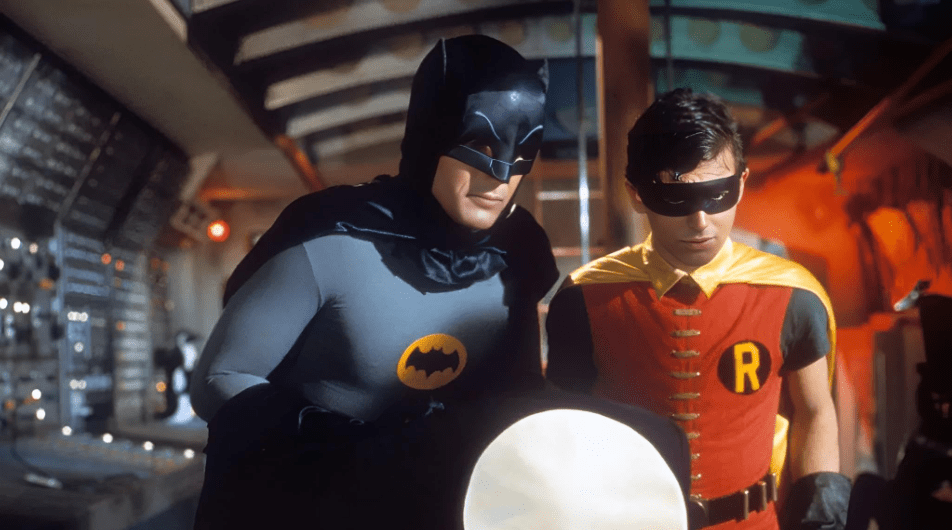
The 1966 Batman movie starring Adam West was a product of the earlier time. This Batman (West) gets his moral values from Sesame Street. He is the sort who disapproves of gambling, believes in the potential for good in everyone, helps old ladies cross the street, goes to church on Sunday, and supports the local police. He is all about law and order, and even denies in one scene to being a vigilante. It’s explained that he and Robin, the Boy Wonder (Burt Ward) are formally deputized agents by the Gotham PD.

After narrowly avoiding a mishap involving a fake yacht and an exploding shark (a detailed explanation wouldn’t make it less ridiculous, I promise) he and Robin uncover a sinister plot to take over the entire world. Such a fiendish scheme, of course, could only involve the work of super-criminals and Commissioner Gordon (Neil Hamilton) discovers that not one, but four super-criminals are currently at large. With Batman’s superior detective skills (AKA improbably correct guesses a propos of nothing whatsoever) he realizes that all four of them must be responsible.
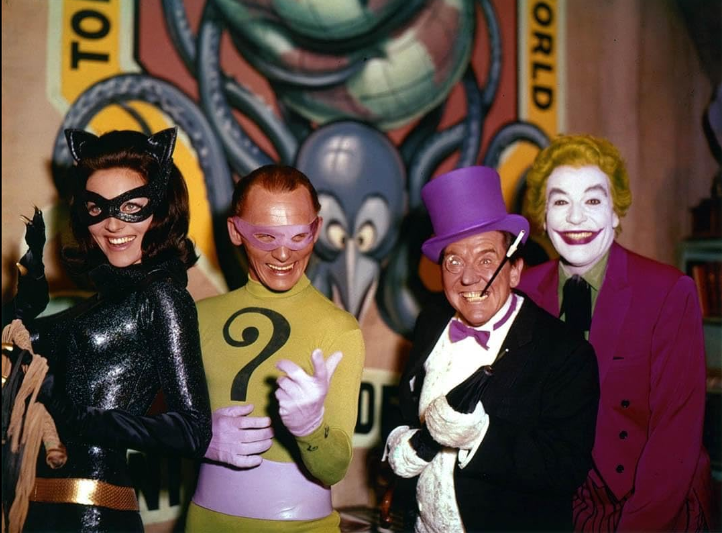
The four dastardly villains now working together are The Penguin (Burgess Meredith), The Joker (Cesar Romero), The Riddler (Frank Gorshin), and Catwoman (Lee Meriwether, replacing TV actress Julie Newmar who was recovering from a back injury at the time).
The movie juggles the four villains remarkably well during the 105-minute length, by simply keeping them together in the same room most of the time. They spend the majority of the movie bickering, laughing together, scheming excitedly, and then laughing some more. Singly on television or all together as in here, these characters are always a ton of fun. Meredith and Gorshin are my favorite actors to play Penguin and Riddler and I think a lot of it is due to the sheer level of enjoyment they have playing their roles. Riddler is constantly excited and laughing in high-pitched giggles. He is the most physical of the four, moving about like he has extreme ADHD. Penguin is laughably mean, squawking about and full of pure malice as he barks orders and complains on a regular basis. Meredith completely throws himself into the role and it is clear watching him on TV and in the movie that he absolutely loves playing it.
Joker contributes the least of all of them, generally going along with the plans and offering a funny comment here and there. Romero plays Joker like he is just happy to be here for the simple mischief of the whole thing, and to me that fits the character just fine; but he sadly gets a bit sidelined by the Riddler’s riddling and the Penguin’s masterminding.
Catwoman, however, plays a more central role this time around. She seduces Bruce Wayne by pretending to be a Russian journalist named Kitka in order to set him up for kidnapping. The wily scheme works and the evildoers wait for Batman to arrive to rescue him in order to trap and kill him. For obvious reasons this doesn’t work out very well and Wayne ends up escaping on his own. Meriwether’s role is fairly straightforward. She struts about in the catsuit all lithesome and seductive while moaning on occasion like a cat in heat. When she is playing Kitka it’s only a matter of silky tones in a fake accent and looking pretty. Catwoman’s eventual rise as a feminist icon is still a generation away.
Still, the combination of all four of them in one film pays off, and it shows that having multiple villains in a superhero movie can be done effectively if done right. A lot of other superhero flicks have struggled with this despite longer runtimes and less characters to juggle.

The super-criminals’ super-scheme to take over the world ultimately leads them to the United World Headquarters (an obvious stand-in for the UN) where representatives of several countries argue about world peace. The Penguin uses a diabolical machine to turn them into dust and it is up to the Dynamic Duo to reclaim the dust and restore the representatives to their original state.
The members of the United World Headquarters are only vaguely characterized. The hows and whys of world peace are not articulated, but is only spoken of in worshipful idealistic tones. There is a sense of moral naivete that is deliberate. Batman lives in a world where the buck stops at right and wrong and any thought of costs and necessary compromises are wholly alien to his philosophy. To him a spade is a spade. But, the Joker is wild and so are his companions. The nefarious villains are similarly single-minded in their badness. Without a touch of ambiguity they seem to be fully aware that they are bad people. The motivations of greed are only secondary to their childish desire to be a foil to Batman who is every bit as outlandish as they are. Without Batman these people would likely just go get desk jobs and give up on crime altogether because it wasn’t fun anymore. The 60s Batman show and the movie play more like an elaborate game of cops and robbers with each playing their respective roles with gusto.

Batman: The Movie is a highly innocent kind of film built up on the values of Dick and Jane and Mr. Rogers. As a straight-up adaptation of the TV series rather than an interpretation of the comics, it may very well be the most true to form Batman movie of all time. The comical tongue-in-cheek style adds to its charm and it is flawless in its intentions. It’s message of unambiguous morality is free and clear while it persistently goofs off. The gadgets are absurdly specific and convenient, the clue-finding is brainlessly non-sequitur, the characters are larger than life and costumed to match, and the action scenes are straight out of cartoons. The movie does more than capture the innocent moralizing of the Silver Age comic books. It also captures the fun.

Director: Leslie H. Martinson
Writers: Lorenzo Semple, Jr; Bob Kane, William Dozier
Cast: Adam West (Batman/Bruce Wayne), Burt Ward (Robin/Dick Grayson), Lee Meriwether (The Catwoman/Kitka), Cesar Romero (The Joker), Burgess Meredith (The Penguin), Frank Gorshin (The Riddler), Alan Napier (Alfred), Neil Hamilton (Commissioner Gordon), Stafford Repp (Chief O’Hara), Madge Blake (Aunt Harriet Cooper), Reginald Denny (Commodore Schmidlapp)
Producers: William Dozier, Charles B. Fitzsimons
Composer: Nelson Riddle
Cinematography: Howard Schwartz
Editor: Harry Gerstad
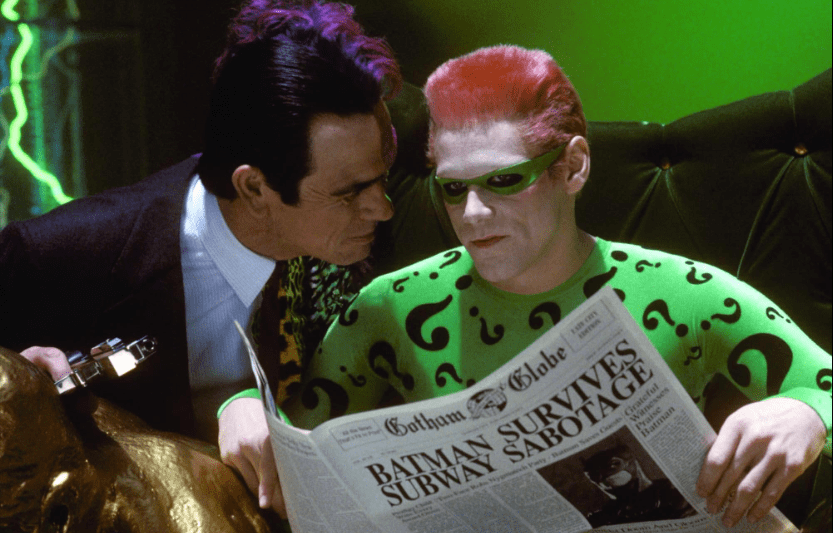
Batman Forever (1995)

2/4 stars

There are three kinds of Batman. Gothic Batman is the subject of the classic comic books and we see him stoically doing what he does best in the Tim Burton movies and the animated TV series from the 90s. The more introspective Edgelord Batman made popular in Christopher Nolan’s Dark Knight trilogy has been a favorite of comic writer Frank Miller, but largely exists elsewhere in memes. Campy Batman is best represented by Adam West back in the 1960s. Campy Batman’s Gotham City is a colorful world of colorful people where villains prance in clownish costumes and laugh maniacally. They are the sort of baddies who twirl their mustaches, tie damsels to railroad tracks, and scheme to poison the city’s water supply.
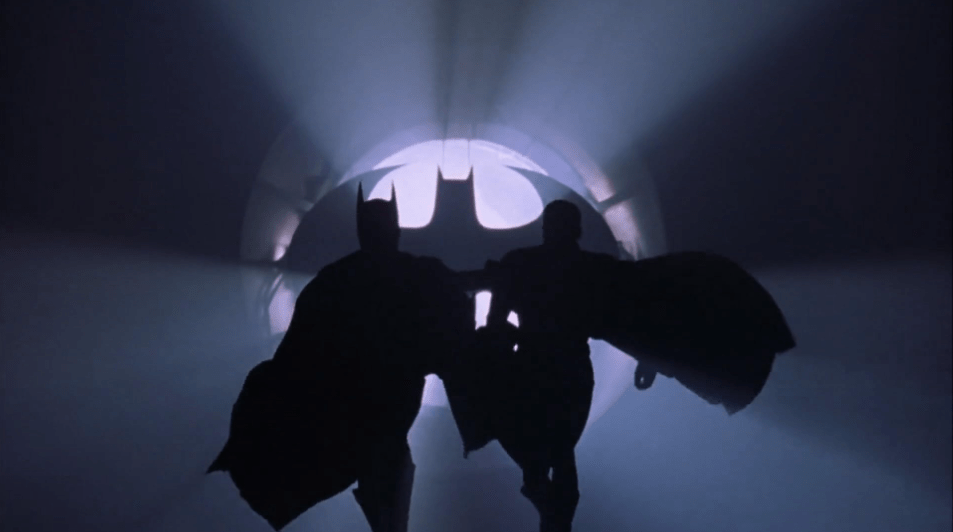
Director Joel Schumacher’s Batman Forever is a return to the old tradition of campy Batman, slanted camera angles and all. When Schumacher, taking over for Tim Burton, approached the material he aimed to make a live-action cartoon. For better or worse, he succeeded. As stupid and ridiculous as the movie is, it is everything it intended to be; its flaws by design and really a matter of taste.

A common complaint leveled at it is that it is too campy and too cartoonish. I hold to the opposite view. I believe it isn’t campy and cartoonish enough, and therein lies Batman Forever’s downfall. The heroes, given what they are up against, are too sullen for their own good. Val Kilmer, replacing Michael Keaton, in the role of Bruce Wayne commands no presence, adding nothing interesting to the part. As Batman he is stale, watering the character down to a fighting costume.
Robin, the Boy Wonder is brought in this time around, and if the fans had been waiting patiently through two movies for Batman’s trusted sidekick to finally appear they must have been sadly disappointed. Chris O’Donnell as Dick Grayson (Robin’s alter ego) has none of Burt Ward’s original energy and passion. O’Donnell plays the role as standoffish and angry. His character development is nothing more than a skin-deep paint-by-numbers expression of the old saw “revenge won’t make the pain go away” and “taking a life leads to a dark path.” There is nothing wrong with such messages of course, but no sincere effort is made to convince the audience of their truthfulness. It’s merely said and Robin comes to these conclusions only when the script finally says so.
Batman and Robin generate no charisma whatsoever, all of their energy being sucked into the two lead villains.

The movie opens with the dastardly Two-Face (Tommy Lee Jones) robbing a bank to lure Batman into a trap. He giggles and jumps up and down like a clown, firing machine guns at nothing in particular as police helicopters swarm above. The burnt side of his face is improbably symmetrical in relation to the other side: a purple bit of prosthetic rubber that appears more like a cartoon’s idea of a deformity than anything seen on a real burn victim. His suit is split in a similar fashion; formal and proper on one side and gaudy and colorful on the other. When we see his evil lair later in the film the interior decoration keeps to this pattern. One side looks like the very throne room of hell and the other is pure white and fit for a fairy tea party. His two sexy girlfriends, Sugar and Spice (Drew Barrymore and Debi Mazar) are bedecked to match.
When Batman arrives at the bank robbery, he is joined by Commissioner Gordon (Pat Hingle) and Dr. Chase Meridian (Nicole Kidman). Meridian is a professional parapsychologist who specializes in super-criminals and caped crusaders alike. She doesn’t look much like a psychologist. She stands next to Batman looking like a blonde bombshell, speaking in silky tones and saying nothing more insightful than what can be gleaned from a copy of Psychology Today. She is about as convincing a psychologist as Denise Richards was as a physicist in The World Is Not Enough. Kidman plays the role like a Bond girl. She feigns a professional interest in Batman that masks something more fetishistic.
We later see a love triangle develop between her, Batman, and his secret identity Bruce Wayne. The movie posits a theme where Dr. Meridian’s infatuation with Batman is something girlish and rebellious; her eventual favoring of Wayne being a moment of maturity. She directs her husky-toned flirtations toward both equally, however, and the point is not hammered home that deeply.

After Two-Face escapes he joins forces with The Riddler (Jim Carrey) whose wild performance is the front and center of the whole show. Carrey plays Riddler with no restraint at all. His acting reaches over the top and then goes only higher. He moves like he is cursed to dance forever and he never stops talking. The performance is loud and obnoxious; Carrey mugs the camera, making bizarre faces and dropping pop culture references and bizarre jokes whenever he is on screen, which ends up being a great deal. Jim Carrey has this way of punctuating his words with sharp turns of his head. He does it so much you could make a drinking game out of it. After Batman Forever I’d be fairly plastered. Try doing it while watching The Mask and you would need a new liver.
When we first meet him he is an excitable and neurotic employee of Wayne Enterprises named Edward Nygma who idolizes Bruce Wayne and wants to impress him with a new mind-control device he invented. Wayne’s predictable rejection crushes the already unhinged Nygma’s spirit and he becomes enraged and bitter. It’s probably the lamest super-villain origin story to date, but it fits the material Schumacher presents.
As Riddler he uses his mind control device to read the minds of everyone in Gotham so he can steal their credit card numbers and financial records. It’s a shockingly short-sighted plot. One man having access to everyone’s money would only crash the economy and more than likely the existence of his machine would force the world to adapt its methods of bookkeeping to counter-act it. But maybe I am overthinking the logistics of a villain scheme obviously reminiscent of a Saturday morning cartoon.

When the movie sticks to Joel Schumacher’s vision it works remarkably well even if Carrey could afford to tone it down a little. Gotham looks better than ever keeping the same Gothic Dr. Seussian aesthetic from before, but more lively and animated. The camera rides through the city like a roller-coaster, allowing the viewer to soak in the details. It reminds me of a professional haunted house made with money as no object.
Tommy Lee Jones and Jim Carrey’s antics are constantly energetic and off the wall. Reminding myself that this is supposed to be a live-action cartoon I can accept them, if not love them overmuch.
Where it fails is with its hero characters. Pat Hingle phones in his performance as Gordon, seeming to be painfully aware of what had become of the series. Kilmer is dry as a bone and O’Donnell is over-serious and undercooked as a character. Nicole Kidman brings to the movie the sort of character we should have had in Catwoman back in Batman Returns. Bond girls and Batman vixens alike are supposed to be somewhat innocent and prepubescent in their sensuality. They entice the man hidden behind the mask, but the boy that the mask represents ultimately wins out and keeps them untouchable. Kidman brings this to Chase Meridian well enough, but still never quite reaches the comic tone that the movie needs more of.

In Batman Forever Schumacher tries too hard to meld the 1960s era camp with the more mature themes of the Burton movies, and the result is an inconsistent mess. In the end I appreciated what the director has tried to do more than what he has done.

Director: Joel Schumacher
Writers: Bob Kane, Lee Batchler, Janet Scott Batchler, Akiva Goldsman
Cast: Val Kilmer (Bruce Wayne/Batman), Tommy Lee Jones (Two-Face/Harvey Dent), Jim Carret (Edward Nygma/Riddler), Nicole Kidman (Dr. Chase Meridian), Chris O’Donnell (Dick Grayson/Robin), Michael Gough (Alfred Pennyworth), Pat Hingle (Commissioner Gordon), Drew Barrymore (Sugar) Debi Mazar (Spice)
Producers: Tim Burton, Mitchell E. Dauterive, Peter Macgregor-Scott, Benjamin Melniker, Kevin J. Messick, Michael E. Uslan
Composer: Elliot Goldenthal
Cinematographer: Stephen Goldblatt
Editors: Mark Stevens, Dennis Virkler