
4/4 stars
Superhero movies tend to have a distinct formula these days. They often open in the middle of the action where the heroes, already familiar to the audience, are on some unrelated mission that goes south. They take a brief break for some funny dialogue before the movie’s main conflict is introduced and they are then whisked away on some adventure. What follows for the next two to three hours is constant action, displays of special effects, and witty banter. The fans are familiar with the characters, and it is that familiarity that carries the movie rather than the plot. It’s akin to seeing a circus performance. You’re there for the clowns and the elephants. No one cares what the ringleader and lion trainers have to say.
But, Superman: The Movie, the film that jump-started the genre, defies that formula. It takes its time establishing its characters and their motivations. It’s also well-performed, artfully photographed, and cleverly written. It is, in fact, what a lot of superhero flicks are not. It’s a movie.
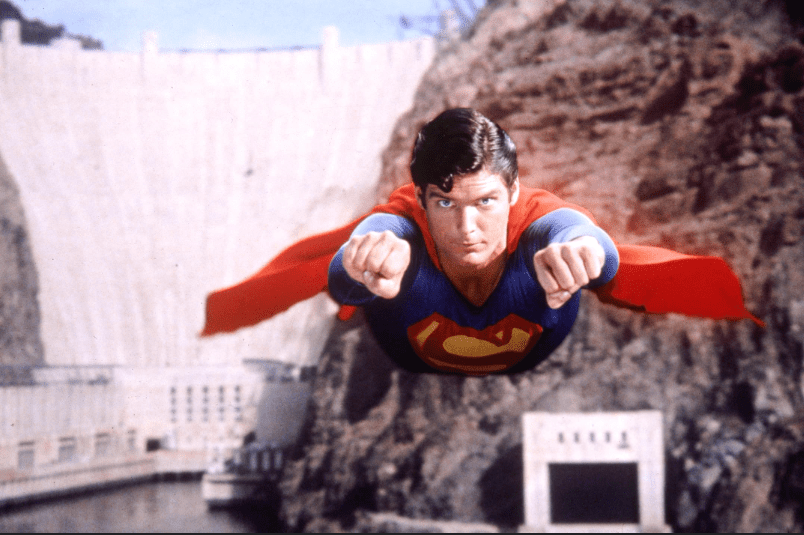
Superman was made in the old Hollywood tradition, playing much like the rousing screen epics that preceded it. Clark Kent’s path to becoming Superman occupies much of the film’s first hour and when he finally does we understand his character completely. Christopher Reeve’s Superman is more than a costume fighting bad guys. He is a personality we get to know and root for. Superman is the classic story of a man born to become something greater. As his adopted father Johnathan Kent (Glenn Ford) puts it, he was put on this Earth for a reason. Clark Kent follows in the tradition of screen epics like Ben-Hur or Gone with the Wind where the situation and conflict serve the characters rather than the other way around. The movie is not a spectacle of human action figures playing out a scenario, but the story of a man growing into his potential.
The film opens on the planet Krypton, a place millions of light years from Earth where crystalline architecture is all the rave and the people wear glowing costumes that anticipate the special effects of Tron. The planet is about to be fatally engulfed in a solar flare, and Superman’s father, Jor-El (Marlon Brando), tries to warn Krypton’s elder council that they need to evacuate. They don’t believe him, so he builds a small spacecraft in secret to send his infant son to Earth where he will be safe.
When he gets there he is found by a childless couple in Kansas, the Kents, who adopt him. It is Johnathan Kent’s values that make Clark Kent the man he becomes. During those years as a teenager on the Kent family farm, Clark learns that his powers are a gift to help others weaker than himself and that selflessness and restraint are the highest obligation of the strong.
Clark Kent’s rearing in Smallville, Kansas make for the strongest scenes in the movie. Everything that Superman believes in and is sent to protect are established there in rural Americana – a setting of open wheat fields and country roads, gorgeously shot in wide-angles.
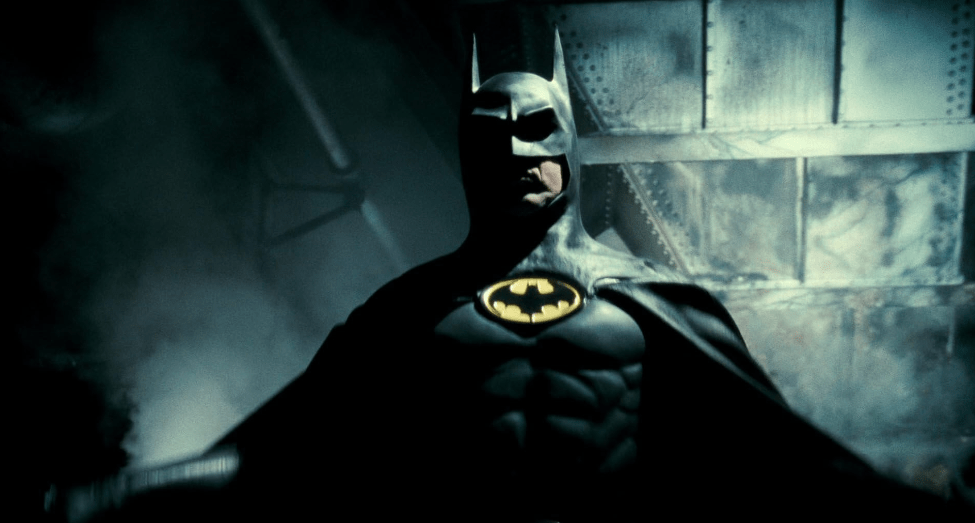
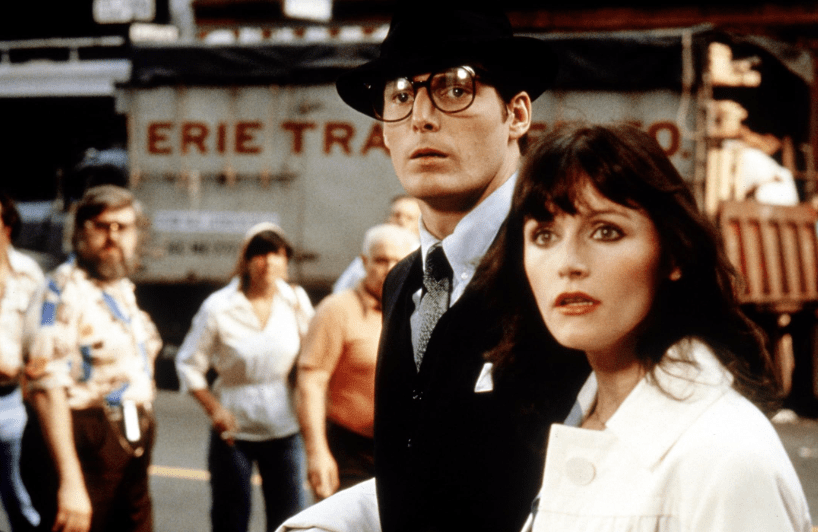
After Pa Kent dies of a heart attack, Clark learns more about his history and where he comes from. He decides to move to the big city of Metropolis and gets a job as a writer for the Daily Planet. It is here that his persona as Clark Kent fully takes off. Christopher Reeve is a great Superman, but he is an even better Clark Kent. He presents himself as bumbling and clumsy as well as a trifle naive. Clark Kent largely represents the people that Superman is there to protect. Like them, Clark is played as easily taken advantage of, but has something in him that kinder souls want to shelter and keep out of trouble. In a way, the alter ego of Clark Kent is closer to who Superman truly is. He abhors violence and has a love of justice and peace. He is the sort of man who just wants everyone to get along. By contrast Bruce Wayne is more of a mask that hides his true identity as Batman. In Superman the reverse is true, with Clark Kent being the true core of his being, while Superman is his mask.
At the Daily Planet he meets a reporter named Lois Lane (Margot Kidder) who finds Clark affable enough, but cannot abide his apparent lack of spine. When they are mugged in an alleyway, Clark insists in non-resistance, but Lois scoffs and tries to struggle with their assailant. The mugger’s gun goes off which Clark surreptitiously catches with his hand, but then pretends to faint. Lois not seeing the trick and assuming the mugger only missed, is disgusted.
Clark is infatuated with Lois, but she has her eyes on Superman after he rescues her from a near accident in a helicopter. On top of this Superman has already begun to make a reputation for himself stopping heists, apprehending criminals, and rescuing cats stuck in trees. She gets an opportunity to interview Superman for the paper and their sexual chemistry is clear from the start. The interaction is flirtatious and Lois finds herself stumbling into innuendos when she tries to speak. She and everyone else doesn’t see what the audience sees, which is that Superman is just Clark Kent with his glasses off. It’s the sort of logical discrepancy that I would call an elephant in the room if it wasn’t for all of the jokes that have been made of it over the years. It’s more of a dead horse than an elephant really.
But, no good superhero movie is lacking in a good villain. In Lex Luthor (Gene Hackman) we get a character who is everything that Superman is not. Luthor is greedy, selfish, indifferent to the suffering of others, and always ready with an insult. His first bit of dialogue is “It’s a wonder that brain can generate enough power to keep those legs moving,” referring to his henchman, Otis (Ned Beatty). Otis follows the old tradition of super-villain henchman. He’s comically dimwitted and so incompetent that Luthor’s continual employment of him raises a lot of questions. I wouldn’t trust this guy to lay down and sleep without screwing it up somehow. Perhaps Otis is a relative or something.
Hackman’s performance as Luthor makes for the greatest super-hero villain of all time. His narcissism and constant sarcasm make him infinitely quotable. Luthor lives in awe of himself while holding everyone else around him in disdain. He is the sort of man who has no idols and heroes more impressive to him than himself. His personality is more of perpetual bemusement than anything threatening. He doesn’t wax philosophical or justify his wickedness with dark monologues. Nor is he governed by hate or revenge. He is more like Jabba the Hutt or Ooogie-Boogie. He is aware of what he is and he doesn’t care.
Lex Luthor has a wild scheme to use navy missiles to target the San Andreas fault line. By destroying much of the West coast he hopes to corner the real estate market in what remains. The only thing standing in his way is Superman who is naturally outraged by the sheer loss of life Luthor’s plan entails. Superman asks, “Is that how you get your kicks? Planning for the death of millions of people?” Luthor responds, “No. Causing the deaths of millions of people.” What a guy!
The climax is satisfying and exciting with an ending that sets the stage for more adventures to come fighting Luthor and worse. Superman’s father, Jor-El, left him with instructions to not interfere with human history. During the final act Superman is faced with the consequences of this command and the decision he makes at the end is decidedly un-Kryptonian, but it is certainly a human one.
Superman is the best of the superhero movies and it is the best-looking. It was the most expensive movie made up to that point, and it was done when CGI was in its infancy. Instead of relying on its special effects (still impressive for the time) it is shot in the classic Hollywood tradition of wide-angle lenses and beautiful natural cinematography sadly missed in blockbuster movies of today. It’s paced like a real movie, focusing on the growth of its main character and performed with convincing dramatic effect.
Superhero movies nowadays are often made with their scripts being the last thing on the filmmakers’ minds. They go into production with little more than a planned set of story beats that get hammered out in the course of their making. When a film of this genre starts life with a tight script, it results in something special. Something not typically seen in superhero movies. It results in an actual movie.
Director: Richard Donner
Writers: Jerry Siegel, Joe Shuster, Mario Puzo, David Newman, Leslie Newman, Robert Benton, Tom Mankiewicz
Cast: Marlon Brando (Jor-El), Gene Hackman (Lex Luthor), Christopher Reeve (Clark Kent/Superman), Ned Beatty (Otis), Jackie Cooper (Perry White), Glenn Ford (Pa Kent), Margot Kidder (Lois Lane), Valerie Perrine (Eve Teschmacher) Phyllis Thaxter (Ma Kent), Susannah York (Lara), Jeff East (Young Clark Kent), Marc McClure (Jimmy Olsen)
Producers: Charles Greenlaw, Ilya Salkind, Pierre Spengler, Richard Lester, Alexander Salkind
Composer: John Williams
Cinematographer: Geoffrey Unsworth
Editors: Stuart Baird, Michael Ellis