Supergirl (1984)

1.5/4 stars

Some days I swear Hollywood thinks that women have nothing better to do. They don’t seem to be aware that the calling to fight for truth and justice or the vices of powerlust and ambition are the provinces of women as well as men. But, too often we see that attempts at creating female equivalents to male figures are not equivalent at all. Their priorities are portrayed as smaller and pettier than those of the opposite sex. The male Hollywood writers render feminism to condescension and being patronizing. And the women are not elevated to the same abilities and concerns of characters that are men.
The writer of Supergirl (David Odell) is, as his name suggests, a man. So is the film’s director (Jeannot Szwarc). In fact, looking through the credits on IMDB I have found that aside from casting and the performances there is not a bit of female input that was applied to the film’s making. Strange for a movie called Supergirl.
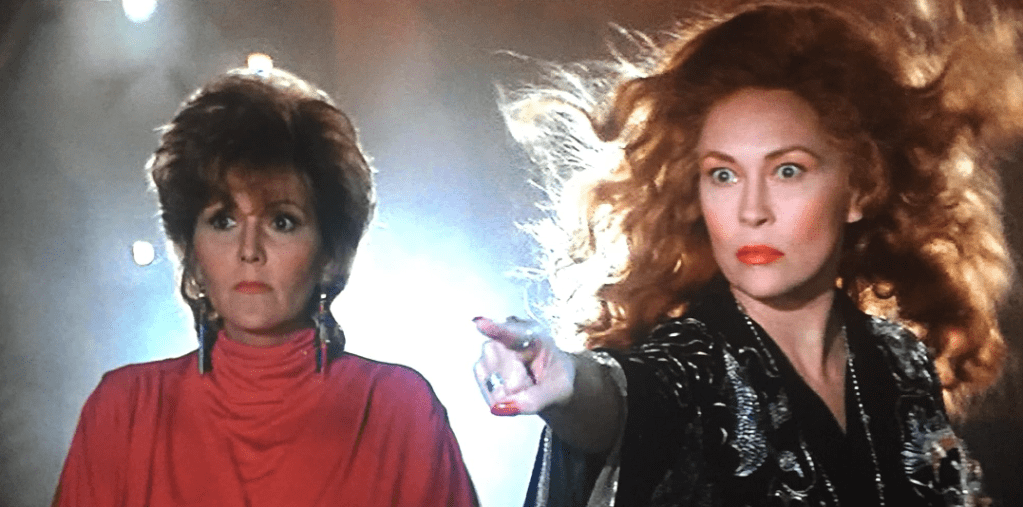
Had a woman contributed to the film’s writing I feel that the plot’s main villain would have proven a much more serious and existential threat as were men like Lex Luthor (Superman, Superman II) and Ross Webster (Superman III). Instead, in Faye Dunaway – whose talents are wasted here – we get a villain more akin to a Powerpuff Girls baddie than any foe that would have been worthy of Superman.

Both Lex and Ross were hellbent on world domination and had both the intelligence and apparatus to make it happen as long as Superman wasn’t there to stop them. And Superman himself was a man driven by a strong sense of justice and a moral desire to see the world become a safer place for everyone.
But, Selena (Dunaway) – a literal witch in this movie – has a plot that boils down to this: Selena sees a hunk doing yard work with his shirt off and wants him. But, Supergirl likes him too. And there we have the crux of Supergirl’s main conflict.

This is such a slap in the face to all the women and girls who have found inspiration in Superman. And to the boys, too, who surely must have known what Superman’s values are. Selena is presented as a woman obsessed with black magic which she largely uses for just common mischief until she sets her sights on Ethan (Hart Bochner). As a love interest for Supergirl (Helen Slater) he is more of a macguffin than a character. He’s a live action Ken doll, too oblivious of the situation to say or do anything interesting. Lois Lane and Lana Lang in the previous Superman movies were sincere personalities that Clark Kent was able to have meaningful conversations with and relate to. Ethan is just 200 pounds of meat. Besides seducing Ethan, Selena’s motivations in the movie never extend very far. When she gets her hands on a crucial Kryptonian power source she uses it mostly to enhance her powers and achieve the same aims she had before. Instead of ruling the world or obtaining great wealth, the power source – a swirling orb – is used to manipulate people into saying they like her very much.
To entice Ethan, Selena concocts a magical love potion (AKA a date rape drug, let’s be honest) and feeds it to him. The potion follows the rules of Cupid and Narcissus where the first person he sees he will fall madly in love with. Unfortunately for Selena, Ethan wanders off and, giving no quarter to logical consistency, he sees several people all at once with nary a reaction until setting eyes on Supergirl. Predictably he falls in love with Supergirl and alarmingly she goes for it. Remember, he is the one under the influence. Supergirl is not, but takes advantage of his affections even when it is obvious he is having some sort of mental break. This is arguably the first superhero movie with a female lead and also a woman serving as the main villain, and they are both rapists. But, apparently it is okay since when the spell is broken later in the movie his affection for Linda (Supergirl’s alter ego) remains intact. I guess this is to suggest that Supergirl is good enough to not need a love potion to fall in love with.
And this scene gives us one of the most idiotic moments in the history of cinema. Ethan doesn’t recognize Linda when she is wearing the Supergirl costume. I had always thought it silly that a pair of glasses was enough to disguise Clark Kent, but that pales in comparison to this kind of stupidity. Linda wears no glasses and her face is not altered in any way. Am I to believe that when this guy gets married he will become confused when he sees his bride in her wedding dress and ask who the hell she is? I can just picture his future wife walking home wearing a new sweater and this moron calls the police over a stranger entering his house.

Supergirl, herself, is given a much less noble backstory than Superman. He was sent to Earth when his homeworld of Krypton blew up and he was tasked with learning to use his powers for the good of the weaker earthlings. Supergirl – or Kara, which is her Kryptonian name – is said to be Superman’s cousin and prior to coming to Earth she was living in a sixth-dimensional alternate reality called Inner Space. This realm was created by a Krypton survivor named Zaltar who used the same power source that Selena had stolen to keep it running. He stupidly lets Kara play with it and she in turn stupidly drops it and it floats away from Inner Space into our world. Zaltar, like Selena, represents another wasted talent in the movie. He is played by the very talented Peter O’Toole who deserves better. He would have made a good Jor-El, I think.

Kara, as Supergirl, goes after the power source and in the climactic battle to wrest it from Selena we are treated to some of the most woeful special effects featured in this series to date. Much of it is poor use of super-imposures that are grainier than your grandpa’s old TV with matte lines thicker than the Washington Monument. About as bad as the effects are the performances which have not an ounce of sincerity or conviction to them. Slater smiles and frowns as the script dictates and she speaks in a constant carefree lilt. Dunaway and O’Toole phone every line in and I found myself wondering what sort of paycheck the producers enticed them with. Bochner plays his role well enough, assuming that sitting around looking dumbfounded all the time is all that was required of him.
Positively I can say the movie was at least well photographed. The camera work is quite good, actually. The cinematography is much better than Superman III; a shot of Supergirl soaring behind a thick foliage of trees, being just one favorite of mine. But well-photographed garbage is still garbage. And it stinks just as much.

Director: Jeannot Szwarc
Writer: David Odell
Producers: Timothy Burrill, Ilya Salkind
Cast: Faye Dunaway (Selena), Helen Slater (Supergirl/Linda Lee), Peter O’Toole (Zaltar), Mia Farrow (Alura), Branda Vaccaro (Bianca), Peter Cook (Nigel), Simon Ward (Zor-El), Marc McClure (Jimmy Olsen), Hart Bochner (Ethan), Maureen Teefy (Lucy Lane)
Composer: Jerry Goldsmith
Cinematographer: Alan Hume
Editor: Malcolm Cooke

Superman II (1980)

3/4 stars

Superman II has all the excitement and visual spectacle of the original Superman film, but lacks its wit and plausibility. As a superhero movie it’s about as good as Tim Burton’s Batman or the first Avengers. But there isn’t much here of what made the 1978 Superman movie special.

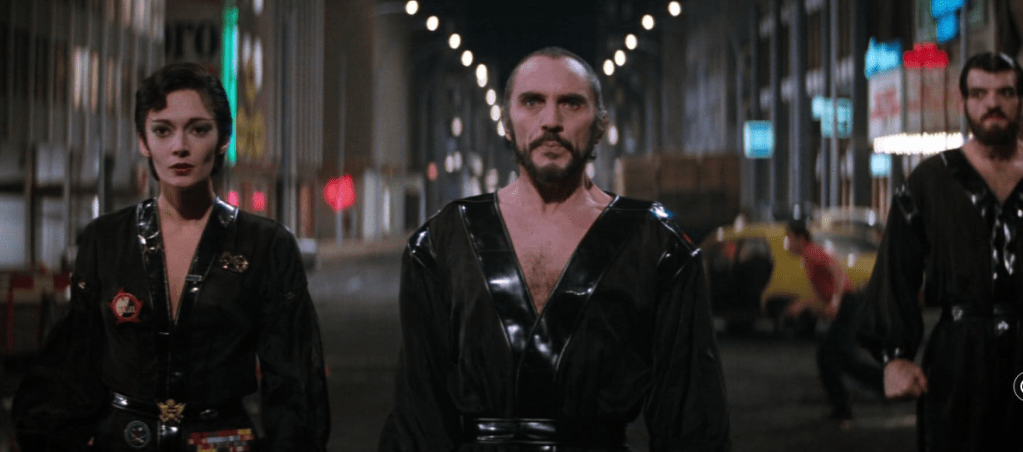
In the first film it opened with three Kryptonian criminals being charged with sedition. General Zod (Terence Stamp), Ursa (Sarah Douglas), and Non (Jack O’Halloran) are condemned to dwell inside a floating disc called the Phantom Zone which floats off into space just as baby Superman’s escape pod leaves the planet. Now, in Superman II we find out what happened to them.
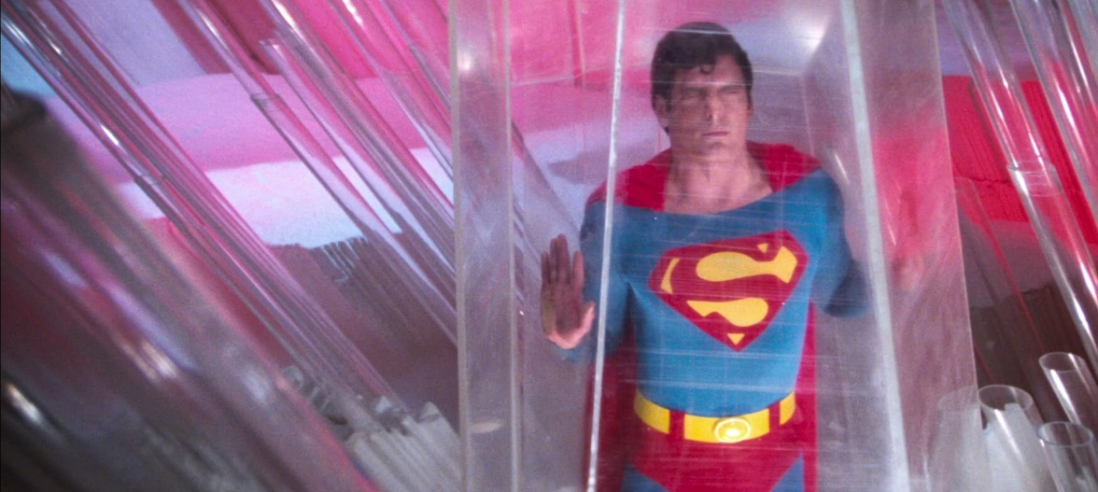
The sequel opens with Superman (Christopher Reeve) rushing to Paris after a group of terrorists with a hydrogen bomb take control of the Eiffel Tower. Superman saves the day by rescuing hostages and flying the bomb up into outer space where it explodes harmlessly. Unfortunately, the Phantom Zone just happened to be flying by and the shock waves shatter it, releasing Zod and gang. Ursa murders a couple of astronauts on the moon, and then the trio land in Houston, Texas. Zod wants to rule the planet and be worshiped by its denizens, but upon hearing stories of Superman he realizes that there is one threat to him and his ambitions that must be removed if he is to succeed.
The three villains have only a low kind of cunning and rely mostly on brute strength and their powers to get what they want. As movie bad guys go they have none of Lex Luthor’s (Gene Hackman) charisma and act more like playground bullies than anything else. Much of their scenes consist of wrecking havoc, causing property damage, and making comments about puny earthlings. Lex is regrettably given less to do. He joins forces with the Zod gang in the hopes of getting revenge against Superman, but he is forcibly sidelined by the new villains; his scenes little more than standing in a corner uttering some witticism.

Superman II’s subplot involving Clark Kent’s growing romance with Lois Lane (Margot Kidder) is slightly more interesting. Lois, who has been growing increasingly suspicious of Kent’s true identity, finally uncovers the truth. Superman is in love with Lois, but he discovers that for the two of them to be together he must sacrifice his powers and immortality. We are not told why and Superman accepts it without question. The time they spend together as a human couple is sweet and hopeful, but is sadly short-lived. Zod and his friends threaten Metropolis and it becomes clear to Clark that the world needs Superman. Clark and Lois’s breakup, however, represents one of several different failings that Superman II has in its writing. The movie does not convincingly establish that Clark Kent and Lois Lane are in love at all. Their interactions throughout the majority of the film is not much different than the simple infatuation they had in the first one. That they are deeply in love is something we are told more than we are shown. Break-ups can take a serious emotional toll on a person, and for a moment in the movie’s final scenes it appears that something poignant will be made of it. Lois tells Clark that he is “a tough act to follow” after he tries to suggest that someday she may meet someone else. I think a lot of people following a break-up feel as Lois does, even when their boyfriend isn’t the Man of Steel. But, the film cops out of any further dramatic tension by Superman implausibly wiping her memories clean with a kiss.
This kiss is just one of several stupid moments in the movie. I cannot abide arbitrary powers being lazily introduced to get the main characters out of a bind, and Superman II is full of moments like this. In the original film, Superman’s powers, while impossible, are at least explicable to the audience. We understand that he has super strength, laser vision, and can fly. We also know why he has these powers, being an alien living on a planet with a different sun and atmosphere. But, in the sequel his powers expand beyond any plausibility. Instead of changing into his costume with super speed he now makes his civie clothes magically vanish as the Superman garb materializes out of thin air. When Non charges at him Superman pulls an S off his chest and throws it at him. The material expands into a sort of plastic wrap that temporarily takes Non out of the fight. These moments are pure dei ex machina, lacking any sort of explanation and occurring from a standpoint of quick convenience.

In the final act, Superman and the Zod gang do battle in the streets of Metropolis and later in the Fortress of Solitude. The Metropolis scenes as action set pieces are not very exciting. There is little energy to them, with most of the fight just smashing things one by one at a slow rate and some petty taunts from Zod. There is a sense of city-wide chaos one would expect that is lacking here. The fight feels more like an elaborate street brawl while the rest of the city remains asleep or dully watches on.
The real purpose of the Metropolis battle seems to be product placement. There is an annoying scene in the first Superman involving Cheerios, but it is brief enough to not detract from that movie’s greatness. In Superman II, though, we are fed a whole marching gallery of products obnoxiously shot to hold the viewer’s attention. In the span of a single minute I counted about four or five products strutting their stuff while Metropolis is under attack. These include, but are not limited to, KFC, Coca-Cola, and even Marlboro cigarettes. I doubt Superman would have approved.

When all is said and done I find Superman II to be a sufficiently entertaining movie. I was not bored by it by any means. And I can get behind its plot and adventure, if not so much its execution. But, as Lois said of Superman himself, the first movie is a tough act to follow.

Directors: Richard Lester, Richard Donner
Writers: Jerry Siegel, Joe Shuster, Mario Puzo, David Newman, Leslie Newman, Tom Mankiewicz
Producers: Pierre Spengler, Ilya Salkind, Alexander Salkind
Cast: Gene Hackman (Lex Luthor), Christopher Reeve (Superman/Clark Kent), Ned Beatty (Otis), Jackie Cooper (Perry White), Sarah Douglas (Ursa), Margot Kidder (Lois Lane), Jack O’Halloran (Non), Valerie Perrine (Eve Teschmacher), Susannah York (Lara), E. G. Marshall (The President), Terence Stamp (General Zod)
Composers: Ken Thorne, John Williams (Superman Theme)
Cinematographers: Robert Paynter, Geoffrey Unsworth
Editor: John Victor Smith

Batman: The Movie (1966)

3/4 stars

I have heard it said that the 1960’s Batman television series existed in a more innocent time. I suspect that people say this to offer an explanation for the campy, childlike flavor of movies and TV in those days. But, I don’t think this is precisely true. The 60’s were no more innocent a time than the 2020s, but what made them different was the counterweight that superhero stories offered against the world, scary as it was at the time and continues to be today.
The first superheroes came on the scene in the late 30s when Hitler was rising in Europe, and their popularity continued through World War II, the counter-culture revolutions, the Cuban missile crisis, Vietnam, the Kennedy assassination, and Watergate. Hardly innocent times.
Instead the difference between Batman (1966) and the modern superheroes is not the times, but how they reacted to them. They are more cynical and reflective now, presenting the world as it really is and demonstrating morality as beleaguered and somewhat of a lonely companion. To stand against evil they must be tough, compromising, and angry.
But, in the Silver Age of comics books and comic book movies, people were more ready to accept goodness as an absolute that was capable of enduring scorn. It was a time when presidents and world leaders were respected figures, the police were more trusted, and antiheroes weren’t admired. It was not the times that changed. It was people who did.

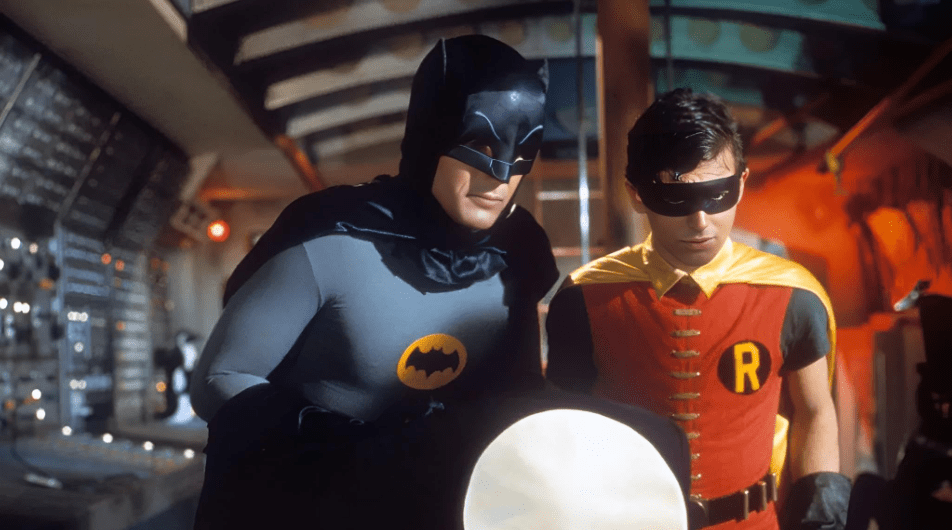
The 1966 Batman movie starring Adam West was a product of the earlier time. This Batman (West) gets his moral values from Sesame Street. He is the sort who disapproves of gambling, believes in the potential for good in everyone, helps old ladies cross the street, goes to church on Sunday, and supports the local police. He is all about law and order, and even denies in one scene to being a vigilante. It’s explained that he and Robin, the Boy Wonder (Burt Ward) are formally deputized agents by the Gotham PD.

After narrowly avoiding a mishap involving a fake yacht and an exploding shark (a detailed explanation wouldn’t make it less ridiculous, I promise) he and Robin uncover a sinister plot to take over the entire world. Such a fiendish scheme, of course, could only involve the work of super-criminals and Commissioner Gordon (Neil Hamilton) discovers that not one, but four super-criminals are currently at large. With Batman’s superior detective skills (AKA improbably correct guesses a propos of nothing whatsoever) he realizes that all four of them must be responsible.
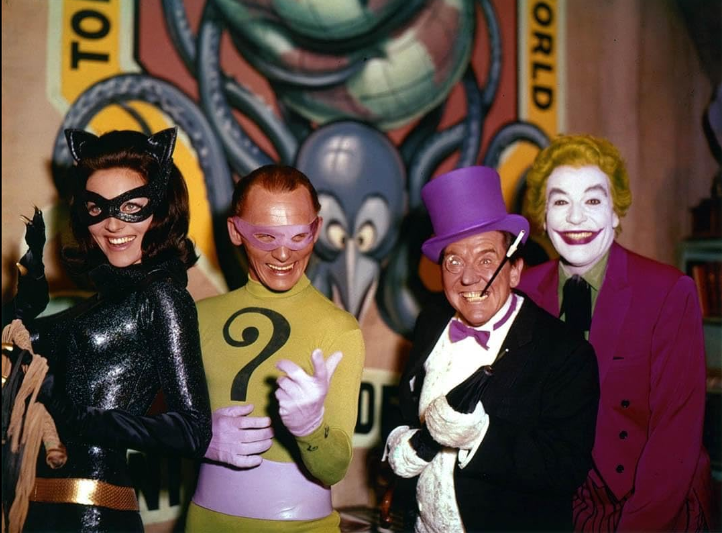
The four dastardly villains now working together are The Penguin (Burgess Meredith), The Joker (Cesar Romero), The Riddler (Frank Gorshin), and Catwoman (Lee Meriwether, replacing TV actress Julie Newmar who was recovering from a back injury at the time).
The movie juggles the four villains remarkably well during the 105-minute length, by simply keeping them together in the same room most of the time. They spend the majority of the movie bickering, laughing together, scheming excitedly, and then laughing some more. Singly on television or all together as in here, these characters are always a ton of fun. Meredith and Gorshin are my favorite actors to play Penguin and Riddler and I think a lot of it is due to the sheer level of enjoyment they have playing their roles. Riddler is constantly excited and laughing in high-pitched giggles. He is the most physical of the four, moving about like he has extreme ADHD. Penguin is laughably mean, squawking about and full of pure malice as he barks orders and complains on a regular basis. Meredith completely throws himself into the role and it is clear watching him on TV and in the movie that he absolutely loves playing it.
Joker contributes the least of all of them, generally going along with the plans and offering a funny comment here and there. Romero plays Joker like he is just happy to be here for the simple mischief of the whole thing, and to me that fits the character just fine; but he sadly gets a bit sidelined by the Riddler’s riddling and the Penguin’s masterminding.
Catwoman, however, plays a more central role this time around. She seduces Bruce Wayne by pretending to be a Russian journalist named Kitka in order to set him up for kidnapping. The wily scheme works and the evildoers wait for Batman to arrive to rescue him in order to trap and kill him. For obvious reasons this doesn’t work out very well and Wayne ends up escaping on his own. Meriwether’s role is fairly straightforward. She struts about in the catsuit all lithesome and seductive while moaning on occasion like a cat in heat. When she is playing Kitka it’s only a matter of silky tones in a fake accent and looking pretty. Catwoman’s eventual rise as a feminist icon is still a generation away.
Still, the combination of all four of them in one film pays off, and it shows that having multiple villains in a superhero movie can be done effectively if done right. A lot of other superhero flicks have struggled with this despite longer runtimes and less characters to juggle.

The super-criminals’ super-scheme to take over the world ultimately leads them to the United World Headquarters (an obvious stand-in for the UN) where representatives of several countries argue about world peace. The Penguin uses a diabolical machine to turn them into dust and it is up to the Dynamic Duo to reclaim the dust and restore the representatives to their original state.
The members of the United World Headquarters are only vaguely characterized. The hows and whys of world peace are not articulated, but is only spoken of in worshipful idealistic tones. There is a sense of moral naivete that is deliberate. Batman lives in a world where the buck stops at right and wrong and any thought of costs and necessary compromises are wholly alien to his philosophy. To him a spade is a spade. But, the Joker is wild and so are his companions. The nefarious villains are similarly single-minded in their badness. Without a touch of ambiguity they seem to be fully aware that they are bad people. The motivations of greed are only secondary to their childish desire to be a foil to Batman who is every bit as outlandish as they are. Without Batman these people would likely just go get desk jobs and give up on crime altogether because it wasn’t fun anymore. The 60s Batman show and the movie play more like an elaborate game of cops and robbers with each playing their respective roles with gusto.

Batman: The Movie is a highly innocent kind of film built up on the values of Dick and Jane and Mr. Rogers. As a straight-up adaptation of the TV series rather than an interpretation of the comics, it may very well be the most true to form Batman movie of all time. The comical tongue-in-cheek style adds to its charm and it is flawless in its intentions. It’s message of unambiguous morality is free and clear while it persistently goofs off. The gadgets are absurdly specific and convenient, the clue-finding is brainlessly non-sequitur, the characters are larger than life and costumed to match, and the action scenes are straight out of cartoons. The movie does more than capture the innocent moralizing of the Silver Age comic books. It also captures the fun.

Director: Leslie H. Martinson
Writers: Lorenzo Semple, Jr; Bob Kane, William Dozier
Cast: Adam West (Batman/Bruce Wayne), Burt Ward (Robin/Dick Grayson), Lee Meriwether (The Catwoman/Kitka), Cesar Romero (The Joker), Burgess Meredith (The Penguin), Frank Gorshin (The Riddler), Alan Napier (Alfred), Neil Hamilton (Commissioner Gordon), Stafford Repp (Chief O’Hara), Madge Blake (Aunt Harriet Cooper), Reginald Denny (Commodore Schmidlapp)
Producers: William Dozier, Charles B. Fitzsimons
Composer: Nelson Riddle
Cinematography: Howard Schwartz
Editor: Harry Gerstad

Batman & Robin (1997)

1.5/4 stars

Reportedly, before every shoot while filming Batman & Robin, director Joel Schumacher would remind the cast and crew to “remember, this is a cartoon.” Perhaps he should have said toy commercial. It is certainly with toys in mind that we see throughout the movie’s two hour runtime frequent costume changes, new gadgets, vehicles, and no less than three new villains. Even the characters seem to know they are in a two-hour toy commercial. Poison Ivy (Uma Thurman) mentions her own action figure in a scene where Batman tries to take her on only to find himself in the grips of Bane (sold separately).
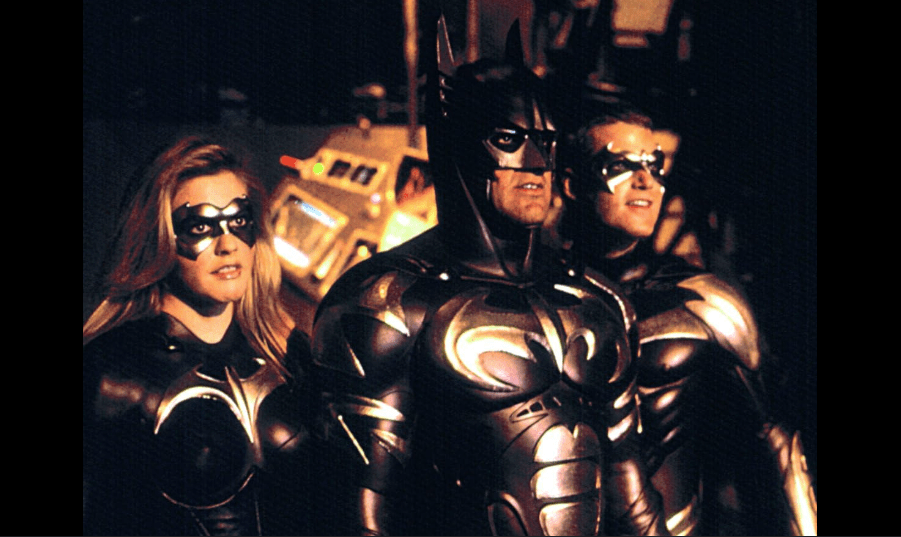
This is a shameless picture with only one clear goal behind its making, and it is not to tell a story. Selling toys has always been an important consideration when making movies like this, but none are as cynical about it. The movie is practically a convention, every shot serving to show off the latest products at your local Toys-R-Us. In the climactic battle during the final act, Batman (George Clooney), Robin (Chris O’Donnell), and newcomer Batgirl (Alicia Silverstone) manage one last costume change before appearing to save the day. There is a sense of urgency in the previous scene that fails to justify this. But, remember, this is a toy commercial.

Schumacher’s claim that Batman & Robin is a cartoon is not entirely unjustified. It certainly explains the movie’s tone. The comical villains, slapstick violence, and gaudy visuals of Batman Forever are taken to the max here with even the gothic undertones from before now a thing of the past. Clooney brings none of the broodiness of Bruce Wayne to the character, instead playing the part like an older brother or someone’s cool uncle. As Batman, he is hardly intimidating. The role is written more like Adam West; falling into one obvious trap after another, making improbable public appearances for charity events, and never without the right gadget to get out of any mess.
Also reminiscent of the 60’s Batman show is the film’s set design. They are shot with the same slanted angles and the same neon shades of lighting that only highlight their fakeness. The only thing missing are all the BIFFs, POPs, and POWs splashing the screen during the many fight scenes in the movie.

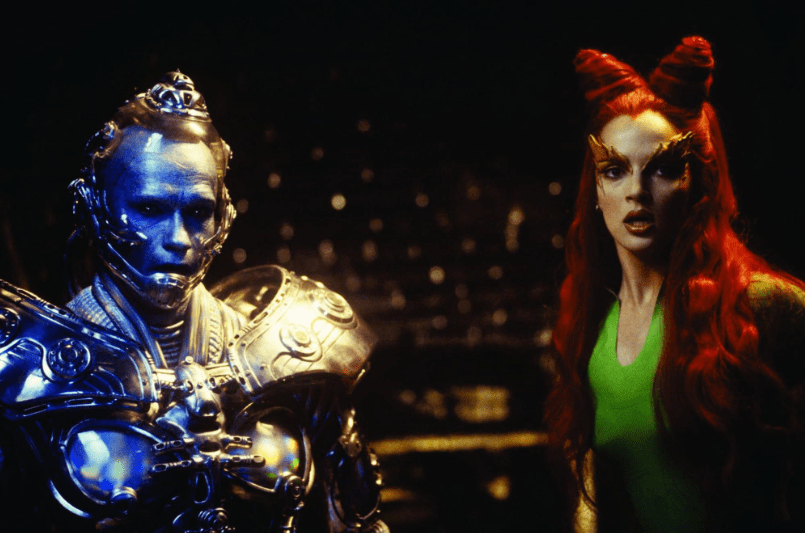
Batman & Robin’s story is really just an after thought. Surely, it is enough to say that the new villains are up to something villainous and Batman must stop them. Knowing that the evil Mr. Freeze (Arnold Schwarzenegger) wants to freeze the entire world with a ray gun or that Poison Ivy wants to reseed the planet with man-eating plants is not that important. You could watch this movie on mute and lose nothing. There’s a simple formula of baddies making an appearance and Batman and friends fighting them that requires no introduction. Even the movie’s subplot about Alfred (Michael Gough) being ill and needing a treatment is sufficiently told through visual cues that would make a lack of sound no challenge to understand.
While Alfred is suffering from a seemingly terminal ailment a new character is brought to Wayne Manor through Alfred’s niece, Barbara. The movie’s dialogue tells us she has come all the way from England to visit her uncle and that she is a bit of a rebel. I’ll have to just take the film’s word for it. Alicia Silverstone makes no attempt to affect an English dialect and she is shown to ride motorbikes fairly well. She is otherwise played with no personality at all and I suspect that somewhere in the movie’s development she was intended to recall Robin’s youthfulness in Batman Forever. But these themes, had they ever been present at all, must have found themselves on the cutting room floor.
Chris O’Donnell, in the meantime, brings no maturity to the Robin character at all; but spends the majority of the movie arguing and whining to Batman about how he feels like he isn’t being treated like an equal. To me, this presents a missed opportunity for Robin to take Batgirl under his wing and counter her brashness with memories of his own. But, Barbara is left by herself throughout most of the movie, while Robin and Batman bicker in a directionless subplot that ends abruptly when they realize their movie is reaching its climax.
Poison Ivy creates a sort of love triangle between them thanks to powerful pheromones she blows around like a magical pixie dust. Robin becomes convinced that Batman is jealous of him because she is in love with him instead of Batman. Batman, reasonably tries to remind him that Ivy is in league with Mr. Freeze and that her manipulative behavior is obvious, but Robin refuses to listen.
Mr. Freeze, another potential action figure, is slightly more interesting. Like Penguin in Batman Returns, he is presented as a tragic figure; but this time he is much more sympathetic, where Penguin was merely repulsive. The movie explains that Freeze’s wife is kept perpetually frozen to halt the progress of an incurable disease. This is said to be the same disease affecting Alfred, but far more advanced. Freeze needs special gems to power the machinery he uses to research and hopefully discover a cure. After an accident leaves him unable to live outside of sub-zero temperatures, he builds himself a special suit to keep himself cold and turns to a live of crime to steal more gems. By the end, Mr. Freeze is given more empathy than Penguin who was treated as irredeemable. It’s a not a deep story by any means, and all the schemings and rushings to save the day are just a thin veil to disguise the movie’s real agenda. Remember, this is a toy commercial.

Turning a beloved franchise into a big toy commercial is unforgivable, and as such, I had low expectations for the movie to have much of a story. But, as a marketing gimmick, I would have hoped for a better display of special effects. Instead, Warner Brothers, sells its toys with one of the worst looking Batman movies of all time. The sets are garish and cheap with even icicles appearing to be made of rubber at times. Outside of the sets, blue screen is used unconvincingly. The Batmobile and Robin’s bike ride against CG backgrounds, thick matte lines and all, like images poorly pasted over on Photoshop.
Batman & Robin has all the appearances of a movie that was cobbled together quickly with little thought. The story and characters play like Saturday morning cartoons with acting and special effects too shoddy to even properly enjoy it as mindless popcorn entertainment. Maybe the film would have been easier to stomach had it actually been a cartoon. Perhaps, collecting the toys is a better investment. I wonder how much they are going for on Ebay nowadays.

Director: Joel Schumacher
Writers: Bob Kane, Akiva Goldsman
Cast: Arnold Schwarzenegger (Mr. Freeze/Dr. Victor Fries), George Clooney (Batman/Bruce Wayne), Chris O’Donnell (Robin/Dick Grayson), Uma Thurman (Poison Ivy/Dr. Pamela Isley), Alicia Silverstone (Batgirl/Barbara Wilson), Michael Gough (Alfred Pennyworth), Pat Hingle (Commissioner Gordon)
Producers: Mitchell Dauterive, William M. Elvin, Peter Macgregor-Scott, Benjamin Melniker, Michael E. Uslan
Composer: Elliot Goldenthal
Cinematographer: Stephen Goldblatt
Editors: Mark Stevens, Dennis Virkler