Sleeper (1973)

Rating 3/4

Comedy, like science fiction, is ripe for social commentary and Woody Allen’s Sleeper, being both, is as brilliant as any.
Combining the physical antics of Buster Keaton and the wit of Bob Hope, Woody Allen had somehow achieved the impossible. He crafted alongside the comedy a highly intelligent vision of the future where the human race will have morally and intellectually degenerated into puerile sheep without ever challenging or being challenged. It’s as relevant and insightful as other great science fiction films like 2001: A Space Odyssey or The Day the Earth Stood Still.

Miles Monroe (Woody Allen) wakes up 200 years into the future after being involuntarily put in cryosleep after a routine surgery goes wrong. The doctors who wake him are able to cure him of his ailment, but what they can’t fix is a world where everyone is mentally infantile and sexually impotent. I am of course referring to the world of 2173. I can understand, I suppose, if someone became confused and thought I was referring to the present. I don’t think a man like Woody Allen could disagree.

Miles ends up on the run for his life after unwillingly getting involved with Marxist revolutionaries who want to use him to take down the government.

I’ve mentioned this film is a comedy while none of this sounds remotely funny. And yet, it is. With a highly well-thought out premise, Sleeper is a hilarious movie. The science-fiction background provides Allen with a comparative view of futurist mankind with how we are now. What being a comedy adds to it is a sharp take on absurdity and deservedly insults moral and intellectual laziness. The same sort of laziness threatening us now in 2024 just as much it did in 1973.

Miles meets Luna Schlosser (Diane Keaton) who is politically apathetic and lives an affluent life of ease. She writes bad poetry and thinks butterflies turn into caterpillars. She gets high with her friends by passing around and rubbing a ritual orb. She has a cheap understanding of sex and prefers to have pleasure artificially induced. Using a special chamber called an Orgasmatron people can now, not only skip the foreplay, but all physical activity involved altogether.

Throughout this insanity he disguises himself as a butler robot only to have his head nearly removed by a technician. He and Luna go on a quest to destroy the dictator’s severed nose to stop him from being cloned. Doctors tells him fudge bars and cigarettes are healthy now. And my favorite of all, he slips on a giant peel from a banana the size of a canoe. This same banana is owned and aggressively protected by a farmer who walks a six-foot high chicken on a leesh. Just in case the situation was not bizarre enough.

Miles is questioned in one scene about the meaning of a few fragments from his time in history. These include photos of famous political figures and selections from TV news broadcasts. The ironic and factually inaccurate answers he gives are some of the funniest and best-written lines in the movie. He also tells Luna this surreal story about how he asked his mother where babies come from. His mother misheard him and thought he said rabies so she tells him from dog bites. He says, “The next week, a woman on my block gave birth to triplets… I thought she’d been bitten by a great dane.”

Sleeper is also the sort of comedy that is rife with slapstick humor most of which is deliberately shot like old silent shorts from Buster Keaton and Laurel and Hardy. The camera is sped up to feign fast movement, the music – composed by Woody Allen himself – is jazzy, and the physical antics are cartoonishly out of this world.

Sleeper is funny from beginning to end and doesn’t become imbalanced with the social commentary. Both perfectly support the other and the rawer slapstick bits fit the the film’s overall tone. This might be the only sci-fi movie with classic bits like a pie in the face and slipping on a banana peel that doesn’t lose its preoccupation with social commentary in an Orwellian setting.

Sleeper is right up there with THX 1138, Logan’s Run, or Silent Running as a work of cerebral sci-fi. Simply because it swaps drama for comedy doesn’t make it any lesser and believing so would be a mistake.

Star Wars: Episode V – The Empire Strikes Back (1980)

4/4

The Empire Strikes Back is flawless. Not many movies are. Only a couple are released per decade really.

After the original Star Wars film released in 1977 it was a massive success with critics and audiences alike, and no film since had such a groundbreaking impact on the future of cinema. Fans, young and old, eagerly waited three years for the next installment in the Saga and what often happens when hype is built up for a sequel is disappointment. Sequels typically never live up to the originals because filmmakers put every bit of their talent into their first pictures and second entries are almost always an afterthought. They become obligatory cashcows bringing back familiar settings and characters with no serious attempt at telling a good story.

And yet, The Empire Strikes Back is flawless. It improves upon the original in every aspect of its production: it’s more tightly edited, employs even better and more groundbreaking special effects, has stronger performances from its cast, and is overall better written. The fans waited patiently (and impatiently) for three years and they got what they expected and more.

In the last film the final shot is of our heroes facing the camera happy and celebrant. This one ends with Luke, Leia, and the droids facing away. Gazing at a distant galaxy, comforting one another; hopeful and fearful. They’ve been separated from their friends, the future is uncertain, and the best they can do is wonder, looking away to their destinies. It ends on a strong note, but not a happy one.

The Empire Strikes Back – directed by Irving Kershner and written by Lawrence Kasdan and Leigh Brackett – is the darkest chapter in the entire 9-film saga. More than a few will argue in favor of Revenge of the Sith, but that movie cannot by its very nature as a prequel ever fill us with the sort of tension and doubt that this one does. At least assuming you are viewing them in the correct order.

The film opens three years after A New Hope and the Rebel Alliance is now on a brand new hidden base on the frozen wasteland world of Hoth. After they are discovered by the evil Empire and viciously attacked the remaining forces scatter.
Their mission is to rendezvous at a distant location in space, but before they do our heroes have unfinished business. Luke Skywalker (Mark Hamill) is sent by the ghost of Obi-Wan Kenobi (Sir Alec Guinness) to find an elusive Jedi Master named Yoda to complete his training as a Jedi Knight. Han Solo (Harrison Ford), Princess Leia (Carrie Fisher), Chewie (Peter Mayhew), and the two droids Artoo (Kenny Baker, Ben Burtt) and Threepio (Anthony Daniels) need to stop for gas.
The evil Dark Lord of the Sith, Darth Vader (James Earl Jones, David Prowse) is obsessed with finding Luke Skywalker in the hopes of turning him to the Dark Side of the Force and make him an evil Sith Lord like himself. Vader can somehow sense Luke’s presence in the Force much like he could with his old master Obi-Wan. Unbeknownst to the protagonists it is this perception which motivated the Imperial attack on Hoth.
Luke begins his training on the boggy world of Dagobah under Yoda who is a two-foot high green little goblin voiced and performed by Muppet-alumnus, Frank Oz. Yoda introduces himself as a playful, mischievous urchin annoying Luke and Artoo both with juvenile pranks and mocking comments. Luke tells him, “I’m looking for a great warrior.” Yoda laughs. “Wars not make one great,” he says. His mirth and behavior exposes Luke’s deep-seated anger issues and lack of patience. It bestows humility on him without which his descent to the Dark Side would be all the easier. I think many Star Wars fans I have seen on the internet could benefit from a weekend on Dagobah with Yoda.
Yoda is a masterful technical achievement. As a mere puppet his texture and look is decidedly realistic and he was designed to feature a whole range of emotions with his eyes and face unseen previously in movie-puppetry.

Han and Leia’s story is further developed in the movie in the meantime. They bicker like an old married couple in a way that is reminiscent of old 1930’s rom-com romances. He’s brash, arrogant, and fatally attracted to the woman who annoys him so much. She’s fierce, independent, unintimidated, and fatally attracted to the man that she imagines to be beneath her.
The hyperdrive on the Millennium Falcon is damaged and they are unable to make it to the rendezvous without making repairs. Han recruits the aid of an old smuggler buddy named Lando Calrissian (Billy Dee Williams) to help them. They go to Cloud City – a veritable castle in the sky floating over a gas giant – where Lando betrays them to the Empire. Vader deliberately tortures them knowing that Luke would sense it in the Force and come rushing to the rescue.
What follows is several grim happenings that are far removed from the heroic devil-may-care adventures of the previous film. Han is left incapacitated and captured by the space mafia and Luke is left physically maimed and devastated by the revelation that Darth Vader is his own true father. His world and pie-eyed optimism were dealt a singular blow and he never recovers or becomes the same person he was again.

What The Empire Strikes Back does is force its characters to grow up. It’s a much more psychological film than the other entries (save for perhaps the much-maligned The Last Jedi). The stakes get raised and there are serious losses. No one walks away unscarred and altered forever. The movie is about trauma and hope without guarantees. Simply being the good guy is not enough anymore.

Irving Kershner is a better director of actors and can get better performances out of his actors than George Lucas can, who takes a backseat from director’s duty and contributes instead to the story and provides creative input on the visuals. We get a much better film as a result with a tight script by Kasdan and Brackett.

Lucasfilm and ILM also had three years to further improve the special effects technology which makes for a spectacle miles ahead of the original film. John Williams also provides us with the best of the nine film scores composed for the Saga with several of them – The Imperial March included – having entered the pantheon of great classical pieces of music. His music is like that of a 19th century ballet and it sets the epic and dramatic tone of the film throughout.

I could keep going, but the fact is there is not a technical or dramatic aspect of The Empire Strikes Back that isn’t done perfectly. Really, after half a dozen or more paragraphs I can still summarize everything into one word. Flawless.

Star Wars (1977)

Rating 4/4

Star Wars since its release in 1977 has become one of those quintessential films like The Wizard of Oz or Snow White which everyone has seen and has entered into the collective consciousness of people all around the world. It’s as recognizable as Hamlet and Tom Sawyer and Hercules and Moses. And being a life-long die hard Star Wars fan and after the brand has expanded upon itself the last 40 years with sequels, prequels, comics, and novels it’s not easy to just review it purely as a movie from 1977. Star Wars is now a phenomenal mythic enterprise and viewing the film simply as a late seventies sci-fi hit created by the director of American Graffiti is not needed anymore.
Which is why I am not going to review it at all. What I would rather do instead is take a few moments of your time and discuss the phenomenon that this movie became and hopefully convey what it means to me personally.
I was 15 years too late to see this movie when it first came out in theaters; seeing it for the first time as a second generation fan in the early 90’s when I was about six years old. I have no recollection of that first viewing experience and as far as I am concerned Star Wars has always been around.
In my earliest memories Star Wars was already a near and dear thing to me. I played with the Kenner and Hasbro action figures, illiterately leafed through my uncle’s collection of comics, and eagerly picked up as much knowledge of the lore as I could. With the amount of affection I had for Star Wars, and how much space it took in my playtime and imagination; first seeing this movie must have been as close to a spiritual experience as I am willing to believe in.
I could drone on some more about how much Star Wars changed everything, but I would be being disingenuous. I never saw it change anything. Things had already been changed by it around the time I was born. The adults and teens who first saw it 47 years ago probably cannot understand how much my generation takes it for granted. It’s like the existence of automobiles, going to church, or just the presence of movies in general. A point in time in which it did not exist is beyond my comprehension.

But Star Wars did change everything. They say hindsight is 20/20 and I don’t disagree. I especially agree when I wasn’t even around back then in the first place. It baffles me how so many people in Hollywood had such little faith in Star Wars’ production. A quick glance at any of the making of features in print or on film will show constant references to risk-taking and predictions of failure. When I look at this movie I wonder how anyone in their right mind could have thought it was going to be a flop. Living in a time when movies like Star Wars are a dime a dozen and oversaturate the box office it’s hard to imagine the late 70’s when more serious pictures were being produced and science fiction/fantasy movies were frequent critical and financial failures. Believe it or not, sci-fi movies used to not be guaranteed blockbusters and many of them were your typical tax-shelter projects similar to what we are seeing being produced for the SyFy channel and Netflix today.

I won’t waste any more words on Star Wars changing cinema since we all know it did. What I find more interesting and less talked about is how much it changed George Lucas himself.
If one were to patiently sit through his early student films from the 60’s followed by his debut, THX 1138, you see the obvious influences and overall tone of his work. Lucas was making films for the anti-war counter-culture youth of America: fed up with Vietnam, fed up with Watergate, fed up with segregation and Jim Crow laws, and just plain fed up with The Man altogether.
He made THX as a Huxley-esque attack on authoritarian government and American Graffiti was a revisit to teenage life in California before Vietnam.
Star Wars was something different. Something special. Yeah, there is an echo of anti-imperialism in it, but much of it was written and produced with a more basic and ergo more important motivation. With his third film, Lucas left counter-culturalism in the background and sought instead to revitalize for younger moviegoers spirituality and myth in a language they could understand. And miraculously its success overshadowed its ambitions. Star Wars has achieved George Lucas’s goal more than he could have anticipated when he first began writing it in 1974. Probably even more than he anticipated when he was actually making the film which was fraught with budget problems, uncooperative cinematographers and crews, cynical execs having no faith in its success, supply problems, and labor difficulties of every kind…
But successful it was. Like the myths Lucas was drawing from, Star Wars became a natural part of our culture. The Force, wookiees, Darth Vader, Luke Skywalker, the Millennium Falcon, and even Jar-Jar Binks are as familiar and recognizable to us as Thor, Zeus, and the Garden of Eden. Many of its characters, creatures, planets, and technology have become proverbial and require no exposition when used to make a point or reference. Many of my generation learned “May the Force be with you” before we learned to say “Amen.” The lightsaber is as iconic as Excalibur or Mjolnir. It would be self-indulgent to go on, but I could for a thousand more paragraphs if I wanted to.

George Lucas would not direct another film again until 1999 with the release of The Phantom Menace. In the meantime he produced and wrote less of the counter-culture material that characterized his earlier work and focused more on writing the remaining movies of the Star Wars trilogy and Indiana Jones as well as championing the progress of special effects in cinema with ILM. In 1997, two years before the release of his first prequel, the Star Wars trilogy was re-released in theaters in the form of Special Editions with the films’ negatives cleaned up and restored, enhanced special effects inserts, and occasionally a few cut scenes put back in. Many of these changes were controversial and ironically helped create some new proverbial myths of their own. “Han Shot First” has become nearly as recognizable as “May the Force be with you.”

You may have begun to notice that I have been so far speaking more about Star Wars as a saga and critically successful franchise than I am about the 1977 picture itself and there is a reason for this. Any review I could write about this movie would add nothing that hasn’t been already said and said better than I can. To be frank, if you haven’t seen Star Wars, nothing in this piece is directed to you. Which is why I must reiterate this is not a review. There are not enough people living under a rock for such a review to be useful and if they emerge I am not so vain as to think they would come flocking to this blog to see if Star Wars is worth watching or not.
It is, and you should go watch it again sometime. Not because I said so, but because you and I already both know that you should.

THX 1138 (1971)

Rating 2.5/4

Director George Lucas’s directorial debut, THX 1138, is in the fine tradition of science fiction movies of ideas such as 2001: A Space Odyssey and Logan’s Run.

Its world is a dystopic underground society, policed by robots and inhabited by a subjugated populace too drugged up by state-mandated medications to even realize they aren’t free or even should be. Their reality is a pale and lifeless one, both mentally and physically. The titular hero, THX 1138 (Robert Duvall), like the rest of the film’s characters; has every facet of his life regulated by an all-watching Big Brother-esque state that forces him to take medications which suppress emotions and molds him into whatever type of working drone the government wants him to be at any time.

THX lives with an assigned roommate named LUH 3417 (Maggie McOmie) who rebels against her government by swapping his pills with hers causing him to develop forbidden emotions and forbidden sexual desire. This relationship and the overwhelming emotions he experiences without the drugs causes a workplace accident that lands him in prison for “drug evasion.”
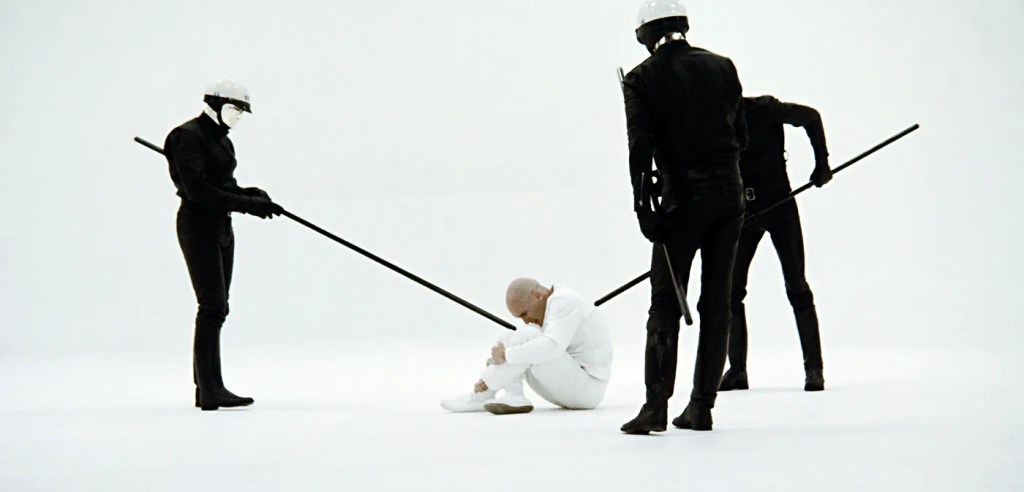
He shares this prison, an all white space stretching eternally, with another dissident named SEN 5241 (Donald Pleasance) whom he had reported earlier for illegally changing shift patterns in order to get a preferential roommate. This society is efficient, if also harsh.
What follows is a daring escape in which THX and SEN evade the authorities in order to find the world’s surface where men and women can live free.

In an impressive directorial debut we get amazing visuals and special effects showing a community rendered colorless and sterile by consumerism and unquestioning loyalty to one’s government. It is a beautiful looking picture and what is even more powerful than its art direction is its editing – largely helmed by director George Lucas himself. Lucas, before he became a filmmaking icon, was a master of using editing to pace a movie limited by its budget.
A lot of THX 1138 is shot from the perspective of computer monitors and surveillance equipment and much of the dialogue and action is presented in closeups that intensify the characters’ desperation and sense of panic – especially when THX begins withdrawing from the drugs.

The movie also brilliantly portrays the impersonal attitude of authority over a populace that has been quantified and dehumanized. Religion has been supplanted by a faux-benign computer system that plays simultaneously the role of a confessional priest and an advertising man. It preaches, “Consume. Be happy,” while failing to adequately respond to the personal issues and problems of its worshippers.
In one of the film’s most affective scenes THX is subjected in prison to a number of torturous tests which is commented on by unseen tormenters who sound like bored lab techs experimenting on mice or IT professionals playing with software. His reactions of pain and stress are just data.

The movie’s weakest point, unfortunately, is its characters who provide necessarily muted performances which serve to show the affects of the state and its drugs on what is essentially a human ant farm. However, by the same token this prevents any one of them from eliciting much care or concern from the viewer. The characters are governed by only the most base emotions of fear and anxiety which carries into all three acts of the plot.

THX 1138 is a visual marvel and it is one of most intelligent examples of dystopic science fiction in cinema. What it is not, however, is a compelling human drama.