
The Father (2020)

4/4 stars

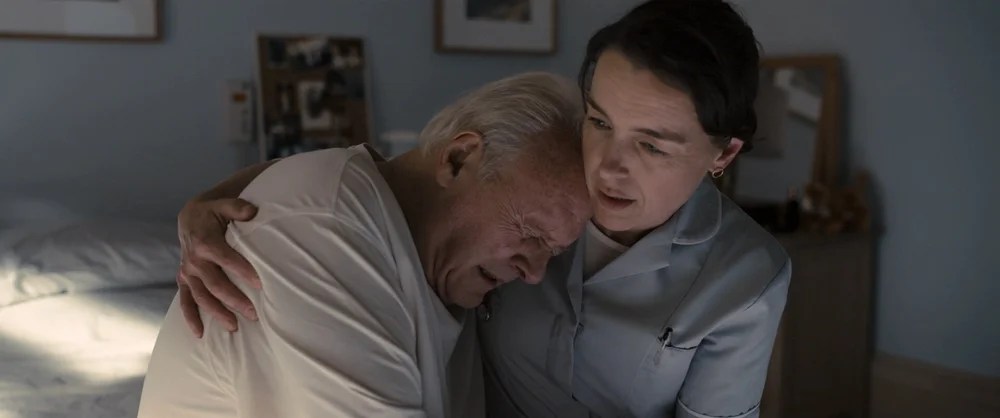
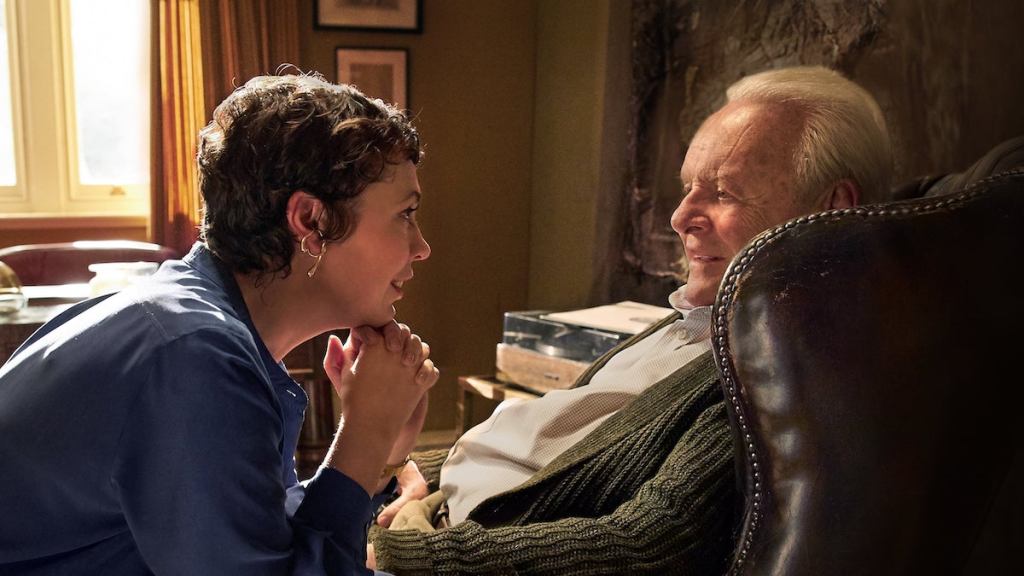
The Father is one of the most compassionate movies I have ever seen. Dementia is a serious subject that the film treats with a deep empathy that is brilliantly artful.
Director Florian Zeller’s writing (he also wrote the original stage play) is subtle and meditative and very brave in its honesty. Instead of taking the easier road of Oscar-bait where emotions are constantly elevated and every scene drips with melodrama, there is a quiet sincerity in the dialogue and performances that resonated with me as a human being. In years to come this film will be regarded as one of the best movies about mental illness ever made.

Anthony (Anthony Hopkins) is an octogenarian living with his daughter Anne (Olivia Colman). He has become well-advanced in dementia, struggling to recognize those around him and he requires constant care. Anthony frequently forgets that the apartment they share is hers and not his and he becomes confused as the many faces that come and go seem to blend together and are hard to identify. He lives a frustrating and frightening existence where each passing moment seems to come with wild changes in circumstances he cannot make sense of. Anne tells him she is moving to France with her husband and he is to be left in the apartment by himself. The next day a strange man named Paul (Mark Gatiss) appears claiming to be Anne’s husband. Anthony doesn’t know who he is and when he mentions France, Paul has no idea what he is talking about. He tells Anthony that the apartment is his and Anne’s and that she is just on her way back home from shopping. When she returns she looks like someone else and he, at first, doesn’t recognize her. She hands a bag of chicken to her husband and he leaves to go dress it in the kitchen. Anthony starts asking her about Paul and Anne tells him she hasn’t been married since she got divorced and that there is no one else there except for the two of them. When she leaves the room Paul reappears to ask him why he is being such a burden to everyone. The entire sequence is brilliantly portrayed in real time and to Anthony these contradictions occur minutes or even seconds apart. These sorts of moments happen frequently throughout the film and there is a sense of passing in and out of different realities that leaves Anthony feeling confused and vulnerable. There are days when Paul is there, who now also looks like someone else (Rufus Sewell); and some days he doesn’t exist at all.
Anthony takes a liking to Laura (Imogen Poots), a home health aide hired by Anne. She strikingly resembles his other daughter Lucy whom he hasn’t seen in some time and there are days when Lucy and Laura are indistinguishable. He misses Lucy a lot and wonders when she will stop by again. Her tragic death in a car accident years ago is largely forgotten. His frustration nearly reaches its peak when after gleefully waiting for Laura to come a completely different aide named Catherine (Olivia Williams) arrives at the apartment and he is told Laura had stopped working for them awhile ago.
I could go on, but it is best to see the film than read about it. Anthony’s story develops along to a climax that is heartbreaking and an exemplar of some of the finest acting I’ve seen in recent cinema.

Anthony Hopkins’ performance earned him his second acting Oscar following his 1991 win for The Silence of the Lambs and it is well-deserved. He goes through every possible emotion on the spectrum, each time doing it with care and subtlety. While he goes from impotent rage to laughter to childlike weeping for his mother it’s all performed as if I was witnessing a real person struggling with dementia.
The film is supported by a minimal cast all of which give performances resembling real people acting as people really do. Contrasts between the sympathetic, annoyed, and overwhelmed are deftly portrayed without aggressive pathos. The directing shows a highly reflective familiarity with human behavior.
The movie is set primarily in a singular setting inside the apartment where Florian Zeller maintains a simple structure in showing each passing day while crafting these skillful and complicated scenes where Anthony’s reality seems to shift in real time. It’s an exceptionally directed picture, impressive in that this is Zeller’s film debut. His knowledge of stagecraft is perfectly translated to film showcasing undeniable talent for direction and introspective writing.

Throughout The Father I was overwhelmed by how kindly its realism is. There is not an ounce of preachiness or sentimentality to the picture and, yet, it doesn’t become raw or cynical in its approach. There is a genuine compassion and kindliness in its writing that cannot be faked. Without being overly cheerful or nihilistic, not a single moment rings false or hollow. Hopkins’ portrait of a man struggling to rationalize his increasingly confusing life during the ravages of dementia is sympathetic and emotionally arresting. In the movie’s final scene Hopkins gives a performance that left me in tears. I was taken aback by how committed to honest feeling the movie was without being depressing or uplifting. Zeller’s screenplay goes beyond either sentiment, giving a solid bit of still-life that didn’t tell me how to feel. The film’s emotions come naturally to the viewer without contrivance or manipulation. When I watched The Father I saw real people, with real feelings, saying real things. And hanging over me the whole time was pure compassion, unadulterated by well-intended lies and triteness.

The Father is the kind of story that an author like Mitch Albom would render toothless with saccharine melodrama or a director like Sidney Lumet would elevate to nigh Shakespearean elegy. Florian Zeller meets us somewhere in the middle where simple empathy doesn’t take the sting out of sorrow, but gives it something we can relate to and find meaning in on our own. The Father is not a profound movie. It’s a deeply human one.

Gilda (1946)

Rating 3.5/4

“Hate can be a very exciting emotion. There is a heat in it, that one can feel. Didn’t you feel it tonight? It warmed me. Hate is the only thing that has ever warmed me.”
Ballin Mundson (George Macready) is sincere when he says this to his wife and she doesn’t disagree. She repeats it herself to her lover Johnny (Glenn Ford) and he doesn’t disagree either.

Charles Vidor’s 1946 film noir, Gilda, is not a love story. It’s a hate story. It’s a story of people using love to cruelly punish and destroy each other.

Gilda (Rita Hayworth) hates Johnny for walking out on her years ago. Johnny hates her for humiliating him and making him feel less like a man. Her husband Ballin hates everybody and carries it wherever he goes so much that no one notices anymore. What comes of this hatred is one of the most unhealthy love triangles out of classic Hollywood.

Johnny makes a crude living as a cheating gambler in Argentina who believes “a dollar is a dollar in any language.” I looked it up and he’s right. What he’s wrong about, though, is that he can keep getting away with cheating. After he’s caught doing it at a Buenos Aires casino Johnny comes face to face with the understandably offended Ballin Mundson who owns the joint. Ballin takes a liking to the kid and instead of smashing his fingers with a hammer he offers him a job as personal security.

Their partnership is surprisingly a happy one although it is apparent that Ballin is keeping secrets from him. Things become more complicated when Johnny is introduced to Ballin’s new wife, the one and only Gilda, his ex. Ballin who has made hate so much a part of himself that he can recognize it begins to sense something is wrong right away. He doesn’t suspect that the two know each other, but he amazingly recognizes hatred coming from Gilda to Johnny immediately. Johnny and Gilda’s “introduction” is extremely cordial and lacks even the slightest innuendo of hostility. But Ballin picks it up all the same even when he cannot understand it.
The movie provides the viewer none of their backstory up to this point letting us see the scene from Ballin’s eyes. We are as perplexed as he is when he questions Gilda about her hatred and she coyly denies it. Not until she and Johnny meet each other later that the truth comes out. It is almost soap opera-like when she is suddenly introduced in this way. Johnny makes no previous mention of her in the film, not even in the frequent voice-overs that are true to film noir fashion. This way of bringing Gilda into the story is effective in making sense of Ballin’s actions later in the movie. He is an extremely complex character and very little of this film is given from his perspective. By doing so here is masterful screenwriting.

Ballin slowly begins to realize their history and starts becoming more possessive and watchful of her. Johnny does so to, but even more aggressively and he deceives himself by saying it’s for his boss’s sake.

Ballin’s dealings with German mafia adds more tension to the situation as Gilda and Johnny meanwhile begin an affair that is both hateful and passionate. For the both of them it is driven purely by sexual passion and they bitterly try to use it overpower the other.
The various twists and turns of the plot lead them closer and closer to each other and Johnny unleashes cruel emotional abuse to bring her down to the humiliation he once felt and which he believes she deserves. Power obtained, Johnny reveals himself to be an awful and vicious man who has resented this woman’s independence and confidence from the very beginning.

At the end we see them at the absolute lowest they can be and Johnny’s empire comes crumbling down around him. Ultimately the film robs us of any emotionally poignant resolution by providing a tacked-on happy ending that undermines the message. An unbelievable twist ending followed by no tragedy ruins the experience.

Overall Gilda is a great film that could have been better concluded. The movie made Rita Hayworth a Hollywood icon and sex symbol. It also launched a long affair between her – married to Orson Welles at the time – and co-star Glenn Ford.

The cinematography was done by Rudolph Maté also known for his work on Dreyer’s Vampyr. In Gilda he plays with light and shadow with the characters emotional states often masking their faces during moments when they are at their most honest.
Jack Cole’s choreography of Hayworth’s dance numbers are legendary and “Put the Blame on Mame” became a staple reused in other films noir.
The movie was produced by Columbia film producer Virginia van Upp who was only one of three women producing films at the time. She was also an accomplished screenwriter who had helped coach Hayworth for this role who was mostly known for doing musical comedies at the time.
The movie has a keen understanding of male emotional abuse in relationships and I think Virgina’s involvement shows.

Heidi (1937)

Rating 2.5/4

Shirley Temple is not everyone’s cup of tea. Many people I know find her work entirely too saccharine and they wince when she appears on screen. They’ve become unused to innocence in movies.
I don’t personally have a problem with Shirley Temple, but I also am able to identify her for what she was and accept it. She’s a heartstring tugger. A patented guaranteed box office draw by simply being cute. She laughs, she cries, she sings, she dances. I think my sister had a toy like her once.

It’s all subjective, but her type of saccharine appeals to some people, myself included. I am a father to two girls of my own and I am not offended by cute.

The 1937 adaptation of Johanna Spyri’s novel – one of dozens – was a later entry in Temple’s child acting career when the studios began wondering if she would soon age out of the sort of roles she was making bank at. However, she continued to be a success with critics and audiences during this period nonetheless.

Heidi is a decent entry in the Shirley Temple canon; not as memorable as Curly Top or as funny as Bright Eyes, but decent.
Temple, playing the titular lead, is sent to live with her grandfather (Jean Hersholt) in the Swiss Alps by her greedy, ill-mannered aunt Dede (Mady Christians) who doesn’t want to care for her after Heidi’s parents pass away. The townsfolk fear the old man who is said to be ill-tempered and isolated himself from society. He is only grumpy for a few minutes of screentime before suddenly growing to love Heidi and show her affection. Many movies from the 30s were edited to favor double-billing in theaters and thus the film is simply too short to portray a change of heart well. Hersholt plays the role less like an angry hermit and more like an old man who has been alone too long and needed someone to give him joy and a reason to live. This he does well and his fear and desperation when he discovers she has been taken away is effectively heartbreaking. Custody battles are painful for everyone.
Heidi is kidnapped from her grandfather’s home by the same aunt from before who was offered cash to deliver a playmate to an invalid girl name Klara (Marcia Mae Jones) in Germany. It makes for a delightful second act in which Heidi is forced to acclimate to snooty high society and forms a friendship with Klara. Sadly these scenes begin to weaken toward the end resorting to tone deaf slapstick involving an escaped monkey which is ignorantly referred to as a gorilla by the butler.
The third act further bastardizes the plot with an over the top chase sequence via sleigh when the grandfather comes to Germany to rescue her from an evil servant (Mary Nash) who tries to sell Heidi to some gypsies. If that sounds stupid to you, that’s only because it is.

All in all Heidi doesn’t work in every aspect, but it is entertaining if you don’t need to be convinced too much by the characters and story.

Arrowsmith (1931)

Rating 2/4

Art is at its best when it isn’t rushed. Otherwise what could be great becomes merely mediocre. And that is precisely what happened to John Ford’s 1931 picture, Arrowsmith. It’s a sad what-could-have-been with fine acting and excellent cinematography mired by a fast pace that comes at the expense of the story.

Based on the Sinclair Lewis novel, Arrowsmith tells the story of an ambitious country doctor (Ronald Colman) who struggles to balance his career fighting infectious diseases with his marriage to his longsuffering wife, Leora (Helen Hayes). She’s spunky, enthusiastic, and charms him with her wit. He’s noble, eager, and humble in his dealings with European professionals who seek his talents fighting plague in the tropics.

We first meet Martin Arrowsmith studying up on Gray’s Anatomy being told that the best doctors need only that book, the Bible, and Shakespeare to be well-rounded in their craft. It’s silly advice and Arrowsmith never takes it in the movie and the character who says it to him never reappears again. He later (and by later I mean in the very next scene) introduces himself to eminent bacteriologist, Dr. Gottlieb (A. E. Anson) who tells him he won’t take him on as a research apprentice until he finishes school. Years later (once again in the very next scene) he is finished with school and ready to serve. He meets Leora, a young nurse scrubbing hospital floors as a punishment for smoking on the job. He asks her out on a date and at the restaurant he proposes to her. If this seems a bit hasty, don’t worry, in a few moments the dialogue reveals they have been already dating for a couple of years.
And here is where I started seeing the problem that persists throughout the whole picture. The film constantly jumps ahead in time with only hasty dialogue explaining the passage of time. When it is not simply confusing it is robbing the story of any dramatic tension.
His life with Leora is always saccharine and happy and every moment of strife or conflict; any obstacle and hurdle they encounter is immediately rectified and resolved by the very next scene. Sometimes even in the very same scene.

Martin declines Gottlieb’s offer to work under him as a researcher in New York because the salary is not enough to support him and his wife. He goes into the country to work as a practical physician: pulling children’s teeth, treating sore throats, and even developing a serum to cure sick cattle. I never saw him charge payment and whenever the subject is brought up he nobly says “don’t worry about it.” I really don’t know why he declined Gottlieb’s offer then.
After his wife miscarries and becomes unhappy in the country he takes his family to New York after all, where his talents as a bacteriologist lands him in the tropics to test out a serum for bubonic plague on the population. What follows is a poorly written third act that tries to tackle research ethics in a way that I found offensive. He is instructed to test the serum on a selection of the population and withhold it from the other half to test its effectiveness. This is profoundly illogical. All of these people are ill and withholding the serum would prove nothing. The ethical question of experimenting in this fashion is brought up and then dropped with a whimper. What we get instead is a diabolical white savior plot that tells us that those who were outraged by the experiment were just being unreasonable. When the “big bad city folk” who opposed the experiment show up at his camp to receive the serum themselves they are portrayed as sycophantic hypocrites who got scared and came running to our hero. This is some of the most reprehensible moralizing I have seen in a movie. Tacked on to this is an implied affair Martin has with a woman named Joyce (a sadly wasted performance by Myrna Loy) that comes out of seemingly nowhere and is easy to miss and misinterpret. We get a scene with Martin in beautifully shot low-key lighting smoking a cigarette outside her room. She changes into a nightgown before the scene cuts to black. Another leering glance from her and a brief parting scene at the end is all that is further developed from this.

I mentioned the lighting above because that is where Arrowsmith’s strengths lie. Low-key lighting, sihouettes, and shadow terrifically capture the characters’ moods in moments of doubt. Ray June’s cinematography here was nominated for an Academy Award and it is merited.
Another strong point is the acting. Helen Hayes is terrific in here. Portraying exuberance, wit, love, grief, and humor; I could see the woman Martin fell in love with. She did not win or even get nominated for her acting in this movie, but I cannot complain since she still won that year for her role in The Sin of Madelon Claudet anyway.

I would have appreciated Arrowsmith more had it not been for the pacing and plot. The third act is morally questionable and quick and convenient resolutions to every conflict take away any investment I could have had in the story.

I read somewhere that producer Samuel Goldwyn allowed director John Ford – best known for his work with John Wayne – to helm Arrowsmith on the condition that he not do any drinking during production. Apparently Ford deliberately rushed through making the film so he could get back to it. I hate to say this, but maybe Goldwyn should have let him have a cheat day.