
Rating 2.5/4
Director George Lucas’s directorial debut, THX 1138, is in the fine tradition of science fiction movies of ideas such as 2001: A Space Odyssey and Logan’s Run.
Its world is a dystopic underground society, policed by robots and inhabited by a subjugated populace too drugged up by state-mandated medications to even realize they aren’t free or even should be. Their reality is a pale and lifeless one, both mentally and physically. The titular hero, THX 1138 (Robert Duvall), like the rest of the film’s characters; has every facet of his life regulated by an all-watching Big Brother-esque state that forces him to take medications which suppress emotions and molds him into whatever type of working drone the government wants him to be at any time.
THX lives with an assigned roommate named LUH 3417 (Maggie McOmie) who rebels against her government by swapping his pills with hers causing him to develop forbidden emotions and forbidden sexual desire. This relationship and the overwhelming emotions he experiences without the drugs causes a workplace accident that lands him in prison for “drug evasion.”
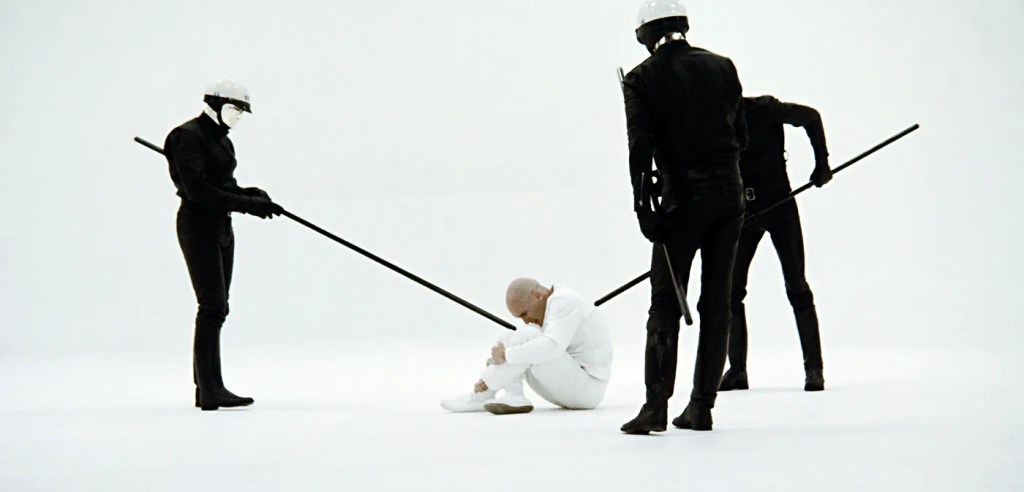
He shares this prison, an all white space stretching eternally, with another dissident named SEN 5241 (Donald Pleasance) whom he had reported earlier for illegally changing shift patterns in order to get a preferential roommate. This society is efficient, if also harsh.
What follows is a daring escape in which THX and SEN evade the authorities in order to find the world’s surface where men and women can live free.
In an impressive directorial debut we get amazing visuals and special effects showing a community rendered colorless and sterile by consumerism and unquestioning loyalty to one’s government. It is a beautiful looking picture and what is even more powerful than its art direction is its editing – largely helmed by director George Lucas himself. Lucas, before he became a filmmaking icon, was a master of using editing to pace a movie limited by its budget.
A lot of THX 1138 is shot from the perspective of computer monitors and surveillance equipment and much of the dialogue and action is presented in closeups that intensify the characters’ desperation and sense of panic – especially when THX begins withdrawing from the drugs.
The movie also brilliantly portrays the impersonal attitude of authority over a populace that has been quantified and dehumanized. Religion has been supplanted by a faux-benign computer system that plays simultaneously the role of a confessional priest and an advertising man. It preaches, “Consume. Be happy,” while failing to adequately respond to the personal issues and problems of its worshippers.
In one of the film’s most affective scenes THX is subjected in prison to a number of torturous tests which is commented on by unseen tormenters who sound like bored lab techs experimenting on mice or IT professionals playing with software. His reactions of pain and stress are just data.
The movie’s weakest point, unfortunately, is its characters who provide necessarily muted performances which serve to show the affects of the state and its drugs on what is essentially a human ant farm. However, by the same token this prevents any one of them from eliciting much care or concern from the viewer. The characters are governed by only the most base emotions of fear and anxiety which carries into all three acts of the plot.
THX 1138 is a visual marvel and it is one of most intelligent examples of dystopic science fiction in cinema. What it is not, however, is a compelling human drama.
 Perspectives on Film