Fly Away Home (1995)

4/4 stars

I am of the mind that there is no genre incapable of producing something good. Take the eco-conscious-child-bonds-with-a-wild-animal genre for instance. They were a dime a dozen in the 80s and 90s and the majority of its examples were utter dreck. Often over-sentimental and preachy, these kinds of movies too frequently end up saccharine and lacking in genuine human feeling. They aren’t hard to find. You can find them in any family movie pack in 5 dollar bargain bins.
Carroll Ballard’s (The Black Stallion) Fly Away Home is an example of the genre being treated with dignity and honest sentiment. The film is an emotionally moving picture that is not a mere environmental sermon or a cute animal movie. While these elements are there, Fly Away Home is more about the human experience. At its core, the movie preaches finding purpose after things we take for granted are taken away. This is a movie that keeps relatable human concerns at the foreground, supported by its green message instead of the other way around.

Amy Alden (Anna Paquin) is a 13 year old girl who, when her mother is killed in a car accident, is sent to Ontario to live with her father, Thomas (Jeff Daniels). She has not seen him in ten years and their interactions are awkward at first as she coldly tries to adjust to the sudden change in her life. Thomas is a socially-unaccustomed sculptor and aviation enthusiast who throws himself into his work. While he tries his best to keep his daughter comfortable there is a lack of connection and neither one of them is quite able to grasp the pain that each of them carries.
The first inkling of their developing bond comes when Amy discovers that he is involved with a local dispute with a real estate developer that threatens the wildlife community. At first, she claims to not care, but this quickly changes when she discovers a nest of goose eggs while playing hooky from school. The birds’ mother was killed by a bulldozer and Amy realizes that without her help the chicks will likely die. She hides the eggs in a drawer, but they are discovered by her father and his girlfriend Susan (Dana Delany) when they hatch.
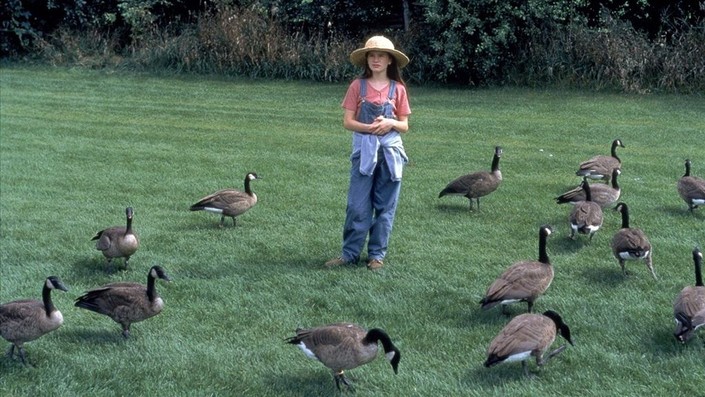
The geese have since imprinted on Amy and they follow her everywhere believing her to be their mother. Thomas allows her to keep them despite the difficulties involved. His reasons for doing so are not stated explicitly, but I felt that he realized in that moment that Amy was overwhelmed by the loss of her mother and felt a kinship with the chicks on this basis. Amy is trying to live vicariously through the memory of her dead mom by being a mother herself to the birds in a way her own mother can no longer do for her. A forced separation would do only more psychological damage, and Thomas understands this.
But, caring for the fast-growing geese is not without complications. Geese have a natural instinct to fly south when winter comes, but require parental guidance to learn in which direction to go. Without parents geese under Canadian law must be rendered flightless by having their wings clipped, an operation that Amy strongly objects to.
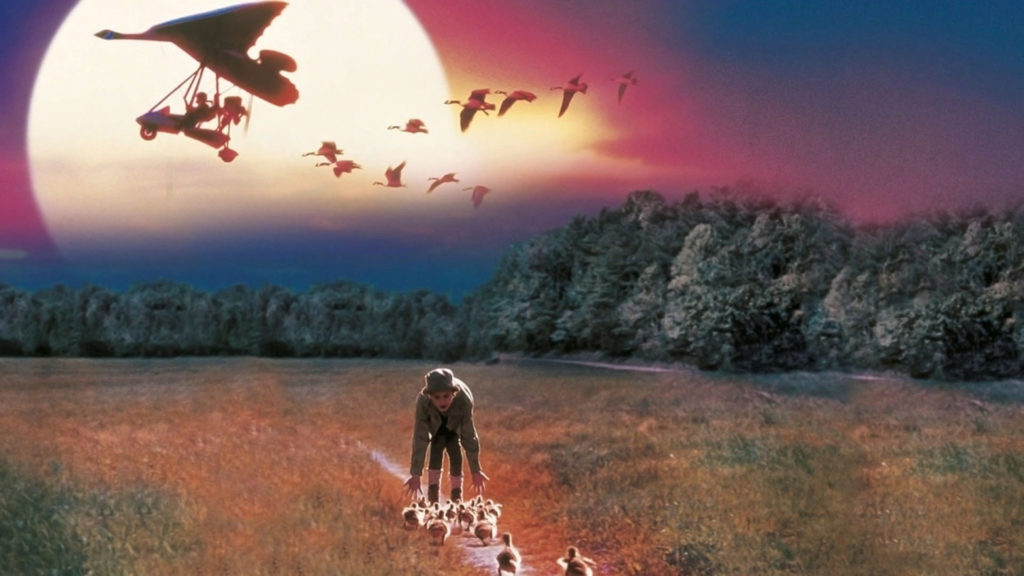
Thomas, his brother David (Terry Kinney), and his assistant Barry (Holter Graham) hatch a plan to use airplanes to teach the geese to fly and guide them to South Carolina to migrate. This is complicated by the fact that the birds will only follow Amy and so Thomas decides to teach his daughter to fly and operate an airplane so they can make the flight together. There is a forgivable plothole here because, of course, all that needs to be done is craft a two-seater with Amy as a passenger. The birds would still follow. Ignoring this issue and moving on, two one-seater planes are built, both of which are fashioned to look like large geese.

Their flight is the highlight of the latter act of the film, bringing a highly emotional payoff to Amy and Thomas’s relationship with Caleb Deschanel’s gorgeous cinematography on full display. The natural Canadian landscapes are gloriously autumnal, shot in wide angles. The beauty of nature and its importance are ever-present in every shot of Fly Away Home and the fight for its survival is deliberately paralleled by the emotional drives of its human characters.
Mark Isham’s beautiful film score adds a sense of sadness and newfound joys to the film’s mood, with a recurring song (10,000 Miles) performed by Mary Chapin Carpenter that sets the movie’s themes of overcoming loss and finding hope afterward.
The film is a spiritual experience in which Man and Nature are not enemies at war with one another, but rather companions that share in and reflect each other’s griefs and influences. Environmentally-minded movies like this one are often angry or else limp and uninspired in presenting their message. Fly Away Home is neither. It takes the subject of human grief and gives us a place where it can be uplifted to new purpose. It doesn’t deny the reality of pain, but finds meaning in it.

While many family movies are cynically dumb and bankrupt of emotional depth, Fly Away Home demonstrates that they don’t have to be. There are too many good wholesome family movies to allow statements like “well, it’s a kids’ movie” to justify dimwitted schlock. I would encourage any parent the next time it is family movie night, instead of tormenting themselves with something obnoxious, loud, and thoughtless, to put this on. Children deserve good movies too.

Arrowsmith (1931)

Rating 2/4

Art is at its best when it isn’t rushed. Otherwise what could be great becomes merely mediocre. And that is precisely what happened to John Ford’s 1931 picture, Arrowsmith. It’s a sad what-could-have-been with fine acting and excellent cinematography mired by a fast pace that comes at the expense of the story.

Based on the Sinclair Lewis novel, Arrowsmith tells the story of an ambitious country doctor (Ronald Colman) who struggles to balance his career fighting infectious diseases with his marriage to his longsuffering wife, Leora (Helen Hayes). She’s spunky, enthusiastic, and charms him with her wit. He’s noble, eager, and humble in his dealings with European professionals who seek his talents fighting plague in the tropics.

We first meet Martin Arrowsmith studying up on Gray’s Anatomy being told that the best doctors need only that book, the Bible, and Shakespeare to be well-rounded in their craft. It’s silly advice and Arrowsmith never takes it in the movie and the character who says it to him never reappears again. He later (and by later I mean in the very next scene) introduces himself to eminent bacteriologist, Dr. Gottlieb (A. E. Anson) who tells him he won’t take him on as a research apprentice until he finishes school. Years later (once again in the very next scene) he is finished with school and ready to serve. He meets Leora, a young nurse scrubbing hospital floors as a punishment for smoking on the job. He asks her out on a date and at the restaurant he proposes to her. If this seems a bit hasty, don’t worry, in a few moments the dialogue reveals they have been already dating for a couple of years.
And here is where I started seeing the problem that persists throughout the whole picture. The film constantly jumps ahead in time with only hasty dialogue explaining the passage of time. When it is not simply confusing it is robbing the story of any dramatic tension.
His life with Leora is always saccharine and happy and every moment of strife or conflict; any obstacle and hurdle they encounter is immediately rectified and resolved by the very next scene. Sometimes even in the very same scene.

Martin declines Gottlieb’s offer to work under him as a researcher in New York because the salary is not enough to support him and his wife. He goes into the country to work as a practical physician: pulling children’s teeth, treating sore throats, and even developing a serum to cure sick cattle. I never saw him charge payment and whenever the subject is brought up he nobly says “don’t worry about it.” I really don’t know why he declined Gottlieb’s offer then.
After his wife miscarries and becomes unhappy in the country he takes his family to New York after all, where his talents as a bacteriologist lands him in the tropics to test out a serum for bubonic plague on the population. What follows is a poorly written third act that tries to tackle research ethics in a way that I found offensive. He is instructed to test the serum on a selection of the population and withhold it from the other half to test its effectiveness. This is profoundly illogical. All of these people are ill and withholding the serum would prove nothing. The ethical question of experimenting in this fashion is brought up and then dropped with a whimper. What we get instead is a diabolical white savior plot that tells us that those who were outraged by the experiment were just being unreasonable. When the “big bad city folk” who opposed the experiment show up at his camp to receive the serum themselves they are portrayed as sycophantic hypocrites who got scared and came running to our hero. This is some of the most reprehensible moralizing I have seen in a movie. Tacked on to this is an implied affair Martin has with a woman named Joyce (a sadly wasted performance by Myrna Loy) that comes out of seemingly nowhere and is easy to miss and misinterpret. We get a scene with Martin in beautifully shot low-key lighting smoking a cigarette outside her room. She changes into a nightgown before the scene cuts to black. Another leering glance from her and a brief parting scene at the end is all that is further developed from this.

I mentioned the lighting above because that is where Arrowsmith’s strengths lie. Low-key lighting, sihouettes, and shadow terrifically capture the characters’ moods in moments of doubt. Ray June’s cinematography here was nominated for an Academy Award and it is merited.
Another strong point is the acting. Helen Hayes is terrific in here. Portraying exuberance, wit, love, grief, and humor; I could see the woman Martin fell in love with. She did not win or even get nominated for her acting in this movie, but I cannot complain since she still won that year for her role in The Sin of Madelon Claudet anyway.

I would have appreciated Arrowsmith more had it not been for the pacing and plot. The third act is morally questionable and quick and convenient resolutions to every conflict take away any investment I could have had in the story.

I read somewhere that producer Samuel Goldwyn allowed director John Ford – best known for his work with John Wayne – to helm Arrowsmith on the condition that he not do any drinking during production. Apparently Ford deliberately rushed through making the film so he could get back to it. I hate to say this, but maybe Goldwyn should have let him have a cheat day.