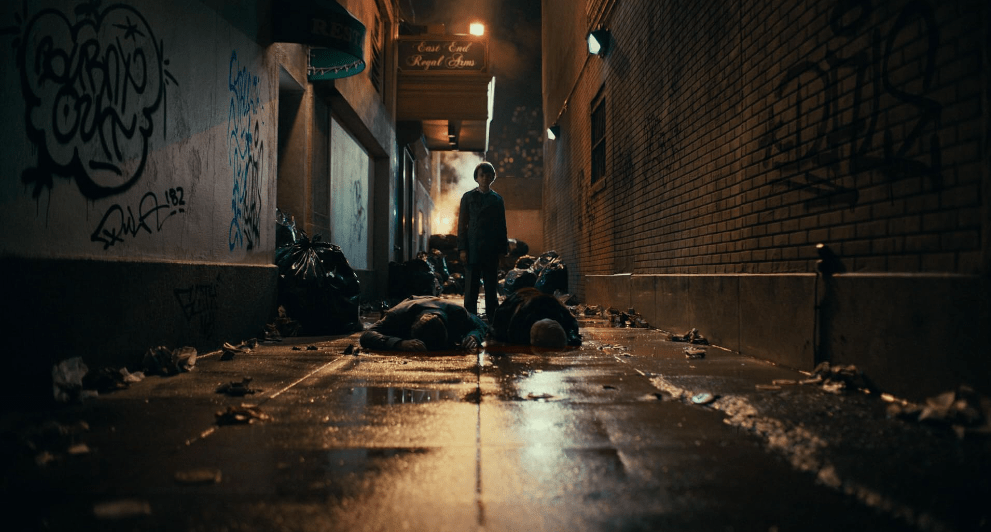
The Secret of NIMH (1982)

4/4 stars

Don Bluth’s The Secret of NIMH is my favorite animated movie of all time. And, I like to think, for good reason. For one, it is one of the most accessible movies for general audiences ever made. There is more to it than being a kids’ movie. It’s a movie for everyone.
The Secret of NIMH is often called an example of children’s fantasy, but I find the reasoning for this flimsy at best. The movie is called a children’s fantasy because children can watch it without being exposed to elements too mature for them to handle. It’s also called a children’s fantasy because it is a cartoon. And that’s pretty much it.
But, assuming that the absence of sex and vulgar language as well as the presence of animation is not a bar to adult engagement, there is little cause to consider The Secret of NIMH a kids’ movie. A family movie may be closer to the mark. But, the film’s story is sophisticated and engaging enough to attract an adult viewer without the presence of a child at all. I would just call it a movie. And a pretty damn good one too.

Don Bluth saw his first successes working as an animator for the Walt Disney Studios lending his talents on such movies as Robin Hood (1973), Pete’s Dragon, and The Rescuers. But, eventually he grew despondent over the direction he thought the studio was going and went off to work on his own animation production company. The 70’s and 80’s did not see Walt Disney at its best. It was a fairly stagnant period in which the company was churning out mostly forgettable projects that saw more status as cult favorites than as all time classics. It was during this period that Don Bluth began making his own animated films that brought new life and creativity into animation. The first of these was The Secret of NIMH. Throughout the remainder of the 1980’s he followed it up with other classics such as An American Tail, The Land Before Time, and All Dogs Go to Heaven.
But, it is The Secret of NIMH that will forever remain his best.

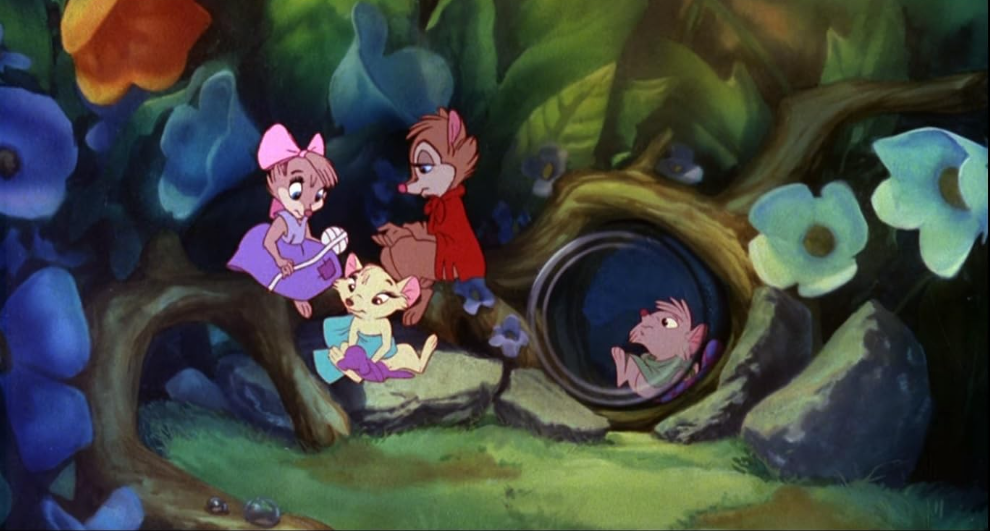
The Secret of NIMH perfectly balances visual artistry and excellent writing with a keen respect for its audience’s intelligence. In this modern era where cartoons are all safely nestled in the genre of comedy, there is sadly little coming out quite like this movie anymore. The film contains some of the most appealing hand-drawn images to date. It’s painted backdrops are reminiscent of the beautiful images seen in Lady and the Tramp or Pinocchio. Those films had backdrops more like Christmas cards, whereas here there is something more pastoral that echoes the paintings of Andrew Wyeth. The colorful animated characters in the movie mix with the painted backgrounds surprisingly well. The hand-drawn cels contain a vibrance and liveliness unseen in the computer animated images of today and every movement and every frame is full of grace and character; and are vigorous in emotional expression.

But, what makes The Secret of NIMH most special is its story. It’s not much in the way of a deep analysis of the human condition, but is rather a simple tale of survival elevated by its heart and writing.
Mrs. Brisby (Elizabeth Hartman) is a widowed field mouse who lives in a cinder block in the middle of a cornfield. The season where the farmer, Mr. Fitzgibbons begins to plow has come sooner than late and the animals who live in the field are expected to flee before their homes are destroyed. However, one of Mrs. Brisby’s children, Timothy, is sick with pneumonia and would not survive a move in the chill air. She manages to sabotage the plow, but this only serves to delay the inevitable. She meets a crow named Jeremy (Dom DeLuise) whom she rescues from the farmer’s cat and he suggests they visit The Great Owl for advice. Jeremy is a ton of fun as a clumsy oaf who dreams of one day building a love nest for two. DeLuise provides a lovable voice performance that makes Jeremy the sole source of comic relief in the picture. His infatuation with the idea of love has him falling head over heels (literally) in his efforts to find items to build his love nest with. These efforts often causing him more trouble than the items are worth. When Brisby first meets him he is tangled up in some string that he thought pretty and tried taking home with him. The comedy his character adds doesn’t detract from the movie’s overall serious tone. Unlike, say, Jar Jar Binks, Jeremy is a character who has purpose rather than just being a shoehorn for laughs. He represents the little people in this story, like the nosy Auntie Shrew (Hermione Baddeley), who know little and can do little, but will do what they can if the cause is good. There are times in which Jeremy is Mrs. Brisby’s only source of encouragement, offering what little aid he can simply because it is the nice thing to do. You can’t hate a fellow like that.
They meet the Great Owl (John Carradine) in a deep, shadowy part of the forest where he lives alone. He is a figure of awe and terror, wiser than any other being in the movie, and perhaps the most dangerous given his placement on the food chain. Like a god in heaven he is above direct involvement, but not above giving words of wisdom. He is hoary and become awesome in his elder age. He is every bit the creature of the night, flying from his tree to hunt, brushing off cobwebs and old bones with glowing eyes like a vampire flapping into the dark. Brisby is petrified of him at first, but her maternal instincts for her son muster the courage she needs to request help. He tells her to go to the rats who live in a rosebush by the farmer’s house. “They have ways” he tells her and he leaves with no further guidance to offer.
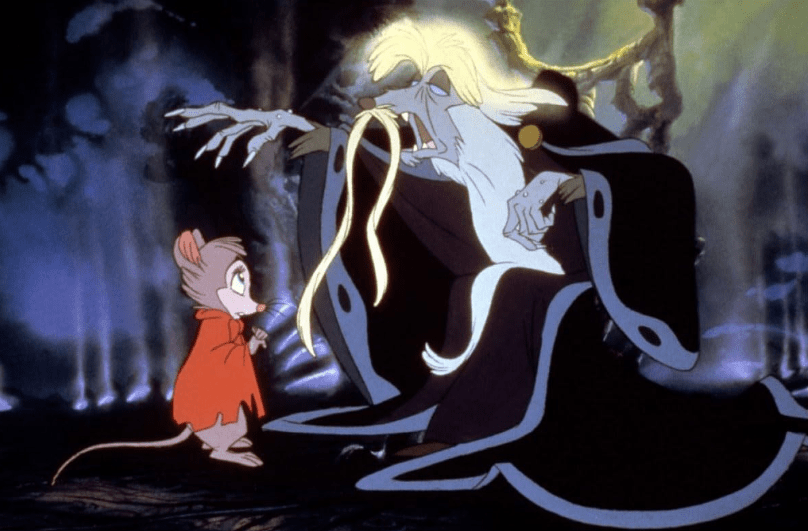
The rats live up to their reputation for problem-solving when she meets them as they are highly intelligent and power their hidden city with lights and electricity stolen from the farmer. Their leader is Nicodemus (Derek Jacobi), an ancient rat with a long beard with powers akin to wizardry. From him Mrs. Brisby learns of the origin of not just the rats, but of herself and all the animals gifted with speech and intelligence. They were the products of a human-led experiment that escaped from their lab leaving the scientists none the wiser to what they had created. The injections they are given by NIMH (the National Institute of Mental Health; a real place) do more than make them intelligent on a par with Man, but also have the side effect of putting them in touch with magic and spirituality. Nicodemus summons a staff like he is Gandalf or something, consults a magic mirror to see what is happening around him, and possesses a bejeweled necklace with mysterious abilities that he gives to Brisby. None of this is explained in the movie and what we are left with is a statement about the nature of science and the unknown. There is nothing in NIMH’s plans that accounts for the sudden contact with the supernatural and it raises questions about animal intelligence and their relationship with us humans and the environment that is not answered. Had the magical elements been removed from the story entirely it would have made little difference, but their presence and the questions they raise adds a layer of potential depth to what is going on.
But, Mrs. Brisby’s quest for aid doesn’t end here and she is soon caught up in an intrigue involving rival parties in the rats’ society. They are not interested in helping Brisby at all and are in a war of words with Nicodemus and his followers regarding their future. At the forefront of the naysayers is the evil Jenner (Paul Shenar), a rat who wants to continue living in the rosebush and stealing electricity from Mr. Fitzgibbons. But, Nicodemus has a plan for the rats to move all of the animals to another location where they can fend for themselves in good conscience without resorting to stealing. Personally, I think this is awfully big of Mr. Nicodemus given that the farmer is the same man who uses a plow to kill the local wildlife and destroy their homes once a year and owns an evil cat named Dragon who roars like an ogre. Nicodemus’s moralizing breaks down to not wanting to raise the farmer’s light bill, which is kind of him I guess. There is something to be said about a story that keeps its ethics basic while all this intrigue and interwoven backstory works its charm on us. Stealing is still wrong, the movie tells us, and I like that. Moral greyness in a lot of stories ends up being a thin excuse for avoiding having anything important to say. Goodness in the midst of institutionalized badness is a theme in need of a revival in this century.

While these events unfold, The Secret of NIMH’s multilayered story never becomes convoluted, but is easy to follow and engage in without the need to dumb down its themes and plot details for the younger audience. While being a cartoon, it takes itself as seriously as any live-action drama would which contributes to its timelessness not a little. As I noted above the plot is appreciable by both children and adults. As a fantasy adventure I would stack the film less with movies like The Sword in the Stone or The Wizard of Oz, but more with The Lord of the Rings, Star Wars, or Harry Potter. These are stories that carry heady weight and dramatic tension alongside their universal accessibility. As a cartoon it challenges pre-conceived notions of what animation is and whom it is for. Like black & white or color cinematography, animation is a legitimate form of visual art that holds boundless potential for story, not limited to a single demographic.

Shameless blurbsters like to toss phrases like “fun for the whole family” with a sincerity that I find suspect when it is lauded at any and all kinds of crap aimed at kids. With that in mind I can say that The Secret of NIMH is the sort of film I honestly believe children will love. But, the adults will love it even more.

Fly Away Home (1995)

4/4 stars

I am of the mind that there is no genre incapable of producing something good. Take the eco-conscious-child-bonds-with-a-wild-animal genre for instance. They were a dime a dozen in the 80s and 90s and the majority of its examples were utter dreck. Often over-sentimental and preachy, these kinds of movies too frequently end up saccharine and lacking in genuine human feeling. They aren’t hard to find. You can find them in any family movie pack in 5 dollar bargain bins.
Carroll Ballard’s (The Black Stallion) Fly Away Home is an example of the genre being treated with dignity and honest sentiment. The film is an emotionally moving picture that is not a mere environmental sermon or a cute animal movie. While these elements are there, Fly Away Home is more about the human experience. At its core, the movie preaches finding purpose after things we take for granted are taken away. This is a movie that keeps relatable human concerns at the foreground, supported by its green message instead of the other way around.

Amy Alden (Anna Paquin) is a 13 year old girl who, when her mother is killed in a car accident, is sent to Ontario to live with her father, Thomas (Jeff Daniels). She has not seen him in ten years and their interactions are awkward at first as she coldly tries to adjust to the sudden change in her life. Thomas is a socially-unaccustomed sculptor and aviation enthusiast who throws himself into his work. While he tries his best to keep his daughter comfortable there is a lack of connection and neither one of them is quite able to grasp the pain that each of them carries.
The first inkling of their developing bond comes when Amy discovers that he is involved with a local dispute with a real estate developer that threatens the wildlife community. At first, she claims to not care, but this quickly changes when she discovers a nest of goose eggs while playing hooky from school. The birds’ mother was killed by a bulldozer and Amy realizes that without her help the chicks will likely die. She hides the eggs in a drawer, but they are discovered by her father and his girlfriend Susan (Dana Delany) when they hatch.
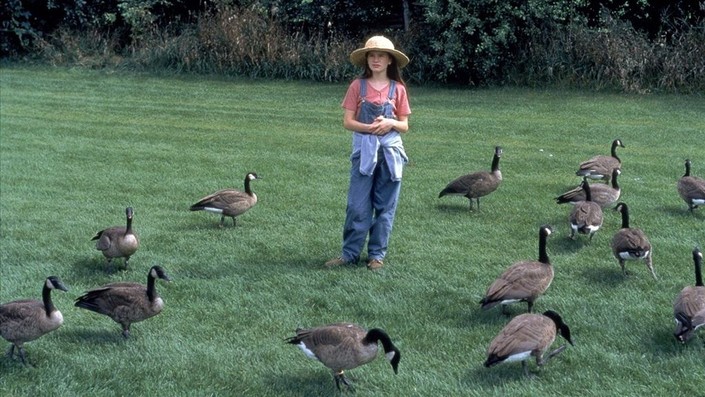
The geese have since imprinted on Amy and they follow her everywhere believing her to be their mother. Thomas allows her to keep them despite the difficulties involved. His reasons for doing so are not stated explicitly, but I felt that he realized in that moment that Amy was overwhelmed by the loss of her mother and felt a kinship with the chicks on this basis. Amy is trying to live vicariously through the memory of her dead mom by being a mother herself to the birds in a way her own mother can no longer do for her. A forced separation would do only more psychological damage, and Thomas understands this.
But, caring for the fast-growing geese is not without complications. Geese have a natural instinct to fly south when winter comes, but require parental guidance to learn in which direction to go. Without parents geese under Canadian law must be rendered flightless by having their wings clipped, an operation that Amy strongly objects to.
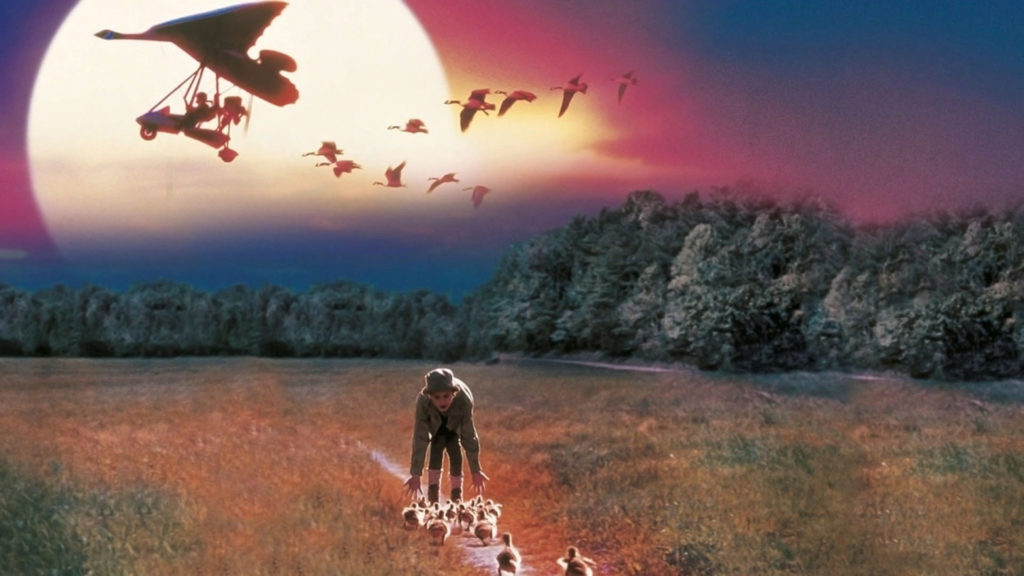
Thomas, his brother David (Terry Kinney), and his assistant Barry (Holter Graham) hatch a plan to use airplanes to teach the geese to fly and guide them to South Carolina to migrate. This is complicated by the fact that the birds will only follow Amy and so Thomas decides to teach his daughter to fly and operate an airplane so they can make the flight together. There is a forgivable plothole here because, of course, all that needs to be done is craft a two-seater with Amy as a passenger. The birds would still follow. Ignoring this issue and moving on, two one-seater planes are built, both of which are fashioned to look like large geese.

Their flight is the highlight of the latter act of the film, bringing a highly emotional payoff to Amy and Thomas’s relationship with Caleb Deschanel’s gorgeous cinematography on full display. The natural Canadian landscapes are gloriously autumnal, shot in wide angles. The beauty of nature and its importance are ever-present in every shot of Fly Away Home and the fight for its survival is deliberately paralleled by the emotional drives of its human characters.
Mark Isham’s beautiful film score adds a sense of sadness and newfound joys to the film’s mood, with a recurring song (10,000 Miles) performed by Mary Chapin Carpenter that sets the movie’s themes of overcoming loss and finding hope afterward.
The film is a spiritual experience in which Man and Nature are not enemies at war with one another, but rather companions that share in and reflect each other’s griefs and influences. Environmentally-minded movies like this one are often angry or else limp and uninspired in presenting their message. Fly Away Home is neither. It takes the subject of human grief and gives us a place where it can be uplifted to new purpose. It doesn’t deny the reality of pain, but finds meaning in it.

While many family movies are cynically dumb and bankrupt of emotional depth, Fly Away Home demonstrates that they don’t have to be. There are too many good wholesome family movies to allow statements like “well, it’s a kids’ movie” to justify dimwitted schlock. I would encourage any parent the next time it is family movie night, instead of tormenting themselves with something obnoxious, loud, and thoughtless, to put this on. Children deserve good movies too.

The Fountain (2006)

3/4 stars

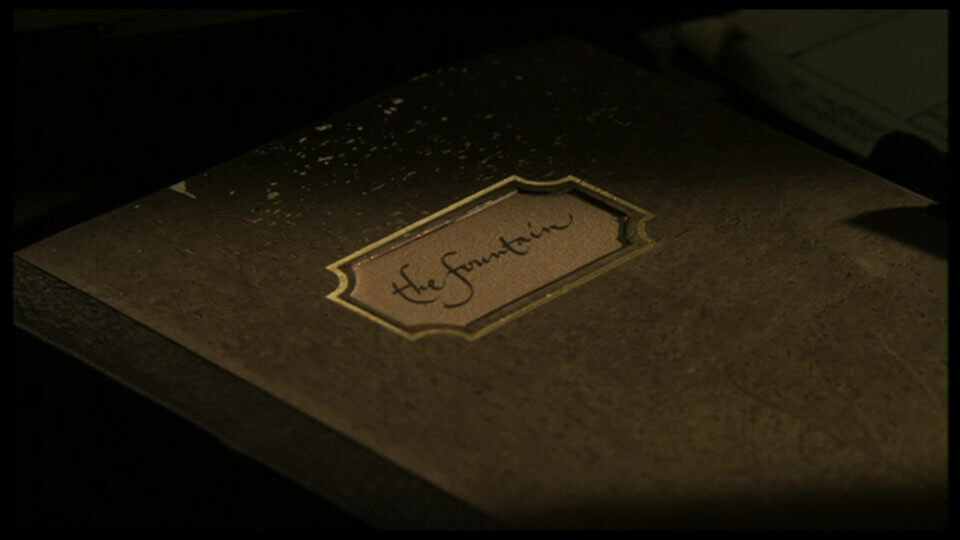
Visionary filmmaker Darren Aronofsky’s The Fountain is a visual marvel offset by a shallow and unsubtle story. It succeeds as a thoughtful meditation on grief, but ultimately fails as a meditation on death. The film aims to accomplish both, but in the end the rich images and Hugh Jackman’s heart-wrenching performance serve to mask a weak narrative that lacks the sort of depth the subject matter demands.
The Fountain has unique and arresting imagery rife with symbols and allegories that, while beautiful, do not give the audience much to think about. The attempts at allegory here are often obvious and over-explained throughout the film’s beats.

Tommy Creo (Jackman) is a doctor engaged in cancer research which, for him, involves a great deal of personal investment as his wife Izzy (Rachel Weisz) is dying of the disease herself. She is a vague figure; an idea whose personal substance has faded from his memories. Her scenes are typically recollections of moments with her that he regrets or quiet images of happiness he once had. She is writing a novel called The Fountain about a Spanish conquistador named Tomas (also Jackman) who, on behalf of Queen Isabella (also Weisz), goes on a quest to the Americas to capture a legendary Mayan temple wherein lies the fabled Tree of Life which promises fountain of youth like powers. The story is set against a backdrop of inquisitions and religious persecution that only feebly tie to his quest. Symbolically the predations of the Spanish Inquisition and the vicious palace intrigue align with the march of death that threatens the life of the real-life Izzy, but within her novel’s context they are under-explained and function poorly as an impetus for the hero. Like her book, the film has a similar problem. All of the visual feasts of allegorical imagery are only sensible when viewed allegorically, but defy logic when examined at the parallel literal level. A good allegory mixes both perfectly, but The Fountain is too obsessed with its symbolism to spend much time on story.
Mixed between the content of Izzy’s novel and the real-life events happening to her and Tommy there is a third parallel plotline involving a vision of Tommy inside a bubble hurtling toward a nebula called Xibalba which, according to the Mayans, contains the abode of the dead. With him, in the bubble, is the Tree of Life itself, dying slowly in conjunction with the passing of Izzy. The vision of Tommy desperately tries to keep the tree alive, occasionally consuming its bark for its rejuvenative effects.
What the movie does best is capture Tommy’s grief and the fear that comes with it. Jackman’s performance is among some of his finest. He evokes pain and loss in a way that is so profoundly real it almost brings me to tears. Another thing The Fountain does that I appreciate is showing the experience of hyper-focusing on random still things when we are frightened and aggrieved over a pending loss. He stares at a ceiling light soaking it in as if there is nothing else in the universe; and he does it again in an elevator creating a huge gestalten image of its interior paneling until it becomes everything. It’s an experience that is difficult to explain to someone who has not felt it, and Aronofsky has found a brilliant way to bring it on screen visually that I have not seen in other movies dealing with the subject.
On top of these excellent qualities is Clint Mansell’s beautiful, funereal score which is among some of his best compositions alongside Requiem for a Dream.

The Fountain’s visual language is highly poetical. It’s images are like music that recreates strong feelings. But, it is like music with bad lyrics. The moments in which Tommy purportedly comes to terms with his wife’s death and the onset of his eventual own are not convincing and are highly contrived by the aesthetics. The film tells me he is over his terror of death, but it doesn’t make me feel it in the slightest. Unlike Aronofsky’s other much better films, The Fountain suffers from the disingenuousness of pretension.
Behind the film’s production was a number of budgetary issues that during pre-production nearly killed the project. Inevitably, Darren Aronofsky, opted to make the film on a smaller budget and a smaller scale of ambition. What was intended to be an epic became a 96-minute art-piece severely lacking the director’s usual profundity and symbolic detail. There was a great picture in the works here during the film’s early planning that evaporated during its execution. Had he made the picture after Black Swan we may have had the masterpiece he originally intended. Alas, what is left is a beautiful and elegiac film, marred by limitations that robbed it off subtlety.
In the end, The Fountain is a good movie. But, it could have been a great one.

Mad Max: Fury Road (2015)

4/4 stars

The Mad Max series continues to improve with each passing entry. The first film was little more than a bit of roughneck ozploitation and lacked the sense of good fun that characterized the sequels. As the films have come along director George Miller hones his skill framing sustained sequences of nonstop action and in Fury Road he has brought his craft to perfection.

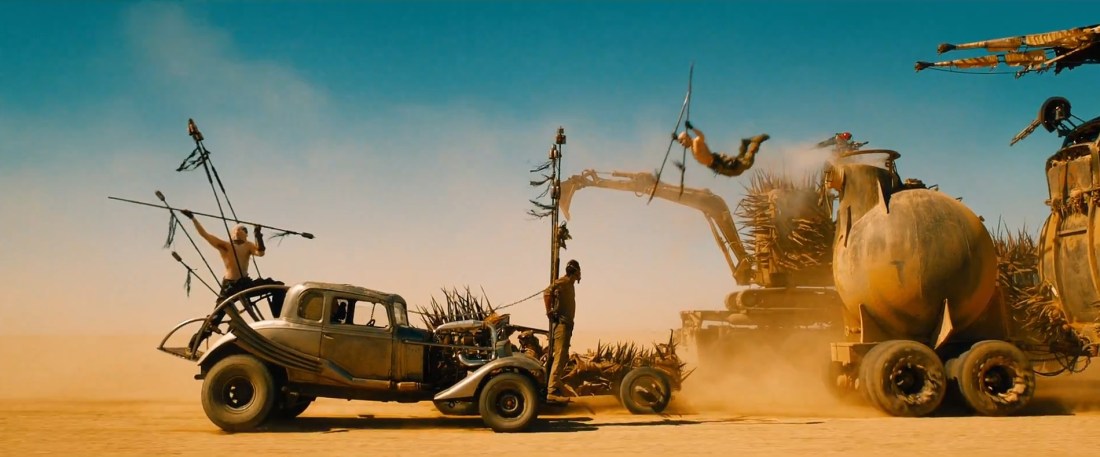
Mad Max: Fury Road is essentially a two hour chase picture; simply plotted and finely choreographed. Nonstop action can be quite dull in a lot of movies, but this movie has such brilliantly tuned pacing that my investment in its story never became fatigued. It takes a fine hand to make movies like this so good and this is one of the best of its kind; proudly standing among Terminator 2 or Aliens as one of the greatest action movies ever made.

The movie sees Mad Max (played by Tom Hardy replacing Mel Gibson) run afoul of a gang of bandits who take him prisoner to their Citadel, a massive canyon fortress ruled by an asthmatic albino warlord named Immortan Joe (Hugh Keays-Byrne). The ruler keeps his minions in religious awe of him and he controls access to a large reservoir of water by which he holds his subjects under his thumb. When his favored Imperator Furiosa (Charlize Theron) defects and smuggles his harem of “breeders” out of the citadel Max is dragged along as Immortan goes after her to get them back. While on the chase Max is handcuffed to one of Immortan’s feral soldiers named Nux (Nicholas Hoult). In the ensuing battle Max escapes his captors along with Nux as an unwanted addition. He makes contact with the fleeing Furiosa and their relationship opens with mistrust and mismatched priorities, but then develops into a friendship and an enjoined quest to bring Immortan’s escaping harem to a place of safety. The girls (Rosie Huntington-Whiteley, Zoe Kravitz, Riley Keough, Abbey Lee, and Courtney Eaton) are a sensual lot of macguffins whose combination of little personality and minimal attire makes them offset whatever feminist and anti-slavery themes the movie is trying to convey. There is something puerile about fantasies of “grateful” rescued women in distress that appeals to the audience, and I feel attempting to find social commentary in how these women are presented here would be dishonest. The girls are eye-candy and little else; and the “people are not property” message is best found elsewhere. If this be a serious flaw, it is a flaw that is participated in by its actresses and its being a testosterone-fueled action romp. And perhaps it can be forgiven. Fury Road makes up for it with a tight camaraderie between its three central heroes and a highly entertaining narrative that marries road pictures (an under-acknowledged genre) with riveting special effects and action. The film is more escapist than philosophical and works perfectly on that level.

The car chase which makes up the majority of the film’s runtime is a spectacle of blood, dust, chrome, booming voices, and good old-fashioned grit. Barely a scene goes by without burning rubber and blowing sand. It’s an aggressive escapade of rust, gasoline, battered metal, and roaring engines. The film is high on bravado and violent energy. It’s post-nuke desert landscape creates a visually arresting palette of reds and yellows while its kinetic pace never stoops to repetition. The use of color in Fury Road is essential to its aesthetic and I can only look at the black-and-white version that was released as a meritless gimmick that fails to understand the proper uses of black-and-white and what it is for. This movie along with Logan (another great picture bastardized with a black-and white version) was made with color in mind and is best seen that way.

Tom Hardy, in a role requiring minimal dialogue, fills Max’s shoes well enough; but he doesn’t quite have the charismatic appeal of Gibson and Miller made the right choice in making Furiosa the film’s main perspective throughout the majority of it. Hardy is left to do the physical gruntwork of the Max character without talking too much to make the recast uncomfortably stand out.
While I would have been happy to see Mel Gibson take on the role again as an older Max, Fury Road still remains, to my mind, the best of the Mad Max series. Miller tried with the first one and succeeded with the next two. With this one, he perfected.

La Chienne (1931)

Rating 4/4

When a good man commits a murder and a bad man who is innocent is hanged for it who is going to care and who should? Jean Renoir’s La Chienne may not answer these questions, but it does show us the consequences.

Renoir tells us in the film’s opening that the movie has no moral or message to give. Instead the movie simply shows us people being people. Renoir doesn’t believe in villains. He believes in humans who do bad things.

Maurice Legrand (Michel Simon) is an aspiring painter whose talents are unappreciated by his shrewish wife Adèle. She thinks he is wasting his time and her drawing room space with his hobby. Adèle frequently compares him negatively to her first husband who was killed in action. “A real man! A hero! A brave man who gave his life in 1914 for sluggards like you!,” she declares.
When the dead husband suddenly shows up very much alive Maurice lets him have her.
This leaves Maurice free to continue his love affair with the young Lulu (Janie Marèse) who is being prostituted by her boyfriend Dédé (Georges Flamant) to pay his debts. He’s greedy, abusive, and narcissistic. The very opposite of the kindly, but shy Maurice.
Lulu and Dédé hatch a scheme to sell Maurice’s paintings as her own. Maurice discovers this, but allows it to happen so she can use the money to live comfortably. Maurice’s naivete and Dédé’s greed end in tragedy for both of them.

The title of the film in English is “The Bitch” and Lulu more than earns it. Incapable of love or empathy she puts on a performance to gain Maurice’s affection and financially benefit from it. Lulu scoffs at his feelings, laughs at him, and is proud of her lack of scruples and two-facedness. Maurice kills her in a moment of passion and Dédé is hanged for the crime. The latter’s reputation as a scoundrel is set dead against him and Maurice finds himself able to live with himself afterward. The film ends with him an old man, a poor vagrant; but still as amiable and as kindly as he was before.

La Chienne, true to its promise that the movie contains no moral lesson, expresses no sense of outrage over what happens. The events happen as they do and the characters remain who they were. The audience is left to make their own judgments. The movie makes no comment.
Maurice is a man who got away with murder. He is also sweet-natured and is in no way an active menace to society. Dédé most certainly is. He’s a selfish bastard and perfectly capable of the crime he is accused of. Nevertheless he dies an innocent victim.
And Lulu is La Chienne. The bitch. She is manipulative, devoid of compassion, and embracing and proud of her duplicitousness. It gets her killed in the end, but the movie doesn’t tell us if she deserved it. It doesn’t tell us if the question of innocence or guilt even matters.
What Renoir’s film does tell us is that people do things, good and bad. And the consequences occur as they may, and not always in a way we deem fair.

La Chienne had the potential of making its title actress Janie Marèse a star in French cinema, but was sadly killed at the age of 23 in a car accident shortly after making the picture. Her co-star Georges Flamant was driving the car. After he survived the press vilified him and his career as an actor was almost destroyed. Adding to the tragedy, Michel Simon had fallen in love with her during production and never forgave Flamant or Renoir (whom he deemed partially responsible) for her death.

The aftermath of La Chienne’s production mirrored its theme. People did things as people often do and there were consequences. And as in the film, who was truly at fault remains unanswered.

Gilda (1946)

Rating 3.5/4

“Hate can be a very exciting emotion. There is a heat in it, that one can feel. Didn’t you feel it tonight? It warmed me. Hate is the only thing that has ever warmed me.”
Ballin Mundson (George Macready) is sincere when he says this to his wife and she doesn’t disagree. She repeats it herself to her lover Johnny (Glenn Ford) and he doesn’t disagree either.

Charles Vidor’s 1946 film noir, Gilda, is not a love story. It’s a hate story. It’s a story of people using love to cruelly punish and destroy each other.

Gilda (Rita Hayworth) hates Johnny for walking out on her years ago. Johnny hates her for humiliating him and making him feel less like a man. Her husband Ballin hates everybody and carries it wherever he goes so much that no one notices anymore. What comes of this hatred is one of the most unhealthy love triangles out of classic Hollywood.

Johnny makes a crude living as a cheating gambler in Argentina who believes “a dollar is a dollar in any language.” I looked it up and he’s right. What he’s wrong about, though, is that he can keep getting away with cheating. After he’s caught doing it at a Buenos Aires casino Johnny comes face to face with the understandably offended Ballin Mundson who owns the joint. Ballin takes a liking to the kid and instead of smashing his fingers with a hammer he offers him a job as personal security.

Their partnership is surprisingly a happy one although it is apparent that Ballin is keeping secrets from him. Things become more complicated when Johnny is introduced to Ballin’s new wife, the one and only Gilda, his ex. Ballin who has made hate so much a part of himself that he can recognize it begins to sense something is wrong right away. He doesn’t suspect that the two know each other, but he amazingly recognizes hatred coming from Gilda to Johnny immediately. Johnny and Gilda’s “introduction” is extremely cordial and lacks even the slightest innuendo of hostility. But Ballin picks it up all the same even when he cannot understand it.
The movie provides the viewer none of their backstory up to this point letting us see the scene from Ballin’s eyes. We are as perplexed as he is when he questions Gilda about her hatred and she coyly denies it. Not until she and Johnny meet each other later that the truth comes out. It is almost soap opera-like when she is suddenly introduced in this way. Johnny makes no previous mention of her in the film, not even in the frequent voice-overs that are true to film noir fashion. This way of bringing Gilda into the story is effective in making sense of Ballin’s actions later in the movie. He is an extremely complex character and very little of this film is given from his perspective. By doing so here is masterful screenwriting.

Ballin slowly begins to realize their history and starts becoming more possessive and watchful of her. Johnny does so to, but even more aggressively and he deceives himself by saying it’s for his boss’s sake.

Ballin’s dealings with German mafia adds more tension to the situation as Gilda and Johnny meanwhile begin an affair that is both hateful and passionate. For the both of them it is driven purely by sexual passion and they bitterly try to use it overpower the other.
The various twists and turns of the plot lead them closer and closer to each other and Johnny unleashes cruel emotional abuse to bring her down to the humiliation he once felt and which he believes she deserves. Power obtained, Johnny reveals himself to be an awful and vicious man who has resented this woman’s independence and confidence from the very beginning.

At the end we see them at the absolute lowest they can be and Johnny’s empire comes crumbling down around him. Ultimately the film robs us of any emotionally poignant resolution by providing a tacked-on happy ending that undermines the message. An unbelievable twist ending followed by no tragedy ruins the experience.

Overall Gilda is a great film that could have been better concluded. The movie made Rita Hayworth a Hollywood icon and sex symbol. It also launched a long affair between her – married to Orson Welles at the time – and co-star Glenn Ford.

The cinematography was done by Rudolph Maté also known for his work on Dreyer’s Vampyr. In Gilda he plays with light and shadow with the characters emotional states often masking their faces during moments when they are at their most honest.
Jack Cole’s choreography of Hayworth’s dance numbers are legendary and “Put the Blame on Mame” became a staple reused in other films noir.
The movie was produced by Columbia film producer Virginia van Upp who was only one of three women producing films at the time. She was also an accomplished screenwriter who had helped coach Hayworth for this role who was mostly known for doing musical comedies at the time.
The movie has a keen understanding of male emotional abuse in relationships and I think Virgina’s involvement shows.