Batman v Superman: Dawn of Justice (2016)

3/4 stars

note: This is a review of the Ultimate Edition, an expanded edition of the film not initially shown in theaters

When I first saw Batman v Superman ten years ago I hated it. A lot of people did. Many still do. But, having seen it for a second time a decade later I find myself in the awkward position of being one of its defenders. Bear in mind, the Ultimate Edition is the only cut of the film I have seen, so I can honestly inform the reader that the extra thirty minutes are not what made the difference to me.
No, what I think happened this second time around was a mixture of acceptance and comprehension of what the filmmakers were trying to do. Being dark is not necessarily an issue for me. What made Man of Steel a bad movie was that its darkness extended to its main character as well as the plot. Putting Superman in a dark story is fine. Wholesome, good people live in a dark world and how they adapt to it and learn to live in it is ripe for good storytelling. But, in Man of Steel Superman comes right off the bat as someone angsty and angry which suited him not a bit. The kinder more winsome Superman of old would have made that film more palatable since light versus dark is what he is all about.

Superman (Henry Cavill) is not much better in this movie either, but, perhaps I have got used to him. He is not as unsure of himself as he was in Man of Steel for one thing. And, also, Batman v Superman is not all about him. It’s not really about Batman (Ben Affleck) that much either. The angsty Superman is here to stay and the movie accepts this and moves on without dwelling on his character as much.
For me, BvS’s saving grace is that the dark tone is not just a gimmick like it was in Man of Steel. This movie has something to say for once. What made many people angry, I suspect, is that they purchased their tickets and expected to see a superhero movie. Can’t really blame them there. But, Batman v Superman: Dawn of Justice – an admittedly awful title – is not a superhero movie. It’s an epic social thriller that takes the subject of Superheroes (or meta-humans as the film calls them) seriously. It’s a commentary on what the ramifications of beings like this would have in a world that is post-9/11. In many ways I view the movie as a companion piece to Zack Snyder’s Watchmen.
Much of the film’s scenes are set in newsrooms, congressional hearings, and foreign lands falling apart under unstable regimes. The frequent cameos of real life figures like Charlie Rose, Nancy Grace, and Neil DeGrasse Tyson commenting on the existence of superheroes is just another way the film tries to posit how a world inhabited by meta-humans would react to them.

The film is set two years after General Zod wrecked devastation on Metropolis and now the world is questioning whether it needs another all-powerful Kryptonian living amongst them. Superman is a good man who is on the side of humanity, but that fact is not unquestionable to the many people who were maimed and lost their loved ones in the fallout. It was Snyder’s conscious decision to spend more time on this subject than on the pure unadulterated superhero flare we have come to expect in these sort of movies. Just before I rewatched it I read this comment from director Zack Snyder that he made about the movie in 2023: “I think that probably is what caused the movie to be so polarizing. I think a lot of people went into the movies for going like, “Oh, it’s the superhero romp, right? Let’s have fun with it.” And we gave them this sort of hardcore deconstructivist, heavily layered, experiential modern mythological superhero movie that … you really need to pay attention to. That was not cool. That’s not something anyone wanted to do.”
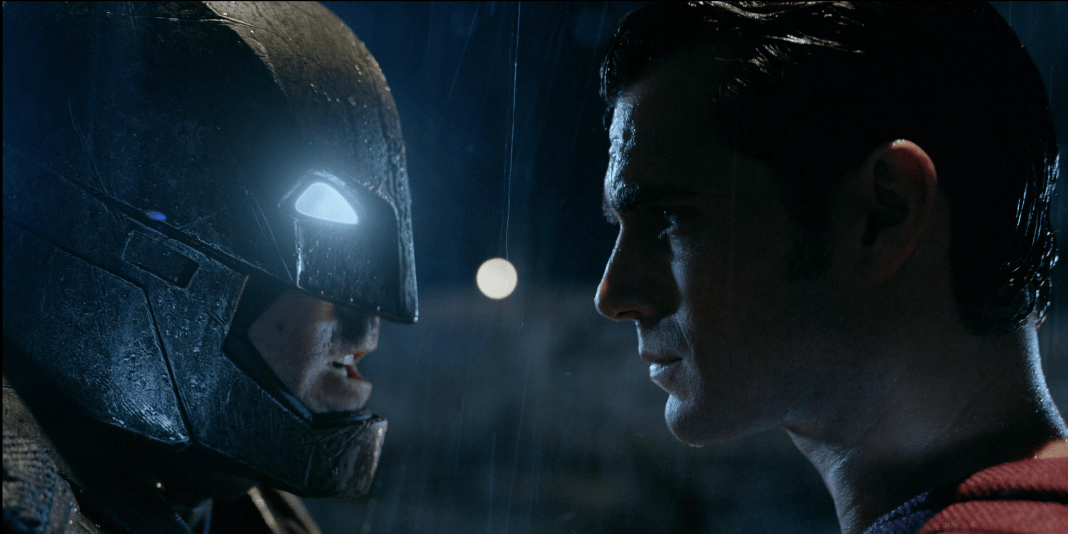
At first when I read that comment I got annoyed. I thought it patronizing and a failure to take ownership of the issues that people actually had with the movie. Watching it again, though, I hearken back to that comment and understand somewhat of what he was trying to say. I believe he was mostly right, but a few people did have other reasons for not liking it. The characterizations of Superman, Batman, and Lex Luthor (Jesse Eisenberg) are hardly traditional. The film still languishes under its fast-edited action sequences and unconvincing special effects. And a lot of people bristled at the reason for Batman sparing Superman’s life being that their mothers’ names were both Martha. The latter issue was meme’d and mocked to death back in 2016 and a lot of people still complain about it today. I am not as angry about it as they are. The scene intended to give Batman an understanding of Superman’s humanity that he had not seen before. He had a mother. The scene only failed because of a lack of subtlety and Batman’s animosity died down too quickly to be believable. I thought Batman’s issues with Superman were not wholly addressed here. Having a mom named Martha should not have been enough to convince him that Superman was not a threat and the movie should have resolved this concern a bit more. I also believe the addition of visual flashbacks to Bruce Wayne’s parents being shot was too on the nose and the scene would have been better received without them. But, the fact that Supes also had a mom named Martha being a turning point in Batman’s relationship with Superman didn’t bother me. It’s not as stupid as people say it is. It just needed some adjustments to its execution. But, people like their bandwagons, you know.

Batman is a big point of contention, and I do understand why. He is a bit hard to swallow. He is much more brutal and violent than any previous incarnation of the character we had seen on screen before. He also shows a shocking indifference to human life. Much of his actions are reckless and indirectly cause the deaths of the men he is fighting. The reason I still am able to accept him, however, is that the reinterpretation of the character is not so jarring as it is with Superman. Clark Kent and his alter ego don’t align at all with what he is supposed to represent, whereas Batman has always been a more edgy character. Making Batman this grim was the only logical thing the filmmakers could do if he is to contrast with Superman as he is presented here. It helps that he is not the movie’s main character. Batman serves the majority of the plot as an antagonist who has become misguided by suspicion and paranoia. The movie focuses most on the loneliness and the near sociopathy of the character which, let’s face it, has been with Batman since the beginning. Batman has always been the sort of guy whose trauma and internal rage at injustice had driven him to becoming a violent vigilante who beats the wicked and corrupt to a bloody pulp. Must I also point out that he dresses up in a vampiric bat costume and has the power of fear and the cover of darkness as his primary weapons? I can forgive the movie for knowing what everyone else knows that such a man in real life would likely be mentally ill.

The actual fight between the two is instigated by Lex Luthor. Instead of the usual self-congratulating Bond villain played by Hackman and Spacey, Jesse Eisenberg plays him…well…as Jesse Eisenberg. Eisenberg is not a bad actor, but he is a one-trick pony. He only plays one guy in all of his films and that is Jesse Eisenberg. His Luthor is neurotic, talks fast, and eats up attention like a child eats up sugar. He clearly loves the sound of his own voice and becomes grandiose and prone to demagoguery. He thinks of Superman as a sort of god in the classical sense and wants him dead on that basis alone. Instead of cutting his teeth on Sesame Street and Dr. Seuss like most normal people, he lives by cherrypicking the philosophies of Nietzsche and Ayn Rand. I’ve known people like this and they aren’t much fun at parties.
By staging a number of terroristic plots that are deliberately centered around Superman’s presence he turns him into a controversial figure. A vocal minority of the citizenry are now leery of Superman and Batman is convinced that the world will not be safe and secure until he is dead.

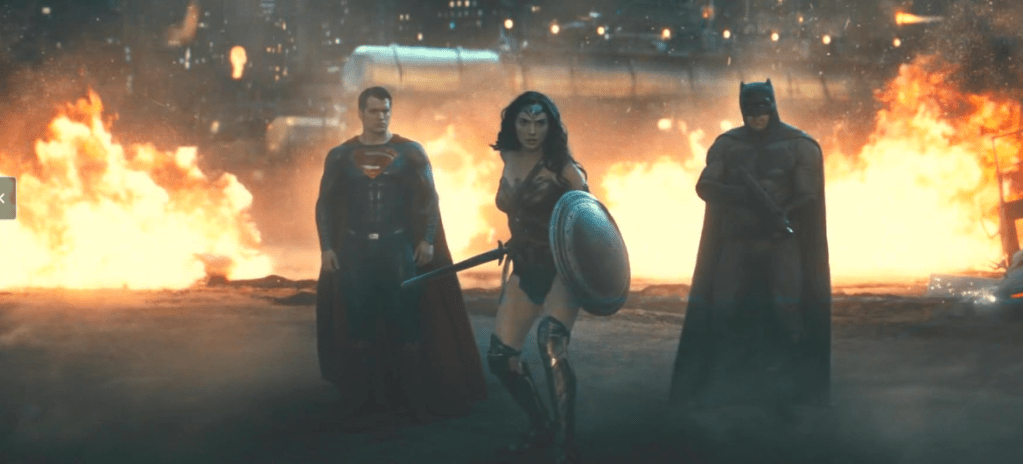
Another newcomer to the franchise is Wonder Woman (Gal Gadot) who spends most of the movie in disguise as Diana Prince. Her purpose in the film is limited and she is there by and large as a justification for the “Dawn of Justice” part of the movie’s title. She is meant to foreshadow the eventual rise of the Justice League. The Flash, Cyborg, and Aquaman also make very brief appearances, but they don’t inundate the movie with too many characters as a lot of superhero movies do with their villains. Secret archived footage is shown of them on computer screens to give us our first look at them before they make it to the main event.
Gadot’s performance is a bit bland, but she is not given a whole lot to do in her defense. As Wonder Woman she doesn’t spring into action until the final climactic battle and when she does she contributes little. Action movie directors must find writing for women hard or something, because I complain about this often.

The final battle is where the movie tends to fall apart. It’s a CGI-laden mess. The three heroes get tossed about frequently, transitioning from CGI models to actors when they land. CGI is supposed to be like a magic trick and when done poorly the trick is revealed to the audience and takes them out of the illusion. Doomsday, a monster made of kryptonite designed by Luthor, looks like a cartoon. It stomps about, roaring its head off and fighting the heroes in front of bluescreen that is so obvious it’s more like watching a video game.
The modern filmmakers have seemed to forget that fight scenes need personality as well as action. There is a lot of emotion involved when fighting someone. There needs to be a personal connection that has to be shown during the fight and not just in the moments leading up to it. This is done through simple emoting, facial expressions, and signs of physical exhaustion as the conflict becomes prolonged. What this movie fails to do is show us any of that. It’s all fast blink-and-you’ll-miss-it kinetics, explosions, loud noises, and whole shots where not a single thing on screen is real. All of which is dimly lit for reasons I suspect have to do with disguising the fakeness of the special effects. It’s more exhausting than entertaining.

Batman v Superman: Dawn of Justice is at its strongest when it is not trying to fulfill its obligations as a superhero movie. The social commentary is brilliant and the pacing of its first act is near perfect. It suffers during its action scenes, but provides a much more profound experience when it is being serious. It’s not perfect, but I rather liked it.

Director: Zack Snyder
Writers: Chris Terrio, David S. Goyer
Producers: Charles Roven, Deborah Snyder, Wesley Coller, David S. Goyer, Geoff Johns, Benjamin Melniker, Steven Mnuchin, Christopher Nolan, Emma Thomas, Michael E. Uslan, Trevor Christie, Curt Kanemoto, Bruce Moriarty, Jim Rowe, Andrea Wertheim, Gregor Wilson
Cast: Ben Affleck (Bruce Wayne/Batman), Henry Cavill (Clark Kent/Superman), Amy Adams (Lois Lane), Jesse Eisenberg (Lex Luthor), Diane Lane (Martha Kent), Laurence Fishburne (Perry White), Jeremy Irons (Alfred), Holly Hunter (Senator Finch), Gal Gadot (Diana Prince/Wonder Woman), Scoot McNairy (Wallace Keefe), Callan Mulvey (Anatoli Knyasev), Tao Okamoto (Mercy Graves)
Composers: Junkie XL, Hans Zimmer
Cinematographer: Larry Fong
Editor: David Brenner
Superman II (1980)

3/4 stars

Superman II has all the excitement and visual spectacle of the original Superman film, but lacks its wit and plausibility. As a superhero movie it’s about as good as Tim Burton’s Batman or the first Avengers. But there isn’t much here of what made the 1978 Superman movie special.

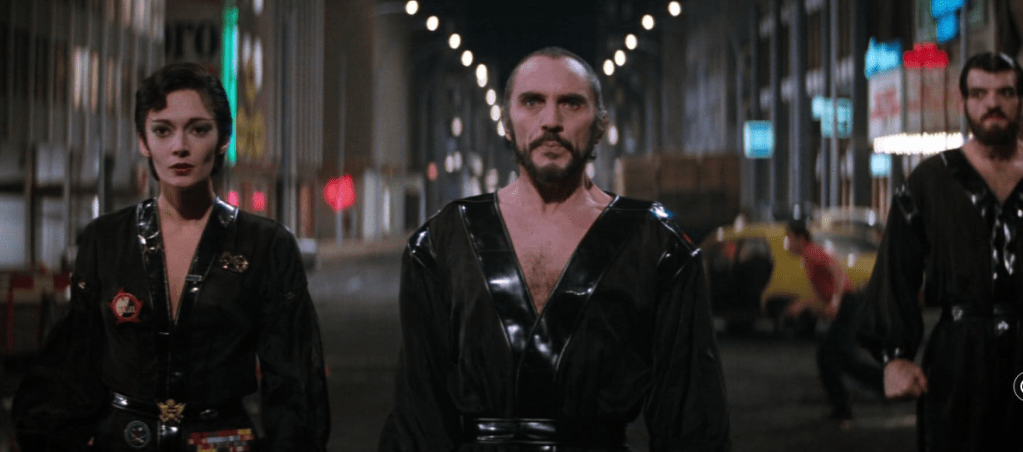
In the first film it opened with three Kryptonian criminals being charged with sedition. General Zod (Terence Stamp), Ursa (Sarah Douglas), and Non (Jack O’Halloran) are condemned to dwell inside a floating disc called the Phantom Zone which floats off into space just as baby Superman’s escape pod leaves the planet. Now, in Superman II we find out what happened to them.
The sequel opens with Superman (Christopher Reeve) rushing to Paris after a group of terrorists with a hydrogen bomb take control of the Eiffel Tower. Superman saves the day by rescuing hostages and flying the bomb up into outer space where it explodes harmlessly. Unfortunately, the Phantom Zone just happened to be flying by and the shock waves shatter it, releasing Zod and gang. Ursa murders a couple of astronauts on the moon, and then the trio land in Houston, Texas. Zod wants to rule the planet and be worshiped by its denizens, but upon hearing stories of Superman he realizes that there is one threat to him and his ambitions that must be removed if he is to succeed.
The three villains have only a low kind of cunning and rely mostly on brute strength and their powers to get what they want. As movie bad guys go they have none of Lex Luthor’s (Gene Hackman) charisma and act more like playground bullies than anything else. Much of their scenes consist of wrecking havoc, causing property damage, and making comments about puny earthlings. Lex is regrettably given less to do. He joins forces with the Zod gang in the hopes of getting revenge against Superman, but he is forcibly sidelined by the new villains; his scenes little more than standing in a corner uttering some witticism.

Superman II’s subplot involving Clark Kent’s growing romance with Lois Lane (Margot Kidder) is slightly more interesting. Lois, who has been growing increasingly suspicious of Kent’s true identity, finally uncovers the truth. Superman is in love with Lois, but he discovers that for the two of them to be together he must sacrifice his powers and immortality. We are not told why and Superman accepts it without question. The time they spend together as a human couple is sweet and hopeful, but is sadly short-lived. Zod and his friends threaten Metropolis and it becomes clear to Clark that the world needs Superman. Clark and Lois’s breakup, however, represents one of several different failings that Superman II has in its writing. The movie does not convincingly establish that Clark Kent and Lois Lane are in love at all. Their interactions throughout the majority of the film is not much different than the simple infatuation they had in the first one. That they are deeply in love is something we are told more than we are shown. Break-ups can take a serious emotional toll on a person, and for a moment in the movie’s final scenes it appears that something poignant will be made of it. Lois tells Clark that he is “a tough act to follow” after he tries to suggest that someday she may meet someone else. I think a lot of people following a break-up feel as Lois does, even when their boyfriend isn’t the Man of Steel. But, the film cops out of any further dramatic tension by Superman implausibly wiping her memories clean with a kiss.
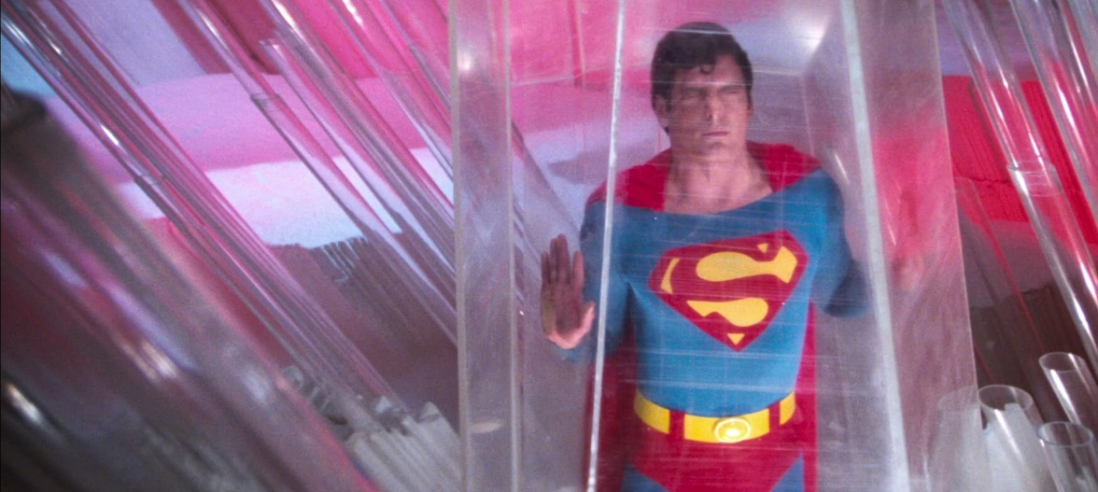
This kiss is just one of several stupid moments in the movie. I cannot abide arbitrary powers being lazily introduced to get the main characters out of a bind, and Superman II is full of moments like this. In the original film, Superman’s powers, while impossible, are at least explicable to the audience. We understand that he has super strength, laser vision, and can fly. We also know why he has these powers, being an alien living on a planet with a different sun and atmosphere. But, in the sequel his powers expand beyond any plausibility. Instead of changing into his costume with super speed he now makes his civie clothes magically vanish as the Superman garb materializes out of thin air. When Non charges at him Superman pulls an S off his chest and throws it at him. The material expands into a sort of plastic wrap that temporarily takes Non out of the fight. These moments are pure dei ex machina, lacking any sort of explanation and occurring from a standpoint of quick convenience.

In the final act, Superman and the Zod gang do battle in the streets of Metropolis and later in the Fortress of Solitude. The Metropolis scenes as action set pieces are not very exciting. There is little energy to them, with most of the fight just smashing things one by one at a slow rate and some petty taunts from Zod. There is a sense of city-wide chaos one would expect that is lacking here. The fight feels more like an elaborate street brawl while the rest of the city remains asleep or dully watches on.
The real purpose of the Metropolis battle seems to be product placement. There is an annoying scene in the first Superman involving Cheerios, but it is brief enough to not detract from that movie’s greatness. In Superman II, though, we are fed a whole marching gallery of products obnoxiously shot to hold the viewer’s attention. In the span of a single minute I counted about four or five products strutting their stuff while Metropolis is under attack. These include, but are not limited to, KFC, Coca-Cola, and even Marlboro cigarettes. I doubt Superman would have approved.

When all is said and done I find Superman II to be a sufficiently entertaining movie. I was not bored by it by any means. And I can get behind its plot and adventure, if not so much its execution. But, as Lois said of Superman himself, the first movie is a tough act to follow.

Directors: Richard Lester, Richard Donner
Writers: Jerry Siegel, Joe Shuster, Mario Puzo, David Newman, Leslie Newman, Tom Mankiewicz
Producers: Pierre Spengler, Ilya Salkind, Alexander Salkind
Cast: Gene Hackman (Lex Luthor), Christopher Reeve (Superman/Clark Kent), Ned Beatty (Otis), Jackie Cooper (Perry White), Sarah Douglas (Ursa), Margot Kidder (Lois Lane), Jack O’Halloran (Non), Valerie Perrine (Eve Teschmacher), Susannah York (Lara), E. G. Marshall (The President), Terence Stamp (General Zod)
Composers: Ken Thorne, John Williams (Superman Theme)
Cinematographers: Robert Paynter, Geoffrey Unsworth
Editor: John Victor Smith

Superman: The Movie (1978)

4/4 stars

Superhero movies tend to have a distinct formula these days. They often open in the middle of the action where the heroes, already familiar to the audience, are on some unrelated mission that goes south. They take a brief break for some funny dialogue before the movie’s main conflict is introduced and they are then whisked away on some adventure. What follows for the next two to three hours is constant action, displays of special effects, and witty banter. The fans are familiar with the characters, and it is that familiarity that carries the movie rather than the plot. It’s akin to seeing a circus performance. You’re there for the clowns and the elephants. No one cares what the ringleader and lion trainers have to say.

But, Superman: The Movie, the film that jump-started the genre, defies that formula. It takes its time establishing its characters and their motivations. It’s also well-performed, artfully photographed, and cleverly written. It is, in fact, what a lot of superhero flicks are not. It’s a movie.

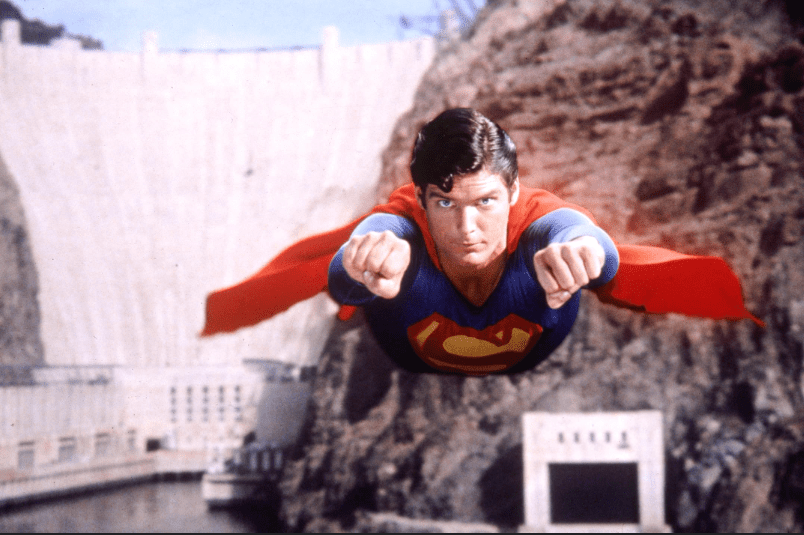
Superman was made in the old Hollywood tradition, playing much like the rousing screen epics that preceded it. Clark Kent’s path to becoming Superman occupies much of the film’s first hour and when he finally does we understand his character completely. Christopher Reeve’s Superman is more than a costume fighting bad guys. He is a personality we get to know and root for. Superman is the classic story of a man born to become something greater. As his adopted father Johnathan Kent (Glenn Ford) puts it, he was put on this Earth for a reason. Clark Kent follows in the tradition of screen epics like Ben-Hur or Gone with the Wind where the situation and conflict serve the characters rather than the other way around. The movie is not a spectacle of human action figures playing out a scenario, but the story of a man growing into his potential.

The film opens on the planet Krypton, a place millions of light years from Earth where crystalline architecture is all the rave and the people wear glowing costumes that anticipate the special effects of Tron. The planet is about to be fatally engulfed in a solar flare, and Superman’s father, Jor-El (Marlon Brando), tries to warn Krypton’s elder council that they need to evacuate. They don’t believe him, so he builds a small spacecraft in secret to send his infant son to Earth where he will be safe.
When he gets there he is found by a childless couple in Kansas, the Kents, who adopt him. It is Johnathan Kent’s values that make Clark Kent the man he becomes. During those years as a teenager on the Kent family farm, Clark learns that his powers are a gift to help others weaker than himself and that selflessness and restraint are the highest obligation of the strong.
Clark Kent’s rearing in Smallville, Kansas make for the strongest scenes in the movie. Everything that Superman believes in and is sent to protect are established there in rural Americana – a setting of open wheat fields and country roads, gorgeously shot in wide-angles.
After Pa Kent dies of a heart attack, Clark learns more about his history and where he comes from. He decides to move to the big city of Metropolis and gets a job as a writer for the Daily Planet. It is here that his persona as Clark Kent fully takes off. Christopher Reeve is a great Superman, but he is an even better Clark Kent. He presents himself as bumbling and clumsy as well as a trifle naive. Clark Kent largely represents the people that Superman is there to protect. Like them, Clark is played as easily taken advantage of, but has something in him that kinder souls want to shelter and keep out of trouble. In a way, the alter ego of Clark Kent is closer to who Superman truly is. He abhors violence and has a love of justice and peace. He is the sort of man who just wants everyone to get along. By contrast Bruce Wayne is more of a mask that hides his true identity as Batman. In Superman the reverse is true, with Clark Kent being the true core of his being, while Superman is his mask.

At the Daily Planet he meets a reporter named Lois Lane (Margot Kidder) who finds Clark affable enough, but cannot abide his apparent lack of spine. When they are mugged in an alleyway, Clark insists in non-resistance, but Lois scoffs and tries to struggle with their assailant. The mugger’s gun goes off which Clark surreptitiously catches with his hand, but then pretends to faint. Lois not seeing the trick and assuming the mugger only missed, is disgusted.
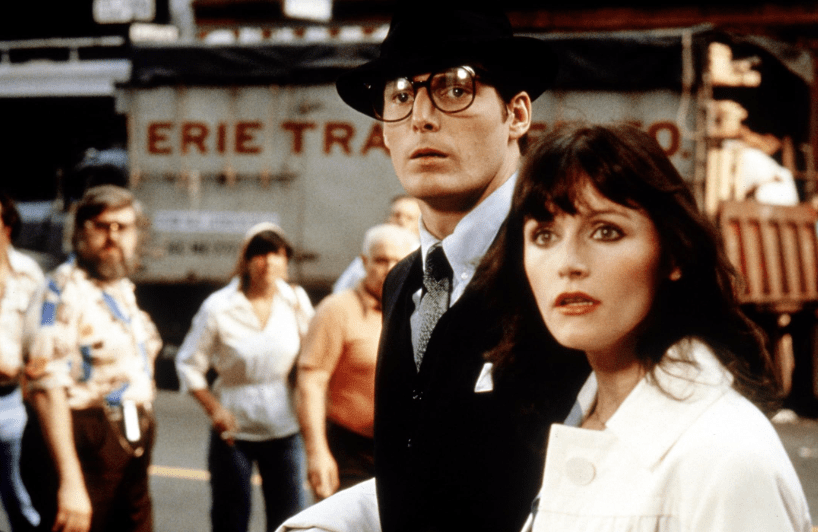
Clark is infatuated with Lois, but she has her eyes on Superman after he rescues her from a near accident in a helicopter. On top of this Superman has already begun to make a reputation for himself stopping heists, apprehending criminals, and rescuing cats stuck in trees. She gets an opportunity to interview Superman for the paper and their sexual chemistry is clear from the start. The interaction is flirtatious and Lois finds herself stumbling into innuendos when she tries to speak. She and everyone else doesn’t see what the audience sees, which is that Superman is just Clark Kent with his glasses off. It’s the sort of logical discrepancy that I would call an elephant in the room if it wasn’t for all of the jokes that have been made of it over the years. It’s more of a dead horse than an elephant really.

But, no good superhero movie is lacking in a good villain. In Lex Luthor (Gene Hackman) we get a character who is everything that Superman is not. Luthor is greedy, selfish, indifferent to the suffering of others, and always ready with an insult. His first bit of dialogue is “It’s a wonder that brain can generate enough power to keep those legs moving,” referring to his henchman, Otis (Ned Beatty). Otis follows the old tradition of super-villain henchman. He’s comically dimwitted and so incompetent that Luthor’s continual employment of him raises a lot of questions. I wouldn’t trust this guy to lay down and sleep without screwing it up somehow. Perhaps Otis is a relative or something.
Hackman’s performance as Luthor makes for the greatest super-hero villain of all time. His narcissism and constant sarcasm make him infinitely quotable. Luthor lives in awe of himself while holding everyone else around him in disdain. He is the sort of man who has no idols and heroes more impressive to him than himself. His personality is more of perpetual bemusement than anything threatening. He doesn’t wax philosophical or justify his wickedness with dark monologues. Nor is he governed by hate or revenge. He is more like Jabba the Hutt or Ooogie-Boogie. He is aware of what he is and he doesn’t care.
Lex Luthor has a wild scheme to use navy missiles to target the San Andreas fault line. By destroying much of the West coast he hopes to corner the real estate market in what remains. The only thing standing in his way is Superman who is naturally outraged by the sheer loss of life Luthor’s plan entails. Superman asks, “Is that how you get your kicks? Planning for the death of millions of people?” Luthor responds, “No. Causing the deaths of millions of people.” What a guy!

The climax is satisfying and exciting with an ending that sets the stage for more adventures to come fighting Luthor and worse. Superman’s father, Jor-El, left him with instructions to not interfere with human history. During the final act Superman is faced with the consequences of this command and the decision he makes at the end is decidedly un-Kryptonian, but it is certainly a human one.

Superman is the best of the superhero movies and it is the best-looking. It was the most expensive movie made up to that point, and it was done when CGI was in its infancy. Instead of relying on its special effects (still impressive for the time) it is shot in the classic Hollywood tradition of wide-angle lenses and beautiful natural cinematography sadly missed in blockbuster movies of today. It’s paced like a real movie, focusing on the growth of its main character and performed with convincing dramatic effect.
Superhero movies nowadays are often made with their scripts being the last thing on the filmmakers’ minds. They go into production with little more than a planned set of story beats that get hammered out in the course of their making. When a film of this genre starts life with a tight script, it results in something special. Something not typically seen in superhero movies. It results in an actual movie.

Director: Richard Donner
Writers: Jerry Siegel, Joe Shuster, Mario Puzo, David Newman, Leslie Newman, Robert Benton, Tom Mankiewicz
Cast: Marlon Brando (Jor-El), Gene Hackman (Lex Luthor), Christopher Reeve (Clark Kent/Superman), Ned Beatty (Otis), Jackie Cooper (Perry White), Glenn Ford (Pa Kent), Margot Kidder (Lois Lane), Valerie Perrine (Eve Teschmacher) Phyllis Thaxter (Ma Kent), Susannah York (Lara), Jeff East (Young Clark Kent), Marc McClure (Jimmy Olsen)
Producers: Charles Greenlaw, Ilya Salkind, Pierre Spengler, Richard Lester, Alexander Salkind
Composer: John Williams
Cinematographer: Geoffrey Unsworth
Editors: Stuart Baird, Michael Ellis