Dr. Jekyll and Mr. Hyde (1920)

9432_5.jpg

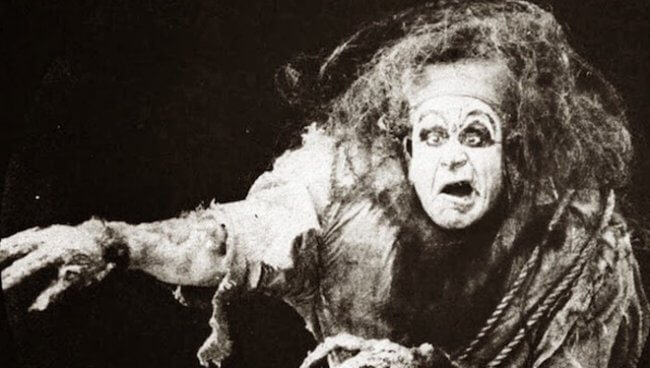
The 1920 adaptation of Robert Louis Stevenson’s Dr. Jekyll and Mr. Hyde is a marvel not from just a narrative standpoint, but also from a technical one. The cinematography and set design is so well crafted and adeptly achieved that one could be forgiven for believing the film to be of a later date than it is.
The film was clearly made with a budget appropriate for its ambitions and we are treated to some very lavish sets. Most notable are scenes in a dining hall where Dr. Jekyll’s love interest waits for him and a scene inside his personal library/parlor. When most silent films have the look and feel of a stage play it is impressive to see a level of detail in set decoration such as seen in these scenes. Today’s standards may see little to make note of, but for a 1920 film crafted in a time when most films were shot on locations very obviously manufactured to even the most untrained eye Dr. Jekyll and Mr. Hyde does better than most in showing the viewer more realistic and lively places.

From a narrative point this movie tells its story with a fast, entertaining pace without a great deal of lingering shots on character expressions and locations which was common practice of silent films of its day. Unlike most of the silent filmmaking of the era the filmmakers knew and understand fully what could be done with the art and they knew that this was a movie and not a stage production. Intercutting with multiple shots depicting action, constant shifts between characters in shots, and quick pacing in storytelling; all of which we take for granted in our movies today are impressively produced in this movie that will in only a few years from this writing turn a century old.

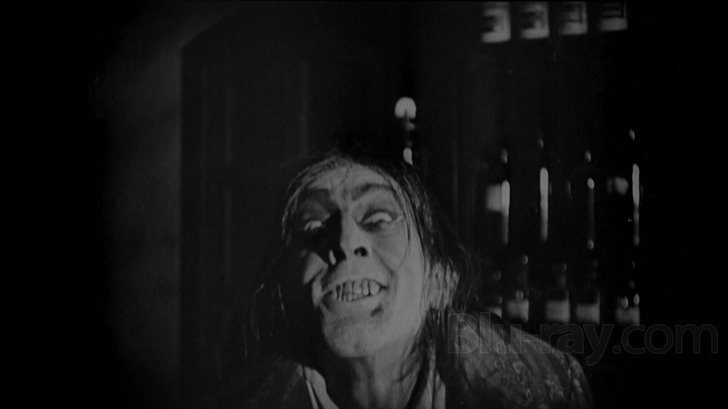
If there is anything more remarkable than the films technical achievements it would be John Barrymore’s performance as the titular Dr. Jekyll and Mr. Hyde. Unbelievably, the transition from Jekyll to Hyde was not achieved through copious amounts of makeup and special effects as was common to most adaptations of this classic story. Instead, Barrymore shows his talents for expression by twisting his own face into the leering, lascivious Mr. Hyde. Like voice work, facial expressions require a great deal of talent that not all actors possess and Barrymore outshines many performers who played this role like Fredric March or Spencer Tracy by this unique talent alone.

Overall Dr. Jekyll and Mr. Hyde (1920) may not fully showcase all of the technical structure and innovations of later film adaptations of the original novella, but it is remarkable in how much it achieves given the limitations of movie-making of its day.

It’s entertaining, does not bore, and is oddly charming in its old school portrayal of a penny dreadful horror story and its alluring sensuality with its dance hall scenes that only pre-code films of the 1920’s could deliver.  For film history buffs and horror geeks both this movie is very much worth a look. You aren’t likely to be disappointed.

3 1/2 Stars
The Cabinet of Dr. Caligari (1920)

caligari11-768x431

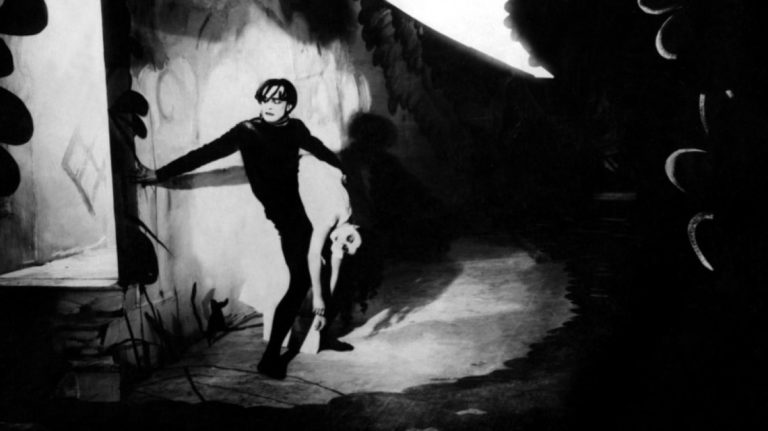
Robert Wiene’s The Cabinet of Dr. Caligari plays out like an eerie nightmare. The macabre imagery from the German Expressionistic set design to the surreal cinematography brings together what is widely considered to be the first true horror film.

Dr. Caligari (Verner Krauss) and the somnambulist, Cesare (Conrad Veidt) both give haunting performances where they seem to cast a shadow over the lives of the protagonist, Francis (Friedrich Feher) and his allies. Dr. Caligari is a spirit of meanness, exerting control and dominance over anything and anyone he can. He moves with a lurching animalistic gait as he gloats and glares at the environment around him. Cesare more haunts his world than he lives in it. He walks in a slow fluid manner as he does the murderous bidding of his master.
All of this plays out in a dreamlike state where reality becomes increasingly unclear and the truth behind the perspectives of the characters becomes uncertain. The Expressionistic art design of the movie, with its crooked almost Dr. Seussian architectures, furthers the impression of everything being a subjective dream.

While the nightmare plays out, a persistent theme of authoritarianism and the evil of dominating others is personified in the character of Dr. Caligari. He uses Cesare to do his bidding even when his will is pure evil. We find later that Cesare was a patient of Caligari’s at an asylum which makes the theme of freedom being suppressed by a tyrant even more palpable as we see Cesare as a victim at the mercy of Caligari who was put over him by the state.

The writers of The Cabinet of Dr. Caligari, Hans Janowitz and Carl Mayer both served in the German military during World War I and grew distrustful of authority and dictatorships after their experiences in the war. Caligari, a man granted power by the state and uses it to dominate and harm others, was representative of the authoritarianism they despised so much.
It was not lost on many retrospective critics and film historians that this film preceded the rise of Hitler and Nazi Germany. To many it would seem that The Cabinet of Dr. Caligari was a reaction and forewarning regarding the spirit of the German people following World War I which later led their nation down the path it did prior to the second World War.
For these reasons Janowitz and Mayer both objected to the Expressionist design and the twist ending forced upon them where we find Francis to be only a madman who fabricated the evil activities of Caligari who was, in reality, just an asylum director. They felt that this invalidated their themes of anti-authority as it made the crimes of Caligari a fantasy to be disregarded. Furthermore the rendering of the hero into a madman in an asylum who needed to be locked up, in fact, seems to encourage an authoritarian viewpoint rather than condemn it. While I am not inclined to disagree with this criticism of the film’s ending I hesitate to condemn the expressionist design as it is the finest and most exemplary use of Expressionism in cinema. While, for some, it may mitigate the essential themes of the film’s story I do not think the harm is so severe as to mitigate the value of the film’s visual artistry. In other words, The Cabinet of Dr. Caligari may be thematically imperfect, but it is one of the most remarkable and influential visual masterpieces ever produced in the history of horror filmmaking.

Extremely divisive when it was first released in 1920, the movie today is one of the most important works of cinema history and remains to this day one of the most influential works of art for filmmakers and film students. Wherever one may stand on the film’s themes and its controversial ending it is an essential work that needs to be seen.

3 1/2 Stars

Frankenstein (1910)

Frankenstein-650x368

The 1910 adaptation of Mary Shelley’s Frankenstein is best approached with an appreciation of its historical context. It is a product of its time and consequentially suffers from the limitations and trends of its era. Little more than an intriguing curiosity now for film historians and horror buffs Edison’s take on Frankenstein aims high, but ultimately fails to achieve its aims.

Before D. W. Griffith came along only a few years later with A Birth of a Nation and forever codified the fundamental language and structure of filmmaking, movies were made in a manner not unlike that of the performances of plays. Shots would linger on sets with little to no inter-cutting, closeups, or any special editing tricks to speak of. And given the lack of sound the means for conveying narrative was limited to the often exaggerated miming of the actors and the use of title cards.
Movies of the time were little more than short sideshow attractions like The Kiss (1896) or films with limited and simple narratives like The Great Train Robbery (1903) and Georges Méliès’ A Trip to the Moon (1902). While The Great Train Robbery and A Trip to the Moon were entertaining rides into escapism the Edison Frankenstein instead tries too hard to create a thought-provoking experience that completely fails due to the then limitations of the craft.
The director had insisted that the gruesomeness of the original novel be omitted from his adaptation and he opted instead to recreate the more mystical elements of the book. However, the attempts at emotional and intellectual depth by director J. Searle Dawley were lacking in subtlety and his attempt at “elimination what would be repulsive to a moving picture audience” (his words not mine) seems to be a vain endeavor as his film is little more than a grotesque geek show to shock audiences of 1910. There is a particularly hamfisted moment in which we see Doctor Frankenstein peer into his looking-glass only to see the monster he created looking back at him rather than his own visage. While I could appreciate the notion that Doctor Frankenstein was a monster deep inside, this sort of symbolic imagery doesn’t convey itself very successfully when the film in question is less than 20 minutes long and none of the characters are given time for development. And that is where The Great Train Robbery and Méliès’ work outshine this movie. Those were competently made films that were designed with the fullest awareness of what sort of limitations the filmmakers had in crafting their stories. Dawley and Edison on the other hand try too hard to do something that their craft could not do at the time.
Frankenstein (1910) aims high with its pretentious and pedantic overtones but misses the mark and lands instead somewhere in the genre of grotesque horror and freak show. Which, admittedly in those areas this movie excels. One of the more striking visual moments in the film is when Frankenstein’s monster is first created. In the giant vat in which the monster is being born we see slowly flesh grow on a skeleton and take shape eventually culminating into the hulking brute portrayed by Charles Stanton Ogle who sadly received no screen credit as such things were not standard practice at the time. Frankenstein’s monster here has not the traditional Karloff look created by Jack Pierce in 1931. You won’t see any bolts on this monster’s neck and nor will you see a flat top to its head. Ogle’s Frankenstein’s monster is a large hunchbacked asymmetrical monstrosity that terrifies and appalls his own creator the minute he comes to life.
While this is no where near as iconic as the Boris Karloff version it certainly shows the creativity and imagination on hand with the early pioneers of filmmaking just after the turn of the century.

While this movie may be imperfect due to its poorly crafted narrative it is certainly an important piece of history and is surely required viewing for any film student or horror buff looking to see the history of the genre. Other films may have done better before and after it, but its place in history outside of its own merits keeps it immortal.

1 1/2 Stars