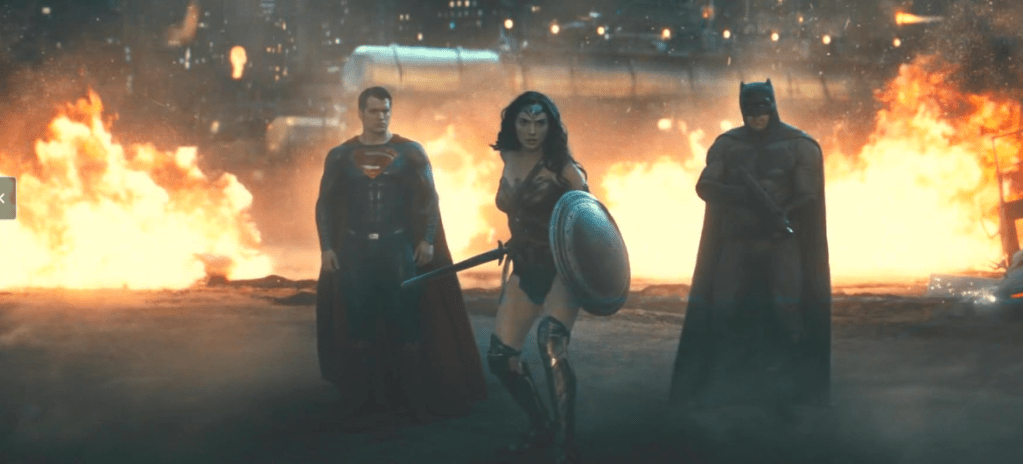
Batman v Superman: Dawn of Justice (2016)

3/4 stars

note: This is a review of the Ultimate Edition, an expanded edition of the film not initially shown in theaters

When I first saw Batman v Superman ten years ago I hated it. A lot of people did. Many still do. But, having seen it for a second time a decade later I find myself in the awkward position of being one of its defenders. Bear in mind, the Ultimate Edition is the only cut of the film I have seen, so I can honestly inform the reader that the extra thirty minutes are not what made the difference to me.
No, what I think happened this second time around was a mixture of acceptance and comprehension of what the filmmakers were trying to do. Being dark is not necessarily an issue for me. What made Man of Steel a bad movie was that its darkness extended to its main character as well as the plot. Putting Superman in a dark story is fine. Wholesome, good people live in a dark world and how they adapt to it and learn to live in it is ripe for good storytelling. But, in Man of Steel Superman comes right off the bat as someone angsty and angry which suited him not a bit. The kinder more winsome Superman of old would have made that film more palatable since light versus dark is what he is all about.

Superman (Henry Cavill) is not much better in this movie either, but, perhaps I have got used to him. He is not as unsure of himself as he was in Man of Steel for one thing. And, also, Batman v Superman is not all about him. It’s not really about Batman (Ben Affleck) that much either. The angsty Superman is here to stay and the movie accepts this and moves on without dwelling on his character as much.
For me, BvS’s saving grace is that the dark tone is not just a gimmick like it was in Man of Steel. This movie has something to say for once. What made many people angry, I suspect, is that they purchased their tickets and expected to see a superhero movie. Can’t really blame them there. But, Batman v Superman: Dawn of Justice – an admittedly awful title – is not a superhero movie. It’s an epic social thriller that takes the subject of Superheroes (or meta-humans as the film calls them) seriously. It’s a commentary on what the ramifications of beings like this would have in a world that is post-9/11. In many ways I view the movie as a companion piece to Zack Snyder’s Watchmen.
Much of the film’s scenes are set in newsrooms, congressional hearings, and foreign lands falling apart under unstable regimes. The frequent cameos of real life figures like Charlie Rose, Nancy Grace, and Neil DeGrasse Tyson commenting on the existence of superheroes is just another way the film tries to posit how a world inhabited by meta-humans would react to them.

The film is set two years after General Zod wrecked devastation on Metropolis and now the world is questioning whether it needs another all-powerful Kryptonian living amongst them. Superman is a good man who is on the side of humanity, but that fact is not unquestionable to the many people who were maimed and lost their loved ones in the fallout. It was Snyder’s conscious decision to spend more time on this subject than on the pure unadulterated superhero flare we have come to expect in these sort of movies. Just before I rewatched it I read this comment from director Zack Snyder that he made about the movie in 2023: “I think that probably is what caused the movie to be so polarizing. I think a lot of people went into the movies for going like, “Oh, it’s the superhero romp, right? Let’s have fun with it.” And we gave them this sort of hardcore deconstructivist, heavily layered, experiential modern mythological superhero movie that … you really need to pay attention to. That was not cool. That’s not something anyone wanted to do.”
At first when I read that comment I got annoyed. I thought it patronizing and a failure to take ownership of the issues that people actually had with the movie. Watching it again, though, I hearken back to that comment and understand somewhat of what he was trying to say. I believe he was mostly right, but a few people did have other reasons for not liking it. The characterizations of Superman, Batman, and Lex Luthor (Jesse Eisenberg) are hardly traditional. The film still languishes under its fast-edited action sequences and unconvincing special effects. And a lot of people bristled at the reason for Batman sparing Superman’s life being that their mothers’ names were both Martha. The latter issue was meme’d and mocked to death back in 2016 and a lot of people still complain about it today. I am not as angry about it as they are. The scene intended to give Batman an understanding of Superman’s humanity that he had not seen before. He had a mother. The scene only failed because of a lack of subtlety and Batman’s animosity died down too quickly to be believable. I thought Batman’s issues with Superman were not wholly addressed here. Having a mom named Martha should not have been enough to convince him that Superman was not a threat and the movie should have resolved this concern a bit more. I also believe the addition of visual flashbacks to Bruce Wayne’s parents being shot was too on the nose and the scene would have been better received without them. But, the fact that Supes also had a mom named Martha being a turning point in Batman’s relationship with Superman didn’t bother me. It’s not as stupid as people say it is. It just needed some adjustments to its execution. But, people like their bandwagons, you know.

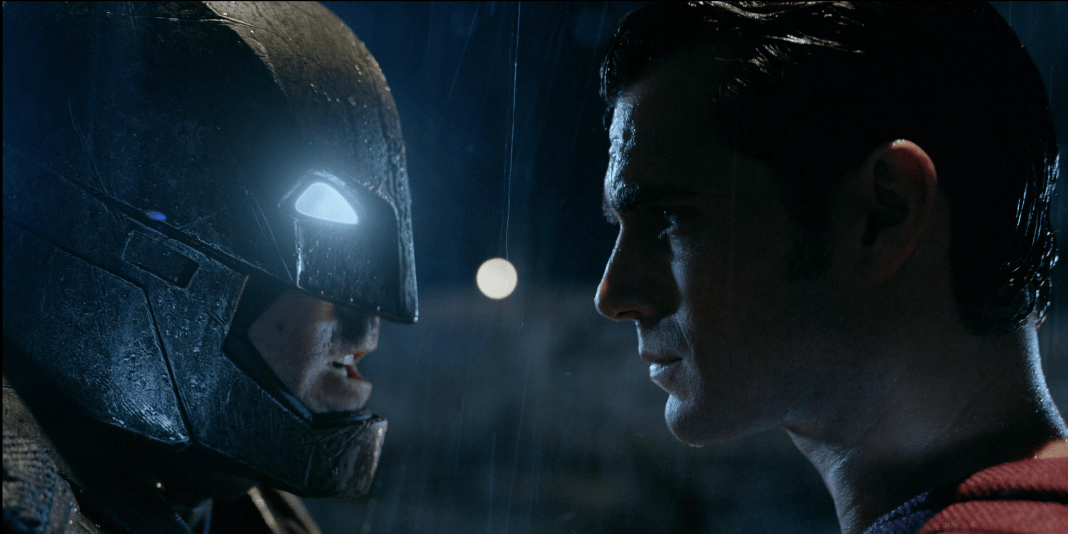
Batman is a big point of contention, and I do understand why. He is a bit hard to swallow. He is much more brutal and violent than any previous incarnation of the character we had seen on screen before. He also shows a shocking indifference to human life. Much of his actions are reckless and indirectly cause the deaths of the men he is fighting. The reason I still am able to accept him, however, is that the reinterpretation of the character is not so jarring as it is with Superman. Clark Kent and his alter ego don’t align at all with what he is supposed to represent, whereas Batman has always been a more edgy character. Making Batman this grim was the only logical thing the filmmakers could do if he is to contrast with Superman as he is presented here. It helps that he is not the movie’s main character. Batman serves the majority of the plot as an antagonist who has become misguided by suspicion and paranoia. The movie focuses most on the loneliness and the near sociopathy of the character which, let’s face it, has been with Batman since the beginning. Batman has always been the sort of guy whose trauma and internal rage at injustice had driven him to becoming a violent vigilante who beats the wicked and corrupt to a bloody pulp. Must I also point out that he dresses up in a vampiric bat costume and has the power of fear and the cover of darkness as his primary weapons? I can forgive the movie for knowing what everyone else knows that such a man in real life would likely be mentally ill.

The actual fight between the two is instigated by Lex Luthor. Instead of the usual self-congratulating Bond villain played by Hackman and Spacey, Jesse Eisenberg plays him…well…as Jesse Eisenberg. Eisenberg is not a bad actor, but he is a one-trick pony. He only plays one guy in all of his films and that is Jesse Eisenberg. His Luthor is neurotic, talks fast, and eats up attention like a child eats up sugar. He clearly loves the sound of his own voice and becomes grandiose and prone to demagoguery. He thinks of Superman as a sort of god in the classical sense and wants him dead on that basis alone. Instead of cutting his teeth on Sesame Street and Dr. Seuss like most normal people, he lives by cherrypicking the philosophies of Nietzsche and Ayn Rand. I’ve known people like this and they aren’t much fun at parties.
By staging a number of terroristic plots that are deliberately centered around Superman’s presence he turns him into a controversial figure. A vocal minority of the citizenry are now leery of Superman and Batman is convinced that the world will not be safe and secure until he is dead.

Another newcomer to the franchise is Wonder Woman (Gal Gadot) who spends most of the movie in disguise as Diana Prince. Her purpose in the film is limited and she is there by and large as a justification for the “Dawn of Justice” part of the movie’s title. She is meant to foreshadow the eventual rise of the Justice League. The Flash, Cyborg, and Aquaman also make very brief appearances, but they don’t inundate the movie with too many characters as a lot of superhero movies do with their villains. Secret archived footage is shown of them on computer screens to give us our first look at them before they make it to the main event.
Gadot’s performance is a bit bland, but she is not given a whole lot to do in her defense. As Wonder Woman she doesn’t spring into action until the final climactic battle and when she does she contributes little. Action movie directors must find writing for women hard or something, because I complain about this often.

The final battle is where the movie tends to fall apart. It’s a CGI-laden mess. The three heroes get tossed about frequently, transitioning from CGI models to actors when they land. CGI is supposed to be like a magic trick and when done poorly the trick is revealed to the audience and takes them out of the illusion. Doomsday, a monster made of kryptonite designed by Luthor, looks like a cartoon. It stomps about, roaring its head off and fighting the heroes in front of bluescreen that is so obvious it’s more like watching a video game.
The modern filmmakers have seemed to forget that fight scenes need personality as well as action. There is a lot of emotion involved when fighting someone. There needs to be a personal connection that has to be shown during the fight and not just in the moments leading up to it. This is done through simple emoting, facial expressions, and signs of physical exhaustion as the conflict becomes prolonged. What this movie fails to do is show us any of that. It’s all fast blink-and-you’ll-miss-it kinetics, explosions, loud noises, and whole shots where not a single thing on screen is real. All of which is dimly lit for reasons I suspect have to do with disguising the fakeness of the special effects. It’s more exhausting than entertaining.

Batman v Superman: Dawn of Justice is at its strongest when it is not trying to fulfill its obligations as a superhero movie. The social commentary is brilliant and the pacing of its first act is near perfect. It suffers during its action scenes, but provides a much more profound experience when it is being serious. It’s not perfect, but I rather liked it.

Director: Zack Snyder
Writers: Chris Terrio, David S. Goyer
Producers: Charles Roven, Deborah Snyder, Wesley Coller, David S. Goyer, Geoff Johns, Benjamin Melniker, Steven Mnuchin, Christopher Nolan, Emma Thomas, Michael E. Uslan, Trevor Christie, Curt Kanemoto, Bruce Moriarty, Jim Rowe, Andrea Wertheim, Gregor Wilson
Cast: Ben Affleck (Bruce Wayne/Batman), Henry Cavill (Clark Kent/Superman), Amy Adams (Lois Lane), Jesse Eisenberg (Lex Luthor), Diane Lane (Martha Kent), Laurence Fishburne (Perry White), Jeremy Irons (Alfred), Holly Hunter (Senator Finch), Gal Gadot (Diana Prince/Wonder Woman), Scoot McNairy (Wallace Keefe), Callan Mulvey (Anatoli Knyasev), Tao Okamoto (Mercy Graves)
Composers: Junkie XL, Hans Zimmer
Cinematographer: Larry Fong
Editor: David Brenner
Batman Forever (1995)

2/4 stars

There are three kinds of Batman. Gothic Batman is the subject of the classic comic books and we see him stoically doing what he does best in the Tim Burton movies and the animated TV series from the 90s. The more introspective Edgelord Batman made popular in Christopher Nolan’s Dark Knight trilogy has been a favorite of comic writer Frank Miller, but largely exists elsewhere in memes. Campy Batman is best represented by Adam West back in the 1960s. Campy Batman’s Gotham City is a colorful world of colorful people where villains prance in clownish costumes and laugh maniacally. They are the sort of baddies who twirl their mustaches, tie damsels to railroad tracks, and scheme to poison the city’s water supply.
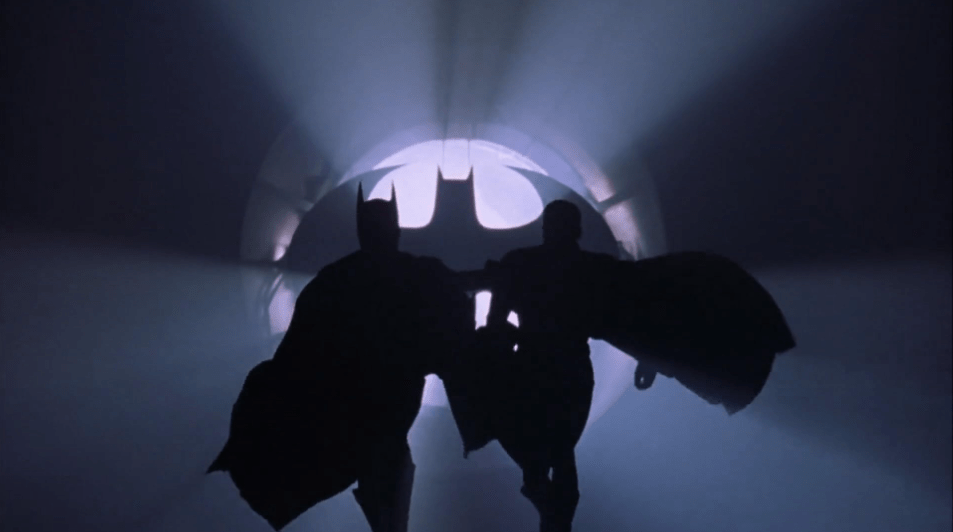
Director Joel Schumacher’s Batman Forever is a return to the old tradition of campy Batman, slanted camera angles and all. When Schumacher, taking over for Tim Burton, approached the material he aimed to make a live-action cartoon. For better or worse, he succeeded. As stupid and ridiculous as the movie is, it is everything it intended to be; its flaws by design and really a matter of taste.

A common complaint leveled at it is that it is too campy and too cartoonish. I hold to the opposite view. I believe it isn’t campy and cartoonish enough, and therein lies Batman Forever’s downfall. The heroes, given what they are up against, are too sullen for their own good. Val Kilmer, replacing Michael Keaton, in the role of Bruce Wayne commands no presence, adding nothing interesting to the part. As Batman he is stale, watering the character down to a fighting costume.
Robin, the Boy Wonder is brought in this time around, and if the fans had been waiting patiently through two movies for Batman’s trusted sidekick to finally appear they must have been sadly disappointed. Chris O’Donnell as Dick Grayson (Robin’s alter ego) has none of Burt Ward’s original energy and passion. O’Donnell plays the role as standoffish and angry. His character development is nothing more than a skin-deep paint-by-numbers expression of the old saw “revenge won’t make the pain go away” and “taking a life leads to a dark path.” There is nothing wrong with such messages of course, but no sincere effort is made to convince the audience of their truthfulness. It’s merely said and Robin comes to these conclusions only when the script finally says so.
Batman and Robin generate no charisma whatsoever, all of their energy being sucked into the two lead villains.

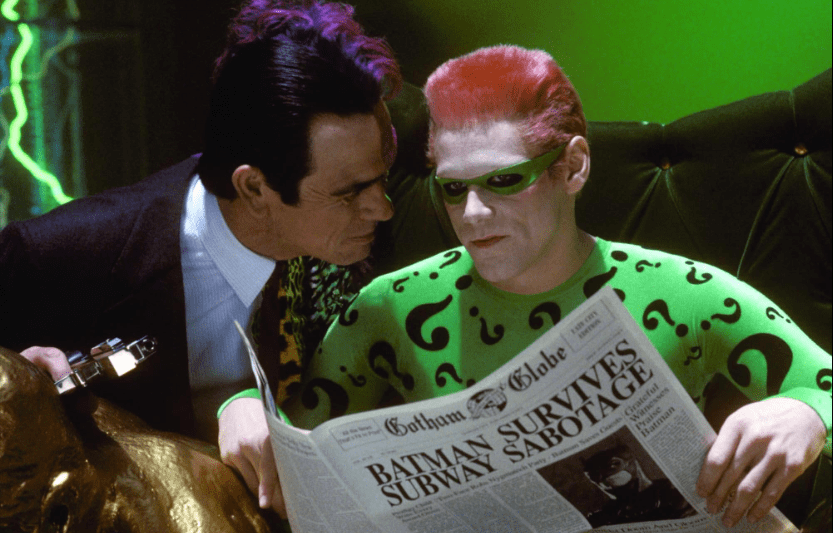
The movie opens with the dastardly Two-Face (Tommy Lee Jones) robbing a bank to lure Batman into a trap. He giggles and jumps up and down like a clown, firing machine guns at nothing in particular as police helicopters swarm above. The burnt side of his face is improbably symmetrical in relation to the other side: a purple bit of prosthetic rubber that appears more like a cartoon’s idea of a deformity than anything seen on a real burn victim. His suit is split in a similar fashion; formal and proper on one side and gaudy and colorful on the other. When we see his evil lair later in the film the interior decoration keeps to this pattern. One side looks like the very throne room of hell and the other is pure white and fit for a fairy tea party. His two sexy girlfriends, Sugar and Spice (Drew Barrymore and Debi Mazar) are bedecked to match.
When Batman arrives at the bank robbery, he is joined by Commissioner Gordon (Pat Hingle) and Dr. Chase Meridian (Nicole Kidman). Meridian is a professional parapsychologist who specializes in super-criminals and caped crusaders alike. She doesn’t look much like a psychologist. She stands next to Batman looking like a blonde bombshell, speaking in silky tones and saying nothing more insightful than what can be gleaned from a copy of Psychology Today. She is about as convincing a psychologist as Denise Richards was as a physicist in The World Is Not Enough. Kidman plays the role like a Bond girl. She feigns a professional interest in Batman that masks something more fetishistic.
We later see a love triangle develop between her, Batman, and his secret identity Bruce Wayne. The movie posits a theme where Dr. Meridian’s infatuation with Batman is something girlish and rebellious; her eventual favoring of Wayne being a moment of maturity. She directs her husky-toned flirtations toward both equally, however, and the point is not hammered home that deeply.

After Two-Face escapes he joins forces with The Riddler (Jim Carrey) whose wild performance is the front and center of the whole show. Carrey plays Riddler with no restraint at all. His acting reaches over the top and then goes only higher. He moves like he is cursed to dance forever and he never stops talking. The performance is loud and obnoxious; Carrey mugs the camera, making bizarre faces and dropping pop culture references and bizarre jokes whenever he is on screen, which ends up being a great deal. Jim Carrey has this way of punctuating his words with sharp turns of his head. He does it so much you could make a drinking game out of it. After Batman Forever I’d be fairly plastered. Try doing it while watching The Mask and you would need a new liver.
When we first meet him he is an excitable and neurotic employee of Wayne Enterprises named Edward Nygma who idolizes Bruce Wayne and wants to impress him with a new mind-control device he invented. Wayne’s predictable rejection crushes the already unhinged Nygma’s spirit and he becomes enraged and bitter. It’s probably the lamest super-villain origin story to date, but it fits the material Schumacher presents.
As Riddler he uses his mind control device to read the minds of everyone in Gotham so he can steal their credit card numbers and financial records. It’s a shockingly short-sighted plot. One man having access to everyone’s money would only crash the economy and more than likely the existence of his machine would force the world to adapt its methods of bookkeeping to counter-act it. But maybe I am overthinking the logistics of a villain scheme obviously reminiscent of a Saturday morning cartoon.

When the movie sticks to Joel Schumacher’s vision it works remarkably well even if Carrey could afford to tone it down a little. Gotham looks better than ever keeping the same Gothic Dr. Seussian aesthetic from before, but more lively and animated. The camera rides through the city like a roller-coaster, allowing the viewer to soak in the details. It reminds me of a professional haunted house made with money as no object.
Tommy Lee Jones and Jim Carrey’s antics are constantly energetic and off the wall. Reminding myself that this is supposed to be a live-action cartoon I can accept them, if not love them overmuch.
Where it fails is with its hero characters. Pat Hingle phones in his performance as Gordon, seeming to be painfully aware of what had become of the series. Kilmer is dry as a bone and O’Donnell is over-serious and undercooked as a character. Nicole Kidman brings to the movie the sort of character we should have had in Catwoman back in Batman Returns. Bond girls and Batman vixens alike are supposed to be somewhat innocent and prepubescent in their sensuality. They entice the man hidden behind the mask, but the boy that the mask represents ultimately wins out and keeps them untouchable. Kidman brings this to Chase Meridian well enough, but still never quite reaches the comic tone that the movie needs more of.

In Batman Forever Schumacher tries too hard to meld the 1960s era camp with the more mature themes of the Burton movies, and the result is an inconsistent mess. In the end I appreciated what the director has tried to do more than what he has done.

Director: Joel Schumacher
Writers: Bob Kane, Lee Batchler, Janet Scott Batchler, Akiva Goldsman
Cast: Val Kilmer (Bruce Wayne/Batman), Tommy Lee Jones (Two-Face/Harvey Dent), Jim Carret (Edward Nygma/Riddler), Nicole Kidman (Dr. Chase Meridian), Chris O’Donnell (Dick Grayson/Robin), Michael Gough (Alfred Pennyworth), Pat Hingle (Commissioner Gordon), Drew Barrymore (Sugar) Debi Mazar (Spice)
Producers: Tim Burton, Mitchell E. Dauterive, Peter Macgregor-Scott, Benjamin Melniker, Kevin J. Messick, Michael E. Uslan
Composer: Elliot Goldenthal
Cinematographer: Stephen Goldblatt
Editors: Mark Stevens, Dennis Virkler

Batman (1989)

3/4 stars

Tim Burton’s Batman opens and it’s night in Gotham City. A family of three are mugged by two strung-out thugs and they sit on a rooftop counting their stolen money. But this is Gotham City and Gotham City has a protector who rules the night. Looming above them in silhouette like a ghoulish reincarnation of Dracula is a figure in the form of a bat. It swoops down upon the two terrified goons and beats them within an inch of their lives. One of them asks, “Who are you?” Gotham’s hero says, “I’m Batman”, and a legend is born.
All this happens in the first ten minutes. There are no forty-minute prologues of Bruce Wayne’s origins. There is little time given to studying his feelings and character. And there are no grounded explanations for where he gets his gear. When Batman uses a grappling hook to escape, the Joker says, “Where does he get those wonderful toys?” He gets no answer and we don’t need one.

This is the perfect Batman movie. It checks all the necessary boxes that define who Batman is, what his world is, and what a story featuring him should be about. The filmmakers understand that the audience knows who Batman is and that he needs no introduction. Batman doesn’t require an explanation. All he needs is to be properly represented.

Bruce Wayne (Michael Keaton) is already Batman when the film begins. We are not told for how long, but the sudden introduction of The Joker suggests it takes place during what the fans of the DC comics call Year One.
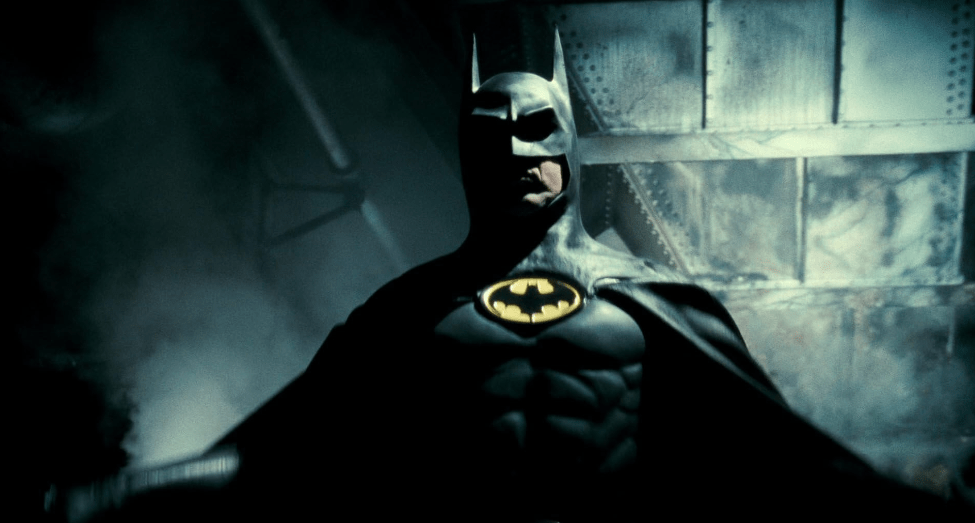
Keaton plays Bruce Wayne as good-natured and mannered, but a bit shy and antisocial. His loner tendencies reflect the consequence of being Batman at night. As Batman he recalls the Phantom of the Opera. He is reclusive and silent, staying in the shadows lest someone sees too much of him and discovers his secret identity.
Michael Keaton is my favorite of all the Batmans (Batmen?) who have attempted the role. He doesn’t stifle the performance with melodrama, but lets the physicality and look of the character dominate the screen. Batman is an icon and a symbol; and Keaton allows the iconography to define what we see. He is a costume and a chin. And that is Batman as we like him.
The costume is fairly traditional. It’s neither the explicable body armor worn by Christian Bale or the gaudy grey cloth of Adam West. The black bulletproof rubber worn by Keaton fits the gothic tone of the character while retaining our quintessential expectations of a Batman costume. The Bat logo stands out in yellow on the chest. The costume is fundamental and perfect.
The Batmobile is even better. It appropriates the mood and style of Batman better than any other Batmobile, in my opinion. It’s long, dark, angular, and the sort of car Count Dracula would have driven had motor vehicles existed in his day. Toy Biz must have made a killing on the market with this thing. It’s one of the coolest fictional movie cars since James Bond’s Aston Martin.
Tim Burton’s Batman also has the best rendition of Gotham City of all time. The gothic architecture brings to mind the German Expressionist images seen in Fritz Lang’s Metropolis, but augmented in technicolor with dark matte paintings and its smoky and steaming set design.
Further setting the mood is Danny Elfman’s iconic score which to this day contains the definitive Batman theme for a lot of fans, myself included. Unlike the more optimistic and rousing Superman theme by John Williams, Elfman’s Batman theme puts itself in the midst of the action, punctuating Batman’s fighting spirit with just a dash of mischievous fun. Like the Williams score it creates its own genre of superhero themes. Sadly it’s becoming a lost art. Does anyone remember the music in the Marvel movies recently? Because I don’t.

But all of these elements add up to beans without a story. The film’s plot manages in its 2 hour runtime to give Batman, Bruce Wayne, and the Joker enough to do in perfect balance. Bruce Wayne juggles his obligations as Batman with his budding infatuation with journalist Vicky Vale (Kim Basinger) while the Joker (Jack Nicholson) has his own eyes on her while he plots to overthrow and take over the criminal underworld.
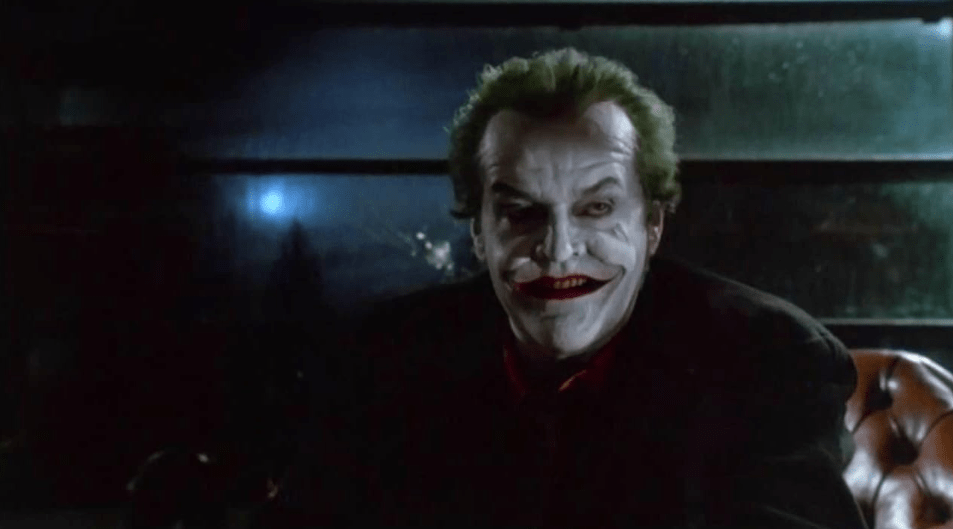
Nicholson portrays the Joker part with surprising restraint given the madcap lunacy of the character and his plans. He laughs, jokes, and plots morbid absurdities as any good Joker would, but never seems out of control. His madness is more of an attitude he brings to his offbeat behavior. Nicholson plays Joker like his descent into madness wasn’t out of tragedy or untreated mental illness. He chooses madness because he simply got annoyed with sanity and enough was enough. His most wildest actions still manage to reflect this attitude. He punches out a TV with a mechanical glove and murders his own henchmen where other men would just roll their eyes.

Controversially, Nicholson’s Joker, is given a backstory whereas the Joker is traditionally portrayed as anonymous and of ambiguous origins. Here he is introduced as Jack Napier, a right hand man to a mob boss (Jack Palance). After Palance discovers that Jack is sleeping with one of his molls he sets Jack up to be killed in a sting operation. But, when Batman makes an appearance, Jack fights him only to fall into a vat of acid. He survives, but is disfigured with chalk-white skin, green hair, and a permanent grin fixed on his face.
The decision to give Joker an identity and origin is still controversial among fans of the comics, but I have grown to accept the change. Nicholson is by far the most charismatic figure in the movie and the motivations his backstory gives him serve the plot perfectly fine. The Batman mythos is interpretive in adaptation, and the changes made to the established lore here doesn’t denigrate the film in the slightest. A Joker with an origin story is, after all, still more tolerable than a moody and angry Superman that the fans of Man of Steel didn’t seem to mind.
Joker gets revenge by killing his former boss and goes on to bend the remaining mob bosses under his rule, removing (quite dramatically) anyone who opposes him. He plots to poison the citizens of Gotham with infected hair care products, before moving onto bigger game with a parade show with floating balloons full of fatal laughing gas that he wants to unleash upon the city.
In the meantime, Batman broods and investigates Jack’s latest schemes, and his alter ego Bruce Wayne begins to suspect that there is an old personal connection between him and the Joker. Between them is Vicky Vale. Joker desires her, Bruce is falling in love with her, and it is Batman who must save her.

This is not a very thoughtful plot, naturally. But as a superhero movie, the story weaves all of the required elements that make the genre appealing. Christopher Nolan’s brilliant Dark Knight trilogy was made for a different sort of audience in mind. There the characters are ideologues for real-world issues that more sophisticated internet-bred audiences post-9/11 have found meaning and expression in. But, none of that is needed here. This movie was made for the boys and girls who love Batman and the Generation X adults who had grown up on him. During my childhood in the 90s, the grown-ups who were pop-culture conscious seemed to be preoccupied by two things: Star Wars and Batman. They coexisted on the same walls on posters, shared shelf space as action figures, filled boxes with comics, and every respectable nerd had both on VHS and their clothes. And in those happy days it was Burton’s image of Batman that dominated.

Director: Tim Burton
Writers: Bob Kane, Sam Hamm, Warren Skaaren
Cast: Michael Keaton (Bruce Wayne/Batman), Jack Nicholson (The Joker, Jack Napier), Kim Basinger (Vicki Vale), Robert Wuhl (Alexander Knox), Pat Hingle (Commissioner Gordon), Billy Dee Williams (Harvey Dent), Michael Gough (Alfred), Jack Palance (Grissom), Jerry Hall (Alicia), Tracey Walker (Bob the Goon), Lee Wallace (Mayor), William Hootkins (Eckhardt)
Producers: Peter Guber, Barbara Kalish, Chris Kenny, Benjamin Melniker, Jon Peters, Michael E. Uslan
Composer: Danny Elfman
Cinematographer: Roger Pratt
Editor: Ray Lovejoy