
3.5/4 stars
Joker is a movie that rarely shows a moment of compassion or kindness. And, yet, compassion is what the film is about. The absence of it creates a vacuum that emphasizes why kindness and warmth are so important. The pervasive images of cruelty and humiliation on display express the film’s ideals by negative example. The lasting impression when the movie is over is powerful.
When I first saw Todd Phillips’ Joker in theaters back in 2019 I had a strong negative reaction to it. I had felt at the time that the film was being disingenuous and that it was catering to the depressive instincts of angry young men. I’m sure you know the type. They quote Nietzsche, wear black, listen to Nine Inch Nails, and casually say life is terrible on principle. But, seven years later, viewing the film a second time, I think I understand the movie a little more. Like Spike Lee’s Do the Right Thing it shows a series of conditions that escalate to terrible acts of violence. It grates against black and white thinking that patently condemns these events without considering the importance of recognizing their causes.
Arthur Fleck (Joaquin Phoenix) is a severely mentally ill man who has unrealistic dreams of becoming a famous comedian. He lives a lonely existence where the only figure in his life sympathetic toward him is his ailing mother Penny (Frances Conroy), But, she is oblivious to the severity of his problems, suffering from debilitating mental issues and delusions herself. She frequently says he was always such a happy boy even though he is far from happy and likely never was. He is on seven different medications and tells his social worker “You just ask the same questions every week. How’s your job? Are you having any negative thoughts? All I have are negative thoughts.”
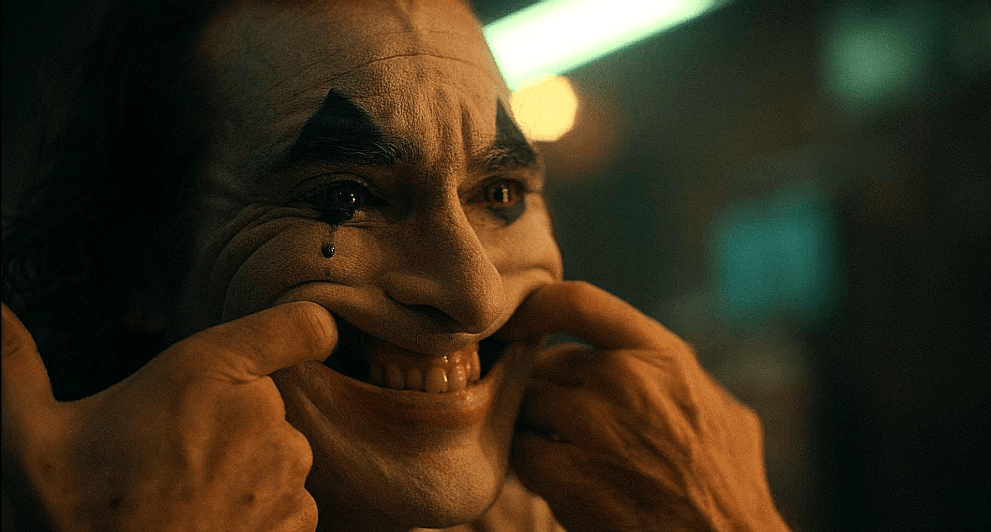
Depression is a real bitch and combining it in a cocktail of emotional immaturity, cognitive difficulties, and social isolation is a recipe for disaster. He and his mother live well below the fringes of poverty which forces him to eke out a living in his condition. His job outsources him as a party clown, but his social awkwardness and odd behavior elicits scorn from his boss and coworkers. A part of his condition is a nervous tick where he flies into fits of uncontrollable laughter regardless of what he is feeling at the time. Despite his attempts to explain the condition he only gets mocked and he is frequently asked what he finds so funny. He is unable to connect or bond with anyone. Arthur looks wishfully on as others socialize and engage with one another, but only becomes off putting when he tries to do the same. He comforts himself with childish fantasies of positive social interactions among people he likes and admires. But, in his real life the only time people give him a second look is usually to say something mean.
The isolation he endures is the key to his slow descent into madness. Mental illness and isolation go hand in hand and it gives the sufferer a unique perspective on people. For most of us we can generally separate the mean people from the kind ones; the good from the bad. But, for people with severe mental illness this is harder to do since neither the good people nor the bad people seem capable of treating them very well. The rotten eggs, of course, take every opportunity to heap cruelty and bullying on mentally ill victims. But, there is also a profound failing among more upright people that cuts even deeper. Sidelong glances of irritation, limited empathy, refusing to listen or understand, and social ostracizing are inflicted on the mentally ill by the upright and wicked alike. An impression is given to men like Arthur Fleck that there is a free pass for otherwise nice people to be dismissive and unkind to them because no one really likes them anyway. It’s a road to resentment and painful consequences that often could have been evaded by one encouraging word at the right time that never came.
I think it is these themes that created the polarizing reactions the film got when it came out. The films plays like a dirge for all the school shooters and impassioned murderers who have plagued our recent history. In the wake of a terrible crime it is easy to justify hatred for the perpetrator given the severity of what they had done. And offering them any sympathy or understanding is a big no-no. But, no one wants to acknowledge the onus that is on people who don’t do those things to prevent them. I do try to avoid commenting on specific current social and political issues on this blog so without naming any names I am going to say that I have heard interviews with school shooting survivors who practically boast of the bullying they inflicted on the shooter prior to the event and justify it by what the killer had done. It is hard to blame them after what they had been through, though. There is no denying that what was done is terrible and there is especially no denying that the actions were morally egregious and unjustifiable. But, there is something ugly about normalizing ostracizing the mentally ill on this basis. The disproportion of their crimes too often leaves us unable to recognize that something morally wrong was being done to them regularly before they snapped. And it is these points that made a lot of people angry when they saw the movie. The filmmakers had something to say that many of us don’t want to hear or deal with. There is a reason that the now infamous Aurora, Illinois theater refused to show the film at all after the murders that occurred there during a showing of The Dark Knight Rises in 2012.
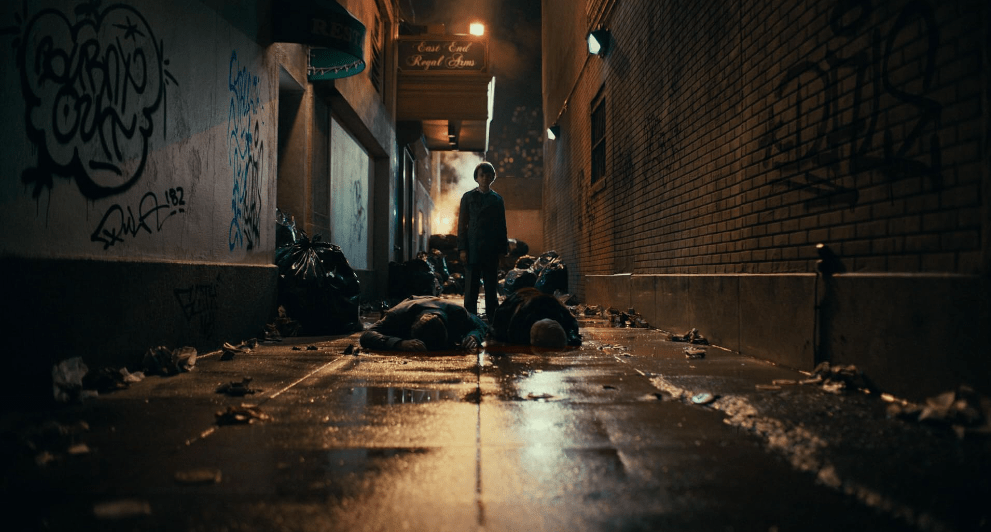
The film starts with Arthur working as a street clown twirling a sign to advertise a small business. A group of teenaged thugs steal the sign and beat him up when he tries to chase them down. What follows is one emotional betrayal after another. His boss is angry over the loss of the sign and doesn’t care that he was injured. The social worker he talks to spends their hour staring at him not listening to a word he says. She asks the minimal textbook questions she is required to ask and does little more. Any attempt he makes to express his emotional state usually ends up getting talked over by others who get angry and annoyed with him. They don’t hide their scorn and Arthur is not capable of understanding why he is being treated this way all the time. When pushed to frustration people scream at him for acting out. He writes in his diary, “The worst thing about mental illness is people expect you to behave as if you don’t.” In reality what they expect is for him to not defend himself. And he is swiftly villainised when he does. On a subway a group of three college aged youths begin to harass him and they physically abuse him when he tries to get away. He ends up murdering all three and flees the scene. Gotham City’s reaction is split. The privileged and powers that be condemn the shooting and characterize the dead students as innocent victims whose lives and potential were taken away by a maniac. Among the lower echelons there is a different sentiment. There is widespread sympathy given to Arthur, still currently unidentified as the killer, that galvanizes mass protests against the city government. The murders become a controversial talking point and the scenes eerily seem to anticipate the actions of Luigi Mangione a few years later.
Shortly after the killings Arthur goes to a local comedy club in the hopes of making it big with his act. His performance, however, is a colossal bomb. His laughing condition comes out in full force and he is unable to make any of the jokes land. The footage of his performance becomes viral after clips of it is shown on a talk show hosted by Murray Franklin (Robert DeNiro). Prior to this both Arthur and his mother were fans of Murray and Arthur fantasizes of impressing him someday. But seeing Murray Franklin publicly mock him and his comedy act on live television sends him spiraling deeper into depression and anger. Arthur’s issues escalate continually and he becomes a ticking timebomb. While he is subjected to abuse every day he is met with new tragedies that leaves his ability to cope any further untenable. His mother suffers a stroke and is hospitalized. It is, in fact, in his mother’s hospital room that he sees the episode of Murray mocking him. City budget cuts the funding to social programs leaving him no longer with a social worker and without any further access to his medication. The final nail in the coffin for his mental health is when he discovers revelations about his childhood and identity that steals away any last vestige of the things he values and cares about. Now the only thing that seems to matter are the ongoing riots that he inadvertently started. Outside there are rioters in clown masks who view his actions as that of some unknown local hero. He becomes a perverse symbol for the downtrodden and with that he and society part company for good. The result is violent tragedy and leaving Arthur behind to become the Joker is the only thing that makes sense to him anymore.
Joaquin Phoenix’s performance is spellbinding. His portrayal of a sociopath spiraling out of control is played without gusto and hamfistedness. He is far removed from the wide eyed silliness of Norma Desmond in Sunset Boulevard or the madcap wild insanity of characters like Renfield in Dracula or even the Joker in other media. He is more reminiscent of Travis Bickle from Taxi Driver who happens to be a primary inspiration for the film. He captures the vulnerability and loneliness of real life sociopaths so well to the point that watching him becomes uncomfortable. His physical posture and movements are nervous and uncertain and he emotes through affectation rather than responding naturally which is not uncommon to people with his conditions. What Phoenix accomplished and what earned him his Academy Award for the performance is a perfect character study of a person with mental problems slowly losing his grip on living normally. The systemic problems that wind him up end in events that, while violent and tragic, are not unexpected.
This movie sees the second acting win at the Oscars for an actor playing the Joker (first was Heath Ledger in The Dark Knight) and it is clear to me that the role of Joker has become something coveted. It’s a role like those of characters from Dickens or Shakespeare that gives an actor an opportunity to interpret a literary character who is challenging and complicated to pull off. After films like Logan and The Dark Knight trilogy somewhat of a trend of treating comic books as serious subjects has come about and it is no wonder we are seeing more serious actors pursue these sorts of roles.
Some critics of the film have gone so far as to label the movie dangerous. There was a genuine impression among a lot of people that the movie would incite a riot. To many it seems that Joker is a message to others who see themselves in Arthur Fleck that their anger and hatred for society is permissible. But the movie isn’t talking to them. It is speaking to those who are more like the people around him. It speaks to churchgoers who after Sunday services cuss out teenagers in drive-thrus. It speaks to decent folk who snub and dismiss weirdos in elevators trying to talk to them who smell bad. It speaks to family men who regale their loved ones with funny anecdotes of some crazy person they met at the bus stop. it speaks to honor roll students who make sure undesirables don’t eat with them. The film tells us that evil doesn’t have to be violent. Sometimes evil is just failing to see another human being when they sit right next to us.
Director: Todd Phillips
Writers: Todd Philips, Scott Silver
Cast: Joaquin Phoenix (Arthur Fleck), Robert DeNiro (Murray Franklin), Zazie Beetz (Sophie Dumond), Frances Conroy (Penny Fleck), Brett Cullen (Thomas Wayne)
Producers: Richard Baratta, Bruce Berman, Jason Cloth, Bradley Cooper, Joseph Garner, Aaron L. Gilbert, Walter Hamada, Anjay Nagpal, Todd Phillips, Emma Tillinger Koskoff, Michael E. Uslan, David Webb)
Composer: Hildur Guðnadóttir
Cinematographer: Lawrence Sher
Editor: Jeff Groth


