Foreign Correspondent (1940)

Rating 4/4

Foreign Correspondent was an extremely timely film. Released on August 16, 1940, Alfred Hitchcock’s film predicted the German aerial raids of London three days before they happened. When it was released in the UK they had already had.

The film had its beginning as a loose adaptation of journalist Vincent Sheean’s memoirs, but became something much more. After nearly five years of development by producer Walter Wanger and tons of rewrites the project was finally handed over to Hitchcock.

Johnny Jones (Joel McCrea) is a New York crime reporter who is assigned duties as a foreign correspondent to London. He’s to report on the conditions of Europe that will eventually lead up to World War II. His boss, Mr. Powers (Harry Davenport) is disillusioned with the correspondents previously sent over and he figures that perhaps sending a crime reporter would be best. War after all is the worst sort of organized crime. Like mafia men ordering a hit, war is often arranged by cleancut men in suits cheerfully distant from the misery and the mess they create. Much of these sort of men – become old and cynical – show a remarkable ambivalence toward war throughout the film.

His assignment is to interview a Dutch diplomat named Van Meer (Albert Basserman) who is to speak at a luncheon hosted by a Universal Peace Party. The party’s leader is one Stephen Fisher (Herbert Marshall) who has treasonous and very unpeacelike motivations of his own.
After Van Meer is seemingly assassinated Jones soon discovers that the diplomat had been kidnapped in secret by Fisher’s men and the assassination target was a decoy. Van Meer is one of only a few men alive who knows the truth about a secret clause in a treaty that would benefit the Nazi regime should it end up in their hands. The clause is never explicitly revealed in the film because it is not important. It is a macguffin. What is important is that Van Meer is rescued safe and sound at all costs.

Involved in the mess is Mr. Fisher’s daughter Carol (Laraine Day) who has fallen in love with Johnny and agrees to marry him. The complications that arise when she discovers her father is a traitor are obvious.

Before its climax Foreign Correspondent moves along with the same mastery of suspense that would color Hitchcock’s later films in Hollywood. One of its most famous scenes is when Johnny gets his coat caught in the gears of an old windmill and struggles to take it off before the machinery kills him. And in, what I believe, is an even more effective moment of suspense is when Carol unwittingly upsets Johnny and another agent’s plans. Johnny takes her on a trip while his colleague Scott ffolliott (George Sanders) tells Mr. Fisher she had been abducted and he needs to disclose the location of Van Meer to get her back. Carol who had not been made aware of the plan comes home early while ffolliot (the F’s are intentionally lower case) is still there threatening her father. Everything had been going so well up until then and the tension created is immediate. It left me hooked to see the outcome.

Foreign Correspondent ends with Johnny reporting over the radio that the Germans had begun bombing London. The lights and power go out, the explosions can be heard outside shaking the studio; but he goes on for the American listeners to hear. The scene was written by screenwriter Ben Hecht and it was added during post-production when all the other footage had been completed. Reports that the Germans would be bombing London soon convinced the filmmakers to replace the film’s original ending with this one.

The extreme timeliness of Foreign Correspondent’s ending made the film more than just one of the greatest political thrillers of all time. It also crafted an extremely well made and effective propaganda piece for both British and American audiences alike. Even the Nazis’ own chief of propaganda, Joseph Goebbels, recognized it as such calling the movie “a masterpiece of propaganda, a first-class production which no doubt will make a certain impression upon the broad masses of the people in enemy countries.” Goebbels is now deservedly dead and so is his Third Reich. As a classic this movie and the nations that created it outlasted him so I suppose he must have been right.

The movie is also technically ahead of its time with an extremely riveting sequence depicting a plane crash. Using actual footage of a plane descending toward water, Hitchcock had it rear projected onto a screen made of rice paper with large water tanks behind it. With a push of a button the water crashes through the screen filling the cockpit set. Highly convincing and innovative for 1940. It was a technical achievement that Hitchcock remained very proud of for the rest of his life.
He was less proud of the casting, wanting Gary Cooper and Joan Fontaine for the main roles of Johnny and Carol. Producer David O. Selznick refused to loan Fontaine out and he had to settle with Laraine Day who is passable in the role.
Gary Cooper turned down the part of Johnny, but he came to regret it and later admitted he made a mistake. I am not sure he had. I really enjoy Joel McCrea’s performance in this as the good-natured and amiably sardonic Mr. Jones. Cooper is a great actor, but this role wasn’t for him.

La Chienne (1931)

Rating 4/4

When a good man commits a murder and a bad man who is innocent is hanged for it who is going to care and who should? Jean Renoir’s La Chienne may not answer these questions, but it does show us the consequences.

Renoir tells us in the film’s opening that the movie has no moral or message to give. Instead the movie simply shows us people being people. Renoir doesn’t believe in villains. He believes in humans who do bad things.

Maurice Legrand (Michel Simon) is an aspiring painter whose talents are unappreciated by his shrewish wife Adèle. She thinks he is wasting his time and her drawing room space with his hobby. Adèle frequently compares him negatively to her first husband who was killed in action. “A real man! A hero! A brave man who gave his life in 1914 for sluggards like you!,” she declares.
When the dead husband suddenly shows up very much alive Maurice lets him have her.
This leaves Maurice free to continue his love affair with the young Lulu (Janie Marèse) who is being prostituted by her boyfriend Dédé (Georges Flamant) to pay his debts. He’s greedy, abusive, and narcissistic. The very opposite of the kindly, but shy Maurice.
Lulu and Dédé hatch a scheme to sell Maurice’s paintings as her own. Maurice discovers this, but allows it to happen so she can use the money to live comfortably. Maurice’s naivete and Dédé’s greed end in tragedy for both of them.

The title of the film in English is “The Bitch” and Lulu more than earns it. Incapable of love or empathy she puts on a performance to gain Maurice’s affection and financially benefit from it. Lulu scoffs at his feelings, laughs at him, and is proud of her lack of scruples and two-facedness. Maurice kills her in a moment of passion and Dédé is hanged for the crime. The latter’s reputation as a scoundrel is set dead against him and Maurice finds himself able to live with himself afterward. The film ends with him an old man, a poor vagrant; but still as amiable and as kindly as he was before.

La Chienne, true to its promise that the movie contains no moral lesson, expresses no sense of outrage over what happens. The events happen as they do and the characters remain who they were. The audience is left to make their own judgments. The movie makes no comment.
Maurice is a man who got away with murder. He is also sweet-natured and is in no way an active menace to society. Dédé most certainly is. He’s a selfish bastard and perfectly capable of the crime he is accused of. Nevertheless he dies an innocent victim.
And Lulu is La Chienne. The bitch. She is manipulative, devoid of compassion, and embracing and proud of her duplicitousness. It gets her killed in the end, but the movie doesn’t tell us if she deserved it. It doesn’t tell us if the question of innocence or guilt even matters.
What Renoir’s film does tell us is that people do things, good and bad. And the consequences occur as they may, and not always in a way we deem fair.

La Chienne had the potential of making its title actress Janie Marèse a star in French cinema, but was sadly killed at the age of 23 in a car accident shortly after making the picture. Her co-star Georges Flamant was driving the car. After he survived the press vilified him and his career as an actor was almost destroyed. Adding to the tragedy, Michel Simon had fallen in love with her during production and never forgave Flamant or Renoir (whom he deemed partially responsible) for her death.

The aftermath of La Chienne’s production mirrored its theme. People did things as people often do and there were consequences. And as in the film, who was truly at fault remains unanswered.

Gilda (1946)

Rating 3.5/4

“Hate can be a very exciting emotion. There is a heat in it, that one can feel. Didn’t you feel it tonight? It warmed me. Hate is the only thing that has ever warmed me.”
Ballin Mundson (George Macready) is sincere when he says this to his wife and she doesn’t disagree. She repeats it herself to her lover Johnny (Glenn Ford) and he doesn’t disagree either.

Charles Vidor’s 1946 film noir, Gilda, is not a love story. It’s a hate story. It’s a story of people using love to cruelly punish and destroy each other.

Gilda (Rita Hayworth) hates Johnny for walking out on her years ago. Johnny hates her for humiliating him and making him feel less like a man. Her husband Ballin hates everybody and carries it wherever he goes so much that no one notices anymore. What comes of this hatred is one of the most unhealthy love triangles out of classic Hollywood.

Johnny makes a crude living as a cheating gambler in Argentina who believes “a dollar is a dollar in any language.” I looked it up and he’s right. What he’s wrong about, though, is that he can keep getting away with cheating. After he’s caught doing it at a Buenos Aires casino Johnny comes face to face with the understandably offended Ballin Mundson who owns the joint. Ballin takes a liking to the kid and instead of smashing his fingers with a hammer he offers him a job as personal security.

Their partnership is surprisingly a happy one although it is apparent that Ballin is keeping secrets from him. Things become more complicated when Johnny is introduced to Ballin’s new wife, the one and only Gilda, his ex. Ballin who has made hate so much a part of himself that he can recognize it begins to sense something is wrong right away. He doesn’t suspect that the two know each other, but he amazingly recognizes hatred coming from Gilda to Johnny immediately. Johnny and Gilda’s “introduction” is extremely cordial and lacks even the slightest innuendo of hostility. But Ballin picks it up all the same even when he cannot understand it.
The movie provides the viewer none of their backstory up to this point letting us see the scene from Ballin’s eyes. We are as perplexed as he is when he questions Gilda about her hatred and she coyly denies it. Not until she and Johnny meet each other later that the truth comes out. It is almost soap opera-like when she is suddenly introduced in this way. Johnny makes no previous mention of her in the film, not even in the frequent voice-overs that are true to film noir fashion. This way of bringing Gilda into the story is effective in making sense of Ballin’s actions later in the movie. He is an extremely complex character and very little of this film is given from his perspective. By doing so here is masterful screenwriting.

Ballin slowly begins to realize their history and starts becoming more possessive and watchful of her. Johnny does so to, but even more aggressively and he deceives himself by saying it’s for his boss’s sake.

Ballin’s dealings with German mafia adds more tension to the situation as Gilda and Johnny meanwhile begin an affair that is both hateful and passionate. For the both of them it is driven purely by sexual passion and they bitterly try to use it overpower the other.
The various twists and turns of the plot lead them closer and closer to each other and Johnny unleashes cruel emotional abuse to bring her down to the humiliation he once felt and which he believes she deserves. Power obtained, Johnny reveals himself to be an awful and vicious man who has resented this woman’s independence and confidence from the very beginning.

At the end we see them at the absolute lowest they can be and Johnny’s empire comes crumbling down around him. Ultimately the film robs us of any emotionally poignant resolution by providing a tacked-on happy ending that undermines the message. An unbelievable twist ending followed by no tragedy ruins the experience.

Overall Gilda is a great film that could have been better concluded. The movie made Rita Hayworth a Hollywood icon and sex symbol. It also launched a long affair between her – married to Orson Welles at the time – and co-star Glenn Ford.

The cinematography was done by Rudolph Maté also known for his work on Dreyer’s Vampyr. In Gilda he plays with light and shadow with the characters emotional states often masking their faces during moments when they are at their most honest.
Jack Cole’s choreography of Hayworth’s dance numbers are legendary and “Put the Blame on Mame” became a staple reused in other films noir.
The movie was produced by Columbia film producer Virginia van Upp who was only one of three women producing films at the time. She was also an accomplished screenwriter who had helped coach Hayworth for this role who was mostly known for doing musical comedies at the time.
The movie has a keen understanding of male emotional abuse in relationships and I think Virgina’s involvement shows.

Sleeper (1973)

Rating 3/4

Comedy, like science fiction, is ripe for social commentary and Woody Allen’s Sleeper, being both, is as brilliant as any.
Combining the physical antics of Buster Keaton and the wit of Bob Hope, Woody Allen had somehow achieved the impossible. He crafted alongside the comedy a highly intelligent vision of the future where the human race will have morally and intellectually degenerated into puerile sheep without ever challenging or being challenged. It’s as relevant and insightful as other great science fiction films like 2001: A Space Odyssey or The Day the Earth Stood Still.

Miles Monroe (Woody Allen) wakes up 200 years into the future after being involuntarily put in cryosleep after a routine surgery goes wrong. The doctors who wake him are able to cure him of his ailment, but what they can’t fix is a world where everyone is mentally infantile and sexually impotent. I am of course referring to the world of 2173. I can understand, I suppose, if someone became confused and thought I was referring to the present. I don’t think a man like Woody Allen could disagree.

Miles ends up on the run for his life after unwillingly getting involved with Marxist revolutionaries who want to use him to take down the government.

I’ve mentioned this film is a comedy while none of this sounds remotely funny. And yet, it is. With a highly well-thought out premise, Sleeper is a hilarious movie. The science-fiction background provides Allen with a comparative view of futurist mankind with how we are now. What being a comedy adds to it is a sharp take on absurdity and deservedly insults moral and intellectual laziness. The same sort of laziness threatening us now in 2024 just as much it did in 1973.

Miles meets Luna Schlosser (Diane Keaton) who is politically apathetic and lives an affluent life of ease. She writes bad poetry and thinks butterflies turn into caterpillars. She gets high with her friends by passing around and rubbing a ritual orb. She has a cheap understanding of sex and prefers to have pleasure artificially induced. Using a special chamber called an Orgasmatron people can now, not only skip the foreplay, but all physical activity involved altogether.

Throughout this insanity he disguises himself as a butler robot only to have his head nearly removed by a technician. He and Luna go on a quest to destroy the dictator’s severed nose to stop him from being cloned. Doctors tells him fudge bars and cigarettes are healthy now. And my favorite of all, he slips on a giant peel from a banana the size of a canoe. This same banana is owned and aggressively protected by a farmer who walks a six-foot high chicken on a leesh. Just in case the situation was not bizarre enough.

Miles is questioned in one scene about the meaning of a few fragments from his time in history. These include photos of famous political figures and selections from TV news broadcasts. The ironic and factually inaccurate answers he gives are some of the funniest and best-written lines in the movie. He also tells Luna this surreal story about how he asked his mother where babies come from. His mother misheard him and thought he said rabies so she tells him from dog bites. He says, “The next week, a woman on my block gave birth to triplets… I thought she’d been bitten by a great dane.”

Sleeper is also the sort of comedy that is rife with slapstick humor most of which is deliberately shot like old silent shorts from Buster Keaton and Laurel and Hardy. The camera is sped up to feign fast movement, the music – composed by Woody Allen himself – is jazzy, and the physical antics are cartoonishly out of this world.

Sleeper is funny from beginning to end and doesn’t become imbalanced with the social commentary. Both perfectly support the other and the rawer slapstick bits fit the the film’s overall tone. This might be the only sci-fi movie with classic bits like a pie in the face and slipping on a banana peel that doesn’t lose its preoccupation with social commentary in an Orwellian setting.

Sleeper is right up there with THX 1138, Logan’s Run, or Silent Running as a work of cerebral sci-fi. Simply because it swaps drama for comedy doesn’t make it any lesser and believing so would be a mistake.

Breathless (1960)

Rating 3.5/4

“After all I am an asshole,” says Michel introducing himself. He speaks with resignation and without apology. The world has reached its verdict about him and he doesn’t disagree. And why shouldn’t he? Michel Poiccard (Jean-Paul Belmondo) is a thoroughly selfish and unlikable individual and cannot see himself being anything else. He steals cars, objectifies women, robs people in public restrooms, and mistreats everyone.
Michel idolizes Humphrey Bogart and plays it cool: wearing sunglasses indoors and rarely goes without a cigarette in his mouth. In Jean-Luc Godard’s Breathless, Belmondo became an instant icon of the French New Wave bringing classic Hollywood cool to young French audiences of the 60s.
He is in love with Patricia (Jean Seberg) an American girl who is rebelling against the expectations of society in her own way. She is smart and independent, but doesn’t seem to like it much. She confides in a friend that she is uncomfortable with her freedom and we see her become unhealthily drawn to Michel’s rude and narcissistic exterior. He tells her he knows he loves her because he wants to sleep with her. She knows this is nonsense, but lets it slide because she wants to sleep with him too. She quotes Faulkner at him, “between grief and nothing I will take grief.” Michel rejects this calling grief a compromise and says he wants all or nothing. In the end we see which of the two he receives.
In a lengthy bedroom scene Patricia’s every attempt to culture and civilize him is rebuffed by his apathy and he constantly interrupts any serious conversation by asking her to take her clothes off. Eventually she says to him, “We look each other in the eyes and I don’t know why.” Michel provides her excitement and not much else.

In the film’s opening Michel steals a car and goes for a ride. He monologues, occasionally looking at the camera toward the audience; and here we get our first clear look at his character. He expresses a number of harsh opinions about anything that is not remotely on his wavelength, refuses to pick up a pair of female hitchers because he thinks they are not attractive enough, and plays with a gun he finds in the glovebox as if it was a toy.
He is stopped by a policeman but gets away when the officer is killed. We don’t see Michel commit the crime. In a series of jump cuts a gunshot is heard, the policeman collapses, and Michel is then seen running away on foot. In Paris he drags Patricia into the mess as he tries desperately seeking men who owe him money so he can fund passage to Italy for himself and her. He steals a few more cars, beats up man in a restroom for the cash in his pocket, and cheats a taxi driver out of his fare. Patricia protects him by lying to investigators who are looking for him.

I am uncertain that Michel is guilty of the crime he is being accused of. The movie spends plenty of time after the murder showing us that even if he hadn’t he is certainly capable of it. After all, he is an asshole as he said himself. Every heinous and reprehensible act he commits is depicted clearly accept for the murder. For society and even Michel himself it doesn’t really matter. Society made its judgments. He is just as aware of his shortcomings as anyone. He just doesn’t care. It’s all the same when the world already hates him whether he did it or not. What he does after the murder won’t be any different no matter what his guilt. In the end his only feelings are of exhaustion and disgust.

Breathless takes a unique approach to its cinematography using custom film in a handheld camera that presents a distinctly documentarian look. The camera is never still for a moment, subtly moving even during still shots like in many of Scorsese’s films.
The scenes of dialogue are subjected to frequent jump cuts, sometimes between every line. Time lapses happen between the characters’ statements even when the next line directly follows the previous one. This was a last minute editorial decision made in post-production and it has been widely debated by viewers for decades. My own interpretation is that the time in which these conversations take place are being deliberately made unimportant by Godard. Different times, same conversation. Michel has given the same pillow talk and used the same lines to seduce women on multiple occasions. He is after all, an asshole.

Breathless – released in France as À bout de souffle – has become immensely popular among young theater goers since its release in 1960. There is a reason for this. It’s rough, raw, and hideously brazen in its honesty. The universe doesn’t blare trumpets declaring objectively that one person or the next is bad or good. People can only see their behavior whatever it may be and make their own judgments. Michel and Patricia are loathsome to many. Either for being unidentifiable or hitting too close to home. Michel is cool, but also a jerk with deep-seated insecurities and completely devoid of empathy or remorse. Patricia is infuriating. She’s beautiful. She’s clever. And every choice she makes is terrible and costs her more and more of her dignity and self-respect. She’s neither a feminist icon nor a stand-in for misogynistic ideals. She is wholly herself for better or worse.

I don’t like anyone in this movie. I don’t like what happens in this movie. Listening to Michel’s putdowns and enduring his selfish attitude is difficult at times. But people like him do exist. And Godard masterfully gives us a realistic and uncomfortable look at them without awkward moralizing or offensive apathy. I didn’t have fun watching the film. I wasn’t supposed to. And that’s what makes it a masterpiece.

Arrowsmith (1931)

Rating 2/4

Art is at its best when it isn’t rushed. Otherwise what could be great becomes merely mediocre. And that is precisely what happened to John Ford’s 1931 picture, Arrowsmith. It’s a sad what-could-have-been with fine acting and excellent cinematography mired by a fast pace that comes at the expense of the story.

Based on the Sinclair Lewis novel, Arrowsmith tells the story of an ambitious country doctor (Ronald Colman) who struggles to balance his career fighting infectious diseases with his marriage to his longsuffering wife, Leora (Helen Hayes). She’s spunky, enthusiastic, and charms him with her wit. He’s noble, eager, and humble in his dealings with European professionals who seek his talents fighting plague in the tropics.

We first meet Martin Arrowsmith studying up on Gray’s Anatomy being told that the best doctors need only that book, the Bible, and Shakespeare to be well-rounded in their craft. It’s silly advice and Arrowsmith never takes it in the movie and the character who says it to him never reappears again. He later (and by later I mean in the very next scene) introduces himself to eminent bacteriologist, Dr. Gottlieb (A. E. Anson) who tells him he won’t take him on as a research apprentice until he finishes school. Years later (once again in the very next scene) he is finished with school and ready to serve. He meets Leora, a young nurse scrubbing hospital floors as a punishment for smoking on the job. He asks her out on a date and at the restaurant he proposes to her. If this seems a bit hasty, don’t worry, in a few moments the dialogue reveals they have been already dating for a couple of years.
And here is where I started seeing the problem that persists throughout the whole picture. The film constantly jumps ahead in time with only hasty dialogue explaining the passage of time. When it is not simply confusing it is robbing the story of any dramatic tension.
His life with Leora is always saccharine and happy and every moment of strife or conflict; any obstacle and hurdle they encounter is immediately rectified and resolved by the very next scene. Sometimes even in the very same scene.

Martin declines Gottlieb’s offer to work under him as a researcher in New York because the salary is not enough to support him and his wife. He goes into the country to work as a practical physician: pulling children’s teeth, treating sore throats, and even developing a serum to cure sick cattle. I never saw him charge payment and whenever the subject is brought up he nobly says “don’t worry about it.” I really don’t know why he declined Gottlieb’s offer then.
After his wife miscarries and becomes unhappy in the country he takes his family to New York after all, where his talents as a bacteriologist lands him in the tropics to test out a serum for bubonic plague on the population. What follows is a poorly written third act that tries to tackle research ethics in a way that I found offensive. He is instructed to test the serum on a selection of the population and withhold it from the other half to test its effectiveness. This is profoundly illogical. All of these people are ill and withholding the serum would prove nothing. The ethical question of experimenting in this fashion is brought up and then dropped with a whimper. What we get instead is a diabolical white savior plot that tells us that those who were outraged by the experiment were just being unreasonable. When the “big bad city folk” who opposed the experiment show up at his camp to receive the serum themselves they are portrayed as sycophantic hypocrites who got scared and came running to our hero. This is some of the most reprehensible moralizing I have seen in a movie. Tacked on to this is an implied affair Martin has with a woman named Joyce (a sadly wasted performance by Myrna Loy) that comes out of seemingly nowhere and is easy to miss and misinterpret. We get a scene with Martin in beautifully shot low-key lighting smoking a cigarette outside her room. She changes into a nightgown before the scene cuts to black. Another leering glance from her and a brief parting scene at the end is all that is further developed from this.

I mentioned the lighting above because that is where Arrowsmith’s strengths lie. Low-key lighting, sihouettes, and shadow terrifically capture the characters’ moods in moments of doubt. Ray June’s cinematography here was nominated for an Academy Award and it is merited.
Another strong point is the acting. Helen Hayes is terrific in here. Portraying exuberance, wit, love, grief, and humor; I could see the woman Martin fell in love with. She did not win or even get nominated for her acting in this movie, but I cannot complain since she still won that year for her role in The Sin of Madelon Claudet anyway.

I would have appreciated Arrowsmith more had it not been for the pacing and plot. The third act is morally questionable and quick and convenient resolutions to every conflict take away any investment I could have had in the story.

I read somewhere that producer Samuel Goldwyn allowed director John Ford – best known for his work with John Wayne – to helm Arrowsmith on the condition that he not do any drinking during production. Apparently Ford deliberately rushed through making the film so he could get back to it. I hate to say this, but maybe Goldwyn should have let him have a cheat day.

THX 1138 (1971)

Rating 2.5/4

Director George Lucas’s directorial debut, THX 1138, is in the fine tradition of science fiction movies of ideas such as 2001: A Space Odyssey and Logan’s Run.

Its world is a dystopic underground society, policed by robots and inhabited by a subjugated populace too drugged up by state-mandated medications to even realize they aren’t free or even should be. Their reality is a pale and lifeless one, both mentally and physically. The titular hero, THX 1138 (Robert Duvall), like the rest of the film’s characters; has every facet of his life regulated by an all-watching Big Brother-esque state that forces him to take medications which suppress emotions and molds him into whatever type of working drone the government wants him to be at any time.

THX lives with an assigned roommate named LUH 3417 (Maggie McOmie) who rebels against her government by swapping his pills with hers causing him to develop forbidden emotions and forbidden sexual desire. This relationship and the overwhelming emotions he experiences without the drugs causes a workplace accident that lands him in prison for “drug evasion.”
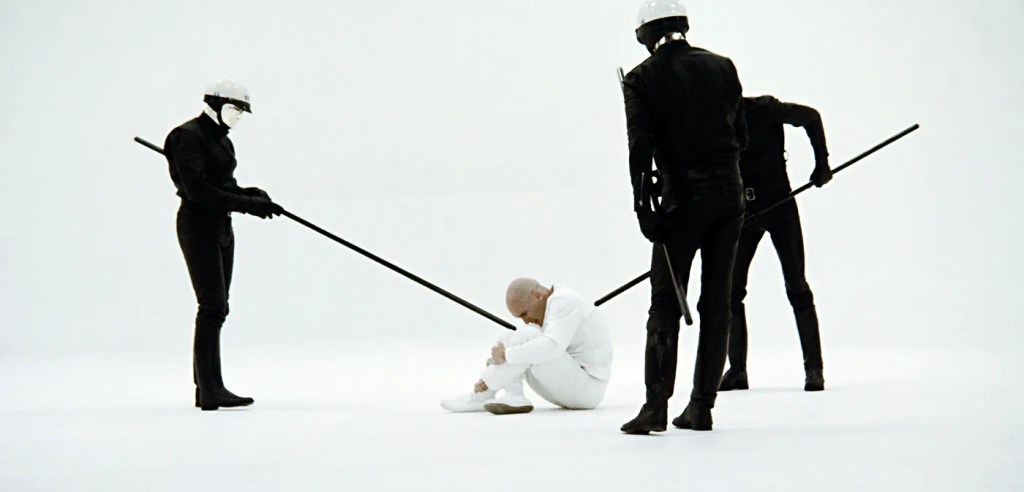
He shares this prison, an all white space stretching eternally, with another dissident named SEN 5241 (Donald Pleasance) whom he had reported earlier for illegally changing shift patterns in order to get a preferential roommate. This society is efficient, if also harsh.
What follows is a daring escape in which THX and SEN evade the authorities in order to find the world’s surface where men and women can live free.

In an impressive directorial debut we get amazing visuals and special effects showing a community rendered colorless and sterile by consumerism and unquestioning loyalty to one’s government. It is a beautiful looking picture and what is even more powerful than its art direction is its editing – largely helmed by director George Lucas himself. Lucas, before he became a filmmaking icon, was a master of using editing to pace a movie limited by its budget.
A lot of THX 1138 is shot from the perspective of computer monitors and surveillance equipment and much of the dialogue and action is presented in closeups that intensify the characters’ desperation and sense of panic – especially when THX begins withdrawing from the drugs.

The movie also brilliantly portrays the impersonal attitude of authority over a populace that has been quantified and dehumanized. Religion has been supplanted by a faux-benign computer system that plays simultaneously the role of a confessional priest and an advertising man. It preaches, “Consume. Be happy,” while failing to adequately respond to the personal issues and problems of its worshippers.
In one of the film’s most affective scenes THX is subjected in prison to a number of torturous tests which is commented on by unseen tormenters who sound like bored lab techs experimenting on mice or IT professionals playing with software. His reactions of pain and stress are just data.

The movie’s weakest point, unfortunately, is its characters who provide necessarily muted performances which serve to show the affects of the state and its drugs on what is essentially a human ant farm. However, by the same token this prevents any one of them from eliciting much care or concern from the viewer. The characters are governed by only the most base emotions of fear and anxiety which carries into all three acts of the plot.

THX 1138 is a visual marvel and it is one of most intelligent examples of dystopic science fiction in cinema. What it is not, however, is a compelling human drama.