
4/4 stars
When looking at cinema and its history, you will be hard-pressed to find a film more significant than Disney’s Snow White. Without it, what would we have today? It paved the way for all animated films produced in the future. Without Snow White there would have been no Pixar, Star Wars, Harry Potter, or the popular influx of superhero movies that we have today. Even The Wizard of Oz would not have been made had MGM not been inspired by Snow White’s success. It brought magic back into the movie theater.
The 1930’s was a rough decade for movies. Aside from the early Universal Monsters and an occasional gem from Hitchcock or Renoir, much of what remains of the decade prior to 1937 are any number of poorly preserved “talkies”; most of which were badly performed and awkwardly paced.
Around the time Snow White came out, the need to redefine cinema was at hand. It happens infrequently throughout the evolution of the art form. When safe bets and stagnation set in an auteur always comes along to remind us of the spectacle that movies were originally made for. It happened in the 1970’s with Spielberg and George Lucas’s Star Wars.
In 1937 the career of Melies – one of the best presenters of spectacle – was long over. Animation at the time was reserved for short subjects and the endeavor to produce a full-length theatrical cartoon like Snow White was considered a big gamble. But, it was a gamble that paid off and movies were never the same again.
The story of Snow White and the Seven Dwarfs is a familiar one. It’s been subject to many other adaptations following the Disney cartoon and it was a well known nursery staple before that. The most popular English form of the Grimm version that inspired the movie was released in 1857. This means that the movie is now older to our current time than the fairy tale was to Disney back in 1937. One might argue that the story is timeless, but if I may be indulged one minor digression, it is my opinion that the original Grimm publication in 1812 (Schneewittchen) was an amalgamation of elements from varying bits of folklore that the Grimm version only compounded and finalized. The story is hardly ancient since the Grimms would have had to make a lot of personal creative choices in its formation. It’s a classic story, but not truly proper folklore.
Literary history aside, the film itself is a work of art. These were the happy days of gorgeous painted backgrounds with animated cels adding liveliness and character to the setting. The film makes minimal use of spoken dialogue, preferring songs to carry the story. The movie makes abundant use of sound in every scene. Often, the musical beats match the beats of the action, letting music replace traditional sound effects. This is particularly seen in Heigh Ho and Whistle While You Work which incorporates the songs’ music into the little visual moments that occur. The mining of diamonds is made with triangles and cowbells and the sound of a tortoise’s laughter is produced with a trumpet. Snow White is one of the most musical of Disney’s productions. It’s like musical theater; a ballet set to the art of animation.
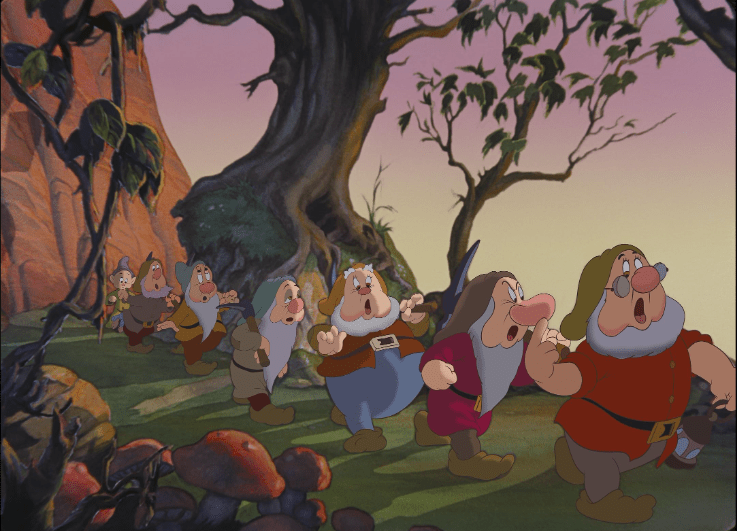
Snow White, the Prince, and the Evil Queen were animated with rotoscoping which was popular at the time. The method had the unfortunate effect of leaving their facial animations ill-defined and it has fallen out of favor long ago. Gratefully the dwarfs and the forest animals are not presented in this way, and they are where the animation truly shines. The saturated color of the animated cels add liveliness and character to the film. They give life and habitation to the beautiful painted backdrops, which unlike rotoscoping, I miss in modern cartoons. The animation gives each of the dwarfs their distinct personalities. They are easily recognized and stand out from each other, which, as fans of The Hobbit will tell you, is a difficult feat.
Disney’s Snow White and the Seven Dwarfs is one of the finest animated fairy tale adaptations ever made. More than that, it is one of the finest films of all time. Unbeknownst to any one at the time, what Walt Disney had accomplished was the future of cinema. It sets the gold standard for how popular films are supposed to be. Its influence cannot be denied. It is as relevant a historical work of art and cultural mainstay as the Sistine Chapel, Wagner’s opera, and the poems of Wordsworth.
In the big picture, film may still be in its adolescence; but Snow White, wherever the arts are respected, will always be among its greatest works.
There has been a lot of talk in recent years of Snow White’s character. Mainly, that she is a misogynistic character type. The general conception is that she lacks personal strength and relies on a male figure to come to her
rescue. In other words, she embodies the damsel in distress motif. However, I disagree with this assessment and I believe the movie deserves a fairer re-analysis. Quite frankly, I think the movie is being grossly misremembered by critics who had not viewed it in a while.
Snow White is shown with a sweet-natured disposition, for sure, and her voice is constantly at a high lilting pitch. She is giggly, bubbly, and extremely positive. But, these are personality traits that some people do have, and per se none of them have anything to do with personal strength. Under her circumstances, though, these traits are more indicative of strength than not. It should be borne in mind that Snow White is living alone with a cruel stepmother after her father had died. Instead of having her spirit broken she remains optimistic and holds onto her ideals of kindness. This is hardly behavior to be expected in the weak.
And the notion that the Prince is some sexist depiction of a male figure coming to her rescue is complete nonsense and not supported by the facts. He only appears in the movie twice, leaving her to spend the majority of the plot doing things for herself. While he does nothing, she survives alone in the woods and takes charge of the dwarfs’ household, becoming their leader. When she sings I’m Wishing, it is not a cry for rescue as modern critics like to claim, but a song of longing. It’s a song about the distance between herself and her lover. It’s a mutually established love and there is nothing sexist about missing the company of one’s partner. His kiss that wakes her from the witch’s curse has been lambasted as an example of non-consent which is just ridiculous when critiquing a fairy tale. In fairy stories we are expected as the audience to suspend our disbelief in love at first sight and we are also expected to accept that they are lovers and that such a kiss was welcome. And I especially don’t want to hear any nonsense about him carrying her in his arms at the end. She was in a coma for a year and her mobility had likely atrophied for awhile. What was the Prince supposed to do? Force her to crawl out of bed Kill Bill-style uphill to his horse?
This may just be my opinion, and others will have their feelings about Snow White, whatever I, or anyone else, might say. What can be agreed on is that movies would not be the same without Snow White. More up-too-date interpretations will continue to come and go and I wish them well. Stories like this were meant to be retold. Even the Grimms were only retelling it. But, better or worse, no retellings of the last hundred years will rival this film in importance. None of them will change the course of the arts like this movie had done. Snow White and the Seven Dwarfs marked the beginning of the modern movie.
Directors: William Cottrell, David Hand, Wilfred Jackson, Larry Morey, Perce Pearce, Ben Sharpsteen
Writers: Ted Sears, Richard Creedon, Otto Englander, Dick Rickard, Earl Hurd, Merrill De Maris, Dorothy Ann Blank, Webb Smith
Producer: Walt Disney
Cast: Roy Atwell (Doc), Adriana Caselotti (Snow White), Eddie Collins (Dopey), Pinto Colvig (Sleepy, Grumpy), Billy Gilbert (Sneezy), Otis Harlan (Happy), Lucille La Verne (Evil Queen), Scotty Mattraw (Bashful), Moroni Olsen (Magic Mirror), Harry Stockwell (The Prince)
Composers: Frank Churchill, Leigh Harline, Paul J. Smith, Bernard B. Brown, Edward H. Plumb, Norman Spencer
Editor: Bill Melendez