
4/4 stars
The Father is one of the most compassionate movies I have ever seen. Dementia is a serious subject that the film treats with a deep empathy that is brilliantly artful.
Director Florian Zeller’s writing (he also wrote the original stage play) is subtle and meditative and very brave in its honesty. Instead of taking the easier road of Oscar-bait where emotions are constantly elevated and every scene drips with melodrama, there is a quiet sincerity in the dialogue and performances that resonated with me as a human being. In years to come this film will be regarded as one of the best movies about mental illness ever made.
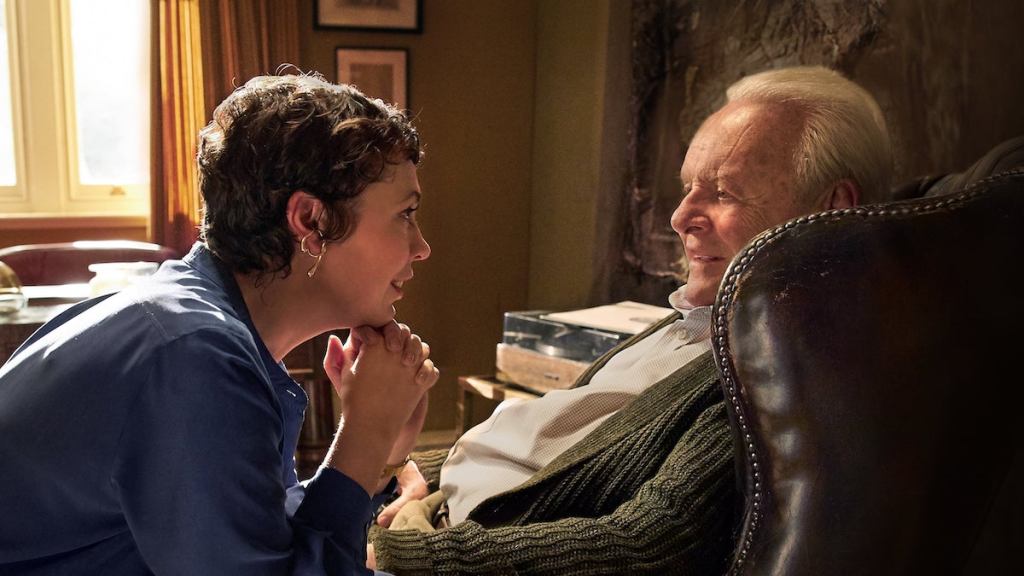
Anthony (Anthony Hopkins) is an octogenarian living with his daughter Anne (Olivia Colman). He has become well-advanced in dementia, struggling to recognize those around him and he requires constant care. Anthony frequently forgets that the apartment they share is hers and not his and he becomes confused as the many faces that come and go seem to blend together and are hard to identify. He lives a frustrating and frightening existence where each passing moment seems to come with wild changes in circumstances he cannot make sense of. Anne tells him she is moving to France with her husband and he is to be left in the apartment by himself. The next day a strange man named Paul (Mark Gatiss) appears claiming to be Anne’s husband. Anthony doesn’t know who he is and when he mentions France, Paul has no idea what he is talking about. He tells Anthony that the apartment is his and Anne’s and that she is just on her way back home from shopping. When she returns she looks like someone else and he, at first, doesn’t recognize her. She hands a bag of chicken to her husband and he leaves to go dress it in the kitchen. Anthony starts asking her about Paul and Anne tells him she hasn’t been married since she got divorced and that there is no one else there except for the two of them. When she leaves the room Paul reappears to ask him why he is being such a burden to everyone. The entire sequence is brilliantly portrayed in real time and to Anthony these contradictions occur minutes or even seconds apart. These sorts of moments happen frequently throughout the film and there is a sense of passing in and out of different realities that leaves Anthony feeling confused and vulnerable. There are days when Paul is there, who now also looks like someone else (Rufus Sewell); and some days he doesn’t exist at all.
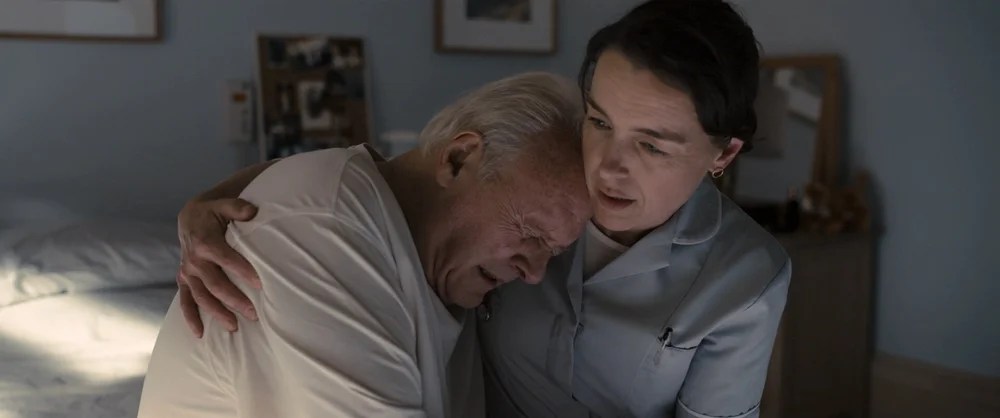
Anthony takes a liking to Laura (Imogen Poots), a home health aide hired by Anne. She strikingly resembles his other daughter Lucy whom he hasn’t seen in some time and there are days when Lucy and Laura are indistinguishable. He misses Lucy a lot and wonders when she will stop by again. Her tragic death in a car accident years ago is largely forgotten. His frustration nearly reaches its peak when after gleefully waiting for Laura to come a completely different aide named Catherine (Olivia Williams) arrives at the apartment and he is told Laura had stopped working for them awhile ago.
I could go on, but it is best to see the film than read about it. Anthony’s story develops along to a climax that is heartbreaking and an exemplar of some of the finest acting I’ve seen in recent cinema.
Anthony Hopkins’ performance earned him his second acting Oscar following his 1991 win for The Silence of the Lambs and it is well-deserved. He goes through every possible emotion on the spectrum, each time doing it with care and subtlety. While he goes from impotent rage to laughter to childlike weeping for his mother it’s all performed as if I was witnessing a real person struggling with dementia.
The film is supported by a minimal cast all of which give performances resembling real people acting as people really do. Contrasts between the sympathetic, annoyed, and overwhelmed are deftly portrayed without aggressive pathos. The directing shows a highly reflective familiarity with human behavior.
The movie is set primarily in a singular setting inside the apartment where Florian Zeller maintains a simple structure in showing each passing day while crafting these skillful and complicated scenes where Anthony’s reality seems to shift in real time. It’s an exceptionally directed picture, impressive in that this is Zeller’s film debut. His knowledge of stagecraft is perfectly translated to film showcasing undeniable talent for direction and introspective writing.
Throughout The Father I was overwhelmed by how kindly its realism is. There is not an ounce of preachiness or sentimentality to the picture and, yet, it doesn’t become raw or cynical in its approach. There is a genuine compassion and kindliness in its writing that cannot be faked. Without being overly cheerful or nihilistic, not a single moment rings false or hollow. Hopkins’ portrait of a man struggling to rationalize his increasingly confusing life during the ravages of dementia is sympathetic and emotionally arresting. In the movie’s final scene Hopkins gives a performance that left me in tears. I was taken aback by how committed to honest feeling the movie was without being depressing or uplifting. Zeller’s screenplay goes beyond either sentiment, giving a solid bit of still-life that didn’t tell me how to feel. The film’s emotions come naturally to the viewer without contrivance or manipulation. When I watched The Father I saw real people, with real feelings, saying real things. And hanging over me the whole time was pure compassion, unadulterated by well-intended lies and triteness.
The Father is the kind of story that an author like Mitch Albom would render toothless with saccharine melodrama or a director like Sidney Lumet would elevate to nigh Shakespearean elegy. Florian Zeller meets us somewhere in the middle where simple empathy doesn’t take the sting out of sorrow, but gives it something we can relate to and find meaning in on our own. The Father is not a profound movie. It’s a deeply human one.


