
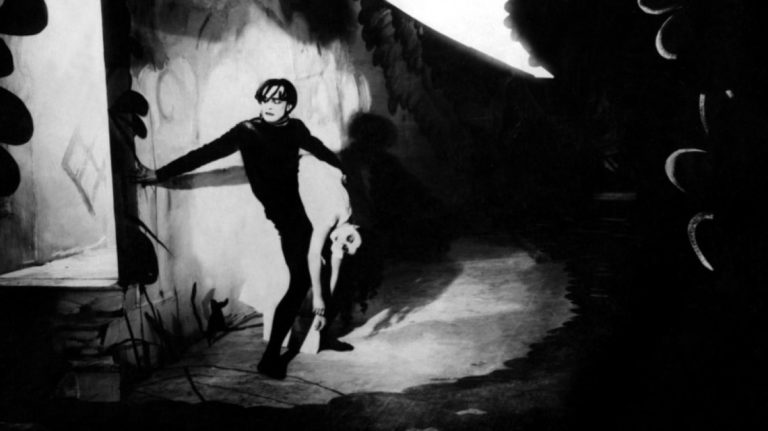
Robert Wiene’s The Cabinet of Dr. Caligari plays out like an eerie nightmare. The macabre imagery from the German Expressionistic set design to the surreal cinematography brings together what is widely considered to be the first true horror film.
Dr. Caligari (Verner Krauss) and the somnambulist, Cesare (Conrad Veidt) both give haunting performances where they seem to cast a shadow over the lives of the protagonist, Francis (Friedrich Feher) and his allies. Dr. Caligari is a spirit of meanness, exerting control and dominance over anything and anyone he can. He moves with a lurching animalistic gait as he gloats and glares at the environment around him. Cesare more haunts his world than he lives in it. He walks in a slow fluid manner as he does the murderous bidding of his master.
All of this plays out in a dreamlike state where reality becomes increasingly unclear and the truth behind the perspectives of the characters becomes uncertain. The Expressionistic art design of the movie, with its crooked almost Dr. Seussian architectures, furthers the impression of everything being a subjective dream.
While the nightmare plays out, a persistent theme of authoritarianism and the evil of dominating others is personified in the character of Dr. Caligari. He uses Cesare to do his bidding even when his will is pure evil. We find later that Cesare was a patient of Caligari’s at an asylum which makes the theme of freedom being suppressed by a tyrant even more palpable as we see Cesare as a victim at the mercy of Caligari who was put over him by the state.
The writers of The Cabinet of Dr. Caligari, Hans Janowitz and Carl Mayer both served in the German military during World War I and grew distrustful of authority and dictatorships after their experiences in the war. Caligari, a man granted power by the state and uses it to dominate and harm others, was representative of the authoritarianism they despised so much.
It was not lost on many retrospective critics and film historians that this film preceded the rise of Hitler and Nazi Germany. To many it would seem that The Cabinet of Dr. Caligari was a reaction and forewarning regarding the spirit of the German people following World War I which later led their nation down the path it did prior to the second World War.
For these reasons Janowitz and Mayer both objected to the Expressionist design and the twist ending forced upon them where we find Francis to be only a madman who fabricated the evil activities of Caligari who was, in reality, just an asylum director. They felt that this invalidated their themes of anti-authority as it made the crimes of Caligari a fantasy to be disregarded. Furthermore the rendering of the hero into a madman in an asylum who needed to be locked up, in fact, seems to encourage an authoritarian viewpoint rather than condemn it. While I am not inclined to disagree with this criticism of the film’s ending I hesitate to condemn the expressionist design as it is the finest and most exemplary use of Expressionism in cinema. While, for some, it may mitigate the essential themes of the film’s story I do not think the harm is so severe as to mitigate the value of the film’s visual artistry. In other words, The Cabinet of Dr. Caligari may be thematically imperfect, but it is one of the most remarkable and influential visual masterpieces ever produced in the history of horror filmmaking.
Extremely divisive when it was first released in 1920, the movie today is one of the most important works of cinema history and remains to this day one of the most influential works of art for filmmakers and film students. Wherever one may stand on the film’s themes and its controversial ending it is an essential work that needs to be seen.
3 1/2 Stars
 Perspectives on Film