

3.5/4 stars
Hope is a powerful thing. It can push a man (or a dog) to achieve more than he otherwise could without it. But hope doesn’t ensure victory and The Plague Dogs is tragically aware of this. By the close of the first act it is clear that nothing that happens in the movie is going to end well.
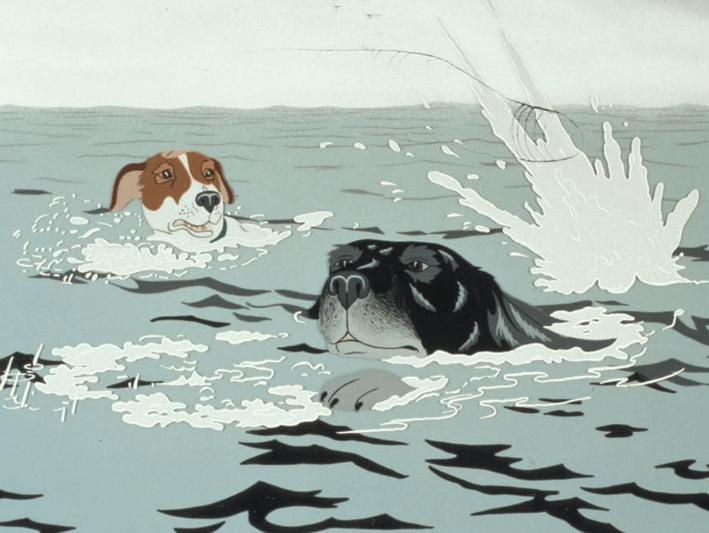
The film (by the creators of Watership Down and based on a novel by the same author) opens with a dog being cruelly drowned by lab scientists. They retrieve and resuscitate him; and it is explained that they have been doing this routinely. What is involved is an endurance test in which the scientists time how long the poor dog can be kept underwater before being saved. It’s stated that psychology is a factor. The dog, named Rowf (Christopher Benjamin), begins to anticipate the rescues which gives him the endurance to survive the longer and longer periods of simulated drowning. Simpler put, hope is trained into him as a Pavlovian response.
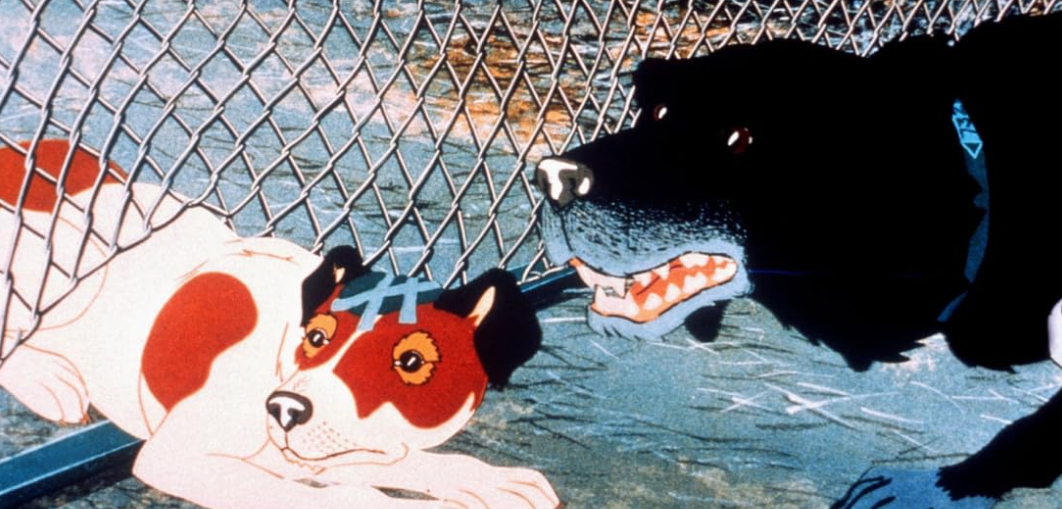
Rowf doesn’t understand why this is being done to him and wonders aloud if he has been a bad dog somehow. His friend, Snitter (John Hurt), has more reason to think so. Unlike Rowf, Snitter was not raised in captivity and once had a kind, loving master. But his old owner was killed by an oncoming truck after he had tried to coax Snitter off the road. Snitter still suffers from bad dreams over the incident and he views the lab and the harsh world they escape into as a sort of purgatory to atone for his past sins. Snitter is not being drowned routinely like Rowf is, but the scientists conducted an experimental brain surgery on him that causes him difficulty in distinguishing reality from his imagination. This causes him to relive his past traumas vividly and he sometimes dives into his own memories of happier days because he thinks he is physically safer there.
Their escape from the lab presents them with freedom, but not much happiness. The English countryside they wander in is to them a stark wild place. The painted backgrounds present wide open fields and stony ground in late Autumn. It’s a cold unfriendly place that requires cold and unfriendly acts to survive. They begin slaughtering sheep for food which gets a lot of angry attention from local herders. It’s not long before the two escaped dogs are on the news and the lab scientists are working hard to find the dogs and kill them. Turns out there is more to the dogs’ escape than killing sheep and inconveniencing farmers. The dogs are revealed to be carriers of the bubonic plague and the scientists have an invested interest in seeing them neutralized.
Rowf and Snitter don’t understand any of this, of course, and they press on trying to find a safe place away from the harsh environment. At first, Snitter holds out in the hopes of finding new masters to care for them, but the harsh reception from the locals dashes these dreams. In the end their only goal is safety. What they find in the end is a world that has rejected them and won’t allow them peace or security.
The driving force throughout the events of The Plague Dogs is hope. But the situation Snitter and Rowf are in is a hopeless one. The film delves into the psychology of hope honestly. Hope does not always bring about victory, but it can lengthen the duration of survival and add endurance. The dogs’ ignorance and their hope gets them as far as it does. But the film’s final note is one of uncertainty and nothing works out for them as they had wished.
The fact that The Plague Dogs is a cartoon can be misleading to the unwary. The painted backdrops give still life realism to the Fall-to-Winter world they dwell in, and the animated cells are not gaudy and colorful like in a Disney picture. The animals and people are drawn with the same realism in mind and they are photographed as if they were live action and not cute cartoon characters. This is also a very violent film that gives tangible reality to the messiness of death. The Plague Dogs, like Watership Down which preceded it, is not a movie for young children. If anything, this film is more traumatizing and dark than Watership Down ever was. That film was about the harshness and sacrificial requirements needed to achieve victory. The Plague Dogs is not about victory at all. Rather, it is about hope in the midst of hopelessness. Their hope carries them far, but never far enough; and there is a stark sort of truth to how this movie handles hope and its value. Most movies cop out with promises of salvation and victory, even if bittersweet and costly. The Plague Dogs is a movie that has the guts to tell us that sometimes things just don’t work out. That is not to say that hope is a dangerous lie. The film doesn’t indict hope at all. But it does say something about being prepared for failure. It’s a rough truth, but a valuable one.
Director: Martin Rosen
Writer: Martin Rosen
Producers: Martin Rosen, Jake Eberts
Cast: John Hurt (Snitter), Christopher Benjamin (Rowf), James Bolam (The Tod), Nigel Hawthorne (Dr. Boycott), Warren Mitchell (Tyson/Wag), Bernard Hepton (Stephen Powell), Penelope Lee (Lynn Driver)
Composer: Patrick Gleeson
Editor: Richard Harkness
 Perspectives on Film