Batman & Robin (1997)

1.5/4 stars

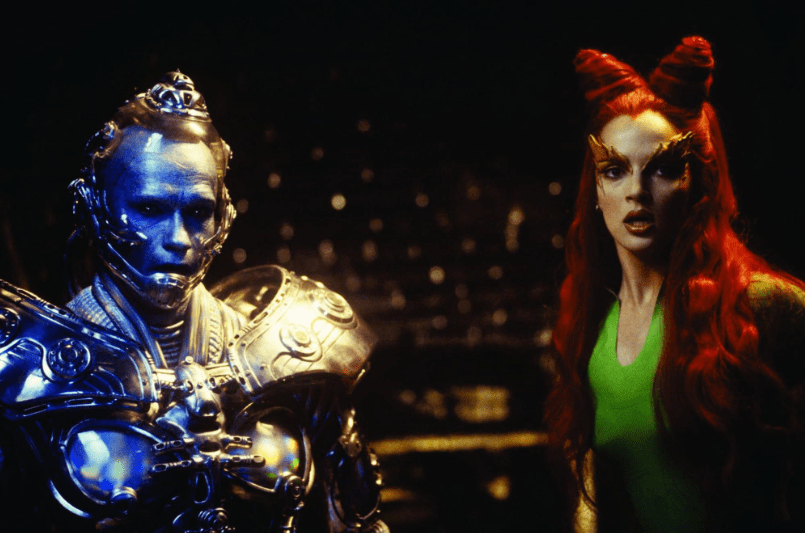
Reportedly, before every shoot while filming Batman & Robin, director Joel Schumacher would remind the cast and crew to “remember, this is a cartoon.” Perhaps he should have said toy commercial. It is certainly with toys in mind that we see throughout the movie’s two hour runtime frequent costume changes, new gadgets, vehicles, and no less than three new villains. Even the characters seem to know they are in a two-hour toy commercial. Poison Ivy (Uma Thurman) mentions her own action figure in a scene where Batman tries to take her on only to find himself in the grips of Bane (sold separately).
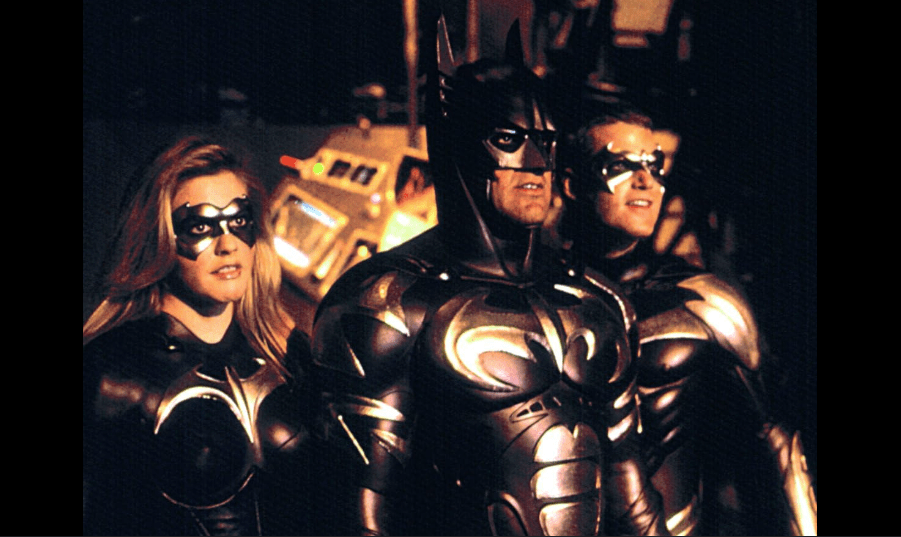
This is a shameless picture with only one clear goal behind its making, and it is not to tell a story. Selling toys has always been an important consideration when making movies like this, but none are as cynical about it. The movie is practically a convention, every shot serving to show off the latest products at your local Toys-R-Us. In the climactic battle during the final act, Batman (George Clooney), Robin (Chris O’Donnell), and newcomer Batgirl (Alicia Silverstone) manage one last costume change before appearing to save the day. There is a sense of urgency in the previous scene that fails to justify this. But, remember, this is a toy commercial.

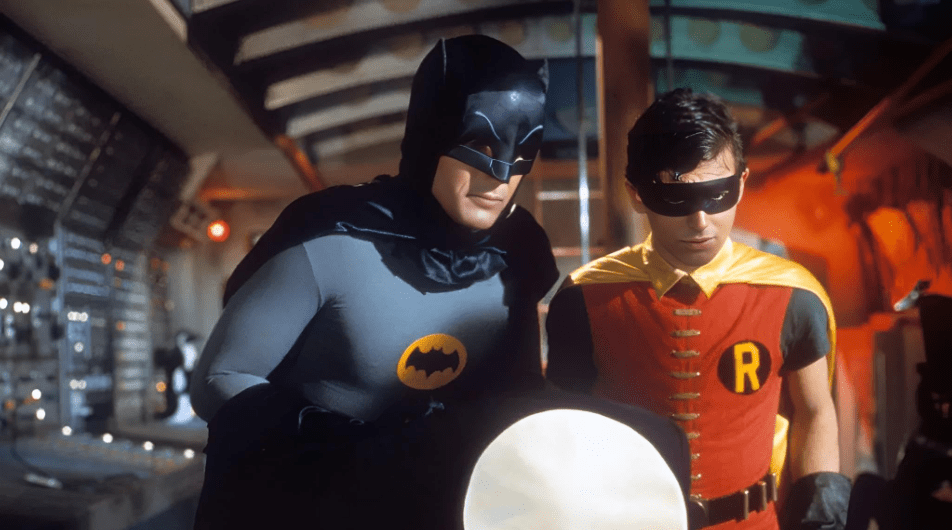
Schumacher’s claim that Batman & Robin is a cartoon is not entirely unjustified. It certainly explains the movie’s tone. The comical villains, slapstick violence, and gaudy visuals of Batman Forever are taken to the max here with even the gothic undertones from before now a thing of the past. Clooney brings none of the broodiness of Bruce Wayne to the character, instead playing the part like an older brother or someone’s cool uncle. As Batman, he is hardly intimidating. The role is written more like Adam West; falling into one obvious trap after another, making improbable public appearances for charity events, and never without the right gadget to get out of any mess.
Also reminiscent of the 60’s Batman show is the film’s set design. They are shot with the same slanted angles and the same neon shades of lighting that only highlight their fakeness. The only thing missing are all the BIFFs, POPs, and POWs splashing the screen during the many fight scenes in the movie.

Batman & Robin’s story is really just an after thought. Surely, it is enough to say that the new villains are up to something villainous and Batman must stop them. Knowing that the evil Mr. Freeze (Arnold Schwarzenegger) wants to freeze the entire world with a ray gun or that Poison Ivy wants to reseed the planet with man-eating plants is not that important. You could watch this movie on mute and lose nothing. There’s a simple formula of baddies making an appearance and Batman and friends fighting them that requires no introduction. Even the movie’s subplot about Alfred (Michael Gough) being ill and needing a treatment is sufficiently told through visual cues that would make a lack of sound no challenge to understand.
While Alfred is suffering from a seemingly terminal ailment a new character is brought to Wayne Manor through Alfred’s niece, Barbara. The movie’s dialogue tells us she has come all the way from England to visit her uncle and that she is a bit of a rebel. I’ll have to just take the film’s word for it. Alicia Silverstone makes no attempt to affect an English dialect and she is shown to ride motorbikes fairly well. She is otherwise played with no personality at all and I suspect that somewhere in the movie’s development she was intended to recall Robin’s youthfulness in Batman Forever. But these themes, had they ever been present at all, must have found themselves on the cutting room floor.
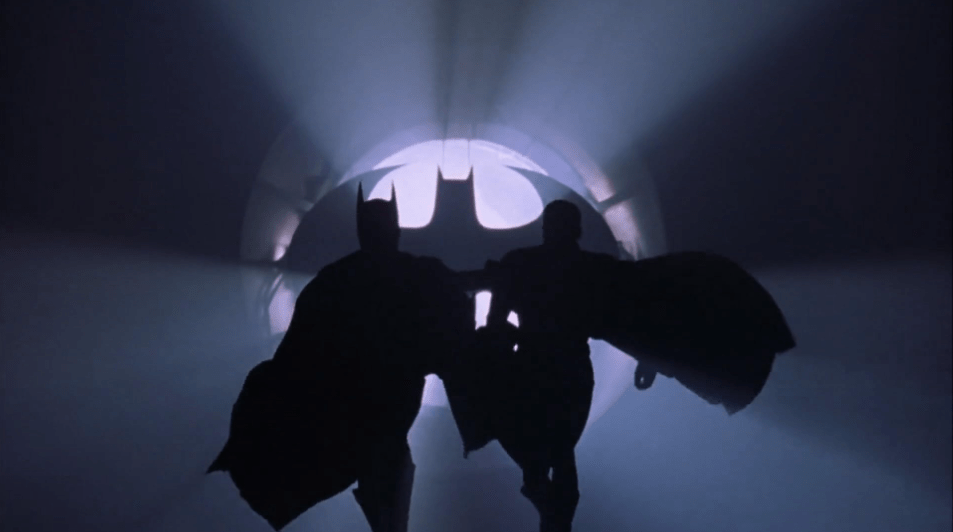
Chris O’Donnell, in the meantime, brings no maturity to the Robin character at all; but spends the majority of the movie arguing and whining to Batman about how he feels like he isn’t being treated like an equal. To me, this presents a missed opportunity for Robin to take Batgirl under his wing and counter her brashness with memories of his own. But, Barbara is left by herself throughout most of the movie, while Robin and Batman bicker in a directionless subplot that ends abruptly when they realize their movie is reaching its climax.
Poison Ivy creates a sort of love triangle between them thanks to powerful pheromones she blows around like a magical pixie dust. Robin becomes convinced that Batman is jealous of him because she is in love with him instead of Batman. Batman, reasonably tries to remind him that Ivy is in league with Mr. Freeze and that her manipulative behavior is obvious, but Robin refuses to listen.
Mr. Freeze, another potential action figure, is slightly more interesting. Like Penguin in Batman Returns, he is presented as a tragic figure; but this time he is much more sympathetic, where Penguin was merely repulsive. The movie explains that Freeze’s wife is kept perpetually frozen to halt the progress of an incurable disease. This is said to be the same disease affecting Alfred, but far more advanced. Freeze needs special gems to power the machinery he uses to research and hopefully discover a cure. After an accident leaves him unable to live outside of sub-zero temperatures, he builds himself a special suit to keep himself cold and turns to a live of crime to steal more gems. By the end, Mr. Freeze is given more empathy than Penguin who was treated as irredeemable. It’s a not a deep story by any means, and all the schemings and rushings to save the day are just a thin veil to disguise the movie’s real agenda. Remember, this is a toy commercial.

Turning a beloved franchise into a big toy commercial is unforgivable, and as such, I had low expectations for the movie to have much of a story. But, as a marketing gimmick, I would have hoped for a better display of special effects. Instead, Warner Brothers, sells its toys with one of the worst looking Batman movies of all time. The sets are garish and cheap with even icicles appearing to be made of rubber at times. Outside of the sets, blue screen is used unconvincingly. The Batmobile and Robin’s bike ride against CG backgrounds, thick matte lines and all, like images poorly pasted over on Photoshop.
Batman & Robin has all the appearances of a movie that was cobbled together quickly with little thought. The story and characters play like Saturday morning cartoons with acting and special effects too shoddy to even properly enjoy it as mindless popcorn entertainment. Maybe the film would have been easier to stomach had it actually been a cartoon. Perhaps, collecting the toys is a better investment. I wonder how much they are going for on Ebay nowadays.

Director: Joel Schumacher
Writers: Bob Kane, Akiva Goldsman
Cast: Arnold Schwarzenegger (Mr. Freeze/Dr. Victor Fries), George Clooney (Batman/Bruce Wayne), Chris O’Donnell (Robin/Dick Grayson), Uma Thurman (Poison Ivy/Dr. Pamela Isley), Alicia Silverstone (Batgirl/Barbara Wilson), Michael Gough (Alfred Pennyworth), Pat Hingle (Commissioner Gordon)
Producers: Mitchell Dauterive, William M. Elvin, Peter Macgregor-Scott, Benjamin Melniker, Michael E. Uslan
Composer: Elliot Goldenthal
Cinematographer: Stephen Goldblatt
Editors: Mark Stevens, Dennis Virkler

Batman Forever (1995)

2/4 stars

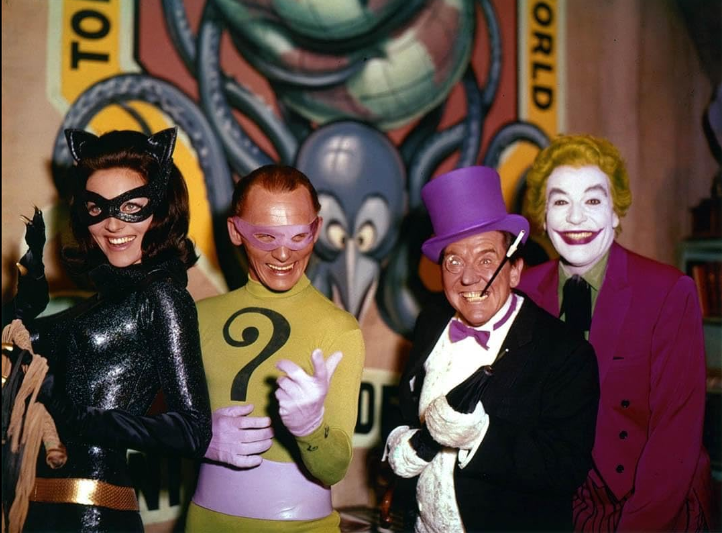
There are three kinds of Batman. Gothic Batman is the subject of the classic comic books and we see him stoically doing what he does best in the Tim Burton movies and the animated TV series from the 90s. The more introspective Edgelord Batman made popular in Christopher Nolan’s Dark Knight trilogy has been a favorite of comic writer Frank Miller, but largely exists elsewhere in memes. Campy Batman is best represented by Adam West back in the 1960s. Campy Batman’s Gotham City is a colorful world of colorful people where villains prance in clownish costumes and laugh maniacally. They are the sort of baddies who twirl their mustaches, tie damsels to railroad tracks, and scheme to poison the city’s water supply.
Director Joel Schumacher’s Batman Forever is a return to the old tradition of campy Batman, slanted camera angles and all. When Schumacher, taking over for Tim Burton, approached the material he aimed to make a live-action cartoon. For better or worse, he succeeded. As stupid and ridiculous as the movie is, it is everything it intended to be; its flaws by design and really a matter of taste.

A common complaint leveled at it is that it is too campy and too cartoonish. I hold to the opposite view. I believe it isn’t campy and cartoonish enough, and therein lies Batman Forever’s downfall. The heroes, given what they are up against, are too sullen for their own good. Val Kilmer, replacing Michael Keaton, in the role of Bruce Wayne commands no presence, adding nothing interesting to the part. As Batman he is stale, watering the character down to a fighting costume.
Robin, the Boy Wonder is brought in this time around, and if the fans had been waiting patiently through two movies for Batman’s trusted sidekick to finally appear they must have been sadly disappointed. Chris O’Donnell as Dick Grayson (Robin’s alter ego) has none of Burt Ward’s original energy and passion. O’Donnell plays the role as standoffish and angry. His character development is nothing more than a skin-deep paint-by-numbers expression of the old saw “revenge won’t make the pain go away” and “taking a life leads to a dark path.” There is nothing wrong with such messages of course, but no sincere effort is made to convince the audience of their truthfulness. It’s merely said and Robin comes to these conclusions only when the script finally says so.
Batman and Robin generate no charisma whatsoever, all of their energy being sucked into the two lead villains.

The movie opens with the dastardly Two-Face (Tommy Lee Jones) robbing a bank to lure Batman into a trap. He giggles and jumps up and down like a clown, firing machine guns at nothing in particular as police helicopters swarm above. The burnt side of his face is improbably symmetrical in relation to the other side: a purple bit of prosthetic rubber that appears more like a cartoon’s idea of a deformity than anything seen on a real burn victim. His suit is split in a similar fashion; formal and proper on one side and gaudy and colorful on the other. When we see his evil lair later in the film the interior decoration keeps to this pattern. One side looks like the very throne room of hell and the other is pure white and fit for a fairy tea party. His two sexy girlfriends, Sugar and Spice (Drew Barrymore and Debi Mazar) are bedecked to match.
When Batman arrives at the bank robbery, he is joined by Commissioner Gordon (Pat Hingle) and Dr. Chase Meridian (Nicole Kidman). Meridian is a professional parapsychologist who specializes in super-criminals and caped crusaders alike. She doesn’t look much like a psychologist. She stands next to Batman looking like a blonde bombshell, speaking in silky tones and saying nothing more insightful than what can be gleaned from a copy of Psychology Today. She is about as convincing a psychologist as Denise Richards was as a physicist in The World Is Not Enough. Kidman plays the role like a Bond girl. She feigns a professional interest in Batman that masks something more fetishistic.
We later see a love triangle develop between her, Batman, and his secret identity Bruce Wayne. The movie posits a theme where Dr. Meridian’s infatuation with Batman is something girlish and rebellious; her eventual favoring of Wayne being a moment of maturity. She directs her husky-toned flirtations toward both equally, however, and the point is not hammered home that deeply.

After Two-Face escapes he joins forces with The Riddler (Jim Carrey) whose wild performance is the front and center of the whole show. Carrey plays Riddler with no restraint at all. His acting reaches over the top and then goes only higher. He moves like he is cursed to dance forever and he never stops talking. The performance is loud and obnoxious; Carrey mugs the camera, making bizarre faces and dropping pop culture references and bizarre jokes whenever he is on screen, which ends up being a great deal. Jim Carrey has this way of punctuating his words with sharp turns of his head. He does it so much you could make a drinking game out of it. After Batman Forever I’d be fairly plastered. Try doing it while watching The Mask and you would need a new liver.
When we first meet him he is an excitable and neurotic employee of Wayne Enterprises named Edward Nygma who idolizes Bruce Wayne and wants to impress him with a new mind-control device he invented. Wayne’s predictable rejection crushes the already unhinged Nygma’s spirit and he becomes enraged and bitter. It’s probably the lamest super-villain origin story to date, but it fits the material Schumacher presents.
As Riddler he uses his mind control device to read the minds of everyone in Gotham so he can steal their credit card numbers and financial records. It’s a shockingly short-sighted plot. One man having access to everyone’s money would only crash the economy and more than likely the existence of his machine would force the world to adapt its methods of bookkeeping to counter-act it. But maybe I am overthinking the logistics of a villain scheme obviously reminiscent of a Saturday morning cartoon.

When the movie sticks to Joel Schumacher’s vision it works remarkably well even if Carrey could afford to tone it down a little. Gotham looks better than ever keeping the same Gothic Dr. Seussian aesthetic from before, but more lively and animated. The camera rides through the city like a roller-coaster, allowing the viewer to soak in the details. It reminds me of a professional haunted house made with money as no object.
Tommy Lee Jones and Jim Carrey’s antics are constantly energetic and off the wall. Reminding myself that this is supposed to be a live-action cartoon I can accept them, if not love them overmuch.
Where it fails is with its hero characters. Pat Hingle phones in his performance as Gordon, seeming to be painfully aware of what had become of the series. Kilmer is dry as a bone and O’Donnell is over-serious and undercooked as a character. Nicole Kidman brings to the movie the sort of character we should have had in Catwoman back in Batman Returns. Bond girls and Batman vixens alike are supposed to be somewhat innocent and prepubescent in their sensuality. They entice the man hidden behind the mask, but the boy that the mask represents ultimately wins out and keeps them untouchable. Kidman brings this to Chase Meridian well enough, but still never quite reaches the comic tone that the movie needs more of.

In Batman Forever Schumacher tries too hard to meld the 1960s era camp with the more mature themes of the Burton movies, and the result is an inconsistent mess. In the end I appreciated what the director has tried to do more than what he has done.

Director: Joel Schumacher
Writers: Bob Kane, Lee Batchler, Janet Scott Batchler, Akiva Goldsman
Cast: Val Kilmer (Bruce Wayne/Batman), Tommy Lee Jones (Two-Face/Harvey Dent), Jim Carret (Edward Nygma/Riddler), Nicole Kidman (Dr. Chase Meridian), Chris O’Donnell (Dick Grayson/Robin), Michael Gough (Alfred Pennyworth), Pat Hingle (Commissioner Gordon), Drew Barrymore (Sugar) Debi Mazar (Spice)
Producers: Tim Burton, Mitchell E. Dauterive, Peter Macgregor-Scott, Benjamin Melniker, Kevin J. Messick, Michael E. Uslan
Composer: Elliot Goldenthal
Cinematographer: Stephen Goldblatt
Editors: Mark Stevens, Dennis Virkler

Batman Returns (1992)

1.5/4 stars

Batman Returns is an ugly, unpleasant, and meanspirited film. There is something sick beneath its surface of gross-out grotesquerie, bondage-inspired sensuality, and gratuitous violence. Watching it, I felt there must have been a lot of anger behind its making. It’s the sort of movie that after viewing it I wanted to ask the filmmakers, “Who hurt you?”

Taking place a few years after the much superior Batman (1989), the film sees the Caped Crusader springing back into action after a group of rogue circus performers kidnap industrialist Max Shreck (Christopher Walken) during a public ceremony. He is blackmailed by the sewer-dwelling Penguin (Danny DeVito) who knows of Shreck’s illegal toxic waste dumping. Unlike the more balanced previous movie, the villains in Batman Returns take center stage leaving Bruce Wayne (Michael Keaton) more time to brood in front of his TV, I guess. The Penguin, far removed from the boyish aristocratic charm of Burgess Meredith, is a repulsive figure. He waddles in disgusting soiled long underwear, chows on raw fish with ill-manners that Gollum would have objected to, and lecherously leers at any woman he meets. His pasty, balding, hook-nosed visage only further elicits disgust in the viewer. In one of the films most disgusting scenes he chews on a raw fish, flesh dribbling from his mouth, right before biting a man on the nose causing it to gush blood. He then turns his attention to a female assistant and confides in Shreck his sexual fantasies featuring her. He flaps his deformed hands saying he wants to show her his “French flipper trick.” The scene’s comic tone only accentuates the rotten spirit that could have gone into writing it.
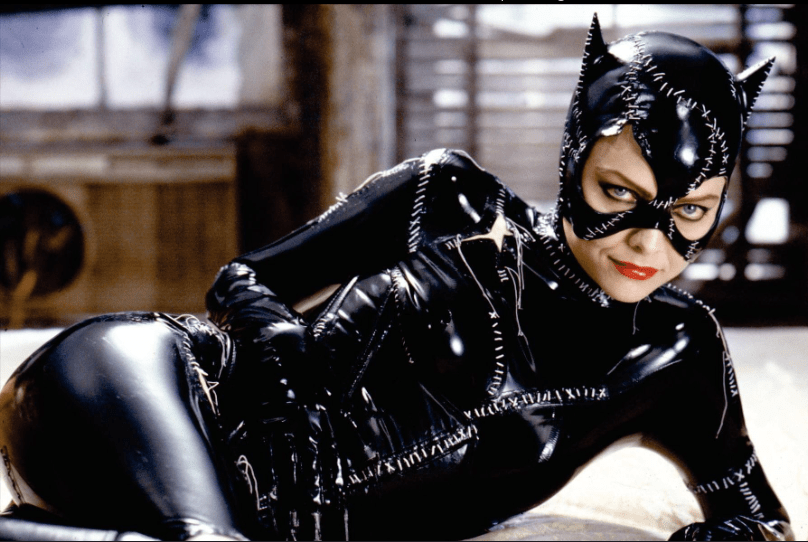
Added to the new rogues’ gallery is Catwoman (Michelle Pfeiffer) who starts out as a mistreated assistant to Max Shreck who pushes her out of a window when she discovers too much about his illegal activities. As Selina Kyle, Catwoman’s alter ego, she is a depressing figure. Selina is a misogynistic caricature of a sexually frustrated working woman living in a man’s world. The attempted murder causes her to snap and she returns to her apartment smashes it to bits and then makes herself a shiny black catsuit. As one does.
The character transformation is sudden and without much explanation. She adopts a sultry voice saying to herself, “Now I feel a lot yummier.” Her performance is sexually charged and out of place in a film made to cater to kids. When she allies herself with the Penguin he continually bombards her with unwanted sexual attention, his language vulgar and graphic. The game she plays with him is one of flirtation, innuendo, and rebuff (in that order). Her action scenes play out like a dance where suggestive comments contextualize a connection between sex and fighting. This sort of thing has been done before, but its application here in a movie for young people is disturbing. Catwoman as an archetype has always represented something prepubescent. She represents the growing confused feelings in young boys still overcoming their “girls are icky” phase. But that element is not here. In Batman Returns Catwoman fully embraces a dominatrix persona rife with explicit sexual dialogue. Every time she defeats a male opponent in a fight I kept waiting for them to take a quiet break for a cigarette.
I’ll let you in on a little secret. Pfeiffer’s Catwoman is my favorite Catwoman. She encapsulates the seductiveness of the character and my reasons for favoring her are undeniably male ones. But the writing’s on the wall when put in the movie’s context. This movie is neither The Batman (2022) or The Dark Knight Rises. There is an offset of cartoonish comic book action and storytelling that makes her raw sensuality inappropriate. I have objections to her representation here in a kids movie as both a man and a father, if not so much as a male. To put it more succinctly, a movie that has been marketed with Happy Meal toys really ought not to have elements of BDSM and sexualized violence in its plot.
If I had any sympathy for the movie it was completely lost when we get to the part where Penguin murders a beauty queen. To frame Batman she is kidnapped and pushed off of a tall building with a flock of bats. The woman’s skimpy costume remains well-photographed throughout the ordeal and when she lands she is in surprisingly good shape, if still dead. There is something I find inherently sick about scantily clad women being killed on film that is especially egregious in a movie like this one.
Further adding to my distaste for the film is Penguin’s plot in the final act to kidnap Gotham’s firstborn and drown them in the toxic waste in his sewer. I had hoped that this would remain discussed and that the movie wouldn’t bother with scenes of scared screaming babies being loaded into cages, but alas, no dice; and the film goes there. Of course, Batman comes to the rescue and nothing horrible happens, but still…

This is among some of the most unpleasant superhero movies ever made. I wish I knew what Tim Burton (a very talented director) was going through when he made it. It is definitely the most Burton-esque of his Batman films. Danny Elfman’s score is highly reminiscent of the style heard in Beetlejuice and Edward Scissorhands and the same Dr. Seussian sense of model design under a winter blue color palette that characterizes Burton’s films is present here. His movies look a lot like the inside of a snow globe.
But, there is a lot of anger and resentment in the film’s writing. Any and every opportunity to be gross, exploitative, and crass is taken throughout. The Joel Schumacher Batman movies that followed are notoriously stupid in their idiotic writing and cartoonish visuals, but Schumacher never juxtaposed the lightweight content with half-naked women being murdered, bondage-geared dominatrices saying “Don’t be too rough with me it’s my first time” before a fight, or vile depictions of gross-out violence. The movie is rated PG-13, but much of the sexual dialogue is more fitting for an R-rated picture. The ugly tone and foul attitudes that fill every scene contains no meaningful commentary, but simply exist for their own sake.
It’s a film where sex is firmly connected to violence, Batman kills people, and the downtrodden and discarded poor folk are, we are told, monstrosities of nature. Batman Returns is the most hate-filled superhero flick ever made, and if I was not clear, I didn’t like it much.

Director: Tim Burton
Writers: Bob Kane, Daniel Waters, Sam Hamm
Cast: Michael Keaton (Bruce Wayne/Batman), Danny DeVito (Oswald Cobblepot/Penguin), Michelle Pfeiffer (Selina Kyle/Catwoman), Christopher Walken (Max Shreck), Michael Gough (Alfred), Michael Murphy (Mayor), Cristi Conaway (Ice Princess), Andrew Bryniarski (Chip), Pat Hingle (Commissioner Gordon)
Producers: Ian Bryce, Tim Burton, Denise Di Novi, Larry Franco, Peter Guber, Benjamin Melniker, Jon Peters, Michael E. Uslan
Composer: Danny Elfman
Cinematographer: Stefan Czapsky
Editors: Bob Badami, Chris Lebenzon

Batman (1989)

3/4 stars

Tim Burton’s Batman opens and it’s night in Gotham City. A family of three are mugged by two strung-out thugs and they sit on a rooftop counting their stolen money. But this is Gotham City and Gotham City has a protector who rules the night. Looming above them in silhouette like a ghoulish reincarnation of Dracula is a figure in the form of a bat. It swoops down upon the two terrified goons and beats them within an inch of their lives. One of them asks, “Who are you?” Gotham’s hero says, “I’m Batman”, and a legend is born.
All this happens in the first ten minutes. There are no forty-minute prologues of Bruce Wayne’s origins. There is little time given to studying his feelings and character. And there are no grounded explanations for where he gets his gear. When Batman uses a grappling hook to escape, the Joker says, “Where does he get those wonderful toys?” He gets no answer and we don’t need one.

This is the perfect Batman movie. It checks all the necessary boxes that define who Batman is, what his world is, and what a story featuring him should be about. The filmmakers understand that the audience knows who Batman is and that he needs no introduction. Batman doesn’t require an explanation. All he needs is to be properly represented.

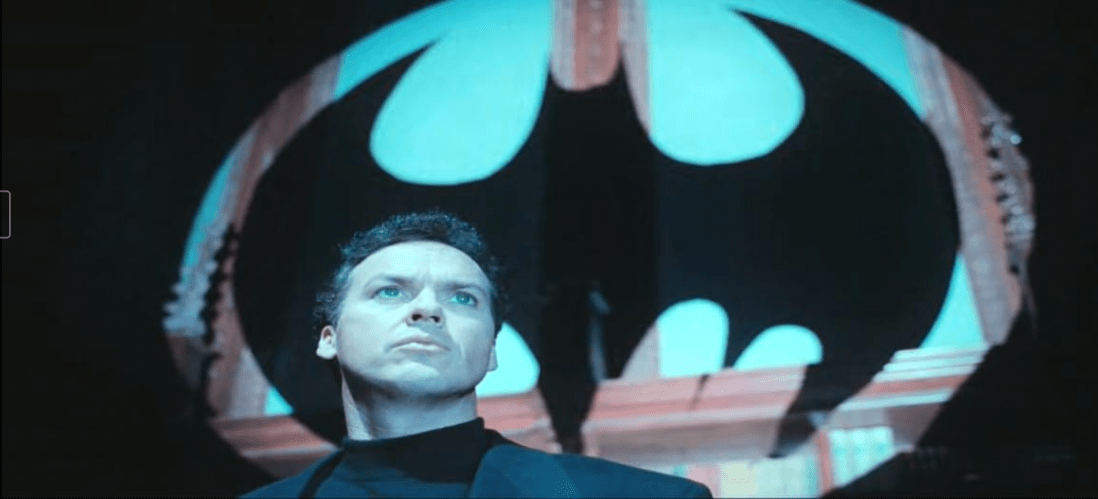
Bruce Wayne (Michael Keaton) is already Batman when the film begins. We are not told for how long, but the sudden introduction of The Joker suggests it takes place during what the fans of the DC comics call Year One.
Keaton plays Bruce Wayne as good-natured and mannered, but a bit shy and antisocial. His loner tendencies reflect the consequence of being Batman at night. As Batman he recalls the Phantom of the Opera. He is reclusive and silent, staying in the shadows lest someone sees too much of him and discovers his secret identity.
Michael Keaton is my favorite of all the Batmans (Batmen?) who have attempted the role. He doesn’t stifle the performance with melodrama, but lets the physicality and look of the character dominate the screen. Batman is an icon and a symbol; and Keaton allows the iconography to define what we see. He is a costume and a chin. And that is Batman as we like him.
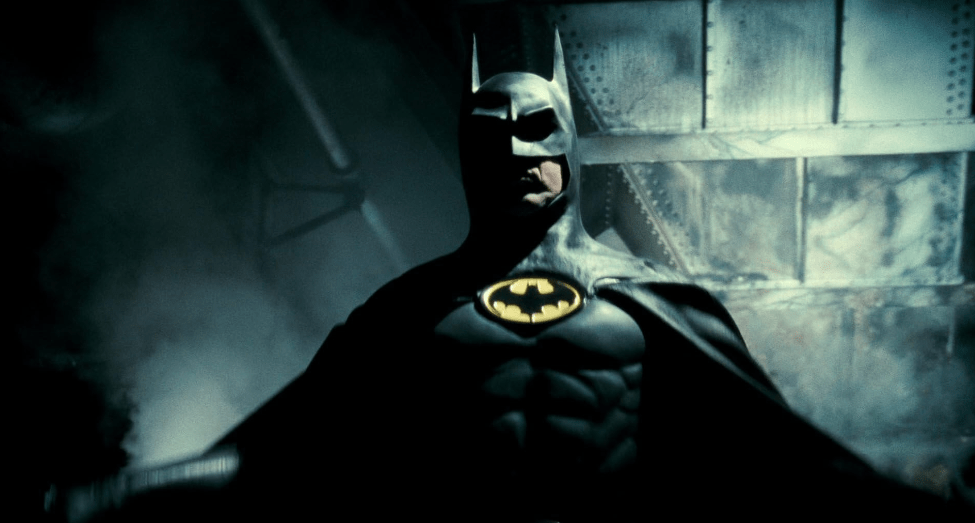
The costume is fairly traditional. It’s neither the explicable body armor worn by Christian Bale or the gaudy grey cloth of Adam West. The black bulletproof rubber worn by Keaton fits the gothic tone of the character while retaining our quintessential expectations of a Batman costume. The Bat logo stands out in yellow on the chest. The costume is fundamental and perfect.
The Batmobile is even better. It appropriates the mood and style of Batman better than any other Batmobile, in my opinion. It’s long, dark, angular, and the sort of car Count Dracula would have driven had motor vehicles existed in his day. Toy Biz must have made a killing on the market with this thing. It’s one of the coolest fictional movie cars since James Bond’s Aston Martin.
Tim Burton’s Batman also has the best rendition of Gotham City of all time. The gothic architecture brings to mind the German Expressionist images seen in Fritz Lang’s Metropolis, but augmented in technicolor with dark matte paintings and its smoky and steaming set design.
Further setting the mood is Danny Elfman’s iconic score which to this day contains the definitive Batman theme for a lot of fans, myself included. Unlike the more optimistic and rousing Superman theme by John Williams, Elfman’s Batman theme puts itself in the midst of the action, punctuating Batman’s fighting spirit with just a dash of mischievous fun. Like the Williams score it creates its own genre of superhero themes. Sadly it’s becoming a lost art. Does anyone remember the music in the Marvel movies recently? Because I don’t.

But all of these elements add up to beans without a story. The film’s plot manages in its 2 hour runtime to give Batman, Bruce Wayne, and the Joker enough to do in perfect balance. Bruce Wayne juggles his obligations as Batman with his budding infatuation with journalist Vicky Vale (Kim Basinger) while the Joker (Jack Nicholson) has his own eyes on her while he plots to overthrow and take over the criminal underworld.
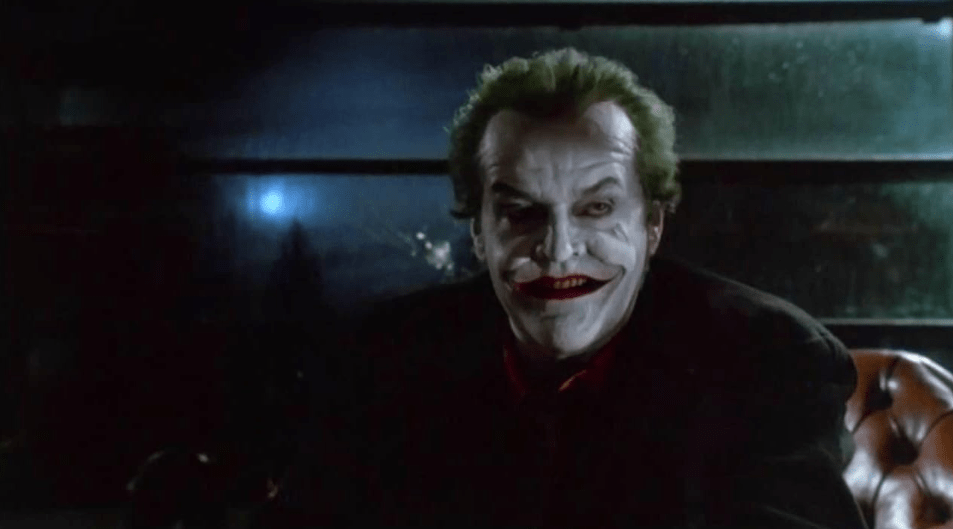
Nicholson portrays the Joker part with surprising restraint given the madcap lunacy of the character and his plans. He laughs, jokes, and plots morbid absurdities as any good Joker would, but never seems out of control. His madness is more of an attitude he brings to his offbeat behavior. Nicholson plays Joker like his descent into madness wasn’t out of tragedy or untreated mental illness. He chooses madness because he simply got annoyed with sanity and enough was enough. His most wildest actions still manage to reflect this attitude. He punches out a TV with a mechanical glove and murders his own henchmen where other men would just roll their eyes.

Controversially, Nicholson’s Joker, is given a backstory whereas the Joker is traditionally portrayed as anonymous and of ambiguous origins. Here he is introduced as Jack Napier, a right hand man to a mob boss (Jack Palance). After Palance discovers that Jack is sleeping with one of his molls he sets Jack up to be killed in a sting operation. But, when Batman makes an appearance, Jack fights him only to fall into a vat of acid. He survives, but is disfigured with chalk-white skin, green hair, and a permanent grin fixed on his face.
The decision to give Joker an identity and origin is still controversial among fans of the comics, but I have grown to accept the change. Nicholson is by far the most charismatic figure in the movie and the motivations his backstory gives him serve the plot perfectly fine. The Batman mythos is interpretive in adaptation, and the changes made to the established lore here doesn’t denigrate the film in the slightest. A Joker with an origin story is, after all, still more tolerable than a moody and angry Superman that the fans of Man of Steel didn’t seem to mind.
Joker gets revenge by killing his former boss and goes on to bend the remaining mob bosses under his rule, removing (quite dramatically) anyone who opposes him. He plots to poison the citizens of Gotham with infected hair care products, before moving onto bigger game with a parade show with floating balloons full of fatal laughing gas that he wants to unleash upon the city.
In the meantime, Batman broods and investigates Jack’s latest schemes, and his alter ego Bruce Wayne begins to suspect that there is an old personal connection between him and the Joker. Between them is Vicky Vale. Joker desires her, Bruce is falling in love with her, and it is Batman who must save her.

This is not a very thoughtful plot, naturally. But as a superhero movie, the story weaves all of the required elements that make the genre appealing. Christopher Nolan’s brilliant Dark Knight trilogy was made for a different sort of audience in mind. There the characters are ideologues for real-world issues that more sophisticated internet-bred audiences post-9/11 have found meaning and expression in. But, none of that is needed here. This movie was made for the boys and girls who love Batman and the Generation X adults who had grown up on him. During my childhood in the 90s, the grown-ups who were pop-culture conscious seemed to be preoccupied by two things: Star Wars and Batman. They coexisted on the same walls on posters, shared shelf space as action figures, filled boxes with comics, and every respectable nerd had both on VHS and their clothes. And in those happy days it was Burton’s image of Batman that dominated.

Director: Tim Burton
Writers: Bob Kane, Sam Hamm, Warren Skaaren
Cast: Michael Keaton (Bruce Wayne/Batman), Jack Nicholson (The Joker, Jack Napier), Kim Basinger (Vicki Vale), Robert Wuhl (Alexander Knox), Pat Hingle (Commissioner Gordon), Billy Dee Williams (Harvey Dent), Michael Gough (Alfred), Jack Palance (Grissom), Jerry Hall (Alicia), Tracey Walker (Bob the Goon), Lee Wallace (Mayor), William Hootkins (Eckhardt)
Producers: Peter Guber, Barbara Kalish, Chris Kenny, Benjamin Melniker, Jon Peters, Michael E. Uslan
Composer: Danny Elfman
Cinematographer: Roger Pratt
Editor: Ray Lovejoy