
3/4 stars
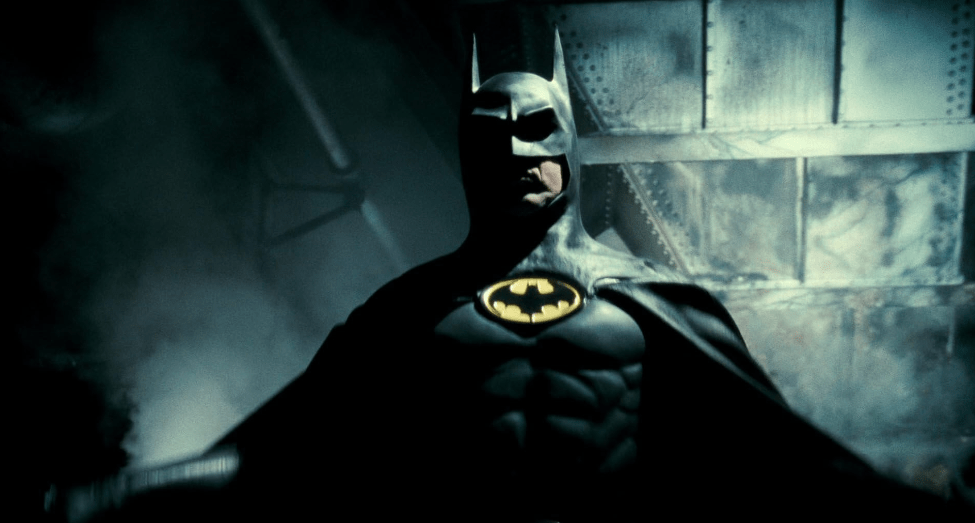
Tim Burton’s Batman opens and it’s night in Gotham City. A family of three are mugged by two strung-out thugs and they sit on a rooftop counting their stolen money. But this is Gotham City and Gotham City has a protector who rules the night. Looming above them in silhouette like a ghoulish reincarnation of Dracula is a figure in the form of a bat. It swoops down upon the two terrified goons and beats them within an inch of their lives. One of them asks, “Who are you?” Gotham’s hero says, “I’m Batman”, and a legend is born.
All this happens in the first ten minutes. There are no forty-minute prologues of Bruce Wayne’s origins. There is little time given to studying his feelings and character. And there are no grounded explanations for where he gets his gear. When Batman uses a grappling hook to escape, the Joker says, “Where does he get those wonderful toys?” He gets no answer and we don’t need one.
This is the perfect Batman movie. It checks all the necessary boxes that define who Batman is, what his world is, and what a story featuring him should be about. The filmmakers understand that the audience knows who Batman is and that he needs no introduction. Batman doesn’t require an explanation. All he needs is to be properly represented.
Bruce Wayne (Michael Keaton) is already Batman when the film begins. We are not told for how long, but the sudden introduction of The Joker suggests it takes place during what the fans of the DC comics call Year One.
Keaton plays Bruce Wayne as good-natured and mannered, but a bit shy and antisocial. His loner tendencies reflect the consequence of being Batman at night. As Batman he recalls the Phantom of the Opera. He is reclusive and silent, staying in the shadows lest someone sees too much of him and discovers his secret identity.
Michael Keaton is my favorite of all the Batmans (Batmen?) who have attempted the role. He doesn’t stifle the performance with melodrama, but lets the physicality and look of the character dominate the screen. Batman is an icon and a symbol; and Keaton allows the iconography to define what we see. He is a costume and a chin. And that is Batman as we like him.
The costume is fairly traditional. It’s neither the explicable body armor worn by Christian Bale or the gaudy grey cloth of Adam West. The black bulletproof rubber worn by Keaton fits the gothic tone of the character while retaining our quintessential expectations of a Batman costume. The Bat logo stands out in yellow on the chest. The costume is fundamental and perfect.
The Batmobile is even better. It appropriates the mood and style of Batman better than any other Batmobile, in my opinion. It’s long, dark, angular, and the sort of car Count Dracula would have driven had motor vehicles existed in his day. Toy Biz must have made a killing on the market with this thing. It’s one of the coolest fictional movie cars since James Bond’s Aston Martin.
Tim Burton’s Batman also has the best rendition of Gotham City of all time. The gothic architecture brings to mind the German Expressionist images seen in Fritz Lang’s Metropolis, but augmented in technicolor with dark matte paintings and its smoky and steaming set design.
Further setting the mood is Danny Elfman’s iconic score which to this day contains the definitive Batman theme for a lot of fans, myself included. Unlike the more optimistic and rousing Superman theme by John Williams, Elfman’s Batman theme puts itself in the midst of the action, punctuating Batman’s fighting spirit with just a dash of mischievous fun. Like the Williams score it creates its own genre of superhero themes. Sadly it’s becoming a lost art. Does anyone remember the music in the Marvel movies recently? Because I don’t.
But all of these elements add up to beans without a story. The film’s plot manages in its 2 hour runtime to give Batman, Bruce Wayne, and the Joker enough to do in perfect balance. Bruce Wayne juggles his obligations as Batman with his budding infatuation with journalist Vicky Vale (Kim Basinger) while the Joker (Jack Nicholson) has his own eyes on her while he plots to overthrow and take over the criminal underworld.
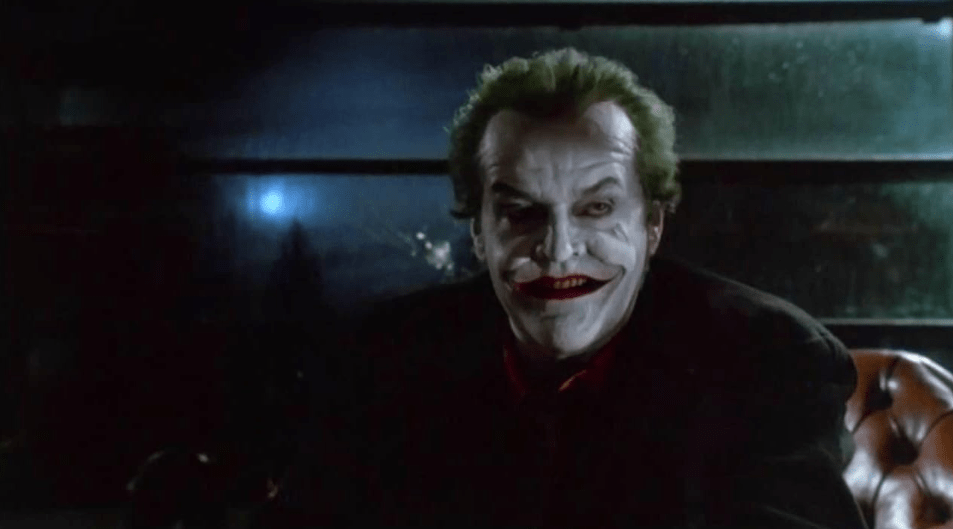
Nicholson portrays the Joker part with surprising restraint given the madcap lunacy of the character and his plans. He laughs, jokes, and plots morbid absurdities as any good Joker would, but never seems out of control. His madness is more of an attitude he brings to his offbeat behavior. Nicholson plays Joker like his descent into madness wasn’t out of tragedy or untreated mental illness. He chooses madness because he simply got annoyed with sanity and enough was enough. His most wildest actions still manage to reflect this attitude. He punches out a TV with a mechanical glove and murders his own henchmen where other men would just roll their eyes.
Controversially, Nicholson’s Joker, is given a backstory whereas the Joker is traditionally portrayed as anonymous and of ambiguous origins. Here he is introduced as Jack Napier, a right hand man to a mob boss (Jack Palance). After Palance discovers that Jack is sleeping with one of his molls he sets Jack up to be killed in a sting operation. But, when Batman makes an appearance, Jack fights him only to fall into a vat of acid. He survives, but is disfigured with chalk-white skin, green hair, and a permanent grin fixed on his face.
The decision to give Joker an identity and origin is still controversial among fans of the comics, but I have grown to accept the change. Nicholson is by far the most charismatic figure in the movie and the motivations his backstory gives him serve the plot perfectly fine. The Batman mythos is interpretive in adaptation, and the changes made to the established lore here doesn’t denigrate the film in the slightest. A Joker with an origin story is, after all, still more tolerable than a moody and angry Superman that the fans of Man of Steel didn’t seem to mind.
Joker gets revenge by killing his former boss and goes on to bend the remaining mob bosses under his rule, removing (quite dramatically) anyone who opposes him. He plots to poison the citizens of Gotham with infected hair care products, before moving onto bigger game with a parade show with floating balloons full of fatal laughing gas that he wants to unleash upon the city.
In the meantime, Batman broods and investigates Jack’s latest schemes, and his alter ego Bruce Wayne begins to suspect that there is an old personal connection between him and the Joker. Between them is Vicky Vale. Joker desires her, Bruce is falling in love with her, and it is Batman who must save her.
This is not a very thoughtful plot, naturally. But as a superhero movie, the story weaves all of the required elements that make the genre appealing. Christopher Nolan’s brilliant Dark Knight trilogy was made for a different sort of audience in mind. There the characters are ideologues for real-world issues that more sophisticated internet-bred audiences post-9/11 have found meaning and expression in. But, none of that is needed here. This movie was made for the boys and girls who love Batman and the Generation X adults who had grown up on him. During my childhood in the 90s, the grown-ups who were pop-culture conscious seemed to be preoccupied by two things: Star Wars and Batman. They coexisted on the same walls on posters, shared shelf space as action figures, filled boxes with comics, and every respectable nerd had both on VHS and their clothes. And in those happy days it was Burton’s image of Batman that dominated.
Director: Tim Burton
Writers: Bob Kane, Sam Hamm, Warren Skaaren
Cast: Michael Keaton (Bruce Wayne/Batman), Jack Nicholson (The Joker, Jack Napier), Kim Basinger (Vicki Vale), Robert Wuhl (Alexander Knox), Pat Hingle (Commissioner Gordon), Billy Dee Williams (Harvey Dent), Michael Gough (Alfred), Jack Palance (Grissom), Jerry Hall (Alicia), Tracey Walker (Bob the Goon), Lee Wallace (Mayor), William Hootkins (Eckhardt)
Producers: Peter Guber, Barbara Kalish, Chris Kenny, Benjamin Melniker, Jon Peters, Michael E. Uslan
Composer: Danny Elfman
Cinematographer: Roger Pratt
Editor: Ray Lovejoy

