Batman (1989)

3/4 stars

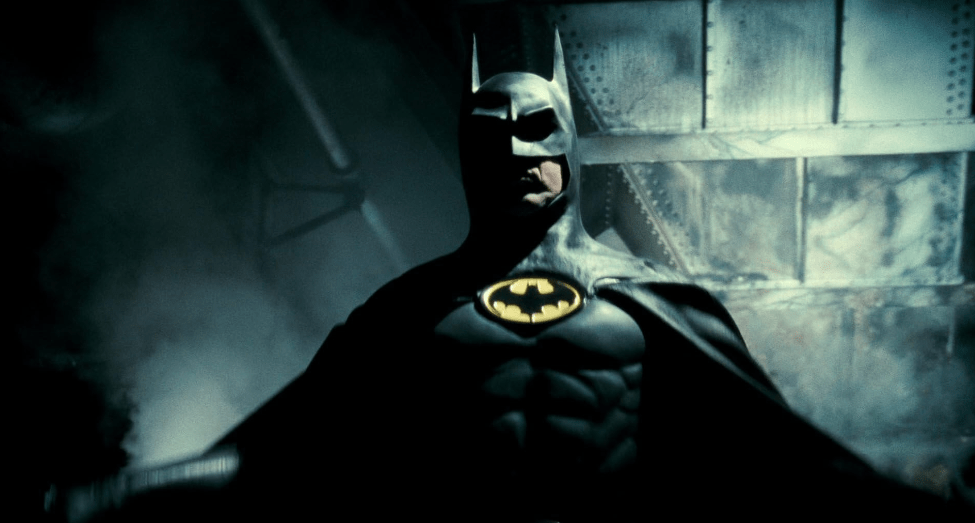
Tim Burton’s Batman opens and it’s night in Gotham City. A family of three are mugged by two strung-out thugs and they sit on a rooftop counting their stolen money. But this is Gotham City and Gotham City has a protector who rules the night. Looming above them in silhouette like a ghoulish reincarnation of Dracula is a figure in the form of a bat. It swoops down upon the two terrified goons and beats them within an inch of their lives. One of them asks, “Who are you?” Gotham’s hero says, “I’m Batman”, and a legend is born.
All this happens in the first ten minutes. There are no forty-minute prologues of Bruce Wayne’s origins. There is little time given to studying his feelings and character. And there are no grounded explanations for where he gets his gear. When Batman uses a grappling hook to escape, the Joker says, “Where does he get those wonderful toys?” He gets no answer and we don’t need one.

This is the perfect Batman movie. It checks all the necessary boxes that define who Batman is, what his world is, and what a story featuring him should be about. The filmmakers understand that the audience knows who Batman is and that he needs no introduction. Batman doesn’t require an explanation. All he needs is to be properly represented.

Bruce Wayne (Michael Keaton) is already Batman when the film begins. We are not told for how long, but the sudden introduction of The Joker suggests it takes place during what the fans of the DC comics call Year One.
Keaton plays Bruce Wayne as good-natured and mannered, but a bit shy and antisocial. His loner tendencies reflect the consequence of being Batman at night. As Batman he recalls the Phantom of the Opera. He is reclusive and silent, staying in the shadows lest someone sees too much of him and discovers his secret identity.
Michael Keaton is my favorite of all the Batmans (Batmen?) who have attempted the role. He doesn’t stifle the performance with melodrama, but lets the physicality and look of the character dominate the screen. Batman is an icon and a symbol; and Keaton allows the iconography to define what we see. He is a costume and a chin. And that is Batman as we like him.
The costume is fairly traditional. It’s neither the explicable body armor worn by Christian Bale or the gaudy grey cloth of Adam West. The black bulletproof rubber worn by Keaton fits the gothic tone of the character while retaining our quintessential expectations of a Batman costume. The Bat logo stands out in yellow on the chest. The costume is fundamental and perfect.
The Batmobile is even better. It appropriates the mood and style of Batman better than any other Batmobile, in my opinion. It’s long, dark, angular, and the sort of car Count Dracula would have driven had motor vehicles existed in his day. Toy Biz must have made a killing on the market with this thing. It’s one of the coolest fictional movie cars since James Bond’s Aston Martin.
Tim Burton’s Batman also has the best rendition of Gotham City of all time. The gothic architecture brings to mind the German Expressionist images seen in Fritz Lang’s Metropolis, but augmented in technicolor with dark matte paintings and its smoky and steaming set design.
Further setting the mood is Danny Elfman’s iconic score which to this day contains the definitive Batman theme for a lot of fans, myself included. Unlike the more optimistic and rousing Superman theme by John Williams, Elfman’s Batman theme puts itself in the midst of the action, punctuating Batman’s fighting spirit with just a dash of mischievous fun. Like the Williams score it creates its own genre of superhero themes. Sadly it’s becoming a lost art. Does anyone remember the music in the Marvel movies recently? Because I don’t.

But all of these elements add up to beans without a story. The film’s plot manages in its 2 hour runtime to give Batman, Bruce Wayne, and the Joker enough to do in perfect balance. Bruce Wayne juggles his obligations as Batman with his budding infatuation with journalist Vicky Vale (Kim Basinger) while the Joker (Jack Nicholson) has his own eyes on her while he plots to overthrow and take over the criminal underworld.
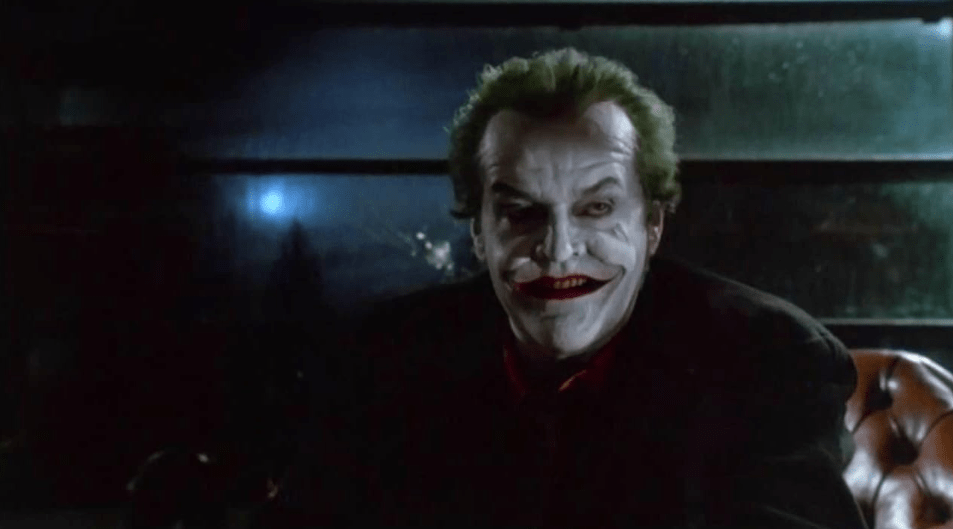
Nicholson portrays the Joker part with surprising restraint given the madcap lunacy of the character and his plans. He laughs, jokes, and plots morbid absurdities as any good Joker would, but never seems out of control. His madness is more of an attitude he brings to his offbeat behavior. Nicholson plays Joker like his descent into madness wasn’t out of tragedy or untreated mental illness. He chooses madness because he simply got annoyed with sanity and enough was enough. His most wildest actions still manage to reflect this attitude. He punches out a TV with a mechanical glove and murders his own henchmen where other men would just roll their eyes.

Controversially, Nicholson’s Joker, is given a backstory whereas the Joker is traditionally portrayed as anonymous and of ambiguous origins. Here he is introduced as Jack Napier, a right hand man to a mob boss (Jack Palance). After Palance discovers that Jack is sleeping with one of his molls he sets Jack up to be killed in a sting operation. But, when Batman makes an appearance, Jack fights him only to fall into a vat of acid. He survives, but is disfigured with chalk-white skin, green hair, and a permanent grin fixed on his face.
The decision to give Joker an identity and origin is still controversial among fans of the comics, but I have grown to accept the change. Nicholson is by far the most charismatic figure in the movie and the motivations his backstory gives him serve the plot perfectly fine. The Batman mythos is interpretive in adaptation, and the changes made to the established lore here doesn’t denigrate the film in the slightest. A Joker with an origin story is, after all, still more tolerable than a moody and angry Superman that the fans of Man of Steel didn’t seem to mind.
Joker gets revenge by killing his former boss and goes on to bend the remaining mob bosses under his rule, removing (quite dramatically) anyone who opposes him. He plots to poison the citizens of Gotham with infected hair care products, before moving onto bigger game with a parade show with floating balloons full of fatal laughing gas that he wants to unleash upon the city.
In the meantime, Batman broods and investigates Jack’s latest schemes, and his alter ego Bruce Wayne begins to suspect that there is an old personal connection between him and the Joker. Between them is Vicky Vale. Joker desires her, Bruce is falling in love with her, and it is Batman who must save her.

This is not a very thoughtful plot, naturally. But as a superhero movie, the story weaves all of the required elements that make the genre appealing. Christopher Nolan’s brilliant Dark Knight trilogy was made for a different sort of audience in mind. There the characters are ideologues for real-world issues that more sophisticated internet-bred audiences post-9/11 have found meaning and expression in. But, none of that is needed here. This movie was made for the boys and girls who love Batman and the Generation X adults who had grown up on him. During my childhood in the 90s, the grown-ups who were pop-culture conscious seemed to be preoccupied by two things: Star Wars and Batman. They coexisted on the same walls on posters, shared shelf space as action figures, filled boxes with comics, and every respectable nerd had both on VHS and their clothes. And in those happy days it was Burton’s image of Batman that dominated.

Director: Tim Burton
Writers: Bob Kane, Sam Hamm, Warren Skaaren
Cast: Michael Keaton (Bruce Wayne/Batman), Jack Nicholson (The Joker, Jack Napier), Kim Basinger (Vicki Vale), Robert Wuhl (Alexander Knox), Pat Hingle (Commissioner Gordon), Billy Dee Williams (Harvey Dent), Michael Gough (Alfred), Jack Palance (Grissom), Jerry Hall (Alicia), Tracey Walker (Bob the Goon), Lee Wallace (Mayor), William Hootkins (Eckhardt)
Producers: Peter Guber, Barbara Kalish, Chris Kenny, Benjamin Melniker, Jon Peters, Michael E. Uslan
Composer: Danny Elfman
Cinematographer: Roger Pratt
Editor: Ray Lovejoy

The Secret of NIMH (1982)

4/4 stars

Don Bluth’s The Secret of NIMH is my favorite animated movie of all time. And, I like to think, for good reason. For one, it is one of the most accessible movies for general audiences ever made. There is more to it than being a kids’ movie. It’s a movie for everyone.
The Secret of NIMH is often called an example of children’s fantasy, but I find the reasoning for this flimsy at best. The movie is called a children’s fantasy because children can watch it without being exposed to elements too mature for them to handle. It’s also called a children’s fantasy because it is a cartoon. And that’s pretty much it.
But, assuming that the absence of sex and vulgar language as well as the presence of animation is not a bar to adult engagement, there is little cause to consider The Secret of NIMH a kids’ movie. A family movie may be closer to the mark. But, the film’s story is sophisticated and engaging enough to attract an adult viewer without the presence of a child at all. I would just call it a movie. And a pretty damn good one too.

Don Bluth saw his first successes working as an animator for the Walt Disney Studios lending his talents on such movies as Robin Hood (1973), Pete’s Dragon, and The Rescuers. But, eventually he grew despondent over the direction he thought the studio was going and went off to work on his own animation production company. The 70’s and 80’s did not see Walt Disney at its best. It was a fairly stagnant period in which the company was churning out mostly forgettable projects that saw more status as cult favorites than as all time classics. It was during this period that Don Bluth began making his own animated films that brought new life and creativity into animation. The first of these was The Secret of NIMH. Throughout the remainder of the 1980’s he followed it up with other classics such as An American Tail, The Land Before Time, and All Dogs Go to Heaven.
But, it is The Secret of NIMH that will forever remain his best.

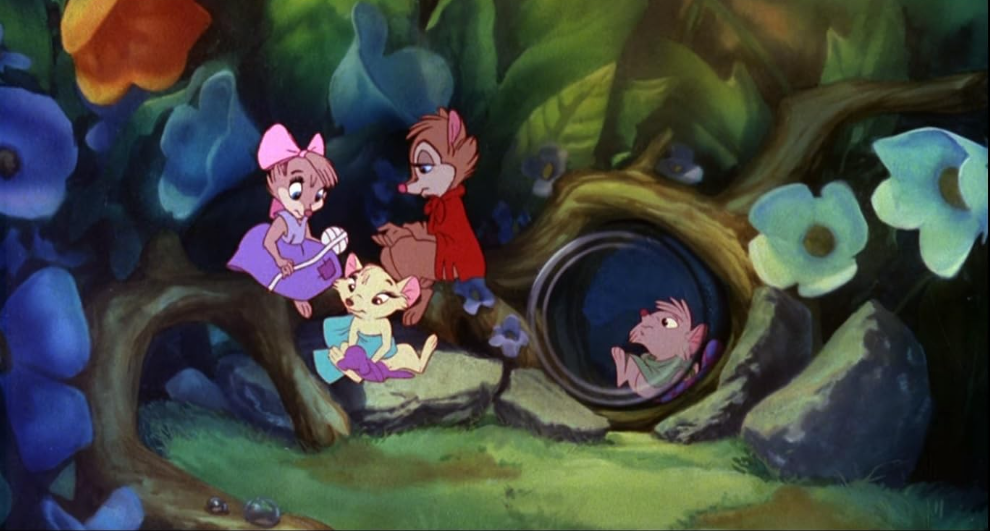
The Secret of NIMH perfectly balances visual artistry and excellent writing with a keen respect for its audience’s intelligence. In this modern era where cartoons are all safely nestled in the genre of comedy, there is sadly little coming out quite like this movie anymore. The film contains some of the most appealing hand-drawn images to date. It’s painted backdrops are reminiscent of the beautiful images seen in Lady and the Tramp or Pinocchio. Those films had backdrops more like Christmas cards, whereas here there is something more pastoral that echoes the paintings of Andrew Wyeth. The colorful animated characters in the movie mix with the painted backgrounds surprisingly well. The hand-drawn cels contain a vibrance and liveliness unseen in the computer animated images of today and every movement and every frame is full of grace and character; and are vigorous in emotional expression.

But, what makes The Secret of NIMH most special is its story. It’s not much in the way of a deep analysis of the human condition, but is rather a simple tale of survival elevated by its heart and writing.
Mrs. Brisby (Elizabeth Hartman) is a widowed field mouse who lives in a cinder block in the middle of a cornfield. The season where the farmer, Mr. Fitzgibbons begins to plow has come sooner than late and the animals who live in the field are expected to flee before their homes are destroyed. However, one of Mrs. Brisby’s children, Timothy, is sick with pneumonia and would not survive a move in the chill air. She manages to sabotage the plow, but this only serves to delay the inevitable. She meets a crow named Jeremy (Dom DeLuise) whom she rescues from the farmer’s cat and he suggests they visit The Great Owl for advice. Jeremy is a ton of fun as a clumsy oaf who dreams of one day building a love nest for two. DeLuise provides a lovable voice performance that makes Jeremy the sole source of comic relief in the picture. His infatuation with the idea of love has him falling head over heels (literally) in his efforts to find items to build his love nest with. These efforts often causing him more trouble than the items are worth. When Brisby first meets him he is tangled up in some string that he thought pretty and tried taking home with him. The comedy his character adds doesn’t detract from the movie’s overall serious tone. Unlike, say, Jar Jar Binks, Jeremy is a character who has purpose rather than just being a shoehorn for laughs. He represents the little people in this story, like the nosy Auntie Shrew (Hermione Baddeley), who know little and can do little, but will do what they can if the cause is good. There are times in which Jeremy is Mrs. Brisby’s only source of encouragement, offering what little aid he can simply because it is the nice thing to do. You can’t hate a fellow like that.
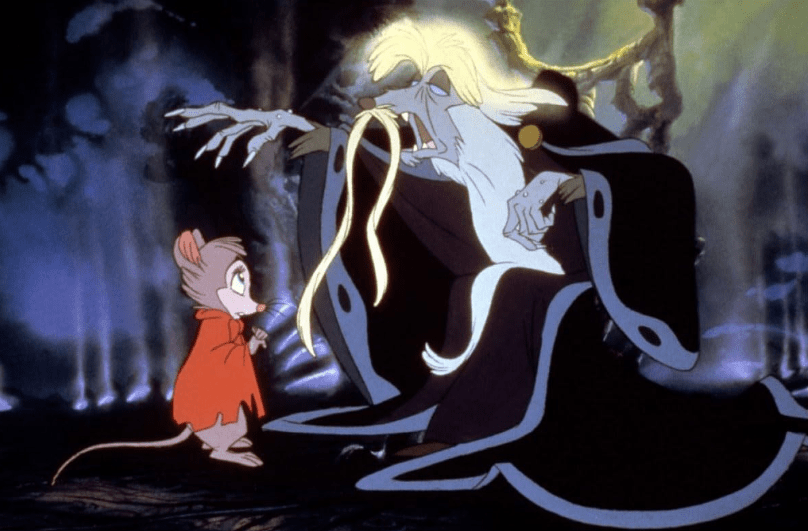
They meet the Great Owl (John Carradine) in a deep, shadowy part of the forest where he lives alone. He is a figure of awe and terror, wiser than any other being in the movie, and perhaps the most dangerous given his placement on the food chain. Like a god in heaven he is above direct involvement, but not above giving words of wisdom. He is hoary and become awesome in his elder age. He is every bit the creature of the night, flying from his tree to hunt, brushing off cobwebs and old bones with glowing eyes like a vampire flapping into the dark. Brisby is petrified of him at first, but her maternal instincts for her son muster the courage she needs to request help. He tells her to go to the rats who live in a rosebush by the farmer’s house. “They have ways” he tells her and he leaves with no further guidance to offer.
The rats live up to their reputation for problem-solving when she meets them as they are highly intelligent and power their hidden city with lights and electricity stolen from the farmer. Their leader is Nicodemus (Derek Jacobi), an ancient rat with a long beard with powers akin to wizardry. From him Mrs. Brisby learns of the origin of not just the rats, but of herself and all the animals gifted with speech and intelligence. They were the products of a human-led experiment that escaped from their lab leaving the scientists none the wiser to what they had created. The injections they are given by NIMH (the National Institute of Mental Health; a real place) do more than make them intelligent on a par with Man, but also have the side effect of putting them in touch with magic and spirituality. Nicodemus summons a staff like he is Gandalf or something, consults a magic mirror to see what is happening around him, and possesses a bejeweled necklace with mysterious abilities that he gives to Brisby. None of this is explained in the movie and what we are left with is a statement about the nature of science and the unknown. There is nothing in NIMH’s plans that accounts for the sudden contact with the supernatural and it raises questions about animal intelligence and their relationship with us humans and the environment that is not answered. Had the magical elements been removed from the story entirely it would have made little difference, but their presence and the questions they raise adds a layer of potential depth to what is going on.
But, Mrs. Brisby’s quest for aid doesn’t end here and she is soon caught up in an intrigue involving rival parties in the rats’ society. They are not interested in helping Brisby at all and are in a war of words with Nicodemus and his followers regarding their future. At the forefront of the naysayers is the evil Jenner (Paul Shenar), a rat who wants to continue living in the rosebush and stealing electricity from Mr. Fitzgibbons. But, Nicodemus has a plan for the rats to move all of the animals to another location where they can fend for themselves in good conscience without resorting to stealing. Personally, I think this is awfully big of Mr. Nicodemus given that the farmer is the same man who uses a plow to kill the local wildlife and destroy their homes once a year and owns an evil cat named Dragon who roars like an ogre. Nicodemus’s moralizing breaks down to not wanting to raise the farmer’s light bill, which is kind of him I guess. There is something to be said about a story that keeps its ethics basic while all this intrigue and interwoven backstory works its charm on us. Stealing is still wrong, the movie tells us, and I like that. Moral greyness in a lot of stories ends up being a thin excuse for avoiding having anything important to say. Goodness in the midst of institutionalized badness is a theme in need of a revival in this century.

While these events unfold, The Secret of NIMH’s multilayered story never becomes convoluted, but is easy to follow and engage in without the need to dumb down its themes and plot details for the younger audience. While being a cartoon, it takes itself as seriously as any live-action drama would which contributes to its timelessness not a little. As I noted above the plot is appreciable by both children and adults. As a fantasy adventure I would stack the film less with movies like The Sword in the Stone or The Wizard of Oz, but more with The Lord of the Rings, Star Wars, or Harry Potter. These are stories that carry heady weight and dramatic tension alongside their universal accessibility. As a cartoon it challenges pre-conceived notions of what animation is and whom it is for. Like black & white or color cinematography, animation is a legitimate form of visual art that holds boundless potential for story, not limited to a single demographic.

Shameless blurbsters like to toss phrases like “fun for the whole family” with a sincerity that I find suspect when it is lauded at any and all kinds of crap aimed at kids. With that in mind I can say that The Secret of NIMH is the sort of film I honestly believe children will love. But, the adults will love it even more.