
2/4 stars
There are three kinds of Batman. Gothic Batman is the subject of the classic comic books and we see him stoically doing what he does best in the Tim Burton movies and the animated TV series from the 90s. The more introspective Edgelord Batman made popular in Christopher Nolan’s Dark Knight trilogy has been a favorite of comic writer Frank Miller, but largely exists elsewhere in memes. Campy Batman is best represented by Adam West back in the 1960s. Campy Batman’s Gotham City is a colorful world of colorful people where villains prance in clownish costumes and laugh maniacally. They are the sort of baddies who twirl their mustaches, tie damsels to railroad tracks, and scheme to poison the city’s water supply.
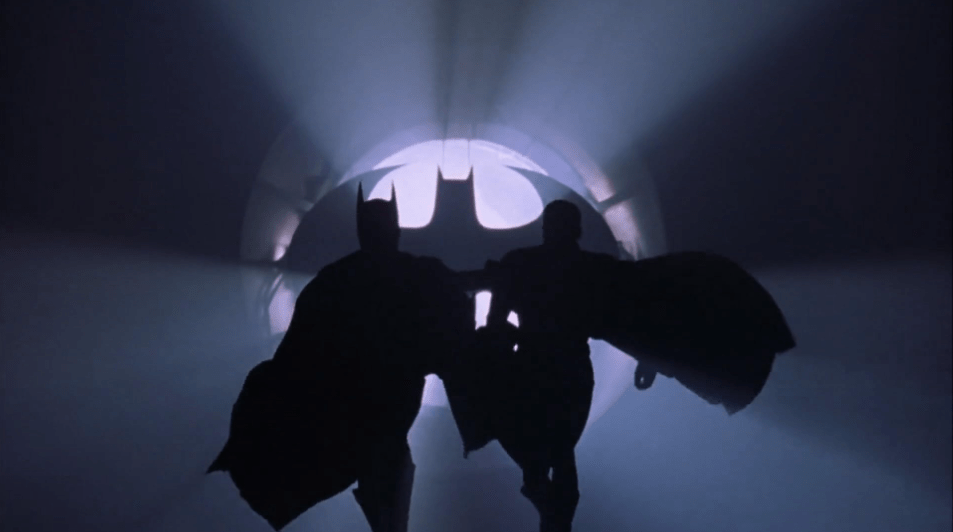
Director Joel Schumacher’s Batman Forever is a return to the old tradition of campy Batman, slanted camera angles and all. When Schumacher, taking over for Tim Burton, approached the material he aimed to make a live-action cartoon. For better or worse, he succeeded. As stupid and ridiculous as the movie is, it is everything it intended to be; its flaws by design and really a matter of taste.
A common complaint leveled at it is that it is too campy and too cartoonish. I hold to the opposite view. I believe it isn’t campy and cartoonish enough, and therein lies Batman Forever’s downfall. The heroes, given what they are up against, are too sullen for their own good. Val Kilmer, replacing Michael Keaton, in the role of Bruce Wayne commands no presence, adding nothing interesting to the part. As Batman he is stale, watering the character down to a fighting costume.
Robin, the Boy Wonder is brought in this time around, and if the fans had been waiting patiently through two movies for Batman’s trusted sidekick to finally appear they must have been sadly disappointed. Chris O’Donnell as Dick Grayson (Robin’s alter ego) has none of Burt Ward’s original energy and passion. O’Donnell plays the role as standoffish and angry. His character development is nothing more than a skin-deep paint-by-numbers expression of the old saw “revenge won’t make the pain go away” and “taking a life leads to a dark path.” There is nothing wrong with such messages of course, but no sincere effort is made to convince the audience of their truthfulness. It’s merely said and Robin comes to these conclusions only when the script finally says so.
Batman and Robin generate no charisma whatsoever, all of their energy being sucked into the two lead villains.
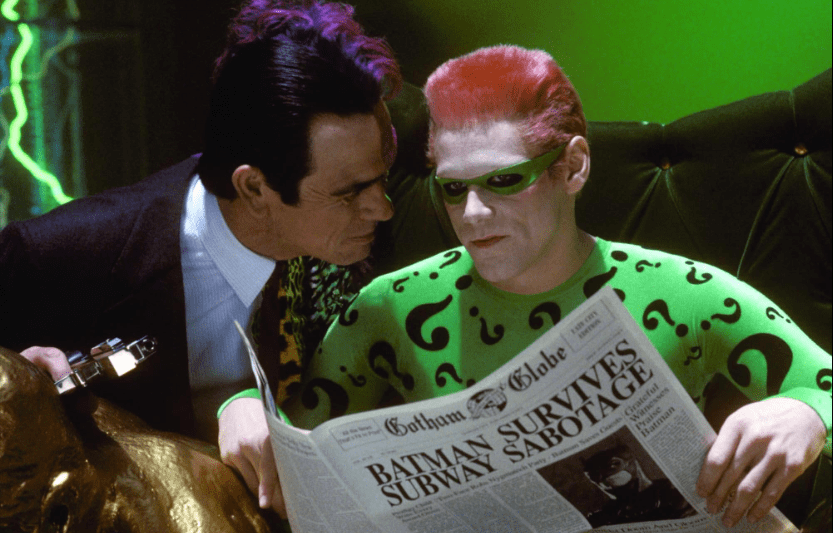
The movie opens with the dastardly Two-Face (Tommy Lee Jones) robbing a bank to lure Batman into a trap. He giggles and jumps up and down like a clown, firing machine guns at nothing in particular as police helicopters swarm above. The burnt side of his face is improbably symmetrical in relation to the other side: a purple bit of prosthetic rubber that appears more like a cartoon’s idea of a deformity than anything seen on a real burn victim. His suit is split in a similar fashion; formal and proper on one side and gaudy and colorful on the other. When we see his evil lair later in the film the interior decoration keeps to this pattern. One side looks like the very throne room of hell and the other is pure white and fit for a fairy tea party. His two sexy girlfriends, Sugar and Spice (Drew Barrymore and Debi Mazar) are bedecked to match.
When Batman arrives at the bank robbery, he is joined by Commissioner Gordon (Pat Hingle) and Dr. Chase Meridian (Nicole Kidman). Meridian is a professional parapsychologist who specializes in super-criminals and caped crusaders alike. She doesn’t look much like a psychologist. She stands next to Batman looking like a blonde bombshell, speaking in silky tones and saying nothing more insightful than what can be gleaned from a copy of Psychology Today. She is about as convincing a psychologist as Denise Richards was as a physicist in The World Is Not Enough. Kidman plays the role like a Bond girl. She feigns a professional interest in Batman that masks something more fetishistic.
We later see a love triangle develop between her, Batman, and his secret identity Bruce Wayne. The movie posits a theme where Dr. Meridian’s infatuation with Batman is something girlish and rebellious; her eventual favoring of Wayne being a moment of maturity. She directs her husky-toned flirtations toward both equally, however, and the point is not hammered home that deeply.
After Two-Face escapes he joins forces with The Riddler (Jim Carrey) whose wild performance is the front and center of the whole show. Carrey plays Riddler with no restraint at all. His acting reaches over the top and then goes only higher. He moves like he is cursed to dance forever and he never stops talking. The performance is loud and obnoxious; Carrey mugs the camera, making bizarre faces and dropping pop culture references and bizarre jokes whenever he is on screen, which ends up being a great deal. Jim Carrey has this way of punctuating his words with sharp turns of his head. He does it so much you could make a drinking game out of it. After Batman Forever I’d be fairly plastered. Try doing it while watching The Mask and you would need a new liver.
When we first meet him he is an excitable and neurotic employee of Wayne Enterprises named Edward Nygma who idolizes Bruce Wayne and wants to impress him with a new mind-control device he invented. Wayne’s predictable rejection crushes the already unhinged Nygma’s spirit and he becomes enraged and bitter. It’s probably the lamest super-villain origin story to date, but it fits the material Schumacher presents.
As Riddler he uses his mind control device to read the minds of everyone in Gotham so he can steal their credit card numbers and financial records. It’s a shockingly short-sighted plot. One man having access to everyone’s money would only crash the economy and more than likely the existence of his machine would force the world to adapt its methods of bookkeeping to counter-act it. But maybe I am overthinking the logistics of a villain scheme obviously reminiscent of a Saturday morning cartoon.
When the movie sticks to Joel Schumacher’s vision it works remarkably well even if Carrey could afford to tone it down a little. Gotham looks better than ever keeping the same Gothic Dr. Seussian aesthetic from before, but more lively and animated. The camera rides through the city like a roller-coaster, allowing the viewer to soak in the details. It reminds me of a professional haunted house made with money as no object.
Tommy Lee Jones and Jim Carrey’s antics are constantly energetic and off the wall. Reminding myself that this is supposed to be a live-action cartoon I can accept them, if not love them overmuch.
Where it fails is with its hero characters. Pat Hingle phones in his performance as Gordon, seeming to be painfully aware of what had become of the series. Kilmer is dry as a bone and O’Donnell is over-serious and undercooked as a character. Nicole Kidman brings to the movie the sort of character we should have had in Catwoman back in Batman Returns. Bond girls and Batman vixens alike are supposed to be somewhat innocent and prepubescent in their sensuality. They entice the man hidden behind the mask, but the boy that the mask represents ultimately wins out and keeps them untouchable. Kidman brings this to Chase Meridian well enough, but still never quite reaches the comic tone that the movie needs more of.
In Batman Forever Schumacher tries too hard to meld the 1960s era camp with the more mature themes of the Burton movies, and the result is an inconsistent mess. In the end I appreciated what the director has tried to do more than what he has done.
Director: Joel Schumacher
Writers: Bob Kane, Lee Batchler, Janet Scott Batchler, Akiva Goldsman
Cast: Val Kilmer (Bruce Wayne/Batman), Tommy Lee Jones (Two-Face/Harvey Dent), Jim Carret (Edward Nygma/Riddler), Nicole Kidman (Dr. Chase Meridian), Chris O’Donnell (Dick Grayson/Robin), Michael Gough (Alfred Pennyworth), Pat Hingle (Commissioner Gordon), Drew Barrymore (Sugar) Debi Mazar (Spice)
Producers: Tim Burton, Mitchell E. Dauterive, Peter Macgregor-Scott, Benjamin Melniker, Kevin J. Messick, Michael E. Uslan
Composer: Elliot Goldenthal
Cinematographer: Stephen Goldblatt
Editors: Mark Stevens, Dennis Virkler