The Godfather (1972)

64323544_2604276916251137_2307355602206064640_n

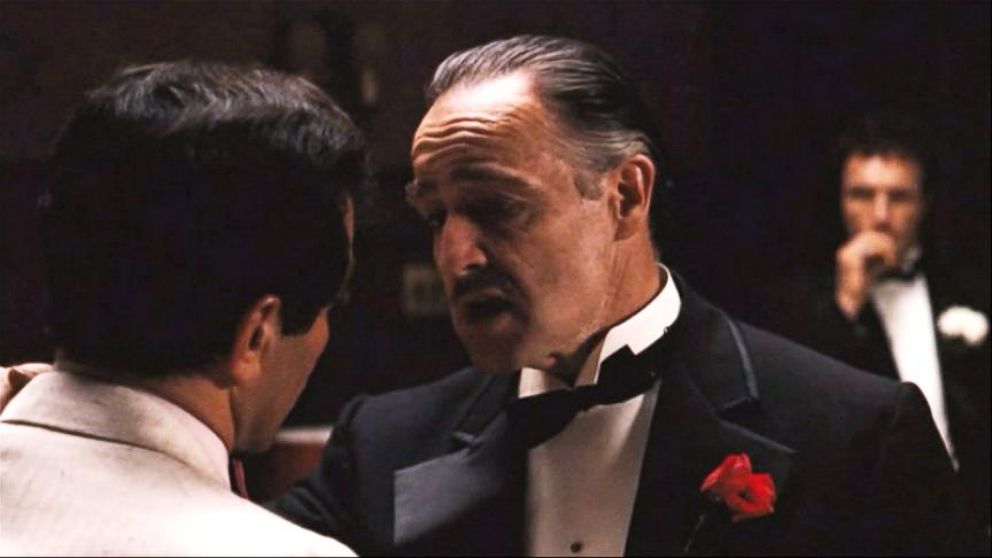
Francis Ford Coppola’s The Godfather tells a story that stands above the majority of your average mob movie. The genre, which often tells its narratives with characters of either morally grey motivations or completely despicable natures is represented in a way here beyond what moviegoers of the 70’s were brought up to expect. In The Godfather the Corleone family, led by the aged Don Vito Corleone (Marlon Brando) live in a world where victims, innocents, and moral white knights do not inhabit. The only police officer ever shown on screen is corrupt and the politicians are men of dubious ethics with their hands in the dirty business that the Corleones and the other mob families have grown powerful on.

Set in the post-war years, the story of the Corleone family is one of tragedy and struggle where their power and relevance in a changing world is slipping as new types of business such as drugs and the ambitions of rivals begin to threaten their hold. Don Vito, the eponymous Godfather, is a man who has grown old and his heirs are still green. A step above many of his peers, the godfather prefers to remain with the old ways having his hands in the business of gambling and prostitution while the upcoming drug market is beginning to become a new source of power and wealth in the larger crime circles.
When some of his rivals seek his aid in securing support from the many politicians in his pocket Don Corleone refuses seeking to follow his own code of ethics. This sets off a series of events where he is nearly assassinated triggering a potential war between the Corleones and the other mafia families seeking to maintain their power in the changing environment in the years following World War II.

But, in the end, this is not his story. The Godfather is the story of Michael Corleone (Al Pacino), his youngest son, who had for the majority of his life sought to stay out of the family business and lead a normal life with the woman he loves, Kay (Diane Keaton). The Corleone family, who were morally upright compared to the rest, had always supported him in this and even they in turn had hopes to turn the family into a more legitimate business.
After the failed assassination of his father and the murder of his brother, Sonny (James Caan), however, Michael slowly goes down a path of becoming the sort of man like his father he wanted to avoid.

Throughout the film we see the seeds of Michael’s own moral decay and as he begins to take over the family business leading to the inevitable role of becoming the new godfather himself we see Michael’s personal turmoil and inner nature catch up to him. In a fashion we see Michael take ruthless actions that even his father would not have done revealing a future where he will turn into a far more corrupt and evil man than any member of his family could have anticipated. As friends and family take their turns in betraying the Corleones in an attempt to take advantage of their current vulnerability Michael gets colder and colder as a human being in his strives to keep the family strong and survive. Old family friends like Tessio (Abe Vigoda) are “offed” when they begin siding with family enemies and when it is revealed that his abusive brother-in-law, Carlo (Gianni Russo), had played a role in conspiring to murder his brother he has him killed in a severely backhanded and deceptive way which the elder Don Vito would have condemned. The film’s climax features Michael being confronted by his widowed sister Connie (Talia Shire) over the murder and he boldly and dishonorably lies to both her and his wife about it.

Earlier in The Godfather, after killing the mob boss and cop who tried to assassinate his father, Michael flees to Sicily for a time to avoid repercussions from the Corleone’s rivals who would seek to murder him in a vendetta. During this period he falls in love with and marries a young local girl named Apollonia (Simonetta Steffanelli). My earliest impressions of this sequence were that Michael was already here beginning to show signs of moral decay since he had hitherto been attached to Kay romantically and this marriage to Apollonia could only be nothing other than an act of betrayal. However, as I have gotten older I feel like, Michael’s first true act of corruption was going back to Kay after Apollonia’s death. I had at first looked at Apollonia as a sort of “side chick” that Michael had turned to for comfort during his stay in Sicily, but I no longer think this was the case. While Kay was for a time Michael’s girlfriend I think the reality is after leaving for Sicily Michael was never intending to return to the United States after marrying Apollonia. It was his intention to move on and settle down with a new family leaving the old family drama firmly and safely behind him. After she was killed in an attempt on his life Michael no longer felt he had any reason to stay overseas and he returned to his family. Returning to Kay, however; to me, felt like an act of settling. And he was never as warm toward her as he was before leaving the country; the memory of Apollonia having too strong a hold on him. It should be noted that he never once tells Kay about his dead wife and he falsely behaves as if nothing had happened to his feelings for her after he left. Kay may be the only true victim in this entire saga. She loved Michael despite who he was and who he was becoming and in the end she was hurt and betrayed by his growing coldness and moral depravity.

The story of the rise and fall of Michael Corleone which is encompassed by the entire The Godfather trilogy is one of those timeless cinematic dramas that has influenced art and movies forever. Films, television, books, comics, and even video games have taken their own hand at imitating, alluding to, or parodying the film which is the ultimate testament to its staying power and mythic grip on society and our culture. Like any myth or great story from The Three Little Pigs to Moby-Dick to Citizen Kane it is one of those eternal narratives that doesn’t need to be seen to be appreciated and recognised. It is now and forever a fixture on our culture and Michael Corleone will be analysed and dissected by viewers and critics for all time to come.

Like The Wizard of Oz or Star Wars it is a film that needs to be seen at least once by everyone to be fully well-rounded in the arts and literature of the world. It is truly a great masterpiece and any opportunity to see it is an offer you cannot refuse.

4 Stars
The Shawshank Redemption (1994)

the_shawshank_redemption_-_h_-_1994

The Shawshank Redemption adapted from Stephen King’s novella, Rita Hayworth and Shawshank Redemption is an uplifting film that glorifies courage, hope, and humanity. If it indulges in dialogue that is over sentimental at times in can be forgiven because the movie’s emotional payoff at the end presents its message loud, clear, and beautifully.
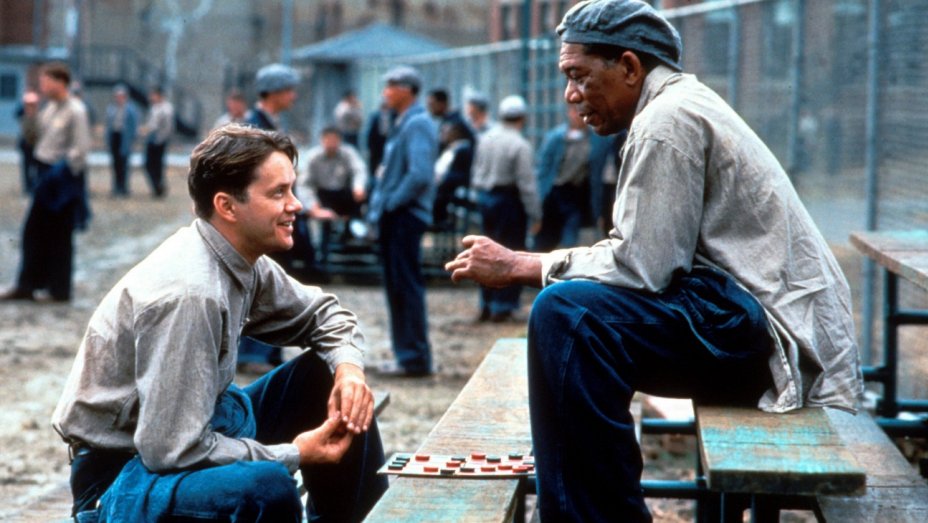
Styled much like a classic movie from the 1940’s it is devoid of nihilism and brutality. The film does not aim to exploitatively showcase the harshness of prison life or disturb and shock us and most of the prison violence is only strongly implied and show off screen. Instead it is the story of a friendship between two men forced to endure a terrible environment who choose to face their lives with hope.

Andy Dufresne (Tim Robbins) is falsely convicted of murdering his wife and is sentenced to two life sentences at Shawshank Prison. There he befriends an old prisoner named Red (Morgan Freeman) who has made a career of acquiring items and contraband for other prisoners. The relationship between Andy and Red is a wonderful portrayal of male friendship often lacking in our current period where toxic masculinity has kept such things at an unhealthy arm’s length.

The corruption within the prison is personified by the warden (Bob Gunton), a brutal prison guard (Clancy Brown), and a gang leader and rapist (Mark Rolston). The warden in particular is a figure of hypocrisy; espousing strong religious sentiment whilst profiteering off of the incarceration and suffering of the prisoners under his care. Under the trappings of his Christian convictions the warden is a greedy and unwholesome person who abuses Andy Dufresne and deliberately deprives him of any chance at proving his innocence when the opportunity arises. The falseness of the character is best symbolised in the film by a framed picture on his office wall depicting Biblical scripture that is later shown to hide a safe underneath containing documents relating to his shady business dealings. Like the picture on the wall the warden’s presentation of himself is a facade disguising what is truly a cruel and evil man.
Paralleling him is Andy himself who likewise uses a picture on a wall to hide his true nature. Andy’s however is a less than Christian sexy poster of Rita Hayworth which later as the years go by is replaced by one of Raquel Welch. What these raw images of sensuality hide, on the other hand, is not corruption and lies like the warden’s religious imagery, but rather Andy’s efforts to escape and be a free man again. For nearly twenty years Andy digs his way out of prison and when he does he spends the rest of his life living peaceably.

The Shawshank Redemption is a very kind film. It’s inspiring, hopeful, and extremely human. It’s harsh setting and unsavory characters don’t come to life on the screen to make us cynical or hate humanity, but to give a backdrop to the human spirit overcoming adversity and continue forward with hope and strength.
The movie is good, not just in cinematic quality, but morally too. It’s the sort of film that we need to see more of in Hollywood and the sort of film that only comes a few times in a lifetime: a movie that leaves an indelible positive impression on the viewer and has even changed viewers’ lives for the better.

3 1/2 Stars

Dark Phoenix (2019)

1

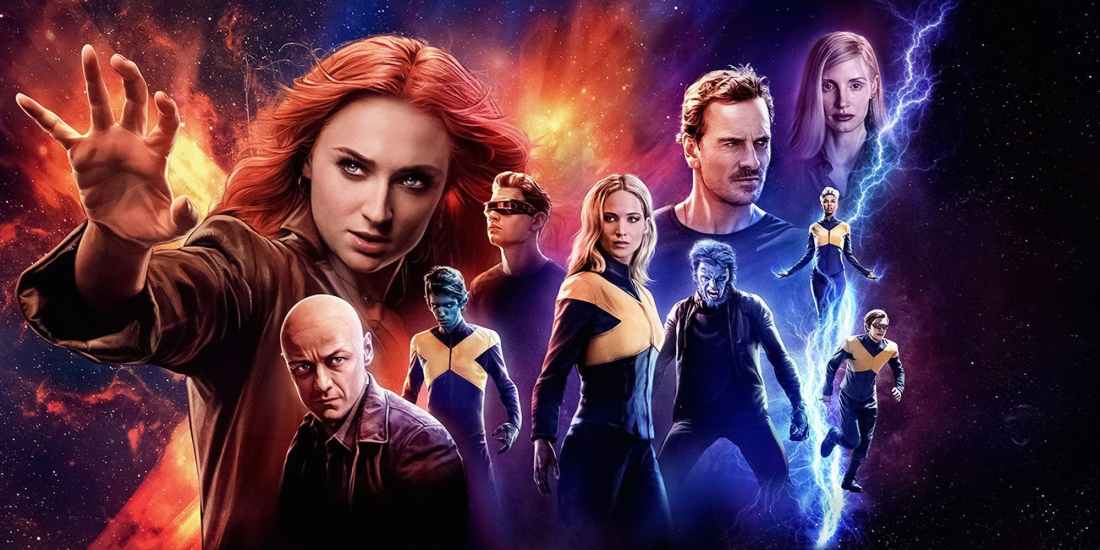
When I walked into this movie I was not anticipating it being finale to this generation of X-Men movies and I did not figure out that it was until the film was just about over. Aside from my not following closely any of the press regarding this series I think a major reason why I had this experience seeing Dark Phoenix is because the movie really has no consistent idea of what it wants to be.
There are moments when Dark Phoenix attempts to shock us with Avengers: Endgame style character deaths and then their are moments where it tries to act self-aware with its tongue held firmly in cheek. At the beginning of the movie as the X-Men are about to undergo a mission in space one of them quips, “So we are doing space missions now?” as if the filmmakers are telling us, “Yeah we know this is a mindless action movie; we know what it is we are peddling.” But the tongue never stays in cheek long enough before we are being subjected to more melodrama.

During the mission in space Jean Grey (Sophie Turner) is hit with a mass of radiation that makes her stronger and uninhibited. This becomes a problem for the X-Men and soon Jean leaves them and joins a bad crowd of aliens who are secretly seeking the power that is inside her.

The motivation of the alien bad guys in Dark Phoenix is extremely foggy and unclear and they are one of the most frustrating aspects of this movie. In Avengers: Infinity War and Avengers: Endgame we have a main villain who had been teased throughout the series in previous films and his motivation and intentions are laid out extremely clearly and consistently throughout.
In Dark Phoenix, the X-Men series’s own attempt at an outing; however, the villains are a group of aliens who are never clearly identified, who were never seen before in a previous installment, and whose reasons for why they are doing what they are doing is never adequately or logically explained.
All we know is that the radiation that penetrated Jean Grey was a universe creating spark that destroyed the aliens’ homeworld and ever since they have been tracking it down in the hopes of someday controlling it.
Why, though? What possessed the aliens into thinking that they could control it or that it was something that could be used at all? And why do they intend to use it to wipe out all life on planet Earth? Everything about these people is nonsensical and I get the feeling that the audience is expected to be acquainted with the comics and source material to even understand the adaptation. Which, to me, is an example of bad screenwriting.

As a standalone X-Men movie Dark Phoenix is sadly pretty average ranking in quality with the likes of X-Men 3 and X-Men: Apocalypse; lacking the depth or scale of say Logan or Days of Future Past. But as a finale that is supposed to mark the end of an era of X-Men cinematic stories Dark Phoenix is an incredible disappointment. It does not have any of the scale or thoughtfulness of the more recent Avengers outing which is a damned shame considering that it was usually the X-Men films that had more thoughtfulness and depth compared to the overall Avengers MCU series.

As the superhero genre becomes more assembly line in its yearly production methods and as the quality of the films begin to dip it becomes apparent to me that in a few years the genre is going to end up on a hiatus. It is going to go the way of the western: popular once; but now no longer in high demand. And I think disappointments like Dark Phoenix is going to play a role in this.

Maybe it is time for Hollywood to consider making some more westerns.

2 Stars