
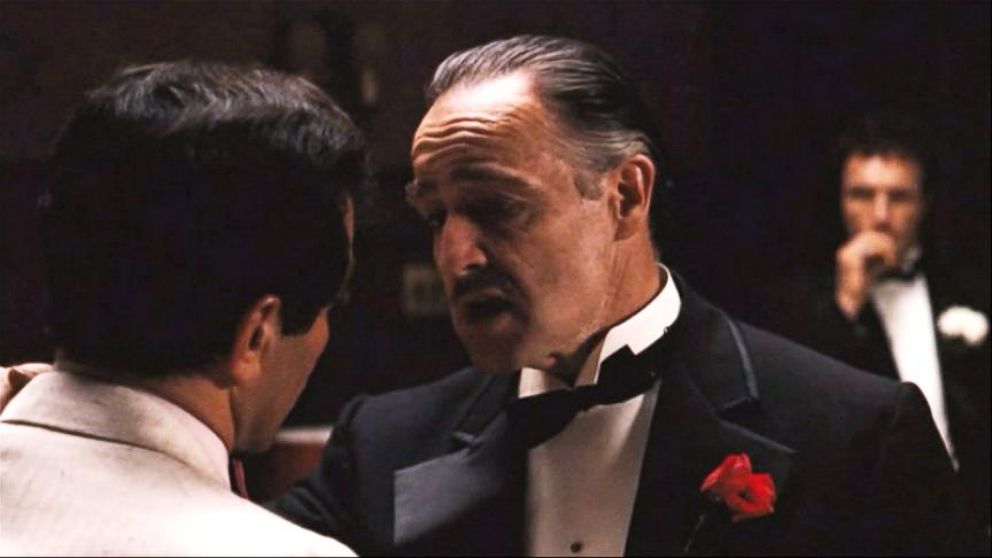
Francis Ford Coppola’s The Godfather tells a story that stands above the majority of your average mob movie. The genre, which often tells its narratives with characters of either morally grey motivations or completely despicable natures is represented in a way here beyond what moviegoers of the 70’s were brought up to expect. In The Godfather the Corleone family, led by the aged Don Vito Corleone (Marlon Brando) live in a world where victims, innocents, and moral white knights do not inhabit. The only police officer ever shown on screen is corrupt and the politicians are men of dubious ethics with their hands in the dirty business that the Corleones and the other mob families have grown powerful on.
Set in the post-war years, the story of the Corleone family is one of tragedy and struggle where their power and relevance in a changing world is slipping as new types of business such as drugs and the ambitions of rivals begin to threaten their hold. Don Vito, the eponymous Godfather, is a man who has grown old and his heirs are still green. A step above many of his peers, the godfather prefers to remain with the old ways having his hands in the business of gambling and prostitution while the upcoming drug market is beginning to become a new source of power and wealth in the larger crime circles.
When some of his rivals seek his aid in securing support from the many politicians in his pocket Don Corleone refuses seeking to follow his own code of ethics. This sets off a series of events where he is nearly assassinated triggering a potential war between the Corleones and the other mafia families seeking to maintain their power in the changing environment in the years following World War II.
But, in the end, this is not his story. The Godfather is the story of Michael Corleone (Al Pacino), his youngest son, who had for the majority of his life sought to stay out of the family business and lead a normal life with the woman he loves, Kay (Diane Keaton). The Corleone family, who were morally upright compared to the rest, had always supported him in this and even they in turn had hopes to turn the family into a more legitimate business.
After the failed assassination of his father and the murder of his brother, Sonny (James Caan), however, Michael slowly goes down a path of becoming the sort of man like his father he wanted to avoid.
Throughout the film we see the seeds of Michael’s own moral decay and as he begins to take over the family business leading to the inevitable role of becoming the new godfather himself we see Michael’s personal turmoil and inner nature catch up to him. In a fashion we see Michael take ruthless actions that even his father would not have done revealing a future where he will turn into a far more corrupt and evil man than any member of his family could have anticipated. As friends and family take their turns in betraying the Corleones in an attempt to take advantage of their current vulnerability Michael gets colder and colder as a human being in his strives to keep the family strong and survive. Old family friends like Tessio (Abe Vigoda) are “offed” when they begin siding with family enemies and when it is revealed that his abusive brother-in-law, Carlo (Gianni Russo), had played a role in conspiring to murder his brother he has him killed in a severely backhanded and deceptive way which the elder Don Vito would have condemned. The film’s climax features Michael being confronted by his widowed sister Connie (Talia Shire) over the murder and he boldly and dishonorably lies to both her and his wife about it.
Earlier in The Godfather, after killing the mob boss and cop who tried to assassinate his father, Michael flees to Sicily for a time to avoid repercussions from the Corleone’s rivals who would seek to murder him in a vendetta. During this period he falls in love with and marries a young local girl named Apollonia (Simonetta Steffanelli). My earliest impressions of this sequence were that Michael was already here beginning to show signs of moral decay since he had hitherto been attached to Kay romantically and this marriage to Apollonia could only be nothing other than an act of betrayal. However, as I have gotten older I feel like, Michael’s first true act of corruption was going back to Kay after Apollonia’s death. I had at first looked at Apollonia as a sort of “side chick” that Michael had turned to for comfort during his stay in Sicily, but I no longer think this was the case. While Kay was for a time Michael’s girlfriend I think the reality is after leaving for Sicily Michael was never intending to return to the United States after marrying Apollonia. It was his intention to move on and settle down with a new family leaving the old family drama firmly and safely behind him. After she was killed in an attempt on his life Michael no longer felt he had any reason to stay overseas and he returned to his family. Returning to Kay, however; to me, felt like an act of settling. And he was never as warm toward her as he was before leaving the country; the memory of Apollonia having too strong a hold on him. It should be noted that he never once tells Kay about his dead wife and he falsely behaves as if nothing had happened to his feelings for her after he left. Kay may be the only true victim in this entire saga. She loved Michael despite who he was and who he was becoming and in the end she was hurt and betrayed by his growing coldness and moral depravity.
The story of the rise and fall of Michael Corleone which is encompassed by the entire The Godfather trilogy is one of those timeless cinematic dramas that has influenced art and movies forever. Films, television, books, comics, and even video games have taken their own hand at imitating, alluding to, or parodying the film which is the ultimate testament to its staying power and mythic grip on society and our culture. Like any myth or great story from The Three Little Pigs to Moby-Dick to Citizen Kane it is one of those eternal narratives that doesn’t need to be seen to be appreciated and recognised. It is now and forever a fixture on our culture and Michael Corleone will be analysed and dissected by viewers and critics for all time to come.
Like The Wizard of Oz or Star Wars it is a film that needs to be seen at least once by everyone to be fully well-rounded in the arts and literature of the world. It is truly a great masterpiece and any opportunity to see it is an offer you cannot refuse.
4 Stars
 Perspectives on Film