
The 1910 adaptation of Mary Shelley’s Frankenstein is best approached with an appreciation of its historical context. It is a product of its time and consequentially suffers from the limitations and trends of its era. Little more than an intriguing curiosity now for film historians and horror buffs Edison’s take on Frankenstein aims high, but ultimately fails to achieve its aims.
Before D. W. Griffith came along only a few years later with A Birth of a Nation and forever codified the fundamental language and structure of filmmaking, movies were made in a manner not unlike that of the performances of plays. Shots would linger on sets with little to no inter-cutting, closeups, or any special editing tricks to speak of. And given the lack of sound the means for conveying narrative was limited to the often exaggerated miming of the actors and the use of title cards.
Movies of the time were little more than short sideshow attractions like The Kiss (1896) or films with limited and simple narratives like The Great Train Robbery (1903) and Georges Méliès’ A Trip to the Moon (1902). While The Great Train Robbery and A Trip to the Moon were entertaining rides into escapism the Edison Frankenstein instead tries too hard to create a thought-provoking experience that completely fails due to the then limitations of the craft.
The director had insisted that the gruesomeness of the original novel be omitted from his adaptation and he opted instead to recreate the more mystical elements of the book. However, the attempts at emotional and intellectual depth by director J. Searle Dawley were lacking in subtlety and his attempt at “elimination what would be repulsive to a moving picture audience” (his words not mine) seems to be a vain endeavor as his film is little more than a grotesque geek show to shock audiences of 1910. There is a particularly hamfisted moment in which we see Doctor Frankenstein peer into his looking-glass only to see the monster he created looking back at him rather than his own visage. While I could appreciate the notion that Doctor Frankenstein was a monster deep inside, this sort of symbolic imagery doesn’t convey itself very successfully when the film in question is less than 20 minutes long and none of the characters are given time for development. And that is where The Great Train Robbery and Méliès’ work outshine this movie. Those were competently made films that were designed with the fullest awareness of what sort of limitations the filmmakers had in crafting their stories. Dawley and Edison on the other hand try too hard to do something that their craft could not do at the time.
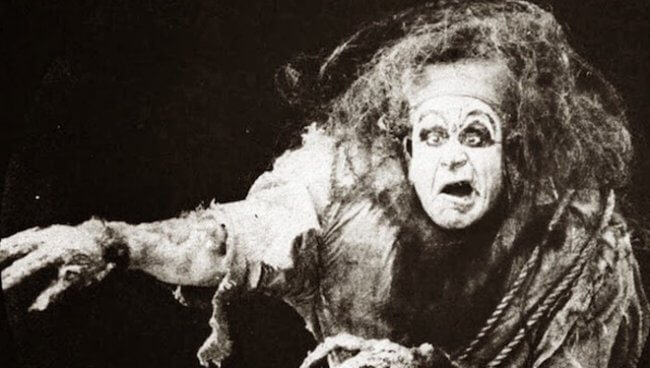
Frankenstein (1910) aims high with its pretentious and pedantic overtones but misses the mark and lands instead somewhere in the genre of grotesque horror and freak show. Which, admittedly in those areas this movie excels. One of the more striking visual moments in the film is when Frankenstein’s monster is first created. In the giant vat in which the monster is being born we see slowly flesh grow on a skeleton and take shape eventually culminating into the hulking brute portrayed by Charles Stanton Ogle who sadly received no screen credit as such things were not standard practice at the time. Frankenstein’s monster here has not the traditional Karloff look created by Jack Pierce in 1931. You won’t see any bolts on this monster’s neck and nor will you see a flat top to its head. Ogle’s Frankenstein’s monster is a large hunchbacked asymmetrical monstrosity that terrifies and appalls his own creator the minute he comes to life.
While this is no where near as iconic as the Boris Karloff version it certainly shows the creativity and imagination on hand with the early pioneers of filmmaking just after the turn of the century.
While this movie may be imperfect due to its poorly crafted narrative it is certainly an important piece of history and is surely required viewing for any film student or horror buff looking to see the history of the genre. Other films may have done better before and after it, but its place in history outside of its own merits keeps it immortal.
1 1/2 Stars
 Perspectives on Film