
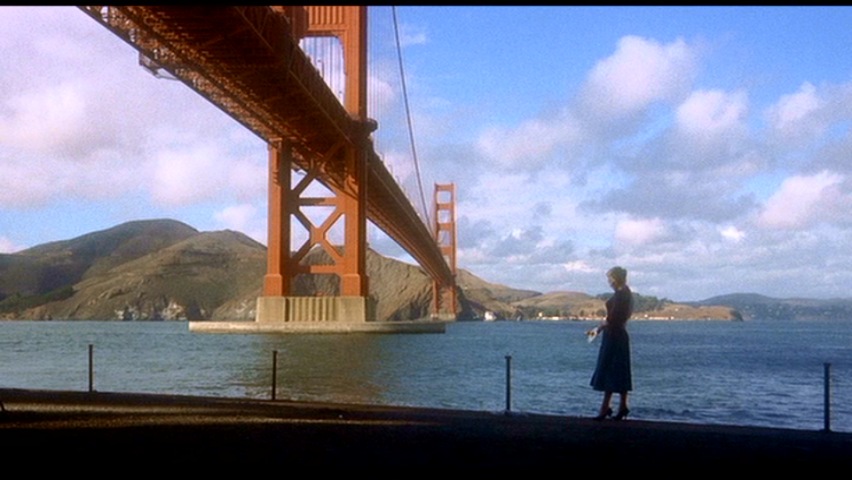
There are certain kinds of movies where not a single shot is wasted. Vertigo is one of these sorts of films. Every frame, every movement, every camera trick finely crafts together a perfect film and a fantastic work of art. Visually the film presents us with a number of memorable moments such as the famous “dolly zoom” effect when Ferguson (Jimmy Stewart) is having acrophobic episodes as well as the abstract and uncanny animated nightmare sequence when his sanity finally begins to unravel. There are so many beautiful shots in this movie that I believe equally showcase the mastery of direction the cinematography uses to tell its story. When Ferguson is trying to reach out to Madeleine (Kim Novak) sitting in the carriage we see her silhouetted against the daylight outside of the stable creating an effect perfectly emphasizing, not in dialogue; but in images, Ferguson’s growing sense of isolation and impending loss regarding this woman he loves. And this is not the only example of Vertigo’s power of visual storytelling outweighing the need for dialogue. One of the best scenes in Vertigo is when Ferguson is tracking Madeleine on the behest of her husband (Tom Helmore) and throughout this sequence he silently watches her behavior without any inner monologue being needed to tell us what he is thinking.
Everything from the angle of the camera, to where the action is centered in view, to the lighting, and to the camera’s movements effectively convey all of the emotions and turmoil of Vertigo’s characters without needing to resort to dialogue to do the job for us.
Hitchcock has always had a unique skill for having the cinematography combined with his actors’ body language and expressions do the communicating. In other Hitchcock films like Rope there are scenes where we can tangibly see Rupert Cadell (also played by Jimmy Stewart) starting to piece together his suspicions without once uttering a word.
There is no better example of a successful practitioner of the “show; don’t tell” rule of filmmaking than Alfred Hitchcock.
Thematically Vertigo is commonly cited as a story of obsession and the vagaries of male aggression. This, of course, could be taken as a reflection of Hitchcock’s general possessive attitude toward women that permeated, not only his films, but also his personal life. Madeleine is a figure of feminine mystique. An alluring and sensual archetype of that other half of humanity that the masculine cannot grasp or comprehend. The feelings and personality and thoughts of Madeleine are not treated in Vertigo as a subject of much importance to the narrative and the only moments where they come to play is when they are needed to create an emotional conflict for Ferguson. But Madeleine is hardly felt to be a real live person throughout this film. She is merely the object for which the film’s subject of male possessiveness and fatal obsession is focused. Hitchcock is a master filmmaker and a fine artist, but one cannot ever accuse him of being a feminist and this attitude toward women is not an uncommon sight in his movies as I pointed out above.
The only female character in the film who seems to have any true personality and character of her own is Midge (Barbara Bel Geddes) and her role is sadly wasted in the last act of the movie. Midge is a funny, charming, intelligent, and companionable woman whose affection for Ferguson is shown through a lot of bumbling, cautious approaches, and awkward mistakes. She is extremely likable and as a viewer I wanted her to win. It was my hope to see Midge succeed and win the affection of the man she adored. It was clear from the beginning that Ferguson’s feelings for Madeleine were fated for tragedy and so as a viewer I could not ever feel like I was rooting for him. His obsessive behavior is repellent and disturbing and Madeleine’s inconsistent and chaotic reactions are infuriating and frightening. Midge is the sole character in this movie who was on a path I could support. Unfortunately her character is tossed aside shortly before Ferguson is released from the hospital never to be seen again. Which I guess one cannot blame the screenplay too much for considering she was a last minute addition created by the third man hired to pen the script. But, to me, she was the most delightful character in the entire movie.
Vertigo is a tragic story. Madeleine’s intrusion into Ferguson’s life could only go in a variety of destructive paths and while the film ends in the best possible outcome (for Ferguson) it is still a painful event that he won’t recover from for a long time. Obsession and possessiveness is never a good thing, but obsession and possessiveness over a person who is toxic is how lives are destroyed and people are left feeling broken. Madeleine is probably the ultimate example of the Hitchcockian femme fatale. The aforementioned figure of feminine mystique that can break or even kill the unwary masculine other half. Are these sort of themes PC? No. But they are Hitchcock.
4 Stars
 Perspectives on Film